
Have you ever stopped while writing and wondered whether you should use passed or past? You are not alone. These two words sound the same, but they have different meanings and grammar rules. This makes passed vs past a common English usage question.
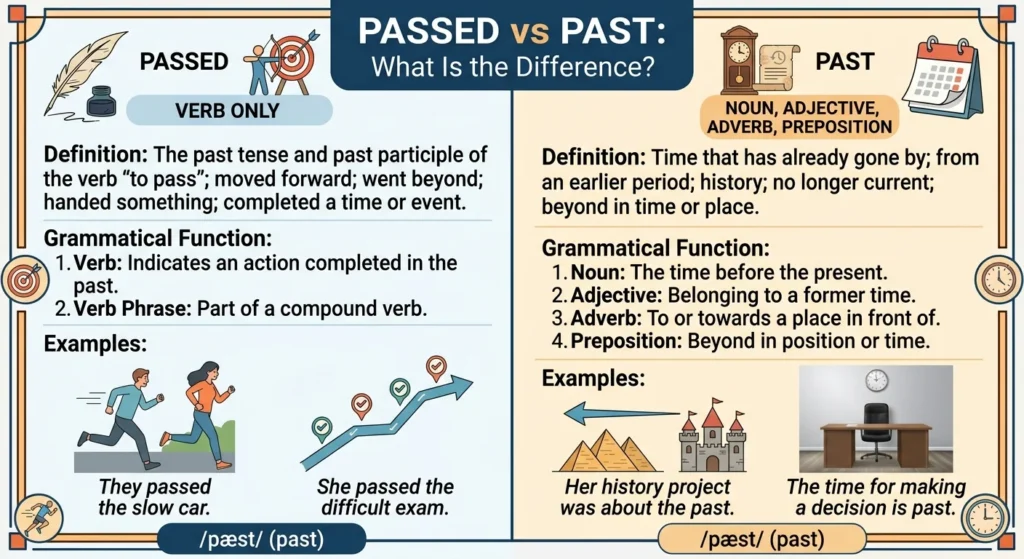
The good news is that the difference is easy to understand once you know what each word does in a sentence. Passed is usually the past tense of the verb pass. It describes an action that happened. Past can be a noun, adjective, preposition, or adverb. It often refers to an earlier time, a position beyond something, or something that has already happened.
For example, you can say, “She passed the exam,” but you would say, “She walked past the school.” You might also say, “We talked about the past.”
In this guide, we will explain passed vs past with simple rules, examples, common mistakes, spelling differences, usage data, and practical tips. By the end, you will know exactly which word to choose.
Passed vs Past – Quick Answer
The simplest rule is:
- Passed = an action or the past tense of pass
- Past = an earlier time, a position, or something beyond a point
Examples of Passed
Passed is usually a verb.
- She passed her driving test.
- The car passed us on the highway.
- He passed me the book.
- Time passed quickly.
In each example, passed describes an action.
Examples of Past
Past can have several roles.
- We lived there in the past.
- Walk past the bank.
- The train went past the station.
- It is past midnight.
Here, past does not mean the action of passing. It describes time, position, or something beyond a point.
Passed vs Past Comparison
| Word | Main Use | Example |
|---|---|---|
| Passed | Verb | She passed the exam. |
| Past | Earlier time | We discussed the past. |
| Past | Beyond a point | Walk past the store. |
| Past | Earlier than a time | It is past noon. |
A useful memory trick is: If you can replace the word with “went by” or “moved by,” use “passed.”
The Origin of Passed vs Past
The words passed and past are closely related. Both come from the idea of moving or going beyond something, but they developed different grammatical roles.
Origin of Passed
Passed comes from the verb pass. The verb entered English through Old French passer, which came from Late Latin passare. It developed meanings related to moving forward, going by, crossing, and eventually completing or succeeding.
The word passed is simply the past tense and past participle of pass.
For example:
She passed the ball.
He passed the test.
The first example describes moving an object. The second describes successfully completing an examination.
Origin of Past
Past developed from the same broad idea of going beyond or moving forward. It became associated with something that has already happened or a point that has been crossed.
Over time, past became useful as several parts of speech.
For example:
- Noun: The past can teach us lessons.
- Adjective: Her past experiences helped her.
- Preposition: We walked past the house.
- Adverb: The time has gone past.
Although the words are related historically, modern English uses them differently.
British English vs American English Spelling
Unlike many spelling differences between British and American English, passed vs past does not change between the two varieties.
British English uses:
- passed
- past
American English also uses:
- passed
- past
The difference is therefore not a spelling preference. It is a difference in meaning and grammar.
Comparison Table
| Meaning | British English | American English |
|---|---|---|
| Completed an exam | passed | passed |
| Moved beyond something | passed | passed |
| Earlier time | past | past |
| Beyond a place | past | past |
| Earlier experience | past | past |
Examples
British English:
Sarah passed the test.
American English:
Sarah passed the test.
Both sentences are correct.
British English:
Walk past the library.
American English:
Walk past the library.
Again, there is no spelling difference.
This is important because some learners search for passed vs past as if one spelling belongs to British English and the other belongs to American English. That is not the case.
Which Spelling Should You Use?
You should not choose passed or past based on whether your audience is American, British, Canadian, Australian, or international.
Instead, choose the word based on its meaning.
For US Audiences
Use passed when you need the verb pass.
He passed the exam.
Use past when talking about earlier time or movement beyond something.
He walked past the office.
For UK and Commonwealth Audiences
The same rule applies.
She passed her driving test.
She walked past the station.
For Global Writing
If you write for an international audience, focus on grammar rather than regional spelling.
The correct word depends on the sentence.
Passed: describes an action.
Past: describes time, position, or something that has already happened.
Common Mistakes with Passed vs Past
Because the two words sound alike, they are easy to confuse in writing.
Mistake 1: “I walked passed the shop.”
Incorrect:
I walked passed the shop.
Correct:
I walked past the shop.
Why? Here, past means beyond the shop.
Mistake 2: “I past the exam.”
Incorrect:
I past the exam.
Correct:
I passed the exam.
Why? Passed is the past tense of the verb pass.
Mistake 3: “He walked past me.”
This sentence is correct.
He walked past me.
Here, past means beyond or beside.
Mistake 4: “She passed the house.”
This sentence can also be correct.
She passed the house.
Here, passed is the action. It means she moved beyond the house.
Easy Test
Ask yourself:
Is the word showing an action?
If yes, passed may be correct.
The bus passed our house.
Is the word showing time or a position beyond something?
If yes, past may be correct.
The bus went past our house.
Passed vs Past in Everyday Examples
Understanding real-world examples makes the difference easier to remember.
In Emails
I passed your message to the manager.
Here, passed is a verb.
Another example:
We discussed the issue in the past.
Here, past refers to an earlier time.
In News Writing
The candidate passed the final test.
Passed describes success.
The storm moved past the city.
Past describes movement beyond a location.
In Social Media
I can’t believe we passed our goal!
Here, passed describes reaching or going beyond a target.
Looking back at the past makes me appreciate today.
Here, past refers to earlier experiences.
In Formal Writing
The company passed the required safety inspection.
Passed is the action of successfully completing an inspection.
The company learned from its past mistakes.
Past refers to previous events.
Passed vs Past – Common Variations
The following table shows how the words work in different sentence patterns.
| Expression | Correct Word | Example |
|---|---|---|
| Pass an exam | Passed | She passed the exam. |
| Move beyond a place | Past | Walk past the building. |
| Earlier time | Past | That happened in the past. |
| Give something to someone | Passed | He passed me the phone. |
| Move by someone | Passed | The car passed me. |
| Beyond a point | Past | It is past the deadline. |
| Previous experience | Past | His past experience helped. |
| Successfully complete | Passed | They passed the inspection. |
Passed vs Past – Google Trends & Usage Data
People search for passed vs past because the words are pronounced similarly but perform different jobs in English.
Search interest often comes from students, English learners, writers, and people checking grammar before publishing text.
The topic is relevant across English-speaking countries, including the United States, United Kingdom, Canada, Australia, and India. It also attracts searches from countries where English is widely taught as a second language.
Search behavior can vary by context. For example:
- Students often search for grammar rules.
- Job applicants may check phrases such as “passed the exam.”
- Writers may check phrases such as “walked past.”
- English learners often search for the difference between homophones.
- Bloggers and editors may search before publishing content.
Google Trends interest can change over time and may vary by country. Because passed and past are both common English words, raw search volume can also include searches unrelated to the grammar question.
For accurate trend comparisons, Google Trends allows users to compare search terms by country, time period, and search category.
A Simple Trick to Remember Passed vs Past
Here is an easy memory trick:
Passed = action
Past = time or position
Think about these two sentences:
She passed the store.
She walked past the store.
The first sentence focuses on the action of moving by the store.
The second sentence uses past as a word showing position.
Another useful example:
I passed my exam.
My exam is in the past.
The first sentence describes an action or result. The second refers to an earlier event.
Passed vs Past: How to Choose the Right Word
When you are unsure, follow these three steps.
Step 1: Identify the Meaning
Ask what you want to say.
Are you describing an action?
Use passed.
Are you talking about an earlier time?
Use past.
Are you describing movement beyond something?
Usually use past after a verb such as walk, run, or go.
Step 2: Look at the Sentence
Check the words around the blank.
She ___ the test.
The correct answer is passed.
She walked ___ the school.
The correct answer is past.
Step 3: Read the Sentence Aloud
Because passed and past often sound alike, reading aloud may not solve the problem. Instead, focus on the meaning.
Ask:
What is this word doing in the sentence?
That will usually reveal the answer.
FAQs About Passed vs Past
1. What is the main difference between passed and past?
Passed is usually a verb and is the past tense of pass. Past can describe an earlier time, a position beyond something, or something that has already happened.
2. Is “passed the house” correct?
Yes. For example:
The car passed the house.
Here, passed describes the action of moving beyond the house.
3. Is “walked passed” correct?
No. The usual expression is:
She walked past the house.
Past shows position or movement beyond the house.
4. Is “I past the exam” correct?
No. The correct sentence is:
I passed the exam.
Passed is the past tense of pass.
5. Are passed and past homophones?
Yes. In standard English pronunciation, passed and past are commonly pronounced the same, although they have different meanings and grammatical uses.
6. Do British and American English use different spellings?
No. Both British and American English use passed and past. The choice depends on meaning, not regional spelling.
7. How can I remember the difference between passed and past?
Remember this simple rule: passed = action, while past = time or position.
Conclusion
The difference between passed vs past is simple once you understand their roles in a sentence. Passed is usually the past tense of the verb pass. It describes an action, such as completing an exam, moving by something, or giving something to another person. Past, on the other hand, can describe an earlier time, a previous experience, or a position beyond something.
For example, you passed your driving test, but you walked past the driving school. You may also talk about something that happened in the past.
There is no British English versus American English spelling difference between these words. Both varieties use passed and past in the same way.
When you are unsure, remember the easiest rule: passed usually describes an action, while past usually refers to time or position. Checking the meaning of the sentence will help you choose the correct word every time.
Once you learn this simple distinction, common mistakes such as “I past the exam” or “walked passed the store” become much easier to avoid.