
Have you ever lost your internet connection and wondered whether the modem or the router was causing the problem? Many people use these two terms as if they mean the same thing. In reality, they are different devices with different jobs. Understanding modem vs router is important whether you’re setting up a home Wi-Fi network, upgrading your internet service, or troubleshooting connection issues.
People search for modem vs router because they want to know if they need both devices, how they work together, and which one connects to the internet. The confusion grows because many internet providers now supply a single device that combines both functions.
This guide explains the difference between a modem and a router in simple English. You’ll learn what each device does, how they work together, their history, common mistakes, real-world examples, and which setup is best for your home or office. By the end, you’ll clearly understand when you need a modem, when you need a router, and why both devices play important roles in modern networking.
Modem vs Router – Quick Answer
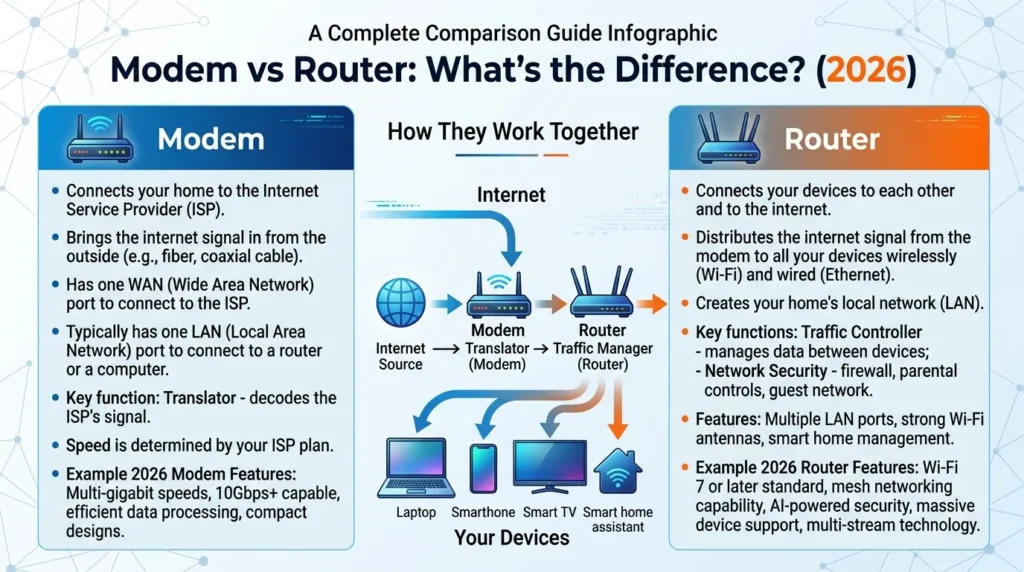
A modem connects your home or office to your Internet Service Provider (ISP).
A router shares that internet connection with multiple devices, either through Wi-Fi or Ethernet cables.
Simple Example
Think of your internet connection like water coming into your house.
- The modem is the main water meter that brings water from the city.
- The router is the plumbing system that distributes water to different rooms.
Without a modem, you cannot connect to the internet.
Without a router, only one device can usually use the internet connection.
Quick Comparison
| Feature | Modem | Router |
|---|---|---|
| Connects to ISP | Yes | No |
| Creates Wi-Fi | No | Yes |
| Shares Internet | No | Yes |
| Needed for Internet | Yes | Usually Yes |
| Connects Multiple Devices | Limited | Yes |
The Origin of Modem vs Router
Although these devices work together, they were created for different purposes.
Modem
The word modem comes from two technical terms:
- MO = Modulator
- DEM = Demodulator
A modem converts digital data from your computer into signals that travel through telephone, cable, or fiber networks. It also converts incoming signals back into digital data.
Early modems used telephone lines and were much slower than today’s broadband modems.
Router
The word router comes from the word route, meaning “to direct a path.”
A router directs or routes data between devices and networks. It decides where internet traffic should go, ensuring the correct information reaches the correct device.
Why There Are No Spelling Differences
Both modem and router are official technology terms.
Their spelling is the same in British English and American English.
British English vs American English Spelling
The words modem and router are spelled exactly the same worldwide.
Only nearby English words change between British and American spelling.
Examples
British English
- Optimise your router settings.
- Analyse modem performance.
American English
- Optimize your router settings.
- Analyze modem performance.
Comparison Table
| British English | American English |
|---|---|
| Modem | Modem |
| Router | Router |
| Optimise | Optimize |
| Analyse | Analyze |
| Organise | Organize |
| Programme | Program (software) |
Which Spelling Should You Use?
Always write the device names exactly as:
- Modem
- Router
Never change their spelling.
For US Readers
Use American English around the technical terms.
Example:
- Optimize your router for better Wi-Fi.
For UK Readers
Use British English.
Example:
- Optimise your router for better Wi-Fi.
For a Global Audience
American English is more common in technology documentation and product manuals, but either style is acceptable if used consistently.
Modem vs Router: Key Differences
Function
A modem connects your network to the internet.
A router connects your devices to the modem and manages local network traffic.
Internet Access
The modem communicates directly with your Internet Service Provider.
The router cannot access the internet without a modem (unless it’s a modem-router combo).
Wi-Fi
Traditional modems do not create Wi-Fi.
Routers provide wireless internet to smartphones, laptops, tablets, and smart TVs.
Number of Devices
A modem usually supports one direct connection.
A router allows many devices to connect at the same time.
Security
Modems provide little network protection.
Routers include features such as:
- Firewalls
- Password protection
- Guest networks
- Device management
Modem vs Router Comparison Table
| Feature | Modem | Router |
|---|---|---|
| Primary Purpose | Connect to ISP | Share internet |
| Internet Connection | Yes | Through modem |
| Wi-Fi Support | Usually No | Yes |
| Ethernet Ports | Limited | Multiple |
| Network Security | Basic | Advanced |
| Connects Multiple Devices | Limited | Yes |
| Firewall | No | Yes |
| Home Network Management | No | Yes |
Common Mistakes with Modem vs Router
Many users misunderstand how these devices work.
Mistake 1
A modem and router are the same device.
✅ Correction:
They perform different functions, although many modern devices combine both.
Mistake 2
A router connects directly to the internet.
✅ Correction:
Most routers require a modem to access the internet.
Mistake 3
Wi-Fi comes from the modem.
✅ Correction:
Wi-Fi is normally provided by the router.
Mistake 4
Buying an expensive router increases internet speed.
✅ Correction:
A better router improves Wi-Fi performance, but it cannot exceed the speed provided by your ISP.
Mistake 5
Every home needs separate devices.
✅ Correction:
Many internet providers supply modem-router combo units that perform both functions.
Modem vs Router in Everyday Examples
“Our internet stopped working after the modem restarted, but the router was still powered on.”
News
“Internet providers continue introducing advanced modem-router combination devices for home users.”
Social Media
“I upgraded my router and now my Wi-Fi reaches every room.”
Formal Writing
“A modem establishes the internet connection, while a router distributes that connection securely across multiple devices.”
Modem vs Router – Google Trends & Usage Data
Interest in modem vs router remains consistently high because people frequently upgrade home internet networks.
Modem
Common search topics include:
- Best cable modem
- Fiber modem
- DOCSIS modem
- Modem troubleshooting
Router
Popular searches include:
- Best Wi-Fi router
- Gaming router
- Mesh router
- Wi-Fi 6 router
Countries with strong search interest include:
- United States
- India
- Canada
- United Kingdom
- Australia
Searches often increase when users switch internet providers, upgrade broadband plans, or improve home Wi-Fi coverage.
Modem vs Router Keyword Variations
| Search Term | Meaning |
|---|---|
| Modem vs Router | Main comparison |
| Router vs Modem | Same comparison, reversed |
| Difference between modem and router | General explanation |
| Do I need a modem or router? | Buying advice |
| Modem and router difference | Device comparison |
| Modem vs router for home | Home networking |
| Modem router combo | Combined device |
| Router vs modem explained | Beginner-friendly guide |
FAQs
What is the difference between a modem and a router?
A modem connects your home to the internet, while a router shares that connection with multiple wired and wireless devices.
Do I need both a modem and a router?
In most homes, yes. However, many ISPs provide modem-router combo devices that combine both functions.
Can a router work without a modem?
A router can create a local network without a modem, but it cannot provide internet access unless connected to one.
Does a modem provide Wi-Fi?
Traditional modems do not provide Wi-Fi. A router is usually responsible for wireless networking.
What is a modem-router combo?
It is a single device that functions as both a modem and a router, saving space and simplifying setup.
Will a better router increase my internet speed?
A better router can improve Wi-Fi coverage and performance, but it cannot exceed the speed of your internet plan.
Which is more important, a modem or a router?
Both are important. The modem connects you to the internet, while the router distributes that connection throughout your home or office.
Conclusion
Understanding modem vs router makes setting up and managing your internet connection much easier. Although the two devices often work together, they perform different tasks. A modem connects your home or office to your Internet Service Provider, while a router distributes that internet connection to multiple devices through Wi-Fi or Ethernet. Many modern households use modem-router combo units, but separate devices can offer greater flexibility and easier upgrades. When troubleshooting internet problems, knowing whether the issue involves the modem or the router can save time and reduce frustration. Whether you’re building a home network, upgrading your broadband, or simply learning about networking basics, understanding these differences helps you make smarter decisions. Choosing the right equipment ensures reliable internet performance, stronger Wi-Fi coverage, and better security for all your connected devices.