
Imagine a factory running large motors, transformers, and air conditioning systems using alternating current (AC) power. Even though voltage is available, the current does not flow freely because the circuit opposes it. This opposition is not caused only by resistance. In AC circuits, inductors and capacitors also affect current flow. The total opposition offered to AC current is called impedance.
The Impedance Formula is one of the most important concepts in electrical engineering because it helps engineers calculate current, voltage drop, power consumption, and circuit performance in AC systems. Without understanding impedance, designing electrical systems such as transformers, motors, generators, and communication circuits becomes difficult.
Impedance combines resistance and reactance into a single value. It explains how AC circuits behave under different frequencies and load conditions. This concept is essential for students, electricians, technicians, and engineers working with modern electrical and electronic systems.
In this article, you will learn the impedance formula, impedance working principle, types of impedance, components, applications, advantages and disadvantages, troubleshooting methods, comparison with resistance, and future developments in electrical technology.
What Is the Impedance Formula?
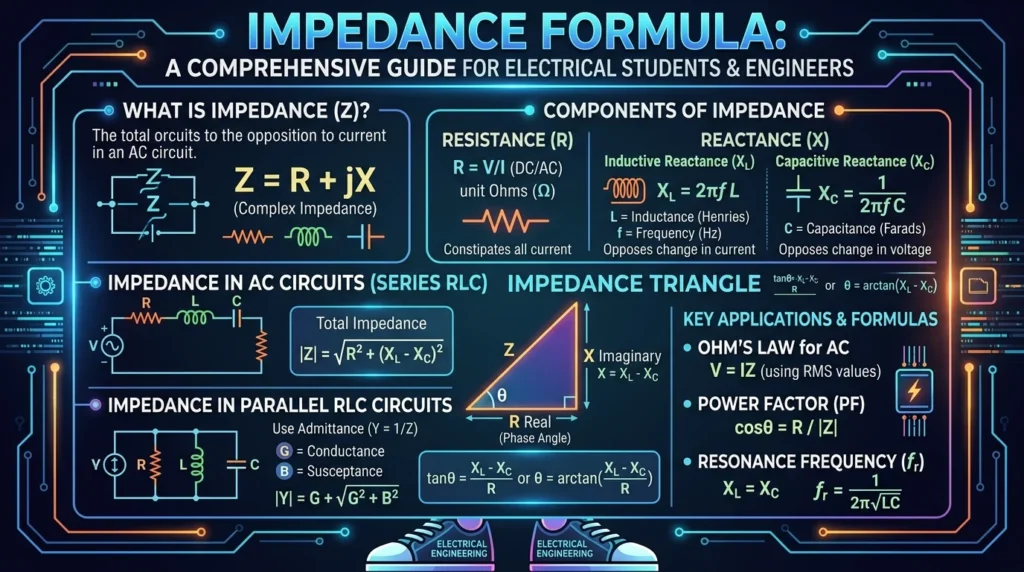
The Impedance Formula is a mathematical equation used to calculate the total opposition that an AC (Alternating Current) circuit offers to the flow of electric current. Unlike DC circuits, where only resistance limits current flow, AC circuits also include the effects of inductive reactance and capacitive reactance. The impedance formula combines all these effects into a single value, making it easier to analyze and design AC electrical systems.
Impedance is represented by the symbol Z and is measured in Ohms (Ω). It plays a vital role in electrical engineering because it determines how much current flows through an AC circuit when a voltage is applied.
Understanding the impedance formula is essential for students, electricians, engineers, and technicians working with transformers, motors, generators, power systems, and electronic circuits.
Impedance Formula for AC Circuits
In an AC circuit, impedance represents the total opposition to current flow caused by both resistance and reactance. For a series RLC circuit, the impedance formula is:
Z = √[R² + (Xₗ − X꜀)²]
Where:
- Z = Impedance in ohms (Ω)
- R = Resistance in ohms (Ω)
- Xₗ = Inductive reactance in ohms (Ω)
- X꜀ = Capacitive reactance in ohms (Ω)
The inductive and capacitive reactances are calculated using:
Xₗ = 2πfL
X꜀ = 1 / (2πfC)
Where:
- f = Frequency in hertz (Hz)
- L = Inductance in henries (H)
- C = Capacitance in farads (F)
How the AC Impedance Formula Works
In a series AC circuit, resistance and reactance combine to determine the total impedance. Inductive reactance and capacitive reactance act in opposite directions, so their difference determines the circuit’s net reactance.
For example, if:
- R = 10 Ω
- Xₗ = 15 Ω
- X꜀ = 5 Ω
Then:
Z = √[10² + (15 − 5)²]
Z = √[100 + 100]
Z ≈ 14.14 Ω
Therefore, the circuit’s impedance is approximately 14.14 Ω.
RLC Impedance Formula
The RLC impedance formula is used to calculate the total opposition to current flow in a circuit containing a resistor (R), inductor (L), and capacitor (C). In a series RLC circuit, the complex impedance is:
Z = R + j(Xₗ − X꜀)
The magnitude of impedance is:
|Z| = √[R² + (Xₗ − X꜀)²]
Where:
- Z = Complex impedance
- |Z| = Magnitude of impedance in ohms (Ω)
- R = Resistance in ohms (Ω)
- Xₗ = Inductive reactance in ohms (Ω)
- X꜀ = Capacitive reactance in ohms (Ω)
- j = Imaginary unit
The reactances are calculated as:
Xₗ = 2πfL
X꜀ = 1 / (2πfC)
RLC Impedance Example
Suppose a series RLC circuit has:
- Resistance = 20 Ω
- Inductive reactance = 30 Ω
- Capacitive reactance = 10 Ω
Using the formula:
|Z| = √[20² + (30 − 10)²]
|Z| = √[400 + 400]
|Z| = √800
|Z| ≈ 28.28 Ω
Therefore, the magnitude of the circuit impedance is approximately 28.28 Ω.
RLC Circuit at Resonance
In a series RLC circuit, resonance occurs when the inductive reactance equals the capacitive reactance:
Xₗ = X꜀
Therefore:
Xₗ − X꜀ = 0
The impedance formula becomes:
Z = R
At resonance, the circuit has minimum impedance for a series RLC circuit, assuming the resistance remains fixed. This allows the circuit to draw its maximum current for a given supply voltage.
The resonance frequency can be calculated using:
fᵣ = 1 / (2π√LC)
Understanding the RLC impedance formula is important when analyzing filters, resonant circuits, motor circuits, power systems, and electronic equipment.
How to Calculate Current Using Impedance
Once the impedance of an AC circuit is known, you can calculate the circuit current using AC Ohm’s law:
I = V / Z
Where:
- I = Current in amperes (A)
- V = Voltage in volts (V)
- Z = Impedance in ohms (Ω)
For current magnitude, use the magnitudes of voltage and impedance:
|I| = |V| / |Z|
Example: Calculate Current Using Impedance
Suppose an AC circuit has:
- Supply voltage = 120 V
- Impedance = 30 Ω
Using the formula:
I = V / Z
I = 120 / 30
I = 4 A
Therefore, the circuit current is 4 A.
Impedance Formula Calculator
An impedance formula calculator can help you quickly determine the impedance of a series RLC circuit when resistance, inductive reactance, and capacitive reactance are known.
Use the formula:
Z = √[R² + (Xₗ − X꜀)²]
How to Calculate Impedance
Follow these steps:
- Find the resistance (R) in ohms.
- Find the inductive reactance (Xₗ) in ohms.
- Find the capacitive reactance (X꜀) in ohms.
- Subtract X꜀ from Xₗ.
- Square the resistance and net reactance.
- Add the two values.
- Take the square root to obtain the impedance.
Example
Suppose:
- R = 12 Ω
- Xₗ = 20 Ω
- X꜀ = 8 Ω
First, calculate the net reactance:
Xₗ − X꜀ = 20 − 8 = 12 Ω
Now apply the impedance formula:
Z = √[12² + 12²]
Z = √[144 + 144]
Z = √288
Z ≈ 16.97 Ω
Therefore, the circuit impedance is approximately 16.97 Ω.
Important Note
This formula applies directly to a series RLC circuit. Parallel circuits require a different approach because their impedance is determined from the total admittance of the circuit.
When calculating impedance, always make sure that resistance and reactance values are expressed in the same unit, normally ohms (Ω).
Impedance Formula for Parallel Circuits
The impedance formula for a parallel circuit is different from the formula used for a series RLC circuit. In a parallel circuit, the total impedance is determined by combining the admittances of the individual branches.
For a parallel RLC circuit, admittance can be written as:
Y = 1/R + j(1/X꜀ − 1/Xₗ)
The total impedance is the reciprocal of admittance:
Z = 1/Y
Where:
- Z = Total impedance in ohms (Ω)
- Y = Total admittance in siemens (S)
- R = Resistance in ohms (Ω)
- Xₗ = Inductive reactance in ohms (Ω)
- X꜀ = Capacitive reactance in ohms (Ω)
- j = Imaginary unit
Why Parallel Impedance Is Different
In a series circuit, the same current flows through each component, so the resistive and reactive components can be combined directly.
In a parallel circuit, the voltage across each branch is the same, while the branch currents can be different. Therefore, it is usually easier to calculate the total admittance first and then take its reciprocal to find impedance.
Simple Parallel Example
Consider a parallel circuit with:
- R = 20 Ω
- Xₗ = 40 Ω
- X꜀ = 80 Ω
First calculate the total admittance:
Y = 1/20 + j(1/80 − 1/40)
Y = 0.05 − j0.0125 S
The total impedance is then:
Z = 1/Y
The result is a complex impedance, meaning it has both a magnitude and a phase angle.
Important Note
Do not use:
Z = √[R² + (Xₗ − X꜀)²]
for a general parallel RLC circuit. That magnitude formula is used for a series RLC circuit. Parallel circuits should be analyzed using admittance or the appropriate parallel impedance equation.
Impedance Phase Angle Formula
In an AC circuit, impedance has both magnitude and phase angle. The phase angle shows the relationship between voltage and current and indicates whether the circuit behaves more like an inductive or capacitive circuit.
For a series RLC circuit, the impedance phase angle can be calculated using:
θ = tan⁻¹[(Xₗ − X꜀) / R]
Where:
- θ = Impedance phase angle
- Xₗ = Inductive reactance in ohms (Ω)
- X꜀ = Capacitive reactance in ohms (Ω)
- R = Resistance in ohms (Ω)
How to Interpret the Impedance Phase Angle
The value of Xₗ − X꜀ determines whether the circuit is inductive, capacitive, or purely resistive.
- Xₗ > X꜀: The circuit is predominantly inductive, and the phase angle is positive.
- X꜀ > Xₗ: The circuit is predominantly capacitive, and the phase angle is negative.
- Xₗ = X꜀: The circuit is purely resistive at resonance, so the phase angle is 0°.
Example of Phase Angle Calculation
Suppose a series RLC circuit has:
- R = 10 Ω
- Xₗ = 20 Ω
- X꜀ = 5 Ω
Using the formula:
θ = tan⁻¹[(20 − 5) / 10]
θ = tan⁻¹(1.5)
θ ≈ 56.3°
Therefore, the circuit has an impedance phase angle of approximately +56.3°, indicating predominantly inductive behavior.
The phase angle is useful for understanding power factor, current phase shift, motor performance, filters, and AC power systems.
Why Impedance Matters for Current
Impedance determines how much an AC circuit opposes current flow. For a given voltage, a higher impedance results in lower current, while a lower impedance results in higher current.
For example:
- Higher impedance → lower current
- Lower impedance → higher current
In circuits containing inductors and capacitors, impedance also affects the phase relationship between voltage and current. This makes impedance important when analyzing motors, transformers, filters, power supplies, and other AC equipment.
Why Impedance Changes With Frequency
Impedance can change when the AC frequency changes because both inductive and capacitive reactance depend on frequency.
- Inductive reactance increases as frequency increases.
- Capacitive reactance decreases as frequency increases.
- Resistance generally remains approximately constant in basic circuit calculations.
This is why frequency is an important factor when calculating impedance in AC circuits.
Impedance Formula
The standard impedance formula for a series AC circuit is:
[
Z=\sqrt{R^2+(X_L-X_C)^2}
]
Explanation of the Formula
Each symbol in the impedance formula has a specific meaning.
Where:
- Z = Impedance (Ohms, Ω)
- R = Resistance (Ohms, Ω)
- Xₗ = Inductive Reactance (Ohms, Ω)
- X꜀ = Capacitive Reactance (Ohms, Ω)
Unit of Impedance
- SI Unit: Ohm (Ω)
What Is Impedance?
Impedance is the total opposition that an AC circuit provides to the flow of alternating current. It is the combined effect of three electrical quantities:
- Resistance (R) – Opposes current in both AC and DC circuits.
- Inductive Reactance (Xₗ) – Opposes changes in current due to inductors or coils.
- Capacitive Reactance (X꜀) – Opposes voltage changes due to capacitors.
Together, these three quantities determine the overall impedance of an AC circuit.
Important Note About Impedance
Impedance is primarily used to analyze AC circuits, where resistance and reactance affect current flow and phase relationships. In a DC steady-state resistive circuit, the impedance is equal to the resistance.
- AC circuit: Impedance can include both resistance and reactance.
- DC resistive circuit: Impedance is equal to resistance.
- AC circuit with inductors or capacitors: Impedance can change with frequency because reactance depends on frequency.
Understanding this distinction helps avoid confusion when using the impedance formula in different types of electrical circuits.
Components of Impedance
1. Resistance (R)
Resistance is the opposition offered by conductors, resistors, and electrical loads.
It converts electrical energy into heat and is present in both AC and DC circuits.
Examples:
- Heating elements
- Electric irons
- Resistors
- Incandescent lamps
2. Inductive Reactance (Xₗ)
Inductive reactance is produced by inductors, coils, transformers, and motors.
It opposes changes in current because of the magnetic field created around the coil.
Inductive reactance increases as the frequency increases.
3. Capacitive Reactance (X꜀)
Capacitive reactance is produced by capacitors.
It opposes changes in voltage by storing and releasing electrical energy.
Unlike inductive reactance, capacitive reactance decreases as the frequency increases.
How the Impedance Formula Works
The impedance formula combines resistance and reactance to calculate the total opposition in an AC circuit.
If Only Resistance Is Present
When there are no inductors or capacitors:
- Impedance equals resistance.
[
Z=R
]
If Resistance and Inductance Are Present
Inductive reactance increases the total impedance.
The circuit offers greater opposition to current flow.
If Resistance and Capacitance Are Present
Capacitive reactance reduces the overall reactance depending on the circuit conditions.
If Both Inductor and Capacitor Are Present
The impedance depends on the difference between:
- Inductive Reactance (Xₗ)
- Capacitive Reactance (X꜀)
This difference is represented by:
[
(X_L-X_C)
]
The impedance formula then calculates the total opposition using the Pythagorean relationship.
Simple Explanation
Imagine a car traveling on a road.
- Resistance is like road friction that always slows the car.
- Inductive Reactance is like driving uphill, making movement more difficult.
- Capacitive Reactance is like driving downhill, helping the car move more easily.
The Impedance is the combined effect of all these factors on the car’s movement.
Similarly, in an AC circuit:
- Resistance always opposes current.
- Inductors oppose changes in current.
- Capacitors oppose changes in voltage.
The impedance formula combines these effects to determine the total opposition to alternating current.
Practical Example
Suppose an AC circuit contains:
- Resistance = 8 Ω
- Inductive Reactance = 12 Ω
- Capacitive Reactance = 5 Ω
Using the impedance formula:
[
Z=\sqrt{8^2+(12-5)^2}
]
[
Z=\sqrt{64+49}
]
[
Z=\sqrt{113}
]
[
Z\approx10.63\ \Omega
]
Result
The total impedance of the circuit is 10.63 Ω.
Key Points to Remember
- Impedance is the total opposition to alternating current.
- It exists only in AC circuits.
- It combines resistance, inductive reactance, and capacitive reactance.
- The symbol for impedance is Z.
- The SI unit of impedance is Ohm (Ω).
- The impedance formula helps calculate current, voltage, and power in AC circuits.
- It is widely used in motors, transformers, generators, transmission lines, electronic circuits, and power systems.
Understanding the Impedance Formula is fundamental for analyzing AC circuits because it explains how different electrical components work together to control the flow of alternating current safely and efficiently.
Practical Example
Suppose an AC circuit contains:
- Resistance = 6Ω
- Inductive reactance = 8Ω
- Capacitive reactance = 2Ω
Using the formula:
[
Z = \sqrt{6^2 + (8-2)^2}
]
[
Z = \sqrt{36 + 36}
]
[
Z = \sqrt{72}
]
[
Z \approx 8.48\Omega
]
So the total impedance is approximately 8.48Ω.
Impedance Working Principle
The Impedance Working Principle explains how an AC (Alternating Current) circuit resists the flow of electric current through the combined effects of resistance, inductive reactance, and capacitive reactance. Unlike a DC circuit, where only resistance limits current, an AC circuit experiences additional opposition because inductors and capacitors continuously interact with the changing current and voltage.
When alternating voltage is applied to a circuit, the current does not flow freely. Instead, it is opposed by these three electrical properties, and their combined effect is known as impedance (Z). The amount of impedance determines how much current can flow through the circuit and directly affects the performance of electrical equipment such as motors, transformers, generators, and electronic devices.
The impedance working principle is one of the fundamental concepts in electrical engineering because it helps engineers design safe, efficient, and reliable AC power systems.
Step-by-Step Working Process of Impedance
The working principle of impedance can be understood through the following steps.
Step 1: AC Voltage Is Applied
The process begins when an alternating voltage (AC) is applied across the electrical circuit.
Unlike DC voltage, AC voltage continuously changes its direction and magnitude many times every second.
As soon as the voltage is applied, it creates an electric field that causes current to flow through the circuit.
Step 2: Alternating Current Begins to Flow
The applied voltage causes electrons to move through the conductors.
Since AC changes direction continuously, the electrons also move back and forth instead of flowing in only one direction.
The amount of current that flows depends on the total impedance of the circuit.
Step 3: Resistance Opposes Current Flow
Every conductor and electrical component has some resistance (R).
Resistance opposes the movement of current by converting part of the electrical energy into heat.
Unlike reactance, resistance remains nearly constant regardless of the AC frequency.
Examples include:
- Heating elements
- Electric irons
- Resistors
- Copper wires
Resistance always reduces current flow in both AC and DC circuits.
Step 4: Inductors Create Magnetic Opposition
If the circuit contains an inductor or coil, another type of opposition called inductive reactance (Xₗ) is produced.
As AC current flows through the coil, it creates a changing magnetic field.
This changing magnetic field induces a voltage that opposes changes in the current, according to Lenz’s Law.
As a result:
- Higher frequency → Higher inductive reactance
- Lower frequency → Lower inductive reactance
Common examples include:
- Electric motors
- Transformers
- Relays
- Chokes
Step 5: Capacitors Oppose Voltage Changes
If a capacitor is connected in the circuit, it introduces capacitive reactance (X꜀).
Instead of allowing continuous current flow, the capacitor repeatedly stores and releases electrical energy in the form of an electric field.
This charging and discharging process opposes changes in voltage.
Unlike inductive reactance:
- Higher frequency → Lower capacitive reactance
- Lower frequency → Higher capacitive reactance
Capacitors are widely used in:
- Filter circuits
- Power supplies
- Timing circuits
- Communication systems
Step 6: Combined Opposition Forms Impedance
In an AC circuit, all three electrical effects work together.
These include:
- Resistance (R)
- Inductive Reactance (Xₗ)
- Capacitive Reactance (X꜀)
Their combined effect is called Impedance (Z).
Impedance determines:
- How much current flows
- Voltage distribution
- Power consumption
- Overall circuit performance
This total opposition is calculated using the impedance formula.
How Impedance Affects Current Flow
The relationship between impedance and current is simple:
- Higher impedance → Lower current
- Lower impedance → Higher current
This principle is widely used to control electrical power in motors, transformers, electronic circuits, and industrial equipment.
Factors Affecting Impedance
Several factors influence the impedance of an AC circuit.
Resistance
Greater resistance increases the total impedance.
Inductance
Larger inductors create greater inductive reactance, increasing impedance.
Capacitance
Higher capacitance reduces capacitive reactance, which can decrease the overall impedance depending on the circuit configuration.
Frequency
Impedance changes with AC frequency because both inductive and capacitive reactance depend on frequency.
Higher frequencies increase inductive reactance while decreasing capacitive reactance.
Simple Analogy
Imagine water flowing through a pipeline.
- Resistance is like a narrow section of the pipe that always slows the water flow.
- Inductive Reactance is like a heavy water wheel that resists sudden changes in the water flow because of its inertia.
- Capacitive Reactance is like a flexible rubber chamber that temporarily stores water pressure before releasing it.
Each of these elements affects the movement of water in a different way.
When combined, they reduce the overall water flow.
In the same way, resistance, inductive reactance, and capacitive reactance combine to create impedance, which limits the flow of alternating current in an AC circuit.
Key Points to Remember
- Impedance exists only in AC circuits.
- It is the combined effect of resistance, inductive reactance, and capacitive reactance.
- Resistance converts electrical energy into heat.
- Inductors oppose changes in current using magnetic fields.
- Capacitors oppose changes in voltage by storing electrical energy.
- Frequency greatly affects the value of impedance.
- Higher impedance reduces current flow.
- Impedance is essential for designing motors, transformers, generators, power systems, communication equipment, and electronic circuits.
Understanding the Impedance Working Principle provides a strong foundation for analyzing AC circuits and helps engineers and technicians design electrical systems that operate safely, efficiently, and reliably.
Types and Classification of Impedance
Impedance in an AC circuit can be classified into different types based on the electrical components present in the circuit. Each type affects the flow of alternating current in a unique way. Understanding these types helps engineers and technicians analyze AC circuits, troubleshoot electrical problems, and select the right components for various applications.
1. Resistive Impedance
Resistive impedance occurs when an AC circuit contains only resistance and no inductors or capacitors. In this case, the impedance is equal to the resistance because there is no reactance to oppose the current.
This is the simplest type of impedance and behaves similarly to a DC circuit.
Formula
[
Z = R
]
Features
- Voltage and current remain in phase.
- No inductive or capacitive reactance is present.
- Power is converted directly into heat or light.
- Impedance remains constant regardless of frequency.
Common Applications
- Electric heaters
- Incandescent lamps
- Electric irons
- Heating elements
- Pure resistor circuits
2. Inductive Impedance
Inductive impedance occurs when an AC circuit contains inductors, coils, or windings. As alternating current flows through the coil, it produces a changing magnetic field that opposes changes in current. This opposition is called inductive reactance (Xₗ).
Inductive impedance increases as the supply frequency increases.
Inductive Reactance Formula
[
X_L = 2\pi fL
]
Where
- Xₗ = Inductive Reactance (Ω)
- f = Frequency (Hz)
- L = Inductance (H)
Features
- Current lags behind the voltage.
- Inductive reactance increases with frequency.
- Produces a magnetic field around the coil.
- Stores energy in the magnetic field.
Common Applications
- Electric motors
- Transformers
- Chokes
- Relays
- Induction heating equipment
3. Capacitive Impedance
Capacitive impedance occurs when capacitors are connected in an AC circuit. A capacitor continuously stores and releases electrical energy, creating capacitive reactance (X꜀) that opposes changes in voltage.
Unlike inductive reactance, capacitive reactance decreases as the frequency increases.
Capacitive Reactance Formula
[
X_C=\frac{1}{2\pi fC}
]
Where
- X꜀ = Capacitive Reactance (Ω)
- f = Frequency (Hz)
- C = Capacitance (F)
Features
- Current leads the voltage.
- Capacitive reactance decreases with increasing frequency.
- Stores energy in an electric field.
- Improves power factor in many electrical systems.
Common Applications
- Filter circuits
- Power factor correction
- Timing circuits
- Communication systems
- Power supplies
4. Series Impedance
A series impedance circuit consists of resistors, inductors, and capacitors connected one after another in a single current path.
Since all components share the same current, the total impedance depends on the combined effect of resistance and reactance.
Characteristics
- Same current flows through every component.
- Voltages across individual components are different.
- Total impedance is calculated using the impedance formula.
- Easier to analyze than parallel circuits.
Applications
- RC circuits
- RL circuits
- RLC series circuits
- Electronic timing circuits
5. Parallel Impedance
In a parallel impedance circuit, all components are connected across the same voltage source.
Each branch has the same voltage, but the current divides among the different branches according to their impedance.
Characteristics
- Same voltage across all branches.
- Current divides into multiple paths.
- Total impedance is lower than the smallest branch impedance.
- Circuit analysis is more complex than series circuits.
Applications
- Household wiring
- Industrial power distribution
- Power factor correction systems
- Electrical control panels
Comparison of Different Types of Impedance
| Type | Main Component | Current and Voltage Relationship | Common Applications |
|---|---|---|---|
| Resistive Impedance | Resistance (R) | Voltage and current are in phase | Heaters, lamps, resistors |
| Inductive Impedance | Inductor (L) | Current lags voltage | Motors, transformers, relays |
| Capacitive Impedance | Capacitor (C) | Current leads voltage | Filters, power factor correction, electronics |
| Series Impedance | R, L, C in series | Same current through all components | RC, RL, and RLC series circuits |
| Parallel Impedance | R, L, C in parallel | Same voltage across all branches | Power distribution, industrial systems |
Main Components of Impedance
The total impedance of an AC circuit depends on several important electrical quantities. Each component affects current flow differently, and together they determine the overall opposition offered by the circuit.
1. Resistance (R)
Resistance is the property of a material that opposes the flow of electric current. It converts part of the electrical energy into heat and is present in both AC and DC circuits.
Resistance is measured in Ohms (Ω) and remains nearly constant regardless of the supply frequency.
Functions
- Opposes current flow
- Converts electrical energy into heat
- Limits circuit current
- Protects electrical components
Common Examples
- Electric heaters
- Incandescent bulbs
- Resistors
- Electric irons
- Heating elements
2. Inductive Reactance (Xₗ)
Inductive reactance is produced by inductors, coils, and transformer windings. It opposes changes in current by generating a magnetic field.
Unlike resistance, inductive reactance depends on the frequency of the AC supply.
Functions
- Opposes changes in current
- Stores energy in a magnetic field
- Controls AC current flow
- Increases total impedance
Common Examples
- Transformers
- Electric motors
- Chokes
- Solenoids
- Relay coils
3. Capacitive Reactance (X꜀)
Capacitive reactance is produced by capacitors. It opposes changes in voltage by storing and releasing electrical energy in an electric field.
As frequency increases, capacitive reactance decreases.
Functions
- Opposes voltage changes
- Stores electrical energy
- Filters unwanted signals
- Improves power factor
Common Examples
- Capacitors
- Electronic filters
- Timing circuits
- Power factor correction banks
- Communication circuits
4. Frequency (f)
Frequency is one of the most important factors affecting impedance in AC circuits.
It represents the number of complete AC cycles occurring each second and is measured in Hertz (Hz).
Frequency directly changes both inductive reactance and capacitive reactance.
Effects of Frequency
- Higher frequency increases inductive reactance.
- Higher frequency decreases capacitive reactance.
- Lower frequency reduces inductive reactance.
- Lower frequency increases capacitive reactance.
Understanding the effect of frequency is essential for designing efficient AC power systems, electronic circuits, and communication equipment.
Component Summary Table
| Component | Symbol | Unit | Primary Function |
|---|---|---|---|
| Resistance | R | Ohm (Ω) | Opposes current and converts electrical energy into heat |
| Inductive Reactance | Xₗ | Ohm (Ω) | Opposes changes in current using magnetic fields |
| Capacitive Reactance | X꜀ | Ohm (Ω) | Opposes changes in voltage by storing electrical energy |
| Frequency | f | Hertz (Hz) | Determines the values of inductive and capacitive reactance |
Together, Resistance (R), Inductive Reactance (Xₗ), Capacitive Reactance (X꜀), and Frequency (f) determine the total Impedance (Z) of an AC circuit, making them the fundamental building blocks for analyzing and designing electrical and electronic systems.
Advantages of Impedance Formula
The impedance advantages and disadvantages are important for AC circuit design.
Advantages
- Helps calculate AC circuit current
- Essential for power system design
- Useful in transformer calculations
- Supports motor performance analysis
- Helps design communication circuits
- Improves power factor correction
- Assists in electrical troubleshooting
Disadvantages / Limitations
Limitations of Impedance
- Complex calculations in large systems
- Depends on frequency changes
- Difficult for beginners to understand
- Requires reactance knowledge
- Phase angle calculations may become complicated
Applications of Impedance
The applications of impedance are found in almost every AC electrical and electronic system. Impedance plays a vital role in controlling the flow of alternating current, ensuring efficient power transfer, protecting electrical equipment, and improving overall system performance.
Engineers use impedance calculations when designing electrical circuits, selecting components, troubleshooting faults, and optimizing the operation of motors, transformers, communication systems, and power networks.
1. Home Applications
Many household appliances operate on AC power, making impedance an important factor in their safe and efficient operation.
Air Conditioners
Air conditioners contain compressors, fan motors, and control circuits that rely on proper impedance for smooth starting, efficient cooling, and reduced power consumption.
Ceiling and Exhaust Fans
Fan motors have inductive windings that create impedance. Proper impedance helps regulate current, improve efficiency, and prevent motor overheating.
Refrigerators
Refrigerators use compressor motors and starting capacitors. Impedance calculations help ensure reliable motor starting and stable operation.
Washing Machines
Modern washing machines contain induction motors, electronic controllers, and inverter circuits that depend on correct impedance for efficient performance.
Microwave Ovens and Other Appliances
Many kitchen appliances contain transformers, filters, and electronic control boards where impedance helps regulate current and protect sensitive components.
2. Industrial Applications
Industrial electrical systems use impedance to improve efficiency, protect equipment, and maintain stable operation under varying loads.
Electric Motors
Motor windings create inductive impedance that affects starting current, running current, and overall motor performance.
Engineers calculate impedance to:
- Select the correct motor
- Improve efficiency
- Reduce energy losses
- Prevent overheating
Transformers
Transformer windings have both resistance and inductive reactance.
Impedance is used to:
- Calculate voltage regulation
- Determine fault current
- Improve power transfer
- Design transformer protection systems
Industrial Machinery
Large industrial machines rely on accurate impedance calculations to ensure stable operation, reduce power losses, and prevent equipment damage.
Examples include:
- CNC machines
- Conveyor systems
- Compressors
- Pumps
- Manufacturing equipment
Welding Equipment
Welding machines use transformers and inductive circuits where impedance controls welding current and improves arc stability.
3. Communication Systems
Communication equipment depends on proper impedance matching to transfer electrical signals efficiently and minimize signal loss.
Radio Transmitters
Radio transmitters require impedance matching between the transmitter and antenna to maximize signal strength and reduce reflected power.
Antenna Systems
Correct antenna impedance improves signal transmission, reception quality, and communication range.
Impedance mismatches can cause:
- Signal reflection
- Reduced transmission efficiency
- Communication losses
Audio Systems
Audio amplifiers, microphones, and loudspeakers use impedance matching to deliver clear sound and maximum power transfer.
Common applications include:
- Home theater systems
- Public address systems
- Recording studios
- Musical instruments
Networking and Communication Equipment
Routers, communication cables, and transmission lines are designed with specific impedance values to maintain signal quality and reduce interference.
4. Power System Applications
Power generation, transmission, and distribution systems rely heavily on impedance calculations to ensure safe and reliable operation.
Transmission Lines
Engineers calculate transmission line impedance to determine:
- Voltage drop
- Power losses
- Current flow
- System efficiency
Proper impedance improves long-distance power transmission.
Electrical Substations
Substation equipment uses impedance calculations to:
- Analyze fault currents
- Coordinate protective relays
- Design grounding systems
- Improve system stability
Power Distribution Networks
Distribution engineers use impedance to:
- Select cables
- Design feeders
- Balance electrical loads
- Maintain voltage regulation
This ensures reliable electricity delivery to homes, businesses, and industries.
5. Modern Electronics Applications
Electronic circuits rely on impedance to control signals, reduce noise, and improve circuit performance.
Electronic Filters
Filters use resistors, capacitors, and inductors to block unwanted frequencies while allowing desired signals to pass.
Applications include:
- Audio equipment
- Communication systems
- Power supplies
- Signal processing
Amplifiers
Amplifiers require proper impedance matching between input and output devices to maximize power transfer and improve sound quality.
Inverters
Modern inverters use impedance calculations to improve:
- Voltage regulation
- Power conversion efficiency
- Harmonic reduction
- Stable AC output
Applications include:
- Solar inverters
- UPS systems
- Variable Frequency Drives (VFDs)
- Battery backup systems
Computer Power Supplies
Switch-mode power supplies (SMPS) use impedance-controlled circuits to provide stable and efficient DC power for computers and electronic devices.
Renewable Energy Systems
Solar and wind power systems use impedance calculations to optimize energy conversion, improve inverter performance, and maintain grid stability.
Importance of Impedance in Electrical Engineering
Impedance is one of the most important concepts in AC circuit analysis because it helps engineers:
- Calculate current flow accurately.
- Design efficient AC electrical systems.
- Improve power transfer.
- Reduce energy losses.
- Protect motors, transformers, and generators.
- Analyze fault conditions.
- Improve communication signal quality.
- Ensure safe and reliable electrical operation.
Summary of Impedance Applications
| Application Area | Common Uses |
|---|---|
| Home Appliances | Air conditioners, fans, refrigerators, washing machines, microwave ovens |
| Industrial Systems | Electric motors, transformers, industrial machinery, welding equipment, pumps |
| Communication Systems | Radio transmitters, antenna systems, audio equipment, networking devices |
| Power Systems | Transmission lines, substations, power distribution networks, protection systems |
| Modern Electronics | Filters, amplifiers, inverters, SMPS, renewable energy systems, electronic control circuits |
The applications of impedance extend across almost every field of electrical and electronic engineering. Whether designing household appliances, industrial machinery, communication equipment, or high-voltage power systems, understanding impedance enables engineers and technicians to build electrical systems that are efficient, reliable, and safe.
Comparison Section
Impedance vs Resistance
Impedance and resistance both oppose current flow, but they are not exactly the same. Resistance is the opposition to current caused by resistive elements, while impedance represents the total opposition in an AC circuit, including both resistance and reactance.
| Feature | Impedance | Resistance |
|---|---|---|
| Symbol | Z | R |
| Unit | Ohm (Ω) | Ohm (Ω) |
| Main use | AC circuit analysis | AC and DC circuit analysis |
| Includes | Resistance and reactance | Resistance only |
| Depends on frequency | Can depend on frequency | Generally does not in basic circuit analysis |
| Phase effect | Can cause voltage-current phase shift | Does not cause phase shift in an ideal resistor |
| Formula | Z = √[R² + (Xₗ − X꜀)²] for a series RLC circuit | R = V / I |
Key Difference
The main difference is that impedance can include both resistance and reactance, while resistance represents only the resistive part of a circuit.
For a purely resistive circuit:
Z = R
However, when inductors or capacitors are present, the impedance can differ from the resistance because reactance contributes to the circuit’s total opposition to AC current.
Simple Example
If a circuit contains only a 20 Ω resistor:
Z = R = 20 Ω
If the circuit also contains inductive or capacitive reactance, the total impedance must be calculated using the appropriate impedance formula.
Understanding the difference between impedance and resistance is essential when analyzing AC circuits, motors, transformers, filters, and other electrical systems.
Difference Between Inductive and Capacitive Reactance
| Feature | Inductive Reactance | Capacitive Reactance |
|---|---|---|
| Symbol | XL | XC |
| Caused By | Inductors | Capacitors |
| Frequency Effect | Increases with frequency | Decreases with frequency |
| Current Behavior | Current lags | Current leads |
Selection Guide
Selection Guide: How to Choose the Proper Impedance
Selecting the proper impedance is essential for ensuring that electrical and electronic equipment operates safely, efficiently, and reliably. Whether you are designing an AC circuit, installing industrial equipment, or troubleshooting an electrical system, understanding impedance helps improve performance, reduce power losses, and prevent equipment damage.
The correct impedance depends on factors such as the operating frequency, circuit components, load type, and power requirements.
1. Identify the AC Supply Frequency
The first step is to determine the operating frequency of the circuit.
Since both inductive reactance (Xₗ) and capacitive reactance (X꜀) depend on frequency, using the correct frequency is essential for accurate impedance calculations.
Common AC Frequencies
- 50 Hz – Used in many countries around the world.
- 60 Hz – Common in North America and several other countries.
Always use the correct frequency when calculating impedance.
2. Measure Resistance Accurately
Resistance is one of the main components of impedance.
Use a digital multimeter to measure the circuit resistance accurately before performing impedance calculations.
Accurate resistance measurements improve:
- Circuit design
- Current calculations
- Power analysis
- Fault diagnosis
3. Identify the Type of Load
Determine whether the electrical load is:
- Resistive
- Inductive
- Capacitive
- Mixed (RLC)
Each type of load affects impedance differently.
Examples
- Resistive Loads: Electric heaters, incandescent lamps
- Inductive Loads: Motors, transformers, relays
- Capacitive Loads: Capacitor banks, electronic filters, power factor correction systems
Understanding the load type helps select the correct impedance model.
4. Calculate Total Impedance
Once the values of resistance and reactance are known, calculate the total impedance using the appropriate impedance formula.
Correct impedance calculations help engineers determine:
- Circuit current
- Voltage drop
- Power consumption
- Equipment performance
5. Consider the Power Rating
The selected impedance should be suitable for the expected voltage and current levels.
Undersized components may overheat, while oversized components may increase system cost unnecessarily.
Always verify:
- Voltage rating
- Current rating
- Power rating
- Temperature limits
6. Ensure Proper Impedance Matching
Impedance matching is essential whenever electrical energy or signals are transferred between two devices.
Proper impedance matching provides:
- Maximum power transfer
- Reduced energy loss
- Better system efficiency
- Improved equipment life
- Higher signal quality
Impedance matching is especially important in:
- Audio systems
- Radio transmitters
- Antenna systems
- Communication equipment
Practical Engineering Tips
Match Equipment Impedance
Always ensure that the impedance of connected equipment is compatible.
Improper impedance matching can result in:
- Reduced efficiency
- Excessive heating
- Increased power loss
- Signal distortion
- Equipment damage
Consider the Power Factor
Power factor significantly affects impedance in AC systems.
A low power factor increases current flow, resulting in:
- Higher power losses
- Increased heating
- Reduced system efficiency
Improving the power factor helps reduce current and improve overall performance.
Avoid Overloading
Connecting loads beyond the designed impedance can overload the electrical system.
To prevent overload:
- Select properly rated equipment.
- Avoid connecting excessive loads.
- Follow manufacturer specifications.
Proper load management extends equipment life and improves safety.
Tips for Beginners
If you are learning AC circuit analysis, follow these simple guidelines:
- Start by identifying the circuit type (R, RL, RC, or RLC).
- Measure resistance carefully using a digital multimeter.
- Know the supply frequency before calculating reactance.
- Use the correct impedance formula for the circuit.
- Always use standard SI units.
- Double-check calculations before connecting equipment.
- Follow electrical safety procedures during testing.
Common Problems and Solutions Related to Impedance
Improper impedance can reduce electrical system performance and may even damage equipment. Understanding these common problems makes troubleshooting much easier.
Problem 1: Excessive Current Flow
If the circuit draws more current than expected, the impedance may be too low.
Possible Causes
- Low circuit impedance
- Short circuit
- Incorrect component selection
- Excessive electrical load
Solution
- Increase the circuit resistance if appropriate.
- Reduce the connected load.
- Inspect the circuit for short circuits.
- Verify impedance calculations before energizing the system.
Problem 2: Voltage Drop
Voltage reaching the load may be lower than expected.
Possible Causes
- High impedance in transmission cables
- Long conductor length
- Loose electrical connections
- Undersized conductors
Solution
- Use conductors with a larger cross-sectional area.
- Reduce cable length where possible.
- Tighten electrical connections.
- Minimize unnecessary impedance in the circuit.
Problem 3: Motor Overheating
Electric motors may overheat if impedance is not properly matched.
Possible Causes
- Incorrect load conditions
- Poor power factor
- Voltage imbalance
- Excessive current
Solution
- Improve the power factor.
- Match the motor to the correct load.
- Verify the supply voltage.
- Perform regular maintenance on the motor.
Problem 4: Signal Loss in Audio or Communication Systems
Weak or distorted signals often result from impedance mismatch.
Possible Causes
- Incorrect speaker impedance
- Improper cable selection
- Antenna mismatch
- Poor connector quality
Solution
- Match the impedance of all connected devices.
- Use high-quality cables and connectors.
- Follow manufacturer recommendations for impedance values.
Problem 5: Poor Power Factor
A low power factor increases current flow and reduces system efficiency.
Possible Causes
- Excessive inductive loads
- Large motors
- Transformers operating under light load
Solution
- Install capacitor banks.
- Use automatic power factor correction systems.
- Reduce unnecessary inductive loading.
Troubleshooting Tips
When diagnosing impedance-related problems:
- Measure resistance with a digital multimeter.
- Verify the operating frequency.
- Check inductive and capacitive components.
- Inspect cables and electrical connections.
- Compare measured values with design specifications.
- Replace damaged components immediately.
A systematic troubleshooting approach improves safety and reduces downtime.
Future Trends in Impedance Technology
As electrical engineering continues to evolve, impedance analysis is becoming smarter, faster, and more accurate. Modern technologies are improving how engineers monitor, calculate, and control impedance in electrical systems.
1. Smart Power Systems
Modern smart grids continuously monitor impedance to improve system reliability and detect faults before they become serious.
Benefits include:
- Real-time monitoring
- Automatic fault detection
- Improved grid stability
- Better energy management
2. Advanced Power Electronics
New semiconductor technologies such as Silicon Carbide (SiC) and Gallium Nitride (GaN) devices provide more precise impedance control.
These technologies offer:
- Higher efficiency
- Faster switching
- Lower power losses
- Improved thermal performance
3. Wireless Power Transfer
Wireless charging systems depend heavily on accurate impedance matching to maximize energy transfer efficiency.
Applications include:
- Wireless phone chargers
- Electric vehicle charging
- Medical devices
- Industrial automation
4. Renewable Energy Systems
Solar and wind energy systems use impedance calculations to optimize inverter performance and improve power quality.
Impedance analysis helps:
- Increase inverter efficiency
- Improve grid synchronization
- Reduce energy losses
- Enhance system reliability
5. AI-Based Electrical Monitoring
Artificial Intelligence is transforming electrical maintenance by continuously analyzing impedance data.
AI-powered systems can:
- Predict equipment failures
- Detect abnormal impedance changes
- Optimize power system performance
- Reduce maintenance costs
- Improve equipment reliability
Industry Outlook
Future electrical systems will rely on intelligent impedance monitoring, automated diagnostics, and advanced power electronics to improve efficiency, safety, and reliability. Although technology continues to advance, the fundamental concept of impedance will remain a cornerstone of AC circuit analysis, power system design, and modern electrical engineering.
Conclusion
The Impedance Formula is one of the most important concepts in AC electrical engineering. It explains the total opposition offered to alternating current by resistance, inductance, and capacitance. Understanding impedance helps engineers design safe, efficient, and reliable electrical systems.
From household appliances to industrial motors and communication systems, impedance calculations are used everywhere in modern technology. Learning impedance working principle, reactance behavior, and impedance applications helps students and professionals solve real electrical problems effectively.
As electrical systems become more advanced with renewable energy, automation, and smart technologies, impedance knowledge will remain essential for every electrical engineer and technician.