
Imagine your air conditioner is running, but instead of cool air, it starts blowing warm air. One of the most common hidden reasons behind this problem is a faulty expansion device inside the refrigeration system. This small but extremely important component controls how refrigerant flows from high pressure to low pressure, making cooling possible.
In real life, whether it is a home AC, refrigerator, cold storage, or industrial cooling plant, the expansion device plays a key role in maintaining proper temperature and system efficiency. Without it, the refrigeration cycle simply cannot work.
In this article, you will learn everything about the Expansion Device—its definition, working principle, types, components, advantages, disadvantages, applications, and how to select the right one. This guide is written in simple language for electrical students, engineers, and beginners so that even complex concepts become easy to understand.
By the end, you will clearly understand how this small device controls the entire cooling process and why it is considered the “control valve” of refrigeration systems.
2. What is Expansion Device?
An Expansion Device is a component used in refrigeration and air conditioning systems that reduces the pressure of refrigerant and controls its flow into the evaporator.
Simple Definition:
It is a device that allows high-pressure liquid refrigerant to expand into a low-pressure mixture before entering the evaporator.
Practical Example:
When refrigerant leaves the condenser, it is at high pressure and temperature. The expansion device suddenly reduces its pressure, making it cold. This cold refrigerant then absorbs heat from the surroundings in the evaporator, producing cooling.
Without this pressure drop, no cooling effect would be possible.
3. Working Principle of Expansion Device
The Expansion Device working principle is based on pressure reduction and controlled flow.
Step-by-Step Explanation:
- High-pressure liquid refrigerant comes from the condenser
- The expansion device restricts or controls its flow
- Pressure suddenly drops inside the device
- Refrigerant temperature also drops (due to throttling effect)
- A cold mixture enters the evaporator
- Heat absorption takes place and cooling is produced
Easy Analogy:
Think of a water bottle with a small hole. When water is forced through the small opening, it sprays out with reduced pressure. Similarly, refrigerant expands and cools when passing through the expansion device.
Key Function:
- Pressure reduction
- Flow control
- Maintaining correct refrigerant supply to evaporator
4. Types / Classification of Expansion Device
Expansion devices are mainly classified based on control method and design.
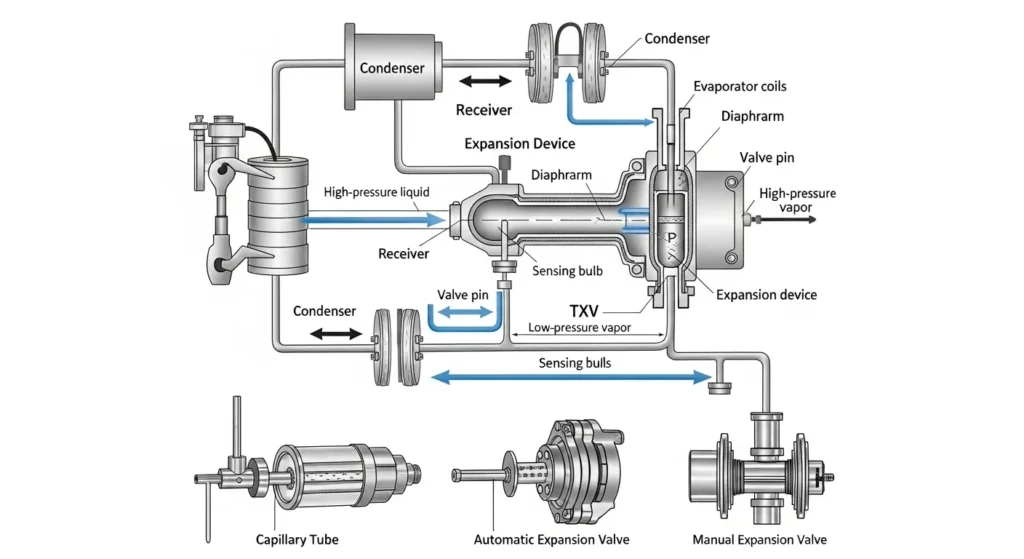
1. Capillary Tube
This is the simplest type of expansion device used in small refrigeration systems.
- Fixed-length narrow tube
- No moving parts
- Used in refrigerators and small AC units
2. Thermostatic Expansion Valve (TXV)
A very common and efficient expansion device.
- Controls refrigerant flow based on temperature
- Uses sensing bulb
- Suitable for medium and large systems
3. Electronic Expansion Valve (EEV)
Modern and advanced type.
- Controlled by electronic sensors
- Very precise flow control
- Used in smart HVAC systems and industrial cooling
4. Float Valve (Low and High Pressure)
- Works based on liquid level
- Mainly used in large industrial systems
- Ensures proper refrigerant balance
5. Orifice Plate
- Fixed opening system
- Simple design but less control
- Used in specific applications
5. Main Components of Expansion Device
Although design varies, most expansion devices include:
1. Valve Body
Holds all internal parts and controls refrigerant passage.
2. Metering Element
Controls how much refrigerant passes (capillary, needle, or valve seat).
3. Sensing Bulb (in TXV)
Detects temperature at evaporator outlet.
4. Spring Mechanism
Maintains pressure balance and valve positioning.
5. Electronic Controller (in EEV)
Processes signals and adjusts flow precisely.
Each part plays a role in maintaining correct refrigerant flow and system efficiency.
6. Advantages of Expansion Device
- Maintains proper cooling efficiency
- Controls refrigerant flow accurately
- Improves system performance
- Prevents compressor overload
- Reduces energy consumption
- Helps maintain stable evaporator temperature
- Increases lifespan of refrigeration system
- Works automatically in advanced systems
7. Disadvantages / Limitations
- Capillary tubes cannot adjust flow automatically
- TXV requires proper calibration
- EEV systems are expensive
- Sensitive to dirt and blockage
- Maintenance required for accurate performance
- Improper sizing can reduce efficiency
Understanding these limitations helps in proper installation and maintenance.
8. Applications of Expansion Device
The Expansion Device applications are found in almost every cooling system.
Home Applications:
- Refrigerators
- Air conditioners
- Water coolers
Industrial Applications:
- Cold storage plants
- Food processing industries
- Ice factories
Commercial Applications:
- Supermarkets refrigeration systems
- Hotels and restaurants cooling systems
Modern Technology:
- Data center cooling
- Smart HVAC systems
- Medical storage systems
Without expansion devices, modern cooling systems cannot function efficiently.
9. Comparison Section
Expansion Devices vs Simple Flow Restrictors
| Feature | Expansion Device | Simple Restrictor |
|---|---|---|
| Control | Precise | Fixed |
| Efficiency | High | Low |
| Cost | Higher | Lower |
| Applications | All systems | Small/basic systems |
| Adjustability | Yes (TXV, EEV) | No |
Difference between Capillary Tube and TXV
| Feature | Capillary Tube | TXV |
|---|---|---|
| Control type | Fixed | Automatic |
| Cost | Low | Medium |
| Efficiency | Moderate | High |
| Usage | Small systems | Large systems |
10. Selection Guide
Choosing the right expansion device depends on:
1. System Size
- Small: Capillary tube
- Medium/Large: TXV or EEV
2. Cooling Load
- Stable load: Capillary
- Variable load: TXV/EEV
3. Budget
- Low cost: Capillary
- High performance: EEV
4. Accuracy Requirement
- Basic cooling: Simple devices
- Precise control: Electronic systems
Beginner Tip:
Always match expansion device capacity with evaporator load to avoid inefficiency.
11. Common Problems & Solutions
Problem 1: Blockage in Expansion Device
Cause: Dirt or moisture
Solution: Clean or replace filter/dryer
Problem 2: Poor Cooling
Cause: Incorrect refrigerant flow
Solution: Check valve calibration
Problem 3: Compressor Overheating
Cause: Improper expansion control
Solution: Adjust or replace device
Problem 4: Ice Formation in Evaporator
Cause: Excess refrigerant flow
Solution: Reduce valve opening
Problem 5: System Fluctuation
Cause: Faulty TXV or sensor
Solution: Replace sensing bulb or valve
12. Future Trends in Expansion Devices
Technology is improving rapidly in HVAC systems.
Smart Expansion Devices:
- AI-based flow control
- IoT-enabled monitoring
Energy Efficiency Improvements:
- Low power consumption designs
- Better refrigerant control
Eco-Friendly Systems:
- Support for new refrigerants
- Reduced environmental impact
Industrial Automation:
- Fully automated EEV systems
- Real-time performance adjustment
Future expansion devices will be smarter, faster, and more energy-efficient.
13. Conclusion
The Expansion Device is one of the most important components in any refrigeration and air conditioning system. It controls refrigerant flow, reduces pressure, and ensures proper cooling in the evaporator. Without it, the refrigeration cycle cannot function properly.
From simple capillary tubes to advanced electronic expansion valves, each type has its own role depending on system size and application. Understanding its working principle, types, and applications helps students and technicians design and maintain efficient cooling systems.
In modern HVAC technology, expansion devices are becoming smarter and more energy-efficient, improving performance and reducing power consumption. For engineers and beginners, mastering this topic is essential for building a strong foundation in refrigeration and air conditioning systems.