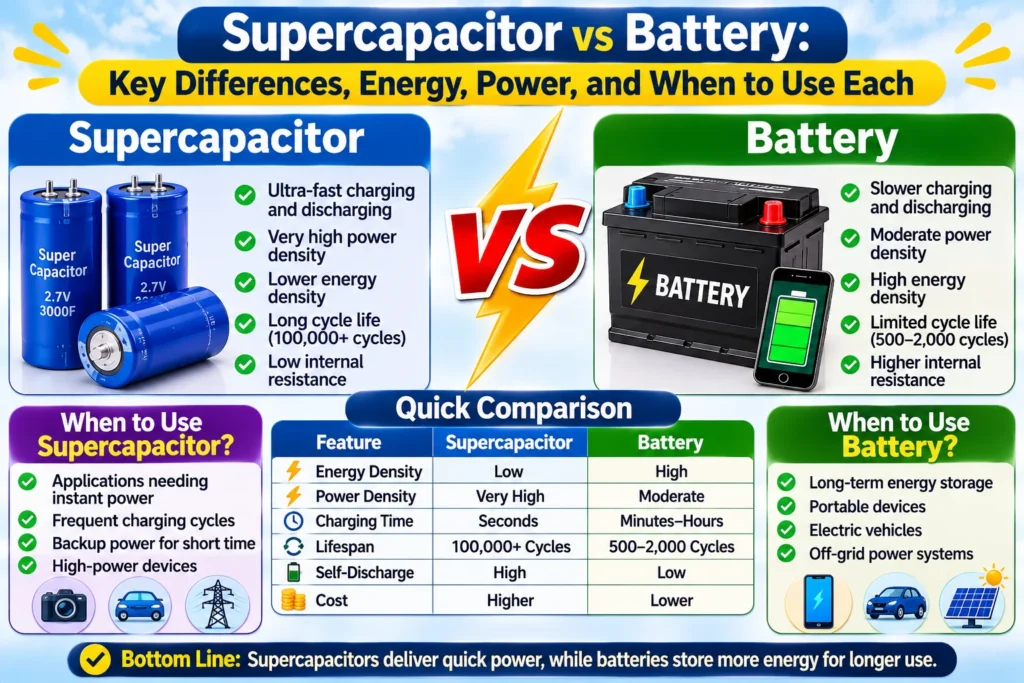

A supercapacitor and a battery both store electrical energy, but they do it in very different ways. A battery stores energy in chemical reactions. A supercapacitor stores it as an electric field, right at the surface of its electrodes. That one difference explains almost everything else: why supercapacitors charge in seconds, last for a million cycles, and still hold far less energy than a battery of the same size.
If you are choosing energy storage for a project, an electric vehicle, or a backup power supply, the question is rarely “which one is better?” It is “which one fits this job?” This guide explains how supercapacitors work, how they compare with batteries on energy, power, lifetime, and cost, and when to use each one — or both together.
What Is a Supercapacitor?
A supercapacitor, also called an ultracapacitor or an electric double-layer capacitor (EDLC), is a capacitor with an extremely large capacitance — from a few farads to thousands of farads. A typical electrolytic capacitor measures in microfarads, so a supercapacitor can hold a million times more charge in a similar volume.
The trick is surface area. A supercapacitor’s electrodes are made from porous activated carbon. One gram of activated carbon can have a surface area of 1,000 to 3,000 square meters — roughly the floor area of a large house, packed into a pinch of powder. Because capacitance grows with electrode area, that huge surface produces huge capacitance.
Unlike a battery, a supercapacitor does not rely on a chemical reaction to store charge. In an EDLC, charge is stored electrostatically: ions from the electrolyte gather on the electrode surfaces and form a double layer only a few nanometers thick. Charging is simply moving ions to the surface, and discharging is letting them go. No chemical bonds are made or broken, so the process is fast and almost completely reversible.
What Is a Battery?
A battery stores energy chemically. When you charge a lithium-ion battery, lithium ions move from the positive electrode (the cathode) through the electrolyte to the negative electrode (the anode) and lodge inside its crystal structure. Discharging reverses the flow, and the chemical reactions push electrons through the external circuit.
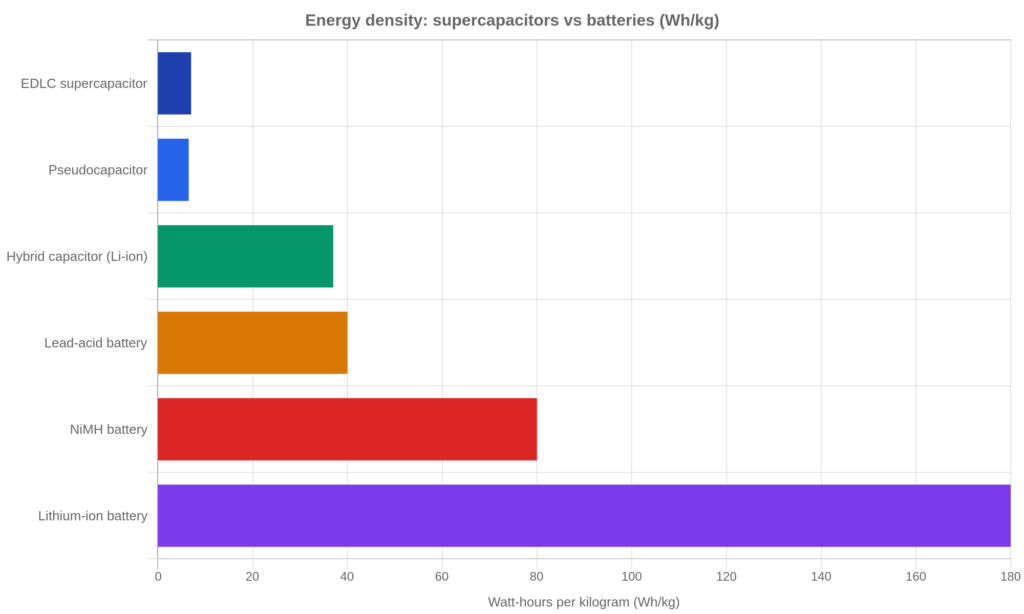
Because the energy is packed into chemical bonds, a battery holds far more energy per kilogram than a supercapacitor. A modern lithium-ion cell stores roughly 100 to 265 watt-hours per kilogram, compared with about 5 to 10 watt-hours per kilogram for a typical supercapacitor. The trade-off is speed and wear: chemical reactions take time, generate heat, and slowly degrade the electrodes. That is why a lithium-ion battery lasts about 500 to 10,000 charge cycles, while a supercapacitor can survive 100,000 to more than a million.
How a Supercapacitor Works
Inside a supercapacitor are two electrodes, a separator, and an electrolyte, sealed in a case with two terminals. When you apply a voltage, positive ions are attracted to the negative electrode and negative ions to the positive electrode. They pile up on the electrode surfaces and form the electric double layer — two sheets of opposite charge separated by only a few nanometers. That tiny separation distance is the second reason the capacitance is so large: capacitance also grows as the distance between the charges shrinks.
The key parts of a supercapacitor are:
- Electrodes: porous activated carbon in an EDLC, or metal oxides such as ruthenium oxide and manganese oxide, or conducting polymers in a pseudocapacitor
- Separator: a thin, ion-permeable membrane that keeps the two electrodes from touching while letting ions pass through
- Electrolyte: the liquid or gel that carries ions between the electrodes. Aqueous electrolytes allow about 1.15 volts per electrode, organic electrolytes allow 2.5 to 2.7 volts, and ionic liquids can exceed 3.5 volts
- Current collectors: metal foils that carry current from each electrode to its terminal
The same formulas you know from basic capacitors apply here, just with much larger numbers. Capacitance is charge divided by voltage:
C = Q / V
The energy stored in a capacitor is:
E = 1/2 × C × V²
Worked example: a 100 farad supercapacitor rated at 2.7 volts stores E = 1/2 × 100 × 2.7² = 364.5 joules. Since one watt-hour equals 3,600 joules, that is about 0.10 watt-hours — enough to run a 1 watt LED for about six minutes.
A much larger 3,000 farad, 2.7 volt cell stores E = 1/2 × 3,000 × 2.7² = 10,935 joules, or about 3.04 watt-hours. For comparison, a single 3.7 volt, 3,000 milliamp-hour phone battery holds 11.1 watt-hours — more energy than a 3,000 farad supercapacitor about the size of a soda can.
Supercapacitors are often connected in series to raise the voltage. Six 100 farad, 2.7 volt cells in series give 16.2 volts, and the total capacitance drops to C = 100 / 6 = 16.7 farads, because capacitors in series combine like resistors in parallel. The total stored energy stays the same: E = 1/2 × 16.7 × 16.2² = about 2,190 joules, or 0.61 watt-hours.
Charging is fast because the current only has to move ions to the surface. The time to charge a capacitor at a constant current is:
t = C × (V2 − V1) / I
So a 100 farad supercapacitor charged from 0 to 2.7 volts at 10 amps takes t = 100 × 2.7 / 10 = 27 seconds. A battery holding the same energy would need many minutes, because its chemical reactions cannot accept charge that quickly without damage.

Types of Supercapacitors
Not every supercapacitor stores charge the same way. There are three main families, and the differences matter for energy, life, and cost.
- Electric double-layer capacitors (EDLCs): the classic supercapacitor. Charge is stored purely electrostatically on activated-carbon electrodes. They offer the longest life — 100,000 to more than a million cycles — and the highest power, but the lowest energy density, about 5 to 10 watt-hours per kilogram.
- Pseudocapacitors: charge is stored by fast, reversible chemical reactions (faradaic reactions) at the electrode surface, using metal oxides such as ruthenium oxide or manganese oxide, or conducting polymers such as polyaniline. They store more energy than an EDLC, roughly 4 to 9 watt-hours per kilogram, but the chemical reactions wear the electrodes out faster, so their cycle life is shorter.
- Hybrid capacitors: one electrode works like an EDLC and the other like a battery electrode. A lithium-ion capacitor, for example, pairs an activated-carbon electrode with a lithium-doped graphite electrode. It reaches about 3.8 to 4.0 volts and around 37 watt-hours per kilogram — far more energy than an EDLC — while keeping most of the supercapacitor’s power and speed. Hybrid capacitors are the closest thing to a bridge between the two worlds.
Supercapacitor vs Battery: Side-by-Side Comparison
The table below compares a typical EDLC supercapacitor with a typical lithium-ion battery, the two technologies most often compared.
| Feature | Supercapacitor (EDLC) | Lithium-ion battery |
|---|---|---|
| Energy density | 5–10 Wh/kg | 100–265 Wh/kg |
| Power density | 2,000–10,000 W/kg | 300–1,500 W/kg |
| Full charge time | Seconds to a few minutes | 30 minutes to several hours |
| Cycle life | 100,000–1,000,000+ | 500–10,000 |
| Round-trip efficiency | About 95% | About 90% |
| Self-discharge | High — loses charge over days to weeks | Low — a few percent per month |
| Single-cell voltage | 2.5–2.7 V (organic electrolyte) | 3.6–3.7 V nominal |
| Calendar life | 10–15 years or more | 3–5 years typical |
| Cost per stored kWh | Much higher | Much lower |
| Cold-weather performance | Works well down to −40 °C | Capacity drops sharply in the cold |
| Best for | Short bursts, frequent cycling, fast charging | Hours of energy at low cost |
The pattern is clear: batteries win on energy and cost, while supercapacitors win on power, speed, and lifetime.
Worked Examples: Power and Regenerative Braking
Energy is only half the story. Supercapacitors shine when power matters — how fast energy can be delivered or absorbed.
Maximum power: a supercapacitor’s peak power is limited by its equivalent series resistance (ESR). The formula is:
Pmax = V² / (4 × ESR)
For a 2.7 volt, 100 farad cell with an ESR of 30 milliohms: Pmax = 2.7² / (4 × 0.03) = 7.29 / 0.12 = about 61 watts from a single small cell. A bank of such cells can deliver tens of kilowatts — enough to start a truck engine or absorb a hard braking event.
Regenerative braking: imagine a city bus braking at 100 kilowatts for 10 seconds. The energy recovered is E = P × t = 100,000 × 10 = 1,000,000 joules, or about 0.28 kilowatt-hours. A supercapacitor bank can swallow that burst in seconds without damage, because no chemical reaction limits the current. A battery asked to absorb the same burst would need to limit its charging current to protect itself, so much of the energy would be wasted as heat in the brakes instead. This is why hybrid buses and light-rail systems — including a 518 volt, 1.5 kilowatt-hour, 600 kilowatt supercapacitor system on a light-rail line in Mannheim, Germany — use supercapacitors for braking energy recovery.
Time constant: the speed of a supercapacitor is set by its time constant, τ = ESR × C. A 100 farad cell with 30 milliohms of ESR has τ = 0.03 × 100 = 3 seconds, which means it can charge or discharge most of its energy in a few seconds.
Advantages and Limitations of Supercapacitors
Advantages:
- Charge and discharge in seconds, not hours
- Last 100,000 to more than a million cycles, and 10 to 15 years or more
- Deliver very high power for their size
- Work reliably in extreme cold, down to −40 °C
- About 95% efficient, with almost no energy lost as heat
- No toxic heavy metals in a standard EDLC, and no memory effect
Limitations:
- Hold 10 to 20 times less energy per kilogram than a lithium-ion battery
- Cost much more per watt-hour stored
- Self-discharge faster than a battery, so they are poor for storing energy for weeks
- Low single-cell voltage (2.5 to 2.7 volts), so many cells must be connected in series for higher voltages
- Voltage drops steadily as they discharge, so the electronics must handle a wide input range
Applications of Supercapacitors
- Regenerative braking: buses, trams, trains, and hybrid cars capture braking energy and reuse it for acceleration
- Electric and hybrid vehicles: supercapacitors provide burst power for acceleration and absorb braking energy, taking the strain off the battery. Formula 1 kinetic energy recovery systems and Toyota’s TS030 and TS040 race cars have used them
- Grid and wind power: smoothing short power dips and supplying pitch control power for wind turbine blades
- Backup power: keeping computer memory alive during a power cut, and bridging the gap until a generator starts in an uninterruptible power supply
- Industrial equipment: cranes, forklifts, and elevators that cycle through short bursts of lifting and lowering
- Medical devices: defibrillators, which must deliver about 500 joules in a short, powerful pulse
- Consumer electronics: camera flashes and short-term memory backup in phones and routers
When to Choose a Supercapacitor, a Battery, or Both
Choose a supercapacitor when the job needs short bursts of power, charges and discharges thousands of times a day, or must work in extreme cold — and when total energy is small. Examples: regenerative braking, camera flashes, memory backup, and wind turbine pitch control.
Choose a battery when the job needs hours of energy at a reasonable cost — phones, laptops, electric cars, and home solar storage. No supercapacitor can match a battery’s energy density or its price per kilowatt-hour.
Choose both when the job needs both energy and power. A hybrid system pairs a battery for range with a supercapacitor for bursts: the supercapacitor handles acceleration and braking, while the battery provides steady energy. The battery lasts longer because the supercapacitor absorbs the damaging high-current peaks, and the vehicle recovers more braking energy. Many modern electric buses and some hybrid cars are built exactly this way.
Related reading: Battery Types: Complete Guide for Electrical Students and Beginners
Related reading: Fuel Cell: How It Works, Types, and Applications
Frequently Asked Questions
Can a supercapacitor replace a battery?
Not on its own, except for jobs that need very little total energy. A supercapacitor holds 10 to 20 times less energy per kilogram than a lithium-ion battery, so replacing a phone or car battery with supercapacitors would need a huge, expensive bank. Supercapacitors replace batteries only in short-burst jobs, or work alongside them in hybrid systems.
How long does a supercapacitor last?
A supercapacitor can last 10 to 15 years or more at room temperature, and 100,000 to more than a million charge cycles. Its lifetime roughly doubles for every 10 °C drop in temperature, so keeping it cool is the simplest way to extend its life.
Why are supercapacitors so expensive per watt-hour?
Because they store so little energy per kilogram, you need a lot of material — activated carbon, electrolyte, and packaging — for each watt-hour. A lithium-ion battery packs far more energy into the same mass, so its cost per kilowatt-hour is much lower. Supercapacitors are priced for power and lifetime, not for energy.
How fast can a supercapacitor charge?
In seconds to a few minutes, depending on the size and the current available. A 100 farad cell charged at 10 amps reaches 2.7 volts in about 27 seconds. In practice the charging source, not the supercapacitor, is usually the limit.
What is the difference between a supercapacitor and an ultracapacitor?
Nothing — the two words mean the same thing. Ultracapacitor is a trade name that became a generic term for a supercapacitor, especially the electric double-layer type.
Conclusion
A supercapacitor and a battery solve different halves of the energy-storage problem. A battery is an energy tank: it holds a lot, but fills and empties slowly, and wears out after a few thousand cycles. A supercapacitor is a power sprinter: it holds little, but charges in seconds, delivers huge bursts of power, and can cycle a million times. For most jobs the right answer is the battery; for short, repeated bursts the supercapacitor wins; and for vehicles and grid systems that need both, the hybrid combination of the two is often the best engineering answer of all.
To go deeper into the technical details, read the Wikipedia article on supercapacitors: https://en.wikipedia.org/wiki/Supercapacitor