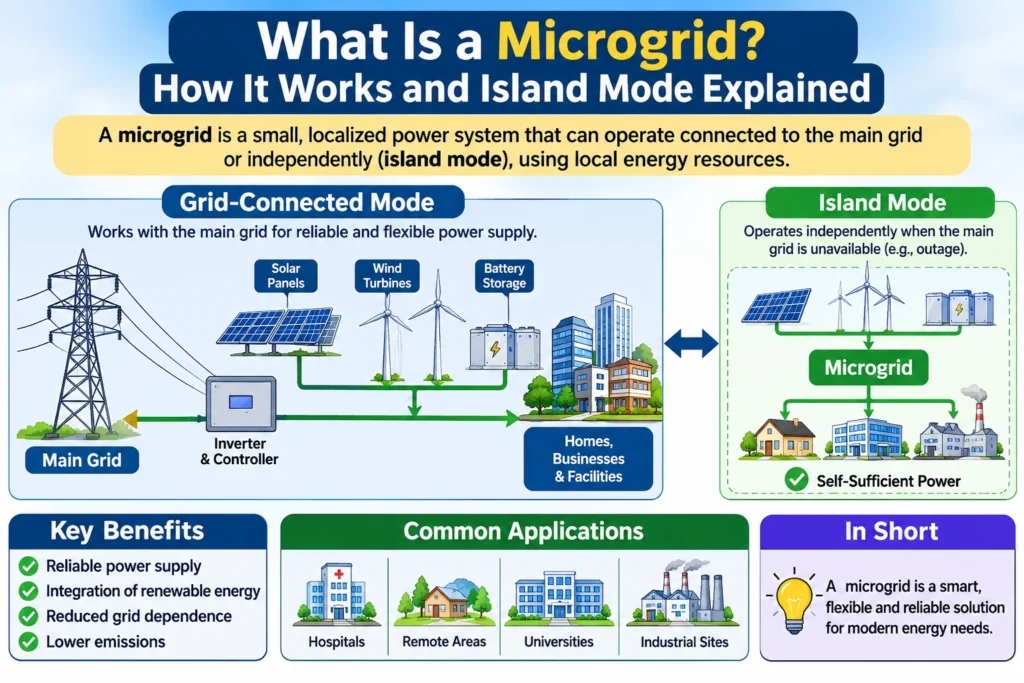

When the power grid goes down, most buildings go dark. A microgrid does not. A microgrid is a small, local power system — a campus, a hospital, a factory, or a whole community — with its own generation, its own battery storage, and its own controller. It can run connected to the main grid, buying and selling power like any other customer. And when the grid fails, it can disconnect and keep running on its own, in what engineers call island mode.
This guide explains what a microgrid is, the components that make one up, how it works in grid-connected and island mode, the grid-forming inverter that makes islanding possible, a worked sizing example, the main types of microgrids, real-world examples, and the benefits and challenges of building one.
What Is a Microgrid?
The U.S. Department of Energy defines a microgrid as “a group of interconnected loads and distributed energy resources within clearly defined electrical boundaries that acts as a single controllable entity with respect to the grid” and that “can connect and disconnect from the grid to enable it to operate in both grid-connected or island mode.” That definition has three parts, and each one matters:
- Clearly defined electrical boundaries: a microgrid serves a specific area — a campus, a hospital complex, a factory, a neighborhood — and everything inside that boundary is part of the microgrid.
- Local generation and storage: inside the boundary there are distributed energy resources — solar panels, batteries, a generator, sometimes wind or a fuel cell — that can supply the loads without the grid.
- A single controllable entity: to the utility, the whole microgrid looks like one customer. One controller coordinates everything inside, so the microgrid can import power, export power, or disconnect entirely.
A microgrid is not the same thing as a smart grid. A smart grid is the whole utility grid made smarter with sensors, communications, and automation. A microgrid is a small piece of the grid that can operate on its own. And it is not the same as a simple off-grid solar system either: an off-grid system never connects to the utility, while a microgrid chooses, moment by moment, whether to connect or to island.
Key Components of a Microgrid
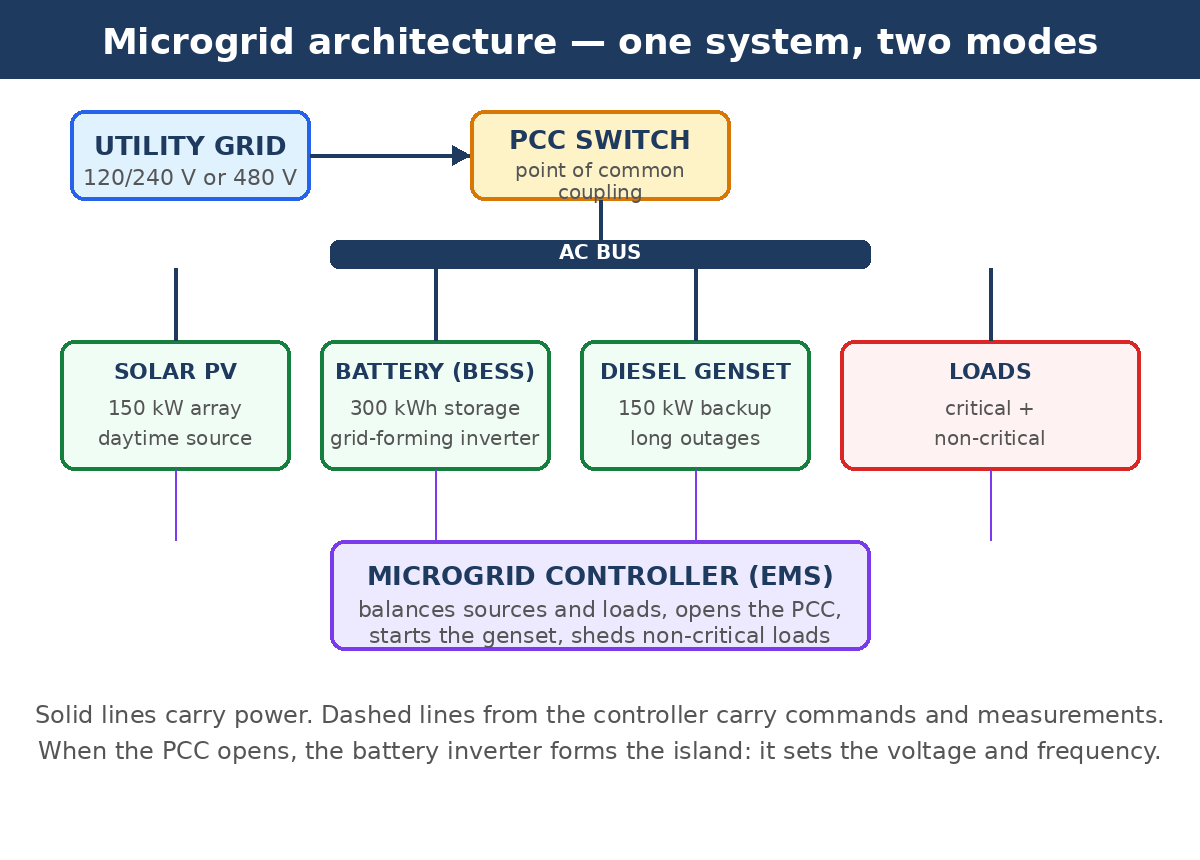
A microgrid is built from familiar power-system equipment, but the equipment must be coordinated as one local operating system. The main components are:
| Component | Role in the system | Example in this guide |
|---|---|---|
| Solar PV | Primary daytime energy source; the cheapest power in the system | 150 kW rooftop array |
| Battery storage (BESS) | Stores daytime surplus, covers the evening peak, and forms the island | 300 kWh lithium-ion battery |
| Diesel or gas genset | Backup generation for long outages or when the battery is empty | 150 kW diesel generator |
| Loads | Everything the microgrid serves, split into critical and non-critical | Critical: lighting, IT, refrigeration |
| Inverters / power converters | Convert DC (solar, battery) to AC (loads); the grid-forming inverter sets voltage and frequency in island mode | Grid-forming battery inverter |
| PCC switch | Connects or disconnects the microgrid from the utility at the point of common coupling | Intelligent breaker at the PCC |
| Microgrid controller (EMS) | Decides which source runs, when the battery charges or discharges, which loads shed, and when to island or reconnect | Energy management system |
| Protection and communications | Detects faults, prevents unsafe backfeed, and carries measurements and commands | Relays, meters, SCADA link |
The battery is what makes the modern microgrid work, for one technical reason above all: grid forming. An ordinary solar inverter is grid-following — it synchronizes to a voltage and frequency reference that someone else provides, and it shuts down when that reference disappears. A grid-forming battery inverter provides the reference itself: it establishes the island’s voltage and frequency so that solar inverters and loads can keep operating with no utility present. Without a grid-forming source, a microgrid cannot island — it can only shut down.
The controller is the intelligence layer. It decides when each source runs, when the battery charges and discharges, which loads are served or shed, and when to island or reconnect. Connected to the grid, it optimizes economics — using cheap solar, shaving demand peaks, and exporting surplus. Islanded, it balances the system second by second: matching supply to load, starting the genset when the battery runs low, and shedding non-critical loads to stretch the runtime.
How a Microgrid Works: Grid-Connected and Island Mode
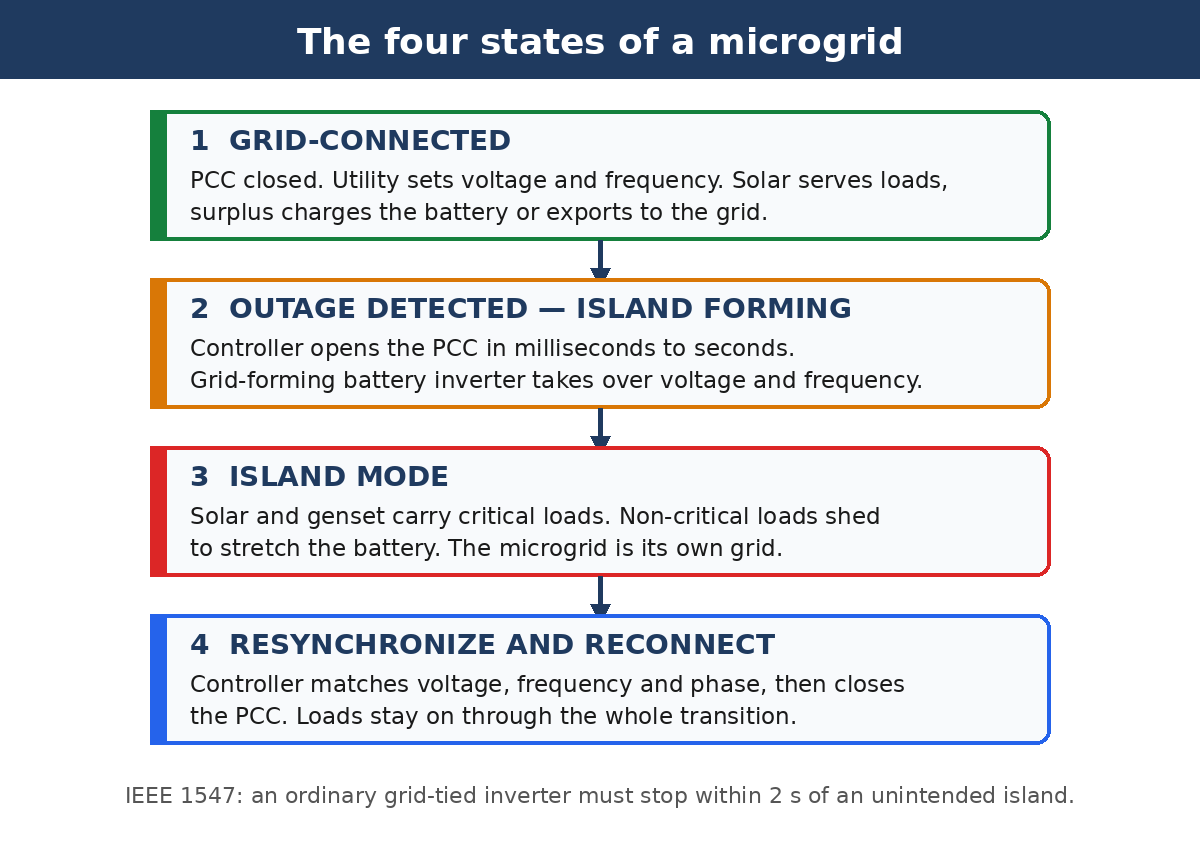
A microgrid has two operating modes and two transitions between them. Most of the time it runs grid-connected. When the utility fails — or when the operator chooses — it transitions to an island, runs alone, and later resynchronizes and reconnects. The standard IEEE 1547-2018 describes an intentional island in exactly these four parts:
Grid-Connected Mode
In grid-connected mode the PCC switch is closed and the utility grid holds the voltage and frequency. The microgrid behaves like a well-optimized solar-plus-storage site: solar serves the load directly, surplus solar charges the battery, and the battery discharges into demand peaks and expensive hours. If the interconnection agreement allows it, the microgrid can export surplus power to the grid — under a net metering arrangement, those exports earn credit against later imports. It can also earn money by cutting its demand at peak times, which is called demand response.
Island Mode Explained
When the grid fails, the controller opens the PCC switch and the microgrid becomes an island. The grid-forming battery inverter takes over as the voltage and frequency reference, solar keeps producing, and the genset starts if the outage outlasts the storage. Non-critical loads are shed to stretch the runtime, while critical loads — emergency lighting, servers, refrigeration, medical equipment — stay on. When the utility returns, the controller resynchronizes the island to the grid — matching voltage, frequency, and phase — and closes the PCC switch without dropping the loads it protected.
Two details matter here. First, an island can also be planned: an operator may island the microgrid deliberately for maintenance, for a resilience test, or for economic reasons. Second, an island must be intentional and controlled. Under the interconnection standard IEEE 1547, an ordinary grid-tied inverter must detect an unintended island and stop within 2 seconds, precisely so that utility workers are not exposed to a live line they believe is dead. A microgrid island is the opposite: a planned, controlled separation, with protection that prevents unsafe backfeed into the utility.
A microgrid that can restart itself without the utility has black start capability: the grid-forming battery starts the island, the solar inverters synchronize to it, and the genset starts to carry the load. Black start is what turns a microgrid from a backup system into a genuine resilience asset.
A Typical Day in a Microgrid — Worked Example
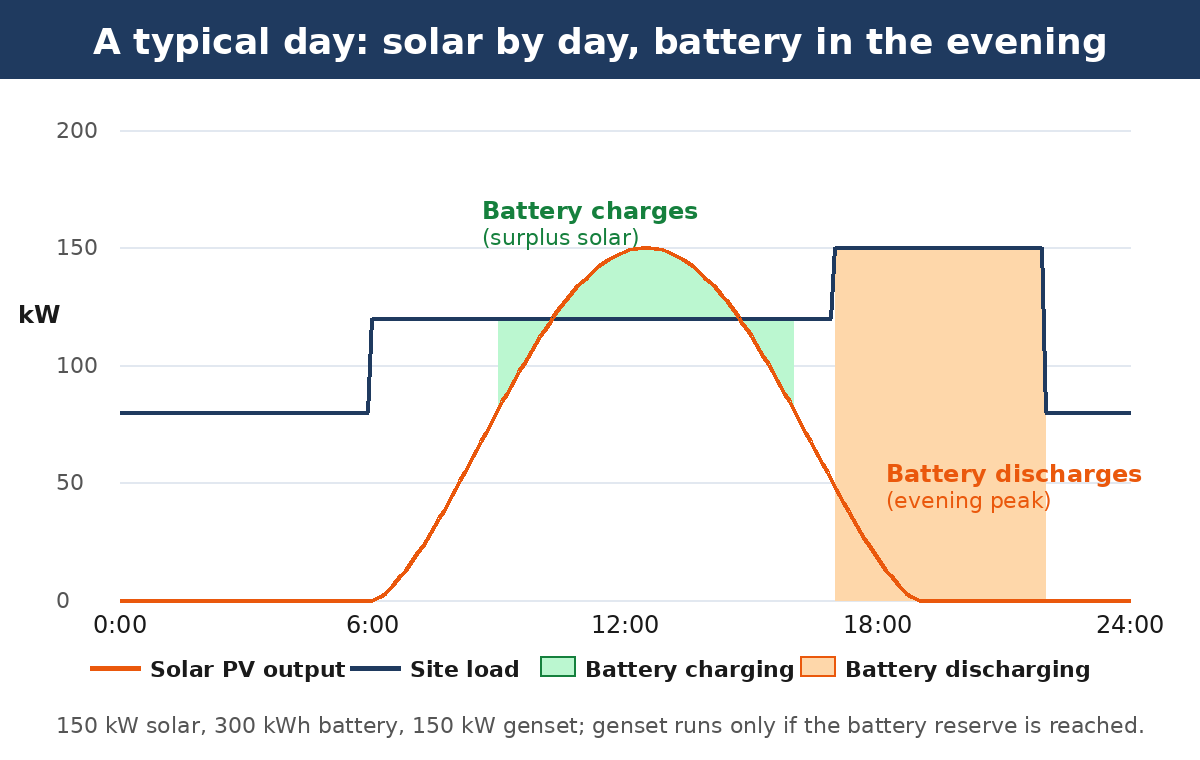
Take a small commercial site with a 150 kW solar array, a 300 kWh battery, and a 150 kW diesel genset. Its load is 80 kW at night, 120 kW during the day, and 150 kW in the evening peak. Over a typical day the controller rotates between sources, always picking the cheapest one that can meet the load:
- Daytime (6 AM – 5 PM): solar carries the load directly. Around midday the array produces its full 150 kW while the load is only 120 kW, so the 30 kW surplus charges the battery.
- Evening (5 PM – 10 PM): the sun sets but demand peaks at 150 kW. The battery discharges to cover the peak, so the site buys little or no power from the grid at the most expensive hours.
- Night (10 PM – 6 AM): the load falls to 80 kW. If the battery still has charge, it carries the load; if it reaches its reserve level, the controller starts the genset for as short a time as possible, then shuts it down again once the battery is recharged.
- Grid failure: the PCC opens and the system continues in island mode. Suppose the outage hits at night with a critical load of 80 kW and a full 300 kWh battery: the battery alone carries the critical load for 300 ÷ 80 = 3.75 hours. With the 150 kW genset running, the site can stay up indefinitely — the genset covers the load and recharges the battery.
Types of Microgrids
- Campus and institutional: universities, hospitals, and military bases with large, steady loads and a strong need for resilience. The University of California, San Diego runs one of the best-known campus microgrids, managing 42 MW of generating capacity including gas turbines, solar, and a fuel cell.
- Community: a whole neighborhood or town served by one microgrid. Borrego Springs in California is the classic example: San Diego Gas & Electric built a primarily renewable-based community microgrid with a 26 MW solar plant, batteries, and distributed generation that can island the entire community — about 2,500 residential and 300 commercial customers — during outages.
- Remote and off-grid: villages, mines, islands, and resorts with no utility connection at all. These permanent islands run on solar, wind, batteries, and a genset, and are the fastest-growing type of microgrid worldwide. Our guide to off-grid vs on-grid solar covers the residential side of the same idea.
- Commercial and industrial: factories, data centers, and cold-storage sites that lose money every minute the power is out. The microgrid pays for itself in avoided downtime and peak-demand savings.
- AC, DC, and hybrid: most microgrids are AC, matching the grid and the loads. DC microgrids connect solar and batteries directly on a DC bus with fewer conversions, and hybrid AC/DC designs combine both. DC designs are common in data centers and telecom sites.
Benefits and Challenges
The benefits are why microgrids are growing fast. Resilience is the headline: critical loads stay on through grid outages, storms, and wildfire shutoffs. Cost savings come from using cheap local solar, shaving demand peaks, and selling surplus power. Renewable integration is easier inside a microgrid, because the battery and controller absorb the variability of solar and wind locally instead of pushing it onto the grid. And energy independence matters for remote sites that would otherwise depend on expensive diesel deliveries.
The challenges are real too. Cost is the first: batteries, grid-forming inverters, and a controller cost far more than a simple grid connection. Complexity is the second: protection must work in both modes, with fault currents that are very different when islanded. Interconnection rules are the third: the utility must approve the PCC, the protection scheme, and the export arrangement, and the rules vary by state and country. And sizing is a genuine engineering problem — an undersized battery leaves the island short, and an oversized one wastes money. The renewable energy sources that feed a microgrid each bring their own variability, and the controller has to manage all of it at once.
Frequently Asked Questions
What is a microgrid in simple words?
A microgrid is a small local power system — a campus, hospital, factory, or neighborhood — with its own solar panels, batteries, and generator, plus a controller that runs them as one system. It can work connected to the main grid or disconnect and run on its own as an island when the grid fails.
What is island mode in a microgrid?
Island mode is when the microgrid disconnects from the utility at the point of common coupling and operates independently. A grid-forming battery inverter sets the voltage and frequency, solar and the genset supply the loads, and non-critical loads are shed to stretch the battery. When the utility returns, the microgrid resynchronizes and reconnects.
What is the difference between a microgrid and off-grid solar?
An off-grid solar system never connects to the utility — it is a permanent island. A microgrid can connect and disconnect: it runs grid-connected most of the time, buying and selling power, and islands only when the grid fails or when the operator chooses. A microgrid also serves multiple buildings and loads under one controller, while off-grid solar usually serves a single home.
Can a microgrid run on 100% renewable energy?
Yes, with enough solar, wind, and battery storage — and it has been demonstrated in the field. The Borrego Springs community microgrid in California has shown islanding led by 100% renewable, inverter-based resources, with a grid-forming battery replacing the diesel generators as the island leader. In practice most microgrids keep a genset as backup for long cloudy periods.
How long can a microgrid run in island mode?
It depends on the battery size, the solar output, and the load. In the worked example in this guide — a 300 kWh battery and an 80 kW critical load — the battery alone lasts 3.75 hours. With solar producing during the day and a genset for backup, a well-designed microgrid can island for days. The controller stretches runtime by shedding non-critical loads first.
Conclusion
A microgrid is a local power system with clear boundaries, its own generation and storage, and a controller that makes it act as one entity toward the grid. Connected, it saves money with cheap solar, peak shaving, and exports. Islanded, it keeps critical loads running through outages that darken everything around it — because a grid-forming battery inverter sets the voltage and frequency, and the controller balances supply and load second by second. The technology is proven, from the 42 MW campus microgrid at UC San Diego to the community microgrid at Borrego Springs, and the costs keep falling. If you are planning one, start with the loads: know what is critical, size the battery for the outage you fear, and let the controller do the rest. For a deeper look at components, benefits, and use cases, see How Microgrids Work on Wattmore.