
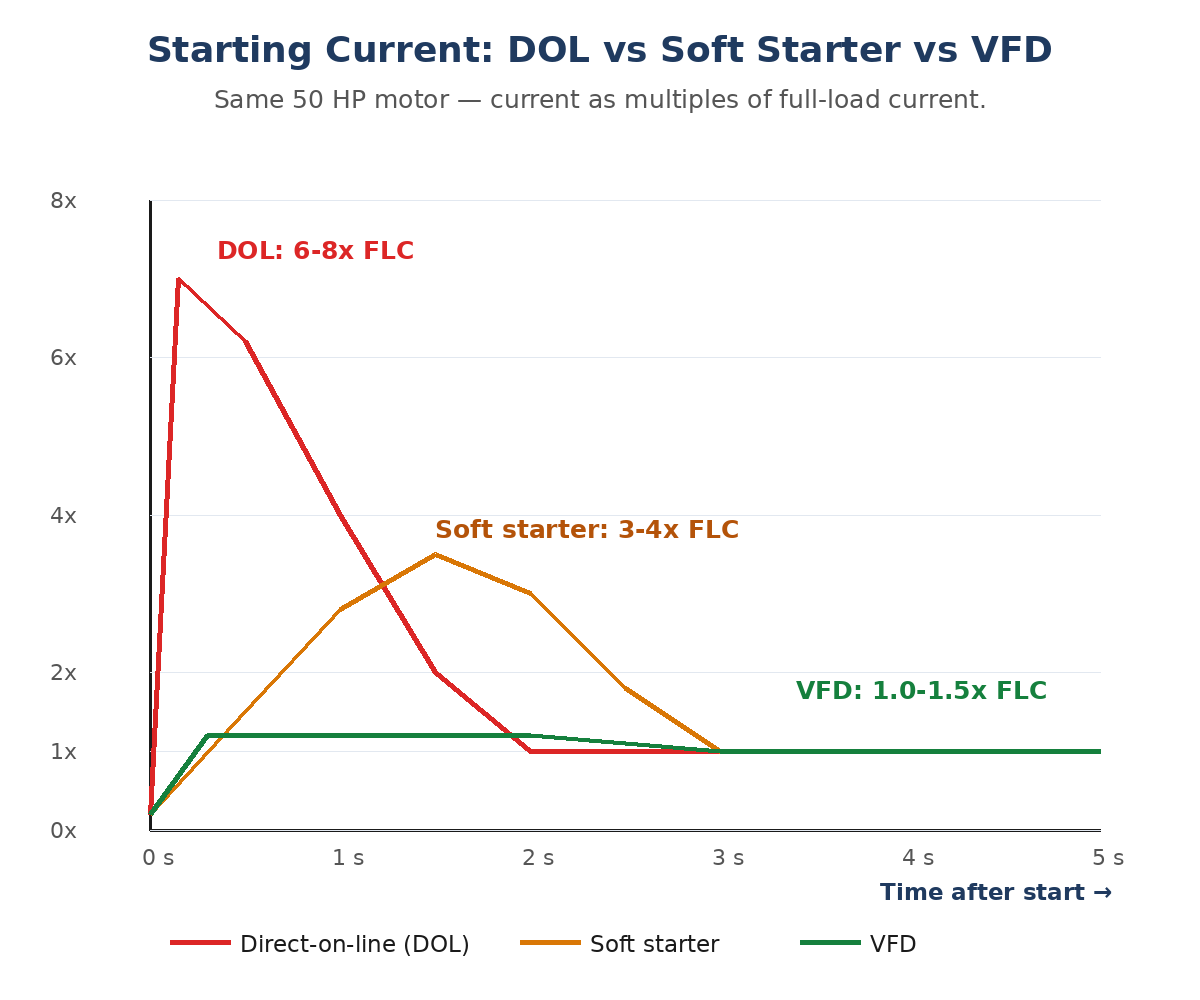
Start a 50 HP motor direct-on-line and it will draw six to eight times its rated current for a second or two — enough to dim the lights, trip breakers, and hammer the coupling, the gearbox, and the driven machine. Every plant engineer faces the same question: how do you start that motor gently without paying for more control than you need? Two solid-state answers dominate the market: the soft starter and the variable frequency drive (VFD). Both tame the start. Only one of them keeps working after the motor is up to speed.
This guide compares the VFD and the soft starter head to head — how each one works, what it costs, how much energy it can save, and which one to choose for pumps, fans, compressors, conveyors, and crushers. For background on the devices themselves, see our guides to the variable frequency drive and the soft starter, and our overview of motor starter types.
The Problem Both Devices Solve
A three-phase induction motor at standstill looks almost like a short circuit to the supply: its rotor is not turning, so there is no back-EMF to limit the current, and the only thing holding the current back is the resistance and leakage reactance of the windings. The result is a starting current of 6 to 8 times full-load current (FLC) and a starting torque that arrives as a sudden shock — a water hammer in the pipes, a belt that jerks, a coupling that takes the full torque in milliseconds. Direct-on-line (DOL) starting is fine for small motors on a stiff grid, but for anything above a few horsepower it causes voltage dips, mechanical wear, and nuisance trips. The soft starter and the VFD both solve this, in completely different ways.
What Is a Soft Starter?
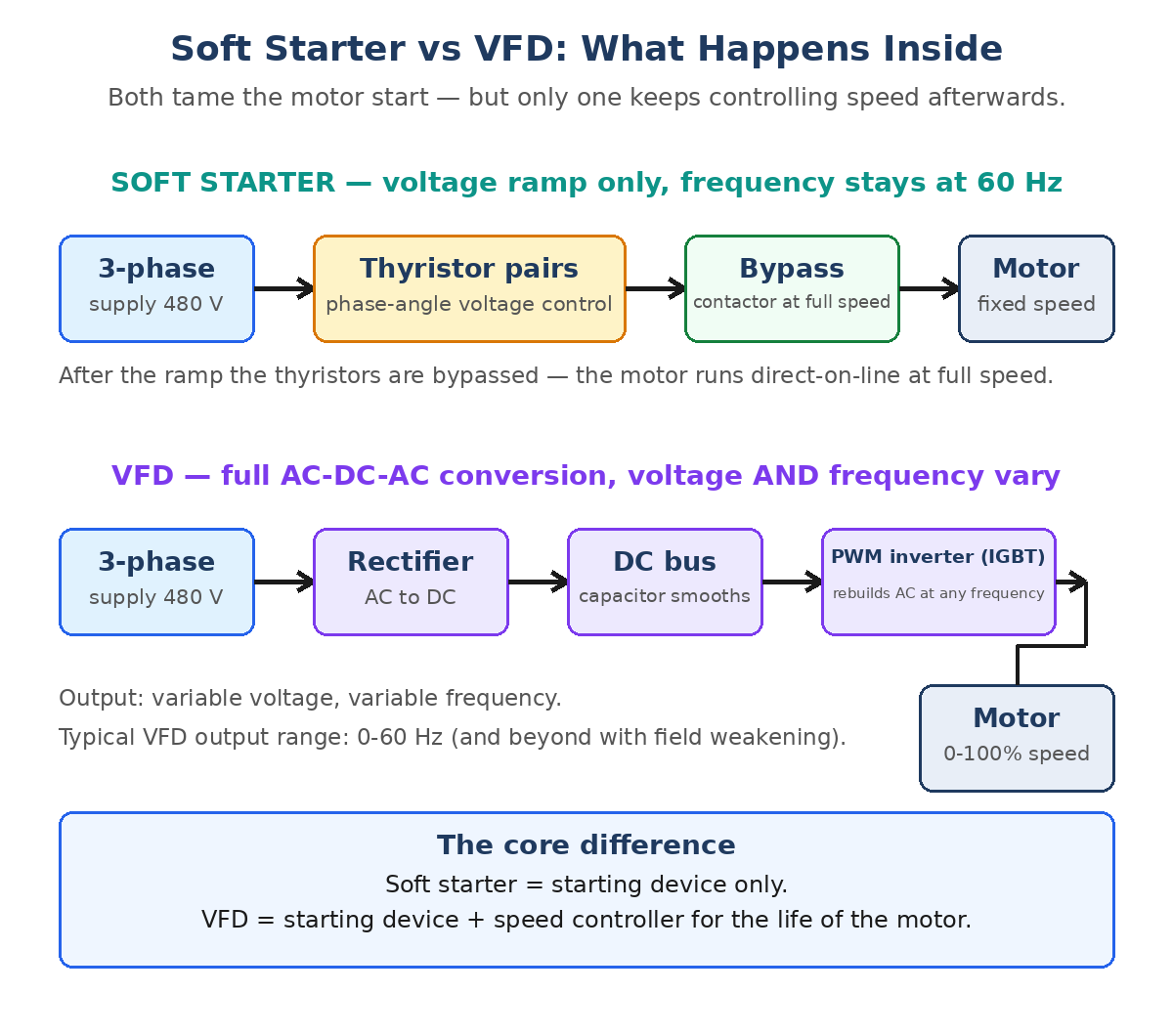
A soft starter is a solid-state reduced-voltage starter. On each of the three phases it has a pair of thyristors (SCRs) connected back-to-back. During starting, the control electronics delay the thyristors’ firing angle within each AC cycle, so the motor sees only part of the supply voltage. The voltage is ramped smoothly from an initial value — typically 30% to 70% of line voltage — up to full voltage over a ramp time of 1 to 60 seconds (5 to 15 seconds is typical). Once the motor is at full speed, a bypass contactor closes and takes the thyristors out of the circuit, so the motor runs direct-on-line at full efficiency — about 99.5% for the starter itself.
The soft starter has one hard limit, and it follows from the physics: motor torque is proportional to the square of the voltage. At 50% voltage the motor produces only 25% of its direct-on-line starting torque; at 40% voltage it produces just 16%. That is fine for a fan or a centrifugal pump, which needs little torque to start, but it rules the soft starter out for a loaded conveyor or a crusher that needs full torque from the first turn. The starter also controls nothing after the ramp is finished — the motor runs at one fixed speed, the line frequency, for as long as it runs. It is a starting device, and only a starting device.
What Is a VFD?
A variable frequency drive takes a completely different approach: instead of chopping the voltage, it rebuilds the power supply. The incoming AC is rectified to DC, smoothed on a DC bus capacitor, and then inverted back to AC by IGBTs switching thousands of times per second (PWM). Because the inverter synthesizes both the voltage and the frequency, the motor’s speed — which follows the synchronous speed formula N = 120f ÷ P — can be controlled continuously from 0 to 100% and beyond, for the entire life of the motor.
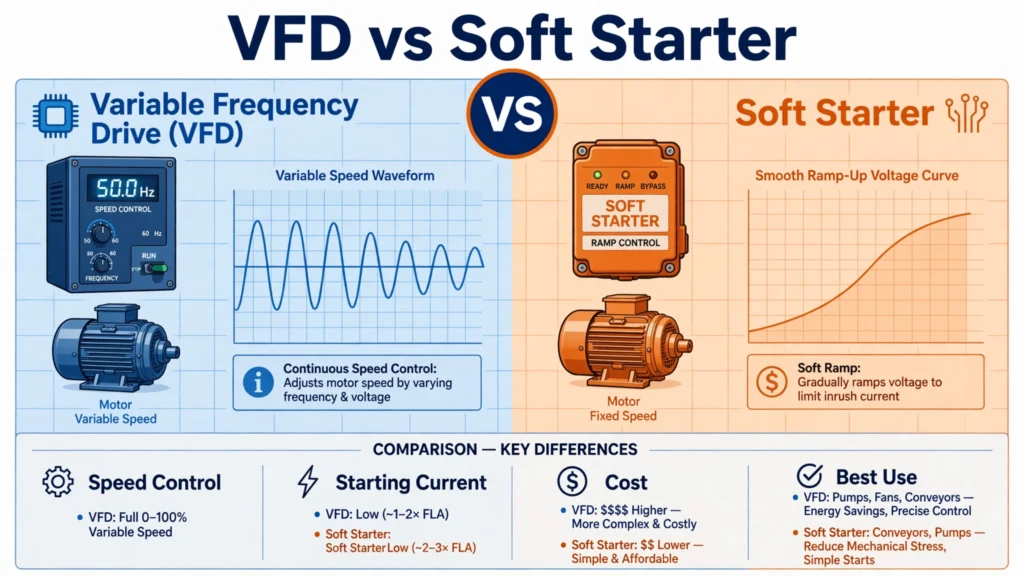
That full control changes the start as well. A VFD ramps the frequency and voltage together, so the motor accelerates with full rated torque available and a starting current of only 1.0 to 1.5 times full-load current — barely more than running current. There is no inrush at all in the DOL sense. And once running, the drive keeps controlling: it can slow a pump to match demand, hold a precise speed for a process, reverse a conveyor, or run a motor above line frequency for extra speed. The price is complexity and cost — a VFD costs roughly two to three times as much as a soft starter for the same motor, runs at 95–97% efficiency instead of 99.5%, and generates harmonics that may need line reactors or filters.
Side-by-Side Comparison
| Feature | Soft starter | VFD |
|---|---|---|
| Primary function | Controls starting and stopping only | Controls speed continuously, all the time |
| Starting current | 2–4× FLC (typically 3–4×) | 1.0–1.5× FLC |
| Starting torque | 9–49% of DOL torque (rises with voltage) | 100–150% of rated torque |
| Speed control | None — fixed speed after start | Full range, 0–100%+ of rated speed |
| Energy savings | Minimal (only during the start) | Up to 50% on variable-torque loads |
| Running efficiency | ~99.5% (bypass contactor) | ~95–97% |
| Initial cost (50 HP) | $800–$1,200 | $2,000–$3,500 |
| Harmonics | Minimal | Generates harmonics; may need filters |
| Size | Compact | Larger; needs ventilation and space |
| Motor insulation stress | Low | PWM voltage spikes; long cables need filters |
The Energy Question: The Affinity Law
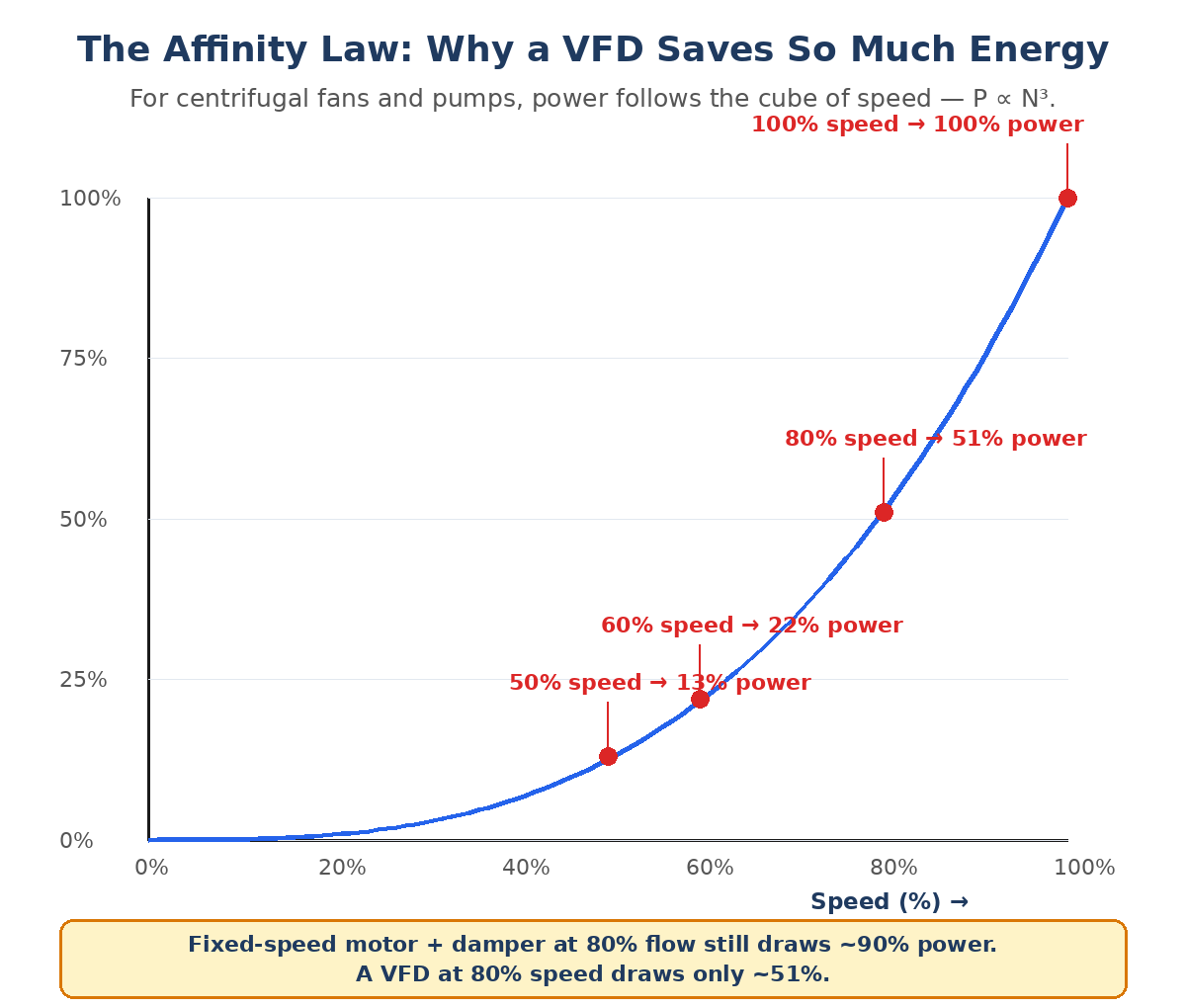
The VFD’s real advantage is not the gentle start — it is what happens during the thousands of hours the motor runs afterward. For centrifugal fans and pumps, the affinity laws say that flow is proportional to speed, pressure is proportional to speed squared, and power is proportional to speed cubed (P ∝ N³). Run a fan at 80% speed and it needs only 0.8³ = 51% of the power. Run it at 60% speed and it needs just 22%. A fixed-speed motor throttled with a damper or valve still draws close to 90% power at 80% flow — the energy is thrown away in the restriction. The VFD simply does not use it.
Worked Example: A 50 HP Fan and the Payback
Take a 50 HP (37 kW) supply fan that runs 4,000 hours a year at an average of 80% flow, with electricity at $0.10 per kWh. The motor’s full-load current at 480 V is about 65 A.
Starting current. Direct-on-line, the start peaks at 6–8 × 65 A = 390–520 A. With a soft starter limited to 3.5 × FLC, the peak is about 228 A. With a VFD at 1.2 × FLC, it is about 78 A — the supply barely notices.
Running energy. With a soft starter the motor runs at full speed and the damper throttles the flow, drawing roughly 90% of 37 kW = 33 kW. With a VFD at 80% speed, the motor draws 0.8³ × 37 kW = 19 kW. The saving is 14 kW, every hour, for 4,000 hours — 56,000 kWh a year, worth $5,600 a year at $0.10 per kWh.
Payback. A 50 HP soft starter costs roughly $800–$1,200 and a comparable VFD $2,000–$3,500, so the VFD premium is about $1,500–$2,300. Against $5,600 a year of savings, the premium pays back in 4 to 5 months. For a constant-torque load such as a conveyor, the same calculation gives no saving at all — the motor must run at full speed whatever the load — and the soft starter wins on price. The load type, not the motor size, decides the economics. On larger machines the same pattern holds at a bigger scale: for a 500 kW pump, industry guides put a VFD at $80,000–$150,000 against $25,000–$50,000 for a soft starter, with VFD payback typically in 12 to 18 months on a variable-flow duty.
Worked Example: Starting Torque on a Soft Starter
Torque is where soft starters catch people out. Suppose a conveyor needs 60% of rated torque to break away, and the soft starter is set to an initial voltage of 40% of line voltage. Starting torque is proportional to voltage squared: 0.4² = 0.16, so the motor produces only 16% of its direct-on-line starting torque — and the conveyor does not move. To get 60% torque the voltage must be √0.6 = 77% of line voltage, at which point the starting current is nearly as high as a star-delta start and the “soft” benefit is mostly gone. A VFD has no such trade-off: it delivers 100–150% of rated torque at starting currents of 1.0–1.5 × FLC, because it controls frequency as well as voltage. For high-inertia or high-breakaway-torque loads — crushers, loaded conveyors, mills — the VFD (or a star-delta starter) is the right answer, not a soft starter.
When to Choose a Soft Starter
- The motor runs at one fixed speed after starting — flow never needs to change.
- The load has low starting torque: centrifugal pumps, fans, and unloaded conveyors.
- The main goal is to limit inrush current and mechanical shock, for example to stop water hammer in a fixed-speed pumping system.
- Budget is tight and no energy saving is available — the soft starter costs 30–40% less than an equivalent VFD.
- Space is limited and harmonics are a concern — the soft starter is compact and electrically quiet.
When to Choose a VFD
- Speed must vary during operation: variable-flow pumps, fans, process lines, extruders, elevators.
- Energy saving is the goal on a centrifugal load — the affinity law does the work.
- The load needs full torque at low speed or a controlled, precise start — crushers, mixers, loaded conveyors, hoists.
- Starting current must be minimal, for example on a weak supply or a generator-fed site.
- The process needs speed control, positioning, or multiple set speeds that a fixed-speed motor cannot provide.
Downsides to Know Before You Buy
Neither device is free of trade-offs. A VFD injects harmonic currents into the supply, which can overheat transformers and trip sensitive equipment unless line reactors or harmonic filters are fitted — and it needs clean, ventilated panel space because it dissipates 3–5% of the motor power as heat. Its PWM output also produces fast voltage spikes that stress motor insulation, especially with long cables; motors on long VFD cable runs often need dv/dt filters or inverter-duty insulation, and the NEC (Article 430, Part X) sets the rules for VFD installations. A soft starter has the opposite profile: it is electrically quiet and efficient at full speed, but it cannot save energy, cannot vary speed, and its reduced starting torque limits the loads it can start. It also needs care with frequent starts — repeated ramps heat the thyristors, and most soft starters limit starts per hour. The three-phase induction motor behind either device is the same; what changes is how much control you buy around it.
Frequently Asked Questions
Can a soft starter control motor speed?
No. A soft starter only controls voltage during the start and stop ramps. Once the motor reaches full speed, the bypass contactor closes and the motor runs at line frequency — one fixed speed. If you need to change speed while the motor is running, you need a VFD.
Is a VFD always better than a soft starter?
No. A VFD is better when speed must vary or energy saving is available. For a fixed-speed pump or compressor that starts a few times a day, a soft starter gives the same gentle start for roughly a third of the price, with higher running efficiency and no harmonics. Buying a VFD for a job that never varies speed is paying for control you will never use.
Can I use a VFD on any induction motor?
Almost any standard three-phase induction motor can run on a VFD, but there are limits. Motors that run slowly for long periods can overheat because their shaft-mounted fan moves less air — a separately powered cooling fan or a derating may be needed. Older motors may also need inverter-duty insulation to survive PWM voltage spikes, and very long motor cables need output filters. Check the motor nameplate and the drive manual before committing.
Do soft starters save energy?
Effectively no. A soft starter reduces energy only during the few seconds of the start ramp, which is a tiny fraction of the motor’s running hours. Once the bypass contactor closes, the motor draws exactly what a direct-on-line motor draws. Real energy saving on a running motor comes from varying its speed — which only a VFD does.
Which one is cheaper over the life of the motor?
It depends on the load. On a variable-torque load (fan or centrifugal pump) the VFD’s energy saving usually repays its higher price in 18 to 36 months, and after that it is pure saving — the 50 HP fan example in this article paid back in under 6 months. On a fixed-speed, constant-torque load there is no saving to repay the premium, so the soft starter is cheaper for the life of the installation.
Conclusion
The choice between a VFD and a soft starter is really a question about the load, not the motor. If the motor runs at one fixed speed and only needs a gentle start, the soft starter is the cheaper, simpler, more efficient answer — it cuts starting current to 3–4× full load and then gets out of the way. If the speed needs to vary, the load is centrifugal, or full starting torque is required at low current, the VFD earns its higher price through the affinity law and full torque control, often paying for itself in months on a fan or pump. Match the device to the duty, size it for the real starting torque and the real running hours, and do not buy speed control for a job that never changes speed. For a deeper engineering comparison of topologies, starting torque, and total cost of ownership, see the VFD vs soft starter selection guide on VFD Distributor.