
A distribution board, often called a DB box, is the gray metal box on the wall where all the electricity in a building is divided up and protected. Every light, socket, and appliance in your home connects back to it, and every circuit inside it has its own breaker that can switch the power off in a fraction of a second if something goes wrong.
If you have ever flipped a tripped breaker back on, opened the panel to find the right switch, or wondered what all those labels mean, you have already used a distribution board. This guide explains what a distribution board is, how it works, what lives inside it, and how to read it safely.
What Is a Distribution Board?
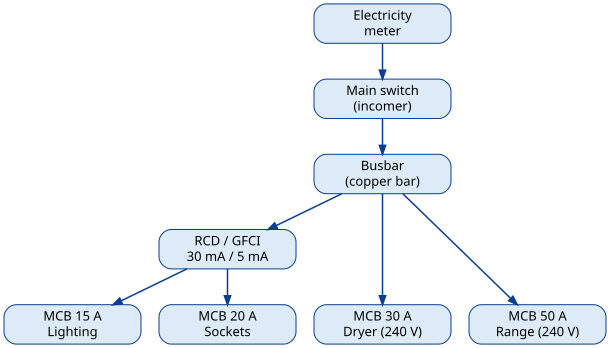
A distribution board is an enclosure that takes one incoming electrical supply and splits it into a number of smaller branch circuits, each protected by its own fuse or circuit breaker. The incoming cable from the electricity meter connects to a main switch, and from there the power is shared out through a metal bar called a busbar to each breaker. Each breaker feeds one circuit: the lights in one room, the sockets in the kitchen, the water heater, the air conditioner, and so on.
Distribution boards go by many names, and the name usually depends on where you live. In the United States and Canada, the same box is most often called a breaker panel, load center, or electric panel. In the United Kingdom, a domestic board is called a consumer unit. In many other countries, including India, Pakistan, and much of the Middle East, the common name is DB box, short for distribution board. Older boards that use fuses instead of breakers are often called fuse boxes. They are all the same idea: one safe, organized place where power is divided and protected.
A board does two jobs at once. First, it distributes power, so each part of a building gets its own circuit and a fault in one circuit does not kill the power everywhere. Second, it protects people and property: breakers stop overloads and short circuits, and residual current devices (RCDs) stop dangerous electric shocks.
How a Distribution Board Works
Power reaches a distribution board in a simple chain. The electricity meter measures what the building uses, then a service cable carries the supply into the board. The first thing the supply meets is the main switch, also called the incomer, which can cut power to the whole board in one movement. From the main switch, the live conductors connect to the busbar, a thick copper bar that runs down the board and feeds every breaker. Each breaker clips onto the busbar and connects to one outgoing circuit.
When you switch on a light, current flows from the busbar, through that circuit’s breaker, along the cable to the light, and back through the neutral bar to complete the circuit. The breaker watches the current the whole time. If the circuit draws more current than the breaker is rated for, for example because too many heaters are plugged into one socket circuit, the breaker trips and opens the circuit. If a live wire touches a neutral or earth wire, the short-circuit current is far larger, and the breaker trips almost instantly.
In a typical US home, the supply is 120/240 V split-phase. The board has two hot busbars, each at 120 V to neutral and 240 V between them. A single-pole breaker connects to one hot bar and feeds a 120 V circuit, while a double-pole breaker connects to both hot bars and feeds a 240 V circuit such as an electric dryer or a range. In the UK and most of Europe, the supply is 230 V single-phase, or 400 V three-phase in larger buildings, and the board has one live busbar for single-phase or three for three-phase.
Here is a quick sizing example. A modern US home often has a 200 A service at 240 V, so the maximum power the board can deliver is P = V × I = 240 V × 200 A = 48,000 W, or 48 kW. An older home may have a 100 A service, which gives 240 V × 100 A = 24,000 W. Now add up the big loads: a dryer at 240 V × 30 A = 7,200 W, an electric range at 240 V × 50 A = 12,000 W, a water heater at 240 V × 30 A = 7,200 W, and an air conditioner at 240 V × 40 A = 9,600 W. Together they add up to 36,000 W, or 150 A at 240 V. That fits a 200 A service with room to spare, but it would overload a 100 A service if everything ran at once, which is why older homes often need a service upgrade when an electric vehicle charger or a heat pump is added. In practice, not everything runs at full power at the same time, so electricians apply a demand factor, but the board and its main breaker must still be rated for the total connected load.
Parts Inside a Distribution Board
- Enclosure: a steel or insulated plastic box with a door that keeps live parts covered and keeps out dust and fingers. Modern UK consumer units are made from non-combustible metal.
- Main switch (incomer): a large switch, usually 100 A or 200 A, that isolates the whole board.
- Busbar: a thick copper bar that carries current from the main switch to every breaker.
- Miniature circuit breaker (MCB): a small breaker, typically 6 to 63 A, that protects one circuit against overload and short circuit. It can be switched off by hand and reset after it trips.
- Residual current device (RCD): a device that compares the current going out on the live wire with the current coming back on the neutral. If the difference is more than about 30 mA, it trips in under 40 milliseconds to prevent a serious shock. In the US, the equivalent device is the GFCI, which trips at 5 mA.
- RCBO: a single device that combines an MCB and an RCD, so one circuit gets both overload and shock protection.
- Neutral bar and earth bar: metal bars where all the neutral and earth wires of the circuits are collected and connected back to the supply.
- Surge protective device (SPD): an optional device that limits voltage spikes from lightning or grid switching.
- Labels and a circuit chart: every breaker should be labeled so anyone can find the right circuit quickly.
Types of Distribution Boards
- Main distribution board: the first board after the meter, with the main switch and the main breakers. Most homes have just one.
- Sub-distribution board: a smaller board fed from the main board, used when circuits are far away, for example in a garage, an outbuilding, or a different floor. It has its own main switch and breakers.
- Single-phase board: one live busbar, used in most homes on a 120/240 V or 230 V supply.
- Three-phase board: three live busbars, used in commercial buildings and large homes with heavy loads such as three-phase motors.
- MCB board: the modern standard, with resettable breakers on a DIN rail.
- Fuse board: an older board with rewirable or cartridge fuses. It still works, but a blown fuse must be replaced, and most electricians recommend upgrading to an MCB board.
- Consumer unit types (UK): a main-switch consumer unit, a dual-RCD unit that splits circuits across two RCDs so one fault does not darken the whole house, and a high-integrity unit that mixes RCBOs and RCDs.
Common Breaker Sizes and What They Protect
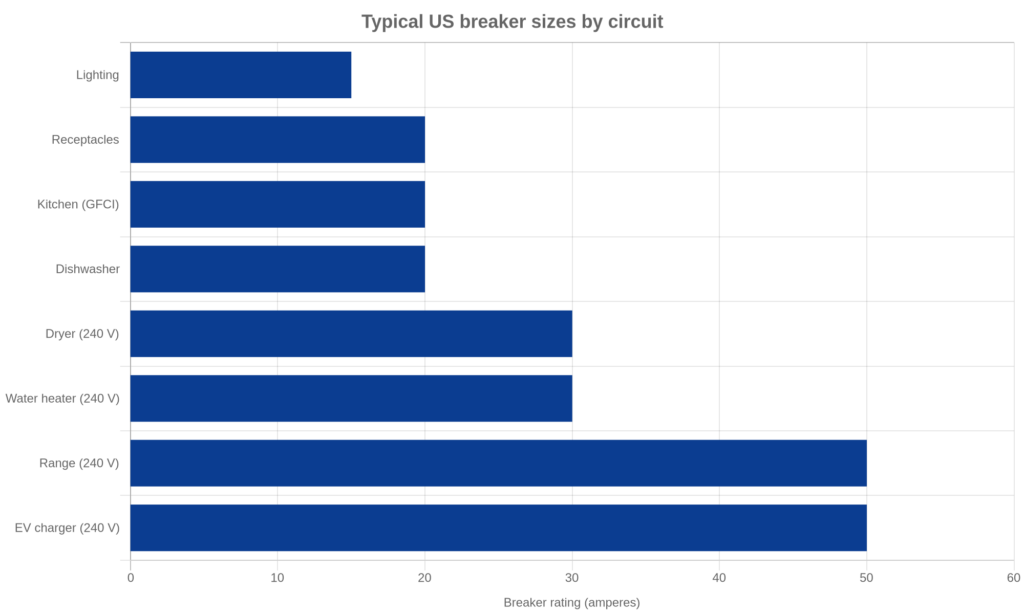
Breaker sizes are matched to the wire and the load. A breaker that is too large for its wire will let the wire overheat before it trips, so the sizes below are the standard values used in US homes.
| Circuit | Breaker size | Voltage | Typical load |
|---|---|---|---|
| Lighting | 15 A | 120 V | Lights, ceiling fans |
| General receptacles | 20 A | 120 V | Sockets, small appliances |
| Kitchen small appliances | 20 A (GFCI) | 120 V | Toaster, microwave |
| Dishwasher | 20 A (GFCI) | 120 V | Dishwasher |
| Electric dryer | 30 A | 240 V | Dryer, 7,200 W |
| Electric water heater | 30 A | 240 V | Water heater, 7,200 W |
| Electric range | 40-50 A | 240 V | Range, 9,600-12,000 W |
| Central air conditioner | 30-60 A | 240 V | HVAC |
| EV charger | 40-50 A | 240 V | Level 2 charger |
A 15 A lighting circuit at 120 V can carry at most 120 V × 15 A = 1,800 W, and the National Electrical Code (NEC) limits continuous loads to 80 percent of the breaker rating, so the safe continuous load is 1,440 W. That is still plenty for LED lighting: a 10 W LED bulb uses so little power that more than 100 of them could run on one circuit, though in practice a lighting circuit serves a few rooms, not a hundred bulbs.
Distribution Board vs Consumer Unit vs Fuse Box
A distribution board and a consumer unit are the same kind of equipment. Consumer unit is simply the name used in the UK for a domestic distribution board, defined in the wiring regulations (BS 7671). A fuse box is an older distribution board that uses fuses instead of circuit breakers. A panelboard is the term used in the US National Electrical Code for a larger commercial board, while a load center is the smaller residential version. The name changes with the country, but the job is the same.
Safety, Maintenance, and When to Call an Electrician
Press the test button on each RCD or GFCI at least once a month. The button creates a small leakage on purpose, and the device should trip immediately. If it does not trip, or if it will not reset, have it replaced.
Keep the board dry, clean, and easy to reach. Never store paint, boxes, or clothes against it, and never remove the dead-front cover, the inner cover that hides the live busbar, unless you are qualified. A board is live even when every breaker is off, because the main switch and the incoming terminals stay energized until the meter is pulled.
Call a licensed electrician if you notice a burning smell, buzzing or crackling, breakers that feel warm, scorch marks, rust or water inside the board, or a breaker that trips again right after you reset it. Also call one before adding a new circuit, replacing the board, or upgrading the service. Adding a circuit means choosing the right wire size and breaker, and getting it wrong can start a fire. If you are not sure, leave the cover on and call a professional.
Related reading: Circuit Breaker Working Principle – Complete Guide for Students and Engineers
Related reading: AC Power Formula: Complete Guide for Electrical Students and Engineers
Frequently Asked Questions
What is the difference between a distribution board and a consumer unit?
They are the same thing. Consumer unit is the name used in the United Kingdom for a domestic distribution board, while distribution board, DB box, breaker panel, and load center are the names used in most other countries.
How many circuits can a distribution board have?
Most home boards have 12 to 42 ways, or breaker spaces. A small apartment may need only 6 to 12 circuits, while a large house with electric heating, a workshop, and an EV charger can need 30 or more. A board should always have a few spare ways for future circuits.
What size distribution board do I need for my house?
It depends on the total load. Many older US homes have a 100 A service, while most new homes have a 200 A service at 240 V, which can deliver up to 48 kW. An electrician calculates the load from your appliances, heating, cooling, and any EV charger, then chooses a service size with spare capacity.
Why does my circuit breaker keep tripping?
A breaker trips because its circuit is overloaded, because there is a short circuit, or because a faulty appliance is leaking current to earth. Unplug the appliance on that circuit and try resetting the breaker once. If it trips again immediately, or if you smell burning, leave it off and call an electrician.
Can I add a new circuit to my distribution board myself?
In most places, only a licensed electrician should add a circuit. The work involves live terminals, correct wire and breaker sizing, and in many areas a permit and an inspection. Doing it wrong can cause a fire or a fatal shock.
Conclusion
A distribution board is the heart of a building’s electrical system. It takes one supply from the meter, divides it into safe, individually protected circuits, and gives you a single place to switch anything off. Knowing what is inside it, what each breaker protects, and how to test the RCD makes you safer and helps you explain a problem clearly when you call an electrician.
For a deeper reference on how distribution boards are built and what they contain, see https://en.wikipedia.org/wiki/Distribution_board