
Imagine waking up in the morning and checking your mobile phone. The phone works because of a battery. When you start your car, the engine begins running because of a battery. Even solar power systems and laptops depend on batteries to store and supply electrical energy.
Batteries are one of the most important parts of modern electrical systems. From small electronic devices to large backup power systems, batteries help store energy and provide electricity whenever it is needed. Without batteries, many technologies we use every day would not function properly.
Understanding battery types is very important for electrical students, engineers, technicians, and beginners. Different batteries have different characteristics, working principles, and applications. Choosing the correct battery type can improve efficiency, safety, and equipment performance.
In this article, you will learn the battery types, battery working principle, battery applications, and battery advantages and disadvantages. You will also understand how batteries work, their main components, and how to select the right battery for different electrical systems.
2. What is a Battery?
A battery is an electrical device that stores chemical energy and converts it into electrical energy. It provides power to electrical circuits and electronic devices.
In simple words, a battery acts like a small power station that stores energy and releases it when needed.
Inside a battery, chemical reactions take place between different materials. These reactions create an electrical current that flows through wires and powers devices.
Practical Example
For example, when you press the power button on a flashlight, the battery inside it starts supplying electricity to the bulb. This electrical energy produces light.
Similarly, mobile phones, laptops, cars, solar systems, and emergency backup systems all rely on batteries to operate.
3. Battery Working Principle
The battery working principle is based on a chemical reaction called an electrochemical reaction.
Inside the battery, chemicals react with each other to produce electrical energy.
Step-by-Step Working Principle
The working process of a battery can be explained in simple steps:
• A battery contains two electrodes: positive electrode (cathode) and negative electrode (anode).
• These electrodes are placed inside a chemical solution called electrolyte.
• A chemical reaction occurs between the electrodes and electrolyte.
• This reaction produces electrons at the negative terminal.
• Electrons move through the external circuit to the positive terminal.
• This movement of electrons creates electric current.
Simple Analogy
You can imagine a battery like a water tank.
The stored water represents stored energy, and when a tap is opened, water flows out.
Similarly, when a circuit is connected, stored chemical energy is converted into electrical energy.
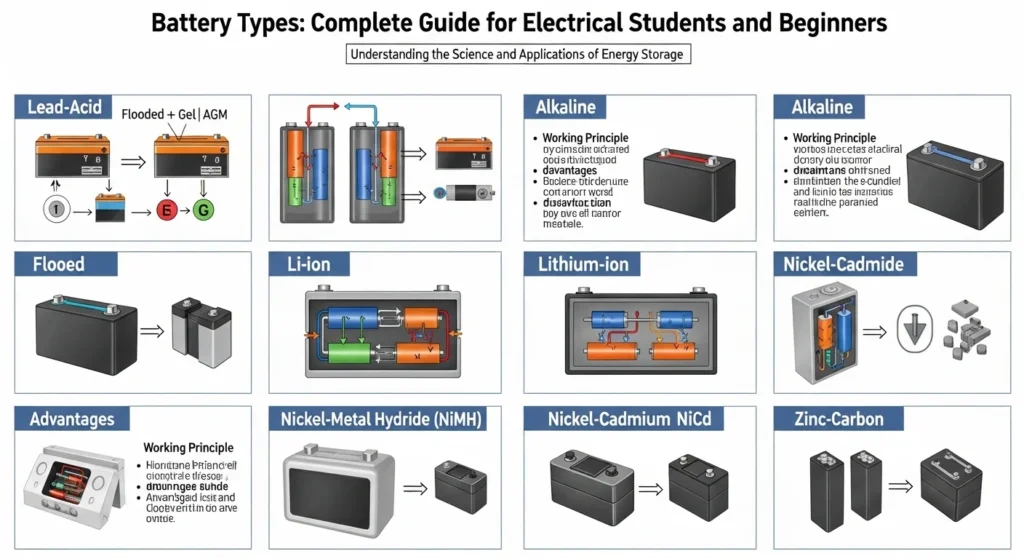
4. Types of Batteries
There are many battery types used in electrical systems. These batteries are generally divided into two main categories.
What Are Primary Batteries? Complete Guide for Beginners
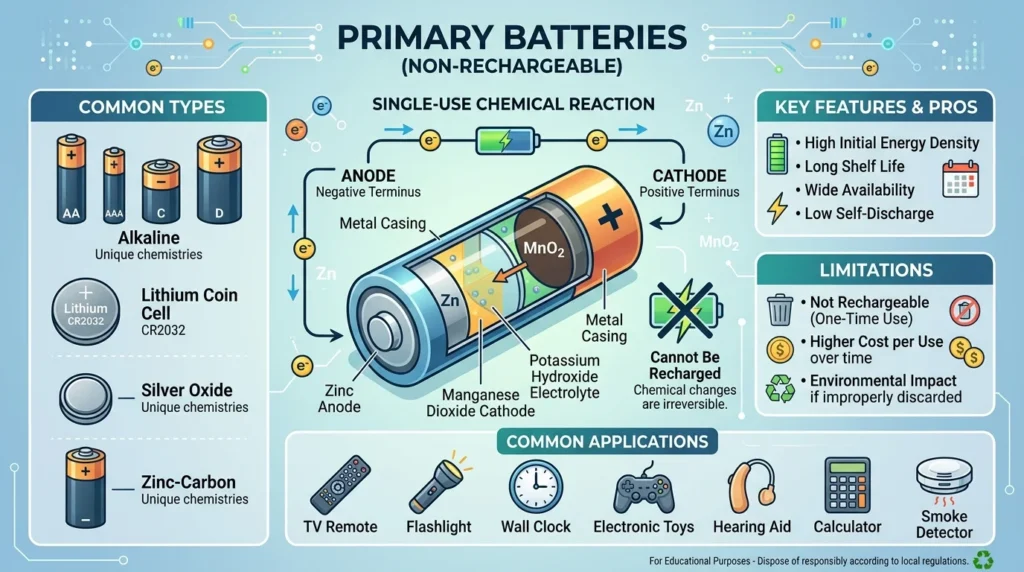
A Primary Battery is a type of electrochemical cell that is designed for single-use only and cannot be recharged once its stored energy is fully used. It converts chemical energy into electrical energy through an internal chemical reaction. Primary batteries are commonly used in torches, remote controls, wall clocks, toys, calculators, and emergency devices because they are simple, reliable, and ready to use.
The working principle of a primary battery is based on the flow of electrons created by a chemical reaction between two different materials called electrodes. When the battery is connected to a load, a chemical reaction occurs inside the cell that releases electrons from the negative electrode (anode). These electrons flow through the external circuit to the positive electrode (cathode), producing electric current. This process continues until the chemical materials inside are fully consumed. The process follows basic electrochemical behavior explained by Electrochemical Cell Principle.
A primary battery consists of key components such as an anode, cathode, electrolyte, separator, and outer casing. The anode is where oxidation occurs, and the cathode is where reduction takes place. The electrolyte helps ions move between electrodes, completing the internal circuit. The separator prevents direct contact between electrodes while allowing ion flow.
There are different types of primary batteries, such as zinc-carbon batteries, alkaline batteries, lithium primary batteries, and silver oxide batteries. Each type has different energy capacity, lifespan, and usage applications. Among these, alkaline batteries are the most commonly used in household devices due to their better performance and longer life.
One of the main advantages of primary batteries is their convenience. They are lightweight, portable, and do not require charging. They also have a long shelf life, making them suitable for emergency use. However, their major disadvantage is that they cannot be reused or recharged, which makes them less cost-effective for long-term use and creates more environmental waste.
Overall, primary batteries are an essential source of portable electrical energy in daily life. Their simple design, reliability, and easy availability make them widely used in small electronic devices and backup applications.
Primary batteries are non-rechargeable batteries. Once their energy is used, they cannot be recharged.
Common Examples
• Alkaline battery
• Zinc-carbon battery
• Lithium primary battery
Features
• Simple design
• Low cost
• Used in small devices
Applications
• Remote controls
• Wall clocks
• Flashlights
• Toys
What Are Secondary Batteries? Complete Guide for Students
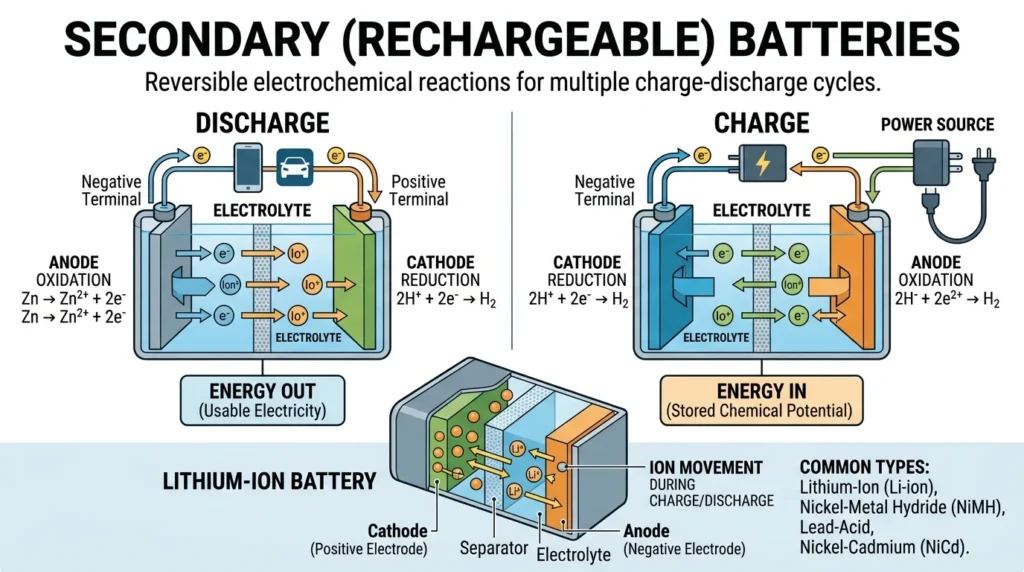
A Secondary Battery is a rechargeable electrochemical device that stores electrical energy in chemical form and converts it back into electrical energy when required. Unlike primary batteries, secondary batteries can be recharged many times by passing an external electric current through them. They are widely used in smartphones, laptops, electric vehicles, inverters, UPS systems, and industrial backup power systems due to their long-term cost efficiency and reusability.
The working principle of a secondary battery is based on reversible chemical reactions. During discharging, the battery supplies electrical energy when chemical reactions occur inside the cell, releasing electrons from the anode to the cathode through an external circuit. During charging, an external power source reverses this reaction, restoring the original chemical condition of the electrodes. This reversible process is explained by Electrochemical Cell Principle, which allows repeated energy storage and release.
A secondary battery consists of key components such as the anode, cathode, electrolyte, separator, and casing. The anode and cathode store and release ions during charging and discharging. The electrolyte allows ion movement between electrodes, while the separator prevents direct contact to avoid short circuits. The casing provides safety and structural protection.
There are several types of secondary batteries, including lead-acid batteries, lithium-ion batteries, nickel-cadmium (Ni-Cd), and nickel-metal hydride (Ni-MH) batteries. Among these, lithium-ion batteries are the most popular due to their high energy density, lightweight design, and longer lifespan. Lead-acid batteries are commonly used in vehicles and backup power systems.
One of the main advantages of secondary batteries is their reusability, which makes them cost-effective in the long run. They provide stable voltage, high efficiency, and are suitable for high-power applications. However, they have higher initial cost, require proper charging systems, and may degrade over time with repeated charging cycles.
Overall, secondary batteries are a crucial part of modern electrical and electronic systems. Their ability to be recharged and reused makes them essential for portable devices, renewable energy storage, and backup power solutions.
Secondary batteries are rechargeable batteries. They can be used many times by recharging them.
Examples
• Lead-acid battery
• Lithium-ion battery
• Nickel-cadmium battery
• Nickel-metal hydride battery
Features
• Rechargeable
• Longer lifespan
• Suitable for heavy-duty applications
Applications
• Electric vehicles
• Solar power systems
• UPS systems
• Mobile phones
Lead-Acid Battery: Traditional Rechargeable Energy Storage System for Cost-Effective, High-Power Backup Applications in Automotive, UPS, and Solar Energy Systems
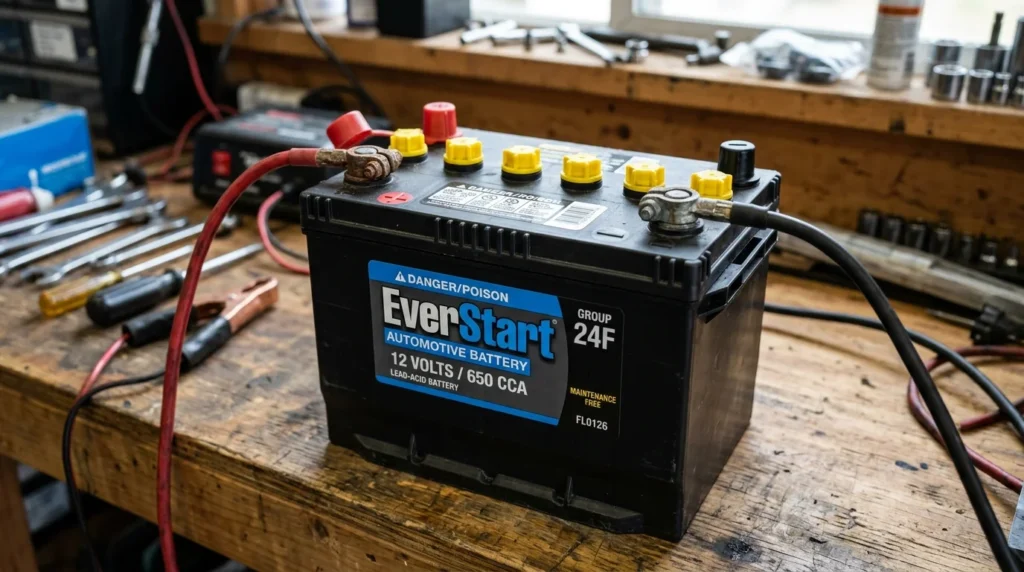
A Lead-Acid Battery is one of the oldest and most widely used types of rechargeable batteries. It is commonly used in vehicles, inverters, UPS systems, solar power storage, and industrial backup systems. This battery is known for its reliability, low cost, and ability to deliver high surge currents, making it suitable for starting engines and providing backup power during outages.
The working principle of a lead-acid battery is based on a reversible chemical reaction between lead plates and sulfuric acid electrolyte. During discharge, the chemical reaction produces electrical energy by converting lead dioxide (positive plate) and sponge lead (negative plate) into lead sulfate, releasing electrons in the process. During charging, the external electrical supply reverses this reaction and restores the original chemical condition of the plates. This process follows the principle of Electrochemical Cell Principle, which explains how chemical energy is converted into electrical energy and vice versa.
A lead-acid battery consists of key components such as positive plate (lead dioxide), negative plate (sponge lead), electrolyte (dilute sulfuric acid), separators, container, and terminals. The electrolyte allows ion movement between plates, while separators prevent direct contact and short circuits. The container holds all components safely and protects the battery structure.
There are two main types of lead-acid batteries: flooded (wet) batteries and sealed (maintenance-free or VRLA) batteries. Flooded batteries require periodic water topping, while sealed batteries are maintenance-free and safer for indoor use. Each type is selected based on application requirements.
One of the main advantages of lead-acid batteries is their low cost and high reliability. They can deliver high starting current, making them ideal for automobiles. They are also widely available and easy to maintain. However, they are heavy, have lower energy density compared to modern batteries, and require proper maintenance in some types. Overcharging or deep discharging can reduce their lifespan.
Overall, lead-acid batteries remain an important part of electrical and energy storage systems. Their durability, affordability, and strong performance in high-current applications make them a trusted choice for backup power and automotive use.
Lead-acid batteries are one of the oldest and most widely used battery types.
Characteristics
• Uses lead plates and sulfuric acid electrolyte
• Low cost
• High current capability
Applications
• Car batteries
• Solar systems
• UPS backup power
Lithium-Ion Battery: High-Efficiency Rechargeable Energy Storage Technology for Lightweight, Long-Lasting, and High-Performance Power Applications in Modern Electronics and Renewable Systems
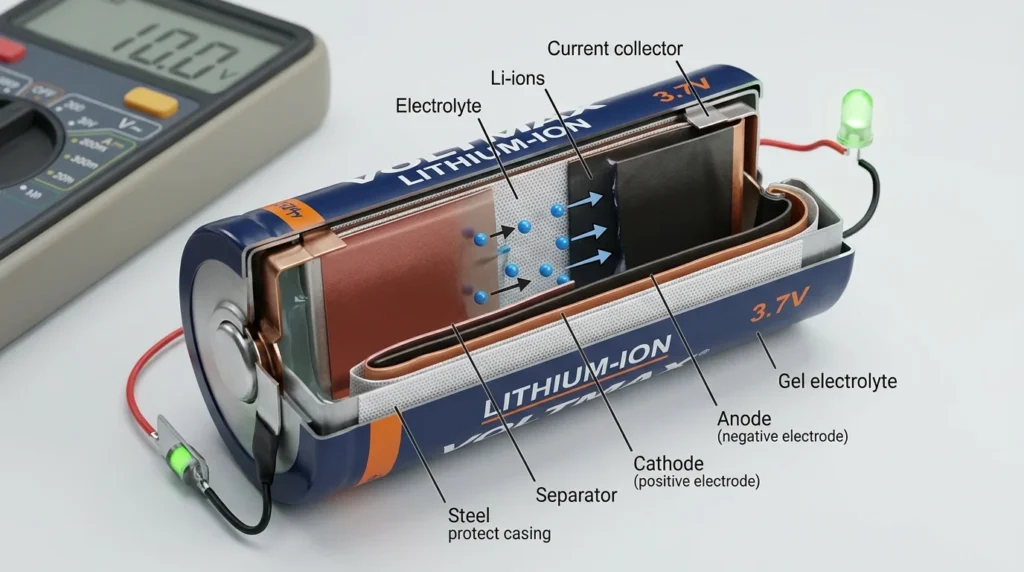
A Lithium-Ion Battery is a modern rechargeable battery widely used in smartphones, laptops, electric vehicles, solar systems, and portable electronics. It is popular because of its high energy density, lightweight design, long life cycle, and fast charging capability. Compared to older battery types, lithium-ion technology provides better performance and efficiency, making it a key energy storage solution in today’s digital world.
The working principle of a lithium-ion battery is based on reversible electrochemical reactions between lithium compounds at the positive and negative electrodes. During discharge, lithium ions move from the negative electrode (anode) through the electrolyte to the positive electrode (cathode), releasing electrical energy to the external circuit. During charging, this process is reversed, and lithium ions move back to the anode, storing energy again. This process follows the principle of Electrochemical Cell Principle, which explains energy conversion between chemical and electrical forms.
A lithium-ion battery consists of key components such as an anode (usually graphite), cathode (lithium metal oxide), electrolyte, separator, and protective casing. The electrolyte allows lithium ions to move between electrodes, while the separator prevents direct contact and avoids short circuits. The casing provides safety and structural strength.
There are different types of lithium-ion batteries, including lithium cobalt oxide (LCO), lithium iron phosphate (LFP), lithium manganese oxide (LMO), and nickel manganese cobalt (NMC). Each type is used for specific applications depending on safety, cost, and performance requirements. For example, LFP batteries are widely used in electric vehicles due to their safety and long cycle life.
One of the main advantages of lithium-ion batteries is their high energy density, which allows them to store more energy in a smaller and lighter package. They also have a long lifespan, low self-discharge rate, and fast charging capability. However, they are more expensive than traditional batteries and require proper battery management systems (BMS) to ensure safety. Overheating or overcharging can lead to performance issues or safety risks.
Overall, lithium-ion batteries are a major advancement in energy storage technology. Their efficiency, portability, and long-term performance make them essential for modern electronics, renewable energy systems, and electric mobility solutions.
Lithium-ion batteries are modern rechargeable batteries widely used in electronics.
Characteristics
• Lightweight
• High energy density
• Long life
Applications
• Smartphones
• Laptops
• Electric vehicles
• Power banks
Nickel-Cadmium (NiCd) Battery: Durable Rechargeable Energy Storage System Known for High Reliability, Long Cycle Life, and Strong Performance in Extreme Conditions
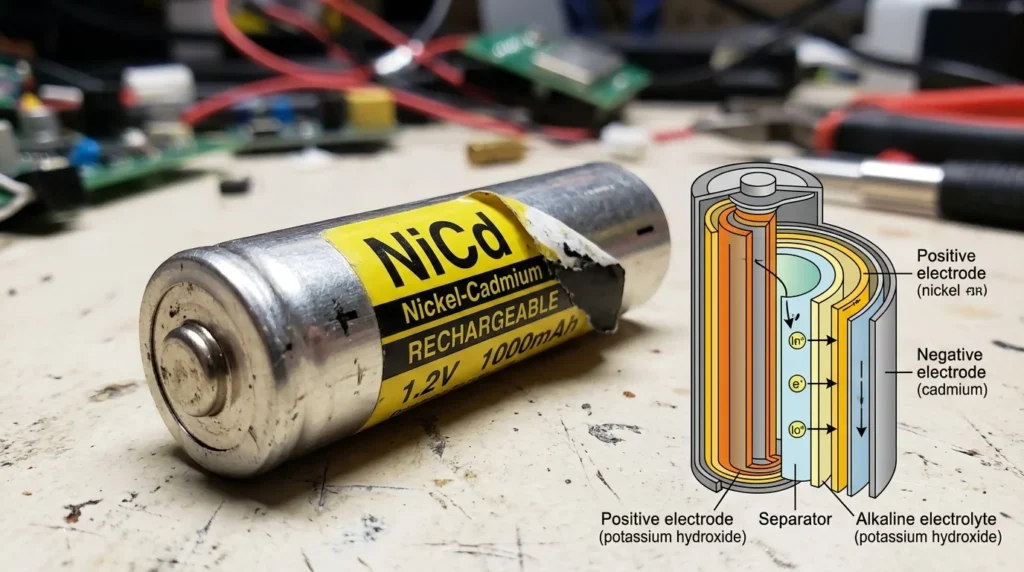
A Nickel-Cadmium (Ni-Cd) Battery is a rechargeable battery that uses nickel oxide hydroxide and metallic cadmium as its electrodes. It is widely used in power tools, emergency lighting, aviation equipment, medical devices, and industrial backup systems. Ni-Cd batteries are known for their durability, ability to deliver high discharge currents, and reliable performance in harsh conditions.
The working principle of a nickel-cadmium battery is based on reversible electrochemical reactions. During discharge, cadmium at the negative electrode reacts with the electrolyte and produces electrons, while nickel oxide hydroxide at the positive electrode is reduced. This reaction generates electrical energy that flows through the external circuit. During charging, an external power source reverses this reaction, restoring the original chemical state of the electrodes. This process follows the principle of Electrochemical Cell Principle, which explains the conversion between chemical and electrical energy.
A Ni-Cd battery consists of key components such as the cadmium anode, nickel oxide cathode, potassium hydroxide electrolyte, separator, and sealed casing. The electrolyte helps ions move between electrodes, while the separator prevents internal short circuits. The sealed design improves safety and reduces maintenance requirements.
One of the main advantages of nickel-cadmium batteries is their long cycle life and ability to perform well under extreme temperatures. They can deliver high discharge currents, making them suitable for heavy-duty applications. They are also very reliable and resistant to mechanical stress. However, they have lower energy density compared to lithium-ion batteries and suffer from the “memory effect,” which can reduce their effective capacity if not properly discharged before recharging. Additionally, cadmium is a toxic material, which raises environmental concerns.
Overall, nickel-cadmium batteries are durable and reliable energy storage devices used in industrial and specialized applications. Despite being replaced in many areas by newer technologies, they are still valued for their robustness and long service life in demanding conditions.
Nickel-cadmium batteries are durable rechargeable batteries.
Characteristics
• Long life cycle
• Works well in extreme temperatures
Applications
• Power tools
• Emergency lighting
• Aviation systems
Nickel-Metal Hydride (NiMH) Battery: Advanced Rechargeable Energy Storage Technology for High-Capacity, Environmentally Safer, and Reliable Portable Power Applications
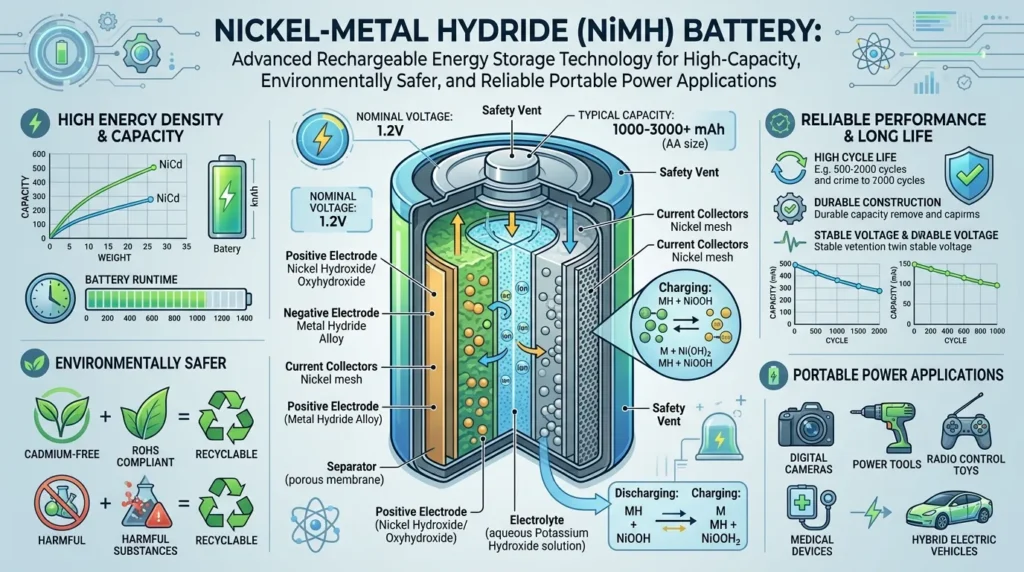
A Nickel-Metal Hydride (Ni-MH) Battery is a rechargeable battery commonly used in hybrid vehicles, household electronics, cameras, cordless phones, and power tools. It was developed as an improved version of the nickel-cadmium battery, offering higher energy capacity and reduced environmental impact. Ni-MH batteries are known for their good balance between performance, safety, and cost.
The working principle of a nickel-metal hydride battery is based on reversible electrochemical reactions. During discharge, hydrogen stored in a metal alloy at the negative electrode reacts and releases electrons, while nickel oxyhydroxide at the positive electrode is reduced. This reaction produces electrical energy that flows through the external circuit to power devices. During charging, an external electrical source reverses the reaction, storing hydrogen back in the metal alloy. This process follows the principle of Electrochemical Cell Principle, which explains how chemical energy is converted into electrical energy and vice versa.
A Ni-MH battery consists of key components such as a hydrogen-absorbing metal alloy (negative electrode), nickel oxyhydroxide (positive electrode), potassium hydroxide electrolyte, separator, and sealed casing. The electrolyte allows ion movement between electrodes, while the separator prevents direct contact and short circuits. The sealed structure improves safety and reduces leakage risks.
One of the main advantages of nickel-metal hydride batteries is their higher energy density compared to nickel-cadmium batteries. They are also more environmentally friendly because they do not contain toxic cadmium. Ni-MH batteries provide stable performance and are suitable for moderate to high power applications. However, they have higher self-discharge rates than lithium-ion batteries and may generate heat during charging if not properly managed.
Overall, nickel-metal hydride batteries are reliable and efficient rechargeable energy sources. Their improved capacity, safety, and eco-friendly design make them widely used in modern electronic devices and hybrid energy systems.
This battery type improved upon nickel-cadmium technology.
Characteristics
• Higher capacity
• More environmentally friendly
Applications
• Hybrid cars
• Digital cameras
• Rechargeable household batteries
5. Main Components of a Battery (Detailed Explanation with Functions)
A battery is made up of several key internal components that work together to store and supply electrical energy through chemical reactions. Each part has a specific role in ensuring safe, stable, and efficient performance.
1. Electrodes (Positive and Negative Plates)
Electrodes are the most important active parts of a battery.
- Positive electrode (Cathode) and negative electrode (Anode)
- Chemical reactions occur between these electrodes
- During discharge, electrons flow from negative to positive terminal
- During charging, reactions are reversed
Function:
They are responsible for producing and storing electrical energy through electrochemical reactions.
2. Electrolyte (Ion Transfer Medium)
The electrolyte is a chemical substance that allows ion movement inside the battery.
- Can be in liquid, gel, or solid form depending on battery type
- Helps ions move between electrodes during charging and discharging
- Does not allow direct electron flow internally
Function:
It completes the internal chemical circuit and enables energy conversion.
3. Separator (Safety Barrier Layer)
The separator is a thin insulating material placed between electrodes.
- Prevents direct contact between positive and negative electrodes
- Allows only ions to pass through
- Made from polymer or special porous materials
Function:
It ensures safety by preventing short circuits while allowing controlled ion movement.
4. Battery Case (Outer Protective Body)
The battery case is the external shell that protects all internal components.
- Made of strong plastic or metal material
- Prevents leakage of chemicals
- Protects against physical damage and environmental factors
Function:
It ensures mechanical safety and durability of the battery.
5. Terminals (Connection Points)
Terminals are external metal connectors of the battery.
- Usually marked as positive (+) and negative (–)
- Connect battery to external electrical circuits
- Allow energy flow to devices or systems
Function:
They provide the interface between the battery and the electrical system.
A battery works through the combined action of electrodes, electrolyte, separator, case, and terminals. Each component plays a critical role in energy storage, safety, and power delivery, making the battery a reliable source of electrical energy for modern applications.
6. Battery Advantages (Detailed Table Format)
| S. No. | Advantage | Explanation | Benefits in Practical Use |
|---|---|---|---|
| 1 | Portable Power Source | Batteries store energy in a compact form | Can be used anywhere without direct electricity connection |
| 2 | Independent Energy Supply | Does not require continuous grid power | Works during power cuts and in remote areas |
| 3 | Backup Power Support | Provides emergency electricity during outages | Keeps essential devices running like lights and fans |
| 4 | Renewable Energy Support | Works with solar and wind energy systems | Stores energy for later use in off-grid systems |
| 5 | Supports Portable Devices | Used in mobile phones, laptops, and gadgets | Enables mobility and wireless device operation |
| 6 | Emergency Power Reliability | Provides instant power during emergencies | Important for hospitals, telecom systems, and UPS setups |
| 7 | Flexible Installation | Can be installed in small or large systems | Suitable for residential, commercial, and industrial use |
Batteries provide a highly reliable and flexible energy source for modern electrical systems. Their ability to deliver portable and backup power makes them essential for both everyday use and advanced renewable energy applications.
7. Battery Disadvantages / Limitations (Detailed Table Format)
| S. No. | Disadvantage / Limitation | Explanation | Impact on System | Proper Solution / Control Method |
|---|---|---|---|---|
| 1 | Limited lifespan | Every battery has a fixed number of charge and discharge cycles | Battery needs replacement after a certain period | Use high-quality batteries and avoid deep discharging |
| 2 | Requires charging or replacement | Batteries do not generate power; they store energy only | Continuous dependency on charging source | Ensure proper charging system (solar, grid, or generator) |
| 3 | High cost for large systems | Large capacity battery banks are expensive | Increases initial installation cost | Use proper system design to optimize battery size |
| 4 | Performance degradation over time | Battery efficiency reduces after repeated cycles | Reduced backup time and lower output | Regular maintenance and monitoring of battery health |
| 5 | Environmental concerns | Some batteries contain toxic materials (lead, acid, chemicals) | Pollution risk if not disposed properly | Follow proper recycling and disposal methods |
| 6 | Heat sensitivity | Batteries can overheat in high temperature conditions | Reduced efficiency and safety risk | Install in cool, ventilated locations |
| 7 | Voltage drop issues | Improper use leads to unstable voltage output | Affects connected devices and system stability | Use correct battery rating and proper wiring design |
Battery systems are essential for energy storage but come with limitations such as cost, lifespan, and environmental impact. However, with proper installation, maintenance, and recycling practices, these disadvantages can be significantly reduced, making batteries more efficient and reliable for long-term use.
8. Battery Applications: Comprehensive Uses in Residential, Industrial, and Modern Technological Systems for Reliable Energy Storage and Power Supply
Batteries are an essential part of modern electrical and electronic systems. They provide portable, reliable, and backup energy storage for a wide range of applications. From small household devices to large industrial systems, batteries play a critical role in ensuring uninterrupted power supply and supporting renewable energy technologies.
1. Home Applications (Residential Energy Storage and Everyday Devices)
Batteries are widely used in household applications where small to medium energy storage is required.
- Powering remote controls for TVs and appliances
- Providing energy for flashlights and emergency lights
- Charging and running laptops and mobile phones
- Supporting home solar backup systems during power outages
- Operating small electronic devices and smart home gadgets
In residential systems, batteries ensure convenience, backup support, and uninterrupted daily usage.
2. Industrial Applications (Heavy-Duty Power Backup and Operations)
In industrial environments, batteries are used for high-power and critical applications where continuous energy supply is necessary.
- UPS (Uninterruptible Power Supply) systems for backup power
- Electric forklifts used in warehouses and logistics
- Emergency backup systems for factories and plants
- Communication towers and network infrastructure systems
- Control systems in industrial automation setups
Industrial batteries are designed for high durability, long cycle life, and stable performance under heavy loads.
3. Modern Technology Applications (Advanced Energy and Smart Systems)
With rapid technological development, battery usage has expanded into advanced and smart systems.
- Electric vehicles (EVs) for transportation
- Renewable energy storage systems (solar and wind power)
- Smart devices such as watches, sensors, and IoT systems
- Medical equipment like portable monitors and emergency devices
- Robotics and automation systems
These applications require high-efficiency, lightweight, and long-lasting battery solutions.
4. Role of Batteries in Renewable Energy Systems
The growth of renewable energy has significantly increased the demand for advanced batteries.
- Store excess solar energy for nighttime use
- Balance energy supply during low sunlight or wind conditions
- Improve reliability of off-grid solar systems
- Support large-scale energy storage in solar farms
- Reduce dependency on traditional fossil fuel-based power
Batteries are now a key component in building a sustainable and green energy future.
Battery applications are present in almost every aspect of modern life, from household electronics to industrial systems and advanced technologies. With the rapid growth of renewable energy and electric mobility, the importance of efficient and high-performance batteries continues to increase, making them a core component of future energy systems.
9. Comparison of Battery Types
Understanding the difference between battery types helps in selecting the right battery.
| Battery Type | Rechargeable | Cost | Lifespan | Common Use |
|---|---|---|---|---|
| Alkaline | No | Low | Short | Remote controls |
| Lead-Acid | Yes | Low | Medium | Cars, solar systems |
| Lithium-Ion | Yes | High | Long | Smartphones, EVs |
| Nickel-Cadmium | Yes | Medium | Long | Power tools |
| Nickel-Metal Hydride | Yes | Medium | Medium | Cameras |
Each battery type has advantages depending on the application.
10. Battery Selection Guide: Complete Method to Choose the Right Battery Based on Capacity, Voltage, Lifespan, Cost, and Safety for Reliable Energy Storage Systems
Selecting the right battery is one of the most important decisions in any electrical or solar energy system. A proper battery ensures stable performance, long backup time, safety, and efficient energy storage. Wrong selection can lead to poor performance, overheating, fast draining, or even system failure. Below is a detailed guide to help choose the correct battery for different applications.
1. Battery Capacity (Ah Rating Selection)
Battery capacity is measured in Ampere-hour (Ah) and indicates how much energy a battery can store.
- Higher Ah rating = longer backup time
- Lower Ah rating = suitable for small loads only
- Choose capacity based on total load consumption (lights, fans, appliances, etc.)
- Oversized batteries increase cost, while undersized batteries reduce backup time
Correct capacity selection ensures balanced performance and longer system runtime.
2. Voltage Compatibility (System Matching)
Battery voltage must match the system requirements to ensure safe operation.
- Common voltages: 12V, 24V, 48V systems
- Mismatch in voltage can damage inverter, charge controller, or devices
- Series connection is used to increase voltage in larger systems
- Parallel connection increases battery capacity (Ah)
Proper voltage matching is essential for system stability and efficiency.
3. Battery Lifespan (Durability and Cycle Life)
Different battery types offer different lifespans depending on usage and quality.
- Lead-acid batteries: 3–5 years average lifespan
- Lithium-ion batteries: 8–15 years lifespan
- Deep cycle batteries last longer under regular discharge cycles
- Proper maintenance increases overall battery life
Long-life batteries reduce replacement cost and improve system reliability.
4. Cost and Budget Consideration
Battery cost plays a major role in system design and selection.
- Lead-acid batteries are cheaper but require more maintenance
- Lithium-ion batteries are expensive but offer higher efficiency
- Long-term cost should be considered, not just initial price
- Cheaper batteries may lead to frequent replacements
A balanced decision between cost and performance is always recommended.
5. Safety and Reliability Standards
Safety is a critical factor in battery selection, especially for solar and backup systems.
- Always choose certified and branded batteries
- Ensure protection against overcharging and overheating
- Prefer batteries with built-in Battery Management System (BMS)
- Avoid low-quality or unverified products
- Proper installation improves safety and performance
Safe batteries reduce risk of fire, leakage, and system damage.
6. Battery Type Selection (Beginner Guide)
Different battery types are used for different applications:
- Lithium-ion Batteries:
- High efficiency, long life, lightweight
- Best for electronics, solar systems, and EVs
- Low maintenance and fast charging
- Lead-Acid Batteries:
- Widely used for backup power systems
- Affordable but heavier and require maintenance
- Suitable for home solar and UPS systems
Choosing the correct type depends on application and budget.
The right battery selection depends on capacity, voltage, lifespan, cost, and safety factors. Proper selection ensures efficient energy storage, longer system life, and stable performance. For beginners, lithium-ion batteries are ideal for modern systems, while lead-acid batteries remain popular for traditional backup power applications.
11. Common Battery Problems & Solutions
Problem 1: Battery Not Charging
Possible Causes:
• Faulty charger
• Damaged battery
Solution:
Check charger and battery connections.
Problem 2: Battery Drains Quickly (Fast Discharging Issue in Solar and Electrical Systems)
Possible Causes:
- Old or degraded battery with reduced storage capacity
- Excessive power consumption beyond battery rating
- Poor charging cycle or incomplete charging from solar panels
- Faulty charge controller causing improper charging/discharging
- High load connection without proper system design
Detailed Solution:
- Replace old battery with a new, high-capacity battery suitable for system load
- Reduce electrical load by disconnecting unnecessary appliances
- Ensure proper battery sizing according to total energy demand
- Check charge controller settings and ensure correct charging profile
- Regularly monitor battery health and performance using a multimeter or battery monitor
Proper load management and correct battery selection significantly improve system backup time and efficiency.
Problem 3: Battery Overheating (Thermal Stress Issue in Energy Storage Systems)
Possible Causes:
- Continuous overcharging beyond recommended voltage limit
- Poor ventilation or installation in closed, hot environments
- High ambient temperature affecting battery performance
- Faulty or low-quality charger/charge controller
- Excessive charging current or mismatched system voltage
Detailed Solution:
- Use a high-quality charge controller with overcharge protection (preferably MPPT)
- Avoid overcharging by correctly setting charging voltage limits
- Install batteries in a cool, dry, and well-ventilated area
- Ensure proper spacing between batteries for heat dissipation
- Replace faulty chargers or damaged charging equipment immediately
- Monitor temperature regularly in high-load systems
Maintaining proper charging conditions and ventilation helps prevent overheating and extends battery life significantly.
12. Future Trends in Battery Technology: Advanced Energy Storage Innovations for Renewable Energy, Electric Vehicles, and Next-Generation Power Systems
Battery technology is evolving at a very fast pace due to the increasing global demand for renewable energy systems, electric vehicles (EVs), and smart energy storage solutions. The future of batteries is focused on improving safety, increasing energy density, reducing charging time, and making energy storage more sustainable and cost-effective. These advancements will play a major role in supporting solar energy systems and modern electrical infrastructure.
1. Solid-State Batteries (Next-Generation High-Safety Technology)
Solid-state batteries are considered one of the most important future breakthroughs in energy storage technology.
- Replace liquid electrolytes with solid materials
- Offer significantly higher energy density compared to lithium-ion batteries
- Reduce risk of leakage, overheating, and fire hazards
- Provide longer lifespan and improved thermal stability
- Suitable for electric vehicles and high-capacity solar storage systems
This technology is expected to revolutionize both renewable energy storage and transportation systems.
2. Fast-Charging Battery Technology (High-Speed Energy Storage Solutions)
Future batteries are being developed to support ultra-fast charging capabilities without reducing battery life.
- Charge up to 70–80% in just a few minutes
- Use advanced electrode materials for faster ion movement
- Reduce downtime in electric vehicles and backup systems
- Improve convenience for residential and industrial users
- Maintain safety even under high charging speeds
Fast-charging systems will make energy storage more practical for daily use.
3. Renewable Energy Storage Systems (Solar and Wind Integration)
Energy storage is the backbone of renewable energy systems like solar and wind power.
- Store excess solar energy during daytime for nighttime use
- Balance energy supply during low sunlight or weather changes
- Improve stability of off-grid and hybrid solar systems
- Support large-scale solar farms and microgrid networks
- Reduce dependency on traditional grid electricity
Advanced battery systems will make renewable energy more reliable and consistent.
4. Electric Vehicle (EV) Battery Innovations
The electric vehicle industry is driving major improvements in battery technology.
- Increased driving range with higher energy density batteries
- Reduced charging time for user convenience
- Lightweight battery designs for better vehicle efficiency
- Improved thermal management systems
- Longer battery life with reduced degradation over time
These improvements will accelerate global adoption of electric transportation.
5. Smart and AI-Based Battery Management Systems (BMS)
Future batteries will include intelligent monitoring and control systems.
- Real-time performance tracking using AI and sensors
- Automatic optimization of charging and discharging cycles
- Predictive maintenance to avoid battery failure
- Enhanced safety through thermal and voltage monitoring
- Integration with smart grids and solar systems
Smart BMS will improve efficiency and extend battery lifespan significantly.
6. Environmentally Friendly and Sustainable Battery Development
Sustainability is a key focus in future battery research and manufacturing.
- Use of recyclable and eco-friendly materials
- Reduction of toxic and harmful chemical components
- Lower carbon footprint during production
- Improved recycling technologies for used batteries
- Support for circular energy economy
This will make energy storage systems more environmentally responsible.
The future of battery technology is moving toward safer, faster, smarter, and more sustainable energy storage solutions. Innovations like solid-state batteries, fast-charging systems, and AI-based battery management will transform how energy is stored and used in solar systems, electric vehicles, and smart grids.
In the coming years, batteries will become more efficient, durable, and environmentally friendly, making renewable energy systems more powerful and reliable than ever before.
13. Conclusion
Batteries are essential components of modern electrical systems. They store energy and provide electricity to devices ranging from small electronics to large power systems. Understanding different battery types helps electrical students, engineers, and technicians choose the right power source for their applications.
In this article, we explored the battery working principle, battery applications, battery advantages and disadvantages, and the main battery classifications. We also discussed how batteries work, their components, and how to select the right battery for different uses.
As technology continues to evolve, batteries will play an even greater role in renewable energy, electric vehicles, and portable electronics. For electrical professionals and students, learning about battery technology is an important step toward understanding modern power systems.