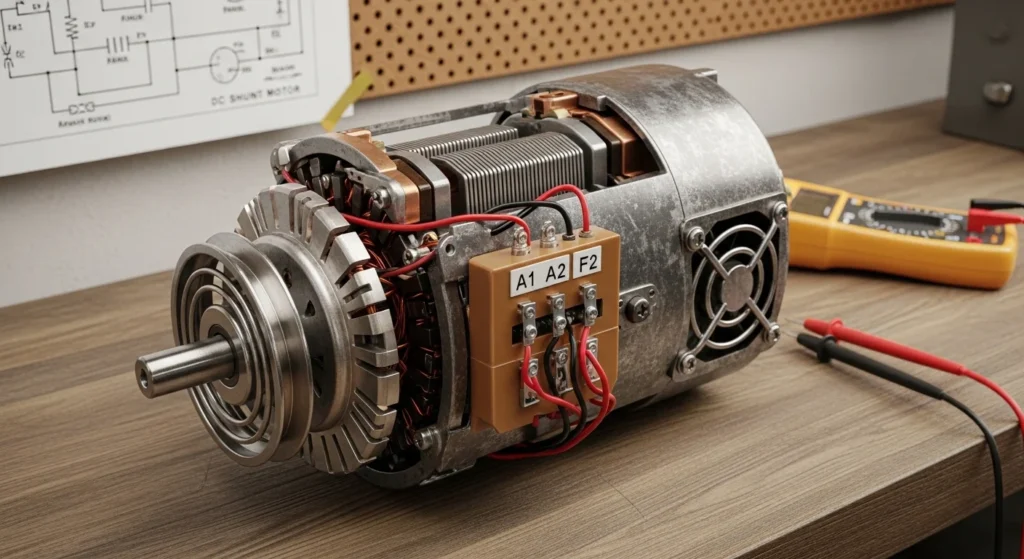

Imagine a factory where machines must run at a steady and constant speed throughout the day. For example, a lathe machine shaping metal parts cannot suddenly speed up or slow down. It needs a motor that can maintain almost the same speed even when the load changes slightly. In many such situations, engineers prefer using a DC Shunt Motor.
Electric motors play a vital role in industry by converting electrical energy into mechanical motion. Among the different types of DC motors, the DC Shunt Motor is known for its excellent speed regulation and stable performance. Because of these features, it is widely used in machine tools, fans, pumps, and industrial equipment.
Understanding how a DC shunt motor works is important for electrical students, technicians, and engineers. A clear knowledge of this motor helps in selecting the right motor, troubleshooting faults, and maintaining equipment properly.
In this article, you will learn the DC Shunt Motor working principle, its types, components, advantages and disadvantages, applications, and common problems with solutions. The explanation is written in simple language so beginners can easily understand how this motor works in real-world electrical systems.
What is a DC Shunt Motor?
A DC Shunt Motor is a type of self-excited DC motor in which the field winding is connected in parallel (shunt) with the armature winding.
Because the field winding is connected across the power supply, it receives the full supply voltage. This produces a constant magnetic field, which helps the motor maintain nearly constant speed.
Simple Explanation
The word “shunt” means parallel connection.
In a DC shunt motor:
- Armature winding is connected to the supply.
- Field winding is also connected across the same supply in parallel.
Both receive the same voltage but carry different currents.
Practical Example
Consider an industrial drilling machine. When the drill bit touches the material, the load slightly increases. A DC shunt motor keeps the speed almost constant, allowing the machine to perform precise work.
DC Shunt Motor Working Principle
The DC Shunt Motor working principle is based on the interaction between a magnetic field and current-carrying conductor.
When current flows through a conductor placed in a magnetic field, a force is produced. This force creates rotational motion in the motor.
Step-by-Step Operation
- DC power supply is applied to the motor.
- Current flows through the field winding, producing a magnetic field.
- Current also flows through the armature winding.
- The interaction between armature current and magnetic field produces electromagnetic force.
- This force generates torque, causing the rotor to rotate.
- The commutator reverses current direction in the armature conductors.
- Continuous rotation of the motor occurs.
Easy Analogy
Think of the motor like a water wheel in a river.
- The magnetic field acts like the river current.
- The armature conductors are like the blades of the wheel.
When the water pushes the blades, the wheel rotates continuously.
Key Points
- Magnetic field remains nearly constant.
- Speed changes very little with load variation.
- Smooth and stable operation.
Types / Classification of DC Shunt Motor
Although the basic design is similar, DC shunt motors can be classified based on their control methods and excitation conditions.
Long Shunt Motor
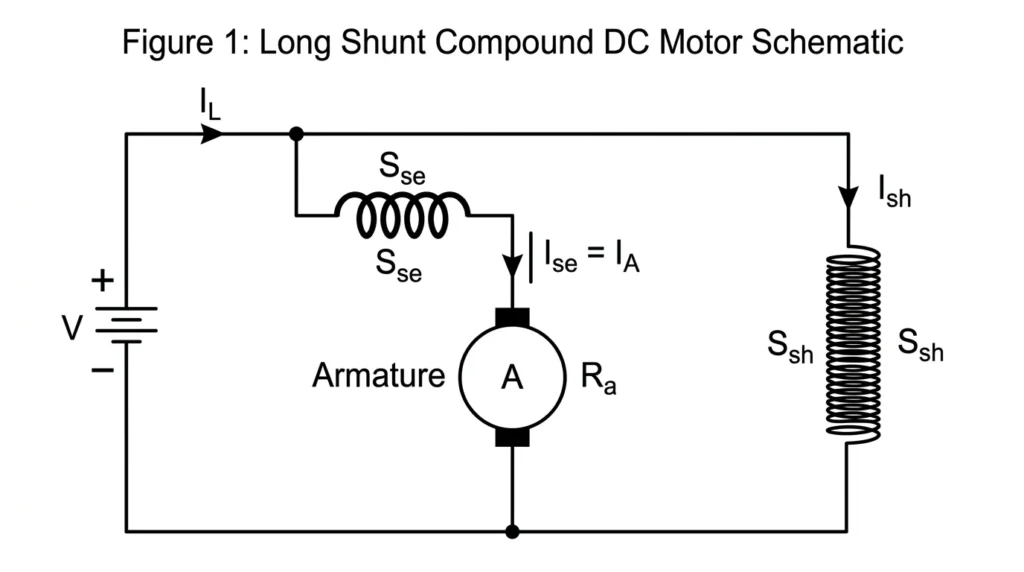
A long shunt motor is a type of DC compound motor in which the shunt field winding is connected in parallel with both the series field winding and the armature winding. This motor combines the features of both series motors and shunt motors, giving it good starting torque and fairly constant speed regulation. Long shunt motors are widely used in industries where stable speed and moderate starting torque are required. The motor operates on direct current (DC) supply and is designed to provide efficient performance under different load conditions. In this type of motor, the shunt winding carries a small current because it has high resistance, while the series winding carries the full armature current. Due to this arrangement, the magnetic fields produced by both windings work together to improve the overall performance of the motor. Long shunt motors are commonly used in elevators, conveyors, rolling mills, cranes, and industrial machinery. One of the major advantages of a long shunt motor is its ability to maintain nearly constant speed even when the load changes. It also provides better efficiency and smoother operation compared to a simple series motor. However, the construction of this motor is more complex and expensive because it uses both series and shunt windings. Proper maintenance is necessary to ensure long life and reliable performance. Overall, the long shunt motor is an important DC motor that offers a balanced combination of speed control and torque, making it suitable for many industrial and commercial applications.
In a long shunt motor, the shunt field winding is connected across the entire armature and series field combination.
Characteristics:
- Simple design
- Stable operation
- Used in compound motor systems
Short Shunt Motor
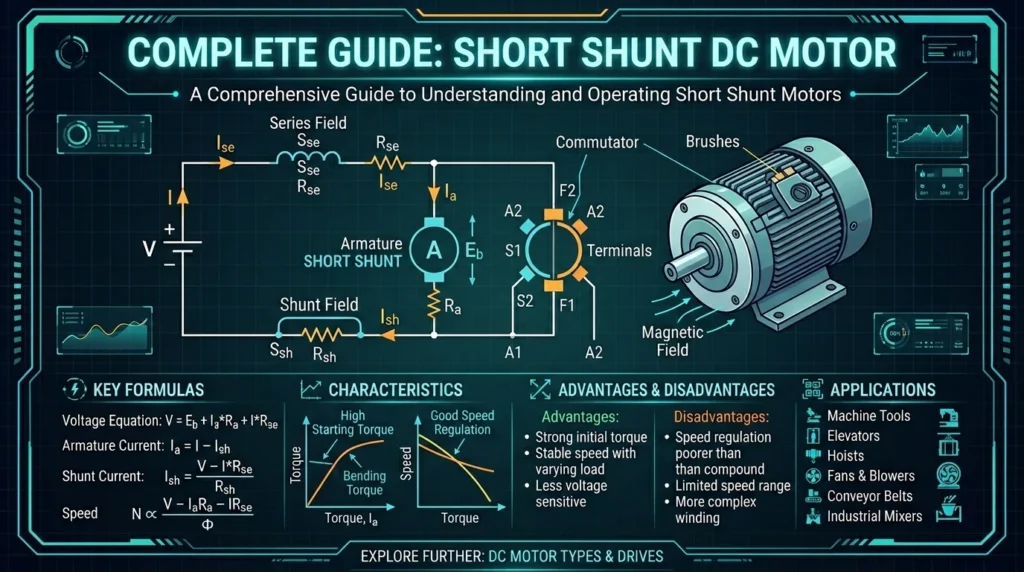
A short shunt motor is a type of DC compound motor in which the shunt field winding is connected in parallel only with the armature winding, while the series field winding is connected in series with the armature circuit. This motor combines the characteristics of both shunt motors and series motors, providing good starting torque along with better speed regulation. Short shunt motors are commonly used in industrial applications where a motor is required to handle varying loads while maintaining a fairly constant speed. In this type of motor, the series winding carries the armature current and helps produce strong starting torque, whereas the shunt winding produces a steady magnetic field for stable operation. Because of this combination, the motor performs efficiently under both light and heavy load conditions. Short shunt motors are often used in cranes, elevators, conveyors, presses, and machine tools where dependable speed and power are important. One of the main advantages of a short shunt motor is its improved speed control compared to a series motor. It also has better load handling capability and smoother operation. However, the motor has a more complicated construction because it uses two separate field windings. This increases the cost and maintenance requirements. Regular inspection of brushes, windings, and connections is necessary for proper working and long service life. Overall, the short shunt motor is a reliable and efficient DC motor that provides a balanced combination of torque and speed, making it suitable for many industrial and engineering applications.
In a short shunt motor, the field winding is connected only across the armature.
Characteristics:
- Slightly different current distribution
- Used in compound motor configurations
Controlled Shunt Motor
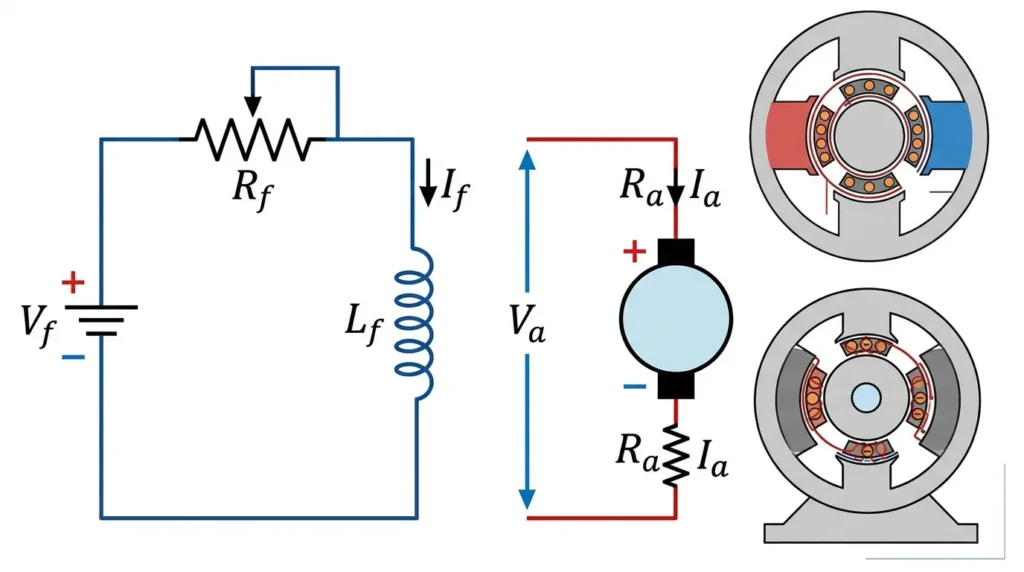
A controlled shunt motor is a type of DC shunt motor in which the speed and performance of the motor can be adjusted or controlled according to the load and operating requirements. In a normal DC shunt motor, the field winding is connected in parallel with the armature winding, which allows the motor to maintain nearly constant speed. In a controlled shunt motor, additional control methods such as field current control, armature voltage control, or electronic controllers are used to regulate the motor speed more accurately. These motors are widely used in industrial and commercial applications where precise speed control is necessary. The working principle of a controlled shunt motor is based on the interaction between the magnetic field produced by the shunt winding and the current flowing through the armature. By changing the field current or armature voltage, the speed of the motor can be increased or decreased smoothly. Controlled shunt motors are commonly used in machine tools, printing machines, conveyor systems, electric vehicles, fans, and textile industries because they provide stable and adjustable performance. One of the main advantages of this motor is its excellent speed regulation and smooth operation under varying load conditions. It also offers high efficiency, reliable performance, and easy control. However, the control system may increase the overall cost and complexity of the motor setup. Regular maintenance of the controller, brushes, and electrical connections is important for safe and efficient operation. Overall, the controlled shunt motor is an important DC motor that provides accurate speed control and dependable performance, making it highly useful in modern industrial automation and electrical engineering applications.
Modern systems sometimes use electronic controllers to regulate the speed of shunt motors.
Characteristics:
- Adjustable speed
- Improved efficiency
- Better control in industrial automation
Main Components of DC Shunt Motor
A DC shunt motor consists of several important parts that work together to produce rotation.
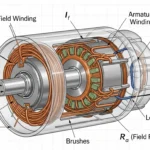
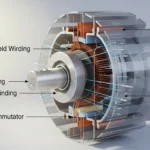
Armature
The armature is the rotating part of the motor.
Function:
- Carries armature current
- Interacts with magnetic field
- Produces torque
Field Winding
Field windings create the magnetic field required for motor operation.
They are connected in parallel with the armature.
Commutator
The commutator is a cylindrical mechanical switch.
Function:
- Reverses current direction in armature conductors
- Maintains continuous torque
Brushes
Brushes are usually made of carbon or graphite.
Function:
- Transfer electrical current from supply to the rotating commutator.
Stator
The stator is the stationary part of the motor that holds field poles and windings.
Shaft
The shaft transfers mechanical power from the motor to the connected machine.
DC Shunt Motor Advantages
The DC Shunt Motor advantages and disadvantages must be considered when selecting motors for industrial applications.
Advantages include:
- Excellent speed regulation
- Nearly constant speed operation
- Simple construction
- Easy speed control using field control method
- Reliable performance
- Smooth operation
- Suitable for many industrial machines
Because of these benefits, shunt motors are commonly used where steady speed is required.
Disadvantages / Limitations
Despite their advantages, DC shunt motors also have some limitations.
- Starting torque is lower than series motors
- Brushes require regular maintenance
- Commutator wear occurs over time
- Not ideal for heavy starting loads
- DC supply is required
Proper maintenance can help reduce these issues.
DC Shunt Motor Applications
The DC Shunt Motor applications are common in systems requiring constant speed operation.
Industrial Machines
- Lathes
- Milling machines
- Drilling machines
- Grinding machines
Ventilation Equipment
- Industrial fans
- Blowers
- Air circulation systems
Pump Systems
- Water pumps
- Oil pumps
- Cooling systems
Printing Machines
Printing presses require steady speed to ensure accurate printing.
Conveyor Systems
Factories often use shunt motors to move products smoothly along conveyor belts.
Comparison: DC Shunt Motor vs DC Series Motor
Understanding the difference between DC shunt motor and DC series motor helps engineers choose the right motor.
| Feature | DC Shunt Motor | DC Series Motor |
|---|---|---|
| Field Connection | Parallel with armature | Series with armature |
| Starting Torque | Moderate | Very high |
| Speed Regulation | Excellent | Poor |
| No-load Speed | Safe | Can become dangerously high |
| Applications | Machine tools, fans | Cranes, electric trains |
Both motors serve different purposes depending on the required torque and speed characteristics.
Selection Guide
Choosing the right DC motor requires several practical considerations.
1. Required Speed Stability
If constant speed is required, DC shunt motor is the best option.
2. Load Type
For light or moderate loads, shunt motors perform well.
Heavy loads may require series motors.
3. Maintenance Capability
Motors with brushes require periodic inspection and cleaning.
4. Power Supply Availability
Ensure a suitable DC power supply is available.
5. Environmental Conditions
Consider temperature, dust, and humidity in industrial environments.
Common Problems & Solutions
Motor Does Not Start
Possible causes:
- Power supply failure
- Loose wiring
- Worn brushes
Solution:
- Check power supply
- Tighten connections
- Replace brushes
Excessive Sparking
Causes:
- Dirty commutator
- Incorrect brush alignment
Solution:
- Clean commutator
- Adjust brushes
Motor Overheating
Causes:
- Overload
- Poor ventilation
- Insulation damage
Solution:
- Reduce load
- Improve cooling
- Inspect winding condition
Speed Fluctuation
Causes:
- Field winding fault
- Voltage variation
Solution:
- Check field circuit
- Stabilize power supply
Future Trends
Although modern industries increasingly use AC drives and brushless motors, DC shunt motors still remain useful in many applications.
Future improvements include:
- Digital motor controllers
- Smart monitoring systems
- Improved insulation materials
- Energy-efficient designs
- Integration with automation systems
These technologies will improve the performance and reliability of traditional DC motors.
Conclusion
The DC Shunt Motor is one of the most widely used DC motors in industrial applications. Its ability to maintain nearly constant speed makes it ideal for machines that require steady operation.
In this article, we explored the DC Shunt Motor working principle, its types, components, advantages and disadvantages, and real-world applications. Understanding these concepts helps electrical students, technicians, and engineers select the right motor and maintain equipment effectively.
Although newer motor technologies are emerging, DC shunt motors continue to play an important role in industries such as manufacturing, machine tools, and ventilation systems. Learning about these motors builds a strong foundation for understanding electric machines and motor control systems.