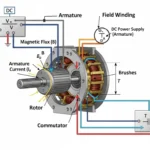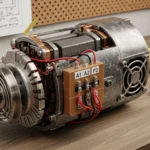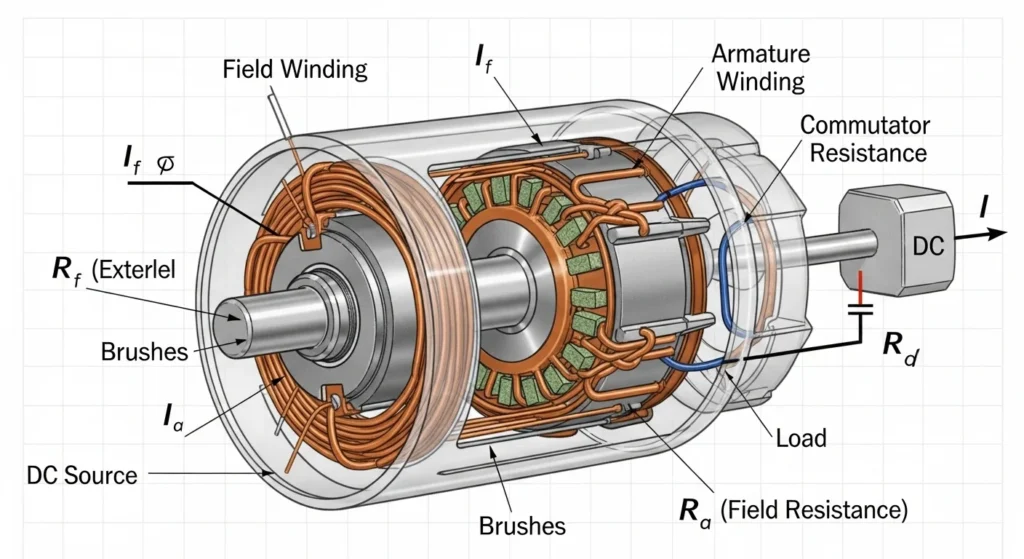

Imagine a small workshop where a conveyor belt moves products smoothly from one station to another. Behind this motion is an electric motor that provides reliable speed and torque. In many industrial machines, this job is often performed by a Self Excited DC Motor.
Electric motors are the backbone of modern industry. From manufacturing plants to elevators and electric vehicles, motors convert electrical energy into mechanical energy. Among different types of DC motors, the Self Excited DC Motor is widely used because it is simple, efficient, and easy to control.
Understanding how this motor works is important for electrical students, technicians, and engineers. It helps in selecting the right motor for different industrial applications and maintaining equipment properly.
In this article, you will learn the Self Excited DC Motor working principle, its types, components, advantages and disadvantages, applications, and troubleshooting methods. The goal is to explain the concept in simple and clear language so beginners can easily understand how this motor works in real-world systems.
Self Excited DC Motor
A self-excited DC motor is a type of direct current motor in which the field winding is energized by the same supply that feeds the armature. In this motor, the magnetic field is produced internally using the motor’s own supply, instead of using an external source. It is widely used in industrial machines, conveyors, pumps, and lifting equipment due to its simple design and reliable performance. The working principle of a DC motor is based on Lorentz Force Law, which states that a current-carrying conductor placed in a magnetic field experiences a mechanical force.
In a self-excited DC motor, the field winding and armature are connected either in series, shunt, or compound configuration. In a shunt motor, the field winding is connected in parallel with the armature, while in a series motor, it is connected in series. When DC supply is given, current flows through the field winding, creating a magnetic field. At the same time, current flows through the armature conductors. The interaction between the magnetic field and armature current produces a force that causes the rotor to rotate.
One of the main advantages of a self-excited DC motor is its simple construction and easy operation. It does not require a separate power source for field excitation, which reduces cost and complexity. It also provides good speed control and high starting torque (especially in series motors), making it suitable for heavy load applications like cranes and electric traction systems.
However, there are some disadvantages. The speed of a DC motor can vary with load, and it requires regular maintenance due to the presence of brushes and commutator. Sparking and wear of brushes can also reduce efficiency over time.
Overall, a self-excited DC motor is a practical and widely used machine in electrical engineering. Its simple design, strong starting performance, and cost-effectiveness make it suitable for many industrial and mechanical applications.
What is a Self Excited DC Motor?
A Self Excited DC Motor is a type of DC motor in which the field winding is connected to the same power supply that powers the armature winding.
In simple words, the motor generates its magnetic field using its own supply voltage. Because the field winding and armature share the same source, the motor does not need a separate power supply to create the magnetic field.
Simple Explanation
In a DC motor, two main things are needed:
- Magnetic field
- Electric current in the armature
When both interact, they produce rotational force called torque.
In a Self Excited DC Motor, the magnetic field is produced by field coils connected directly with the motor power supply.
Practical Example
A good example is an industrial fan or conveyor system powered by a DC motor. The same supply line energizes both the field winding and the armature, allowing the motor to run without a separate excitation source.
Self-Excited DC Motor Working Principle: Detailed Explanation
The working principle of a Self-Excited DC Motor is based on Lorentz Force, which states that when a current-carrying conductor is placed in a magnetic field, it experiences a mechanical force. This force produces motion, which is used to rotate the motor shaft and generate mechanical output.
In a self-excited DC motor, the magnetic field is produced by the motor’s own field winding, which is supplied by the same DC source as the armature. This means the motor does not require a separate external excitation source for the field winding. Instead, both the field winding and armature winding are energized from the same supply, making it a self-sustaining system.
Step-by-Step Working Process
When a DC voltage is applied to the motor, the following sequence takes place:
Field Winding Excitation
The DC supply first energizes the field winding, which produces a stationary magnetic field in the stator. This magnetic field is essential for motor operation because it provides the magnetic environment needed for torque production.
Armature Current Flow
At the same time, current flows through the armature winding placed in the magnetic field. The armature conductors carry current while being positioned inside the magnetic field generated by the field winding.
Force Production (Lorentz Force)
Due to the interaction between the magnetic field and the armature current, a mechanical force is generated on the conductors. This force follows the Lorentz force principle and acts in a direction that produces rotation.
Torque Generation and Rotation
The combined forces acting on the armature produce electromagnetic torque, which causes the rotor to start rotating. This torque is responsible for converting electrical energy into mechanical energy.
Role of Commutator
The commutator plays a very important role in maintaining continuous rotation. It reverses the direction of current in the armature conductors at the correct time so that the torque always acts in the same direction. Without the commutator, the motor would stop or oscillate instead of rotating continuously.
Simple Analogy
A self-excited DC motor can be understood like riding a bicycle:
- The DC supply acts like the rider’s energy
- The magnetic field acts like the road direction
- The armature current acts like pedaling force
- The combined interaction moves the system forward smoothly
Just like continuous pedaling keeps the bicycle moving, continuous interaction between current and magnetic field keeps the motor rotating.
Key Working Steps Summary
- DC supply energizes field winding
- Magnetic field is produced in the stator
- Armature current flows in the rotor
- Interaction between field and current produces force
- Electromagnetic torque rotates the rotor
- Commutator ensures continuous rotation
The self-excited DC motor works on the principle of electromagnetic force generated by the interaction of field flux and armature current. Because both windings are energized from the same source, the motor operates efficiently and reliably. The commutator ensures smooth and continuous rotation, making this motor widely used in industrial and electrical applications where controlled speed and high torque are required.
Types of Self Excited DC Motor
Self excited motors are classified based on how the field winding connects with the armature.
Shunt DC Motor: Construction, Working Principle, Characteristics, and Applications
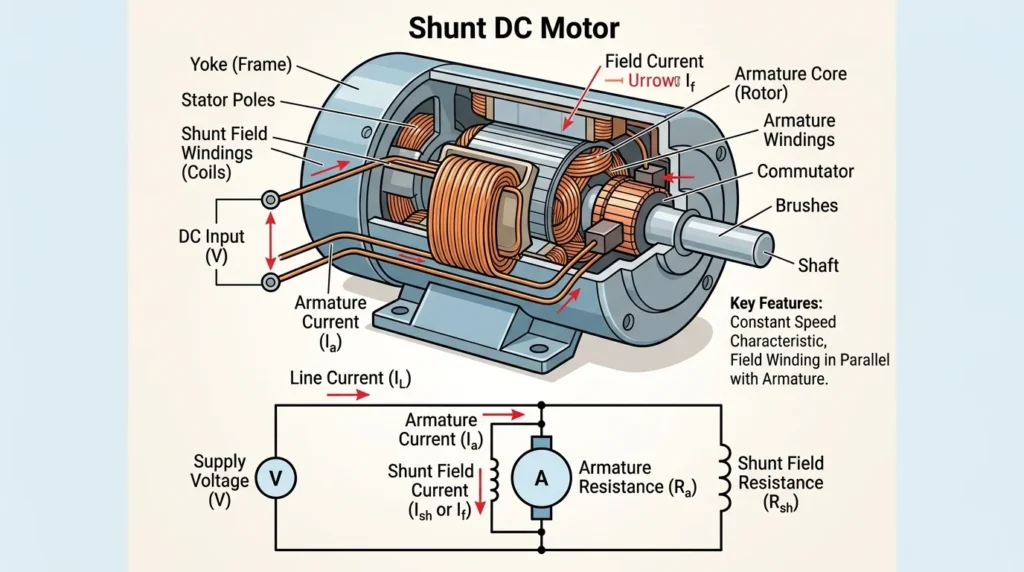
In a shunt motor, the field winding is connected parallel to the armature.
A Shunt DC Motor is a type of direct current (DC) motor where the field winding is connected in parallel (or “shunt”) with the armature winding. This simple connection gives the motor stable speed characteristics, making it one of the most commonly used DC motors in industries.
In a shunt DC motor, both the armature and field windings receive the same supply voltage, but the current flowing through them is different. The field winding has high resistance, so it draws a small current, while the armature carries a larger current to produce torque. Because the field current remains almost constant, the motor speed stays nearly constant even when the load changes. This is the main reason why shunt motors are preferred in applications where steady speed is required.
The working principle of a shunt DC motor is based on the interaction between the magnetic field and current-carrying conductors. When current flows through the armature conductors placed in a magnetic field, a force is produced according to electromagnetic principles. This force causes the armature to rotate, converting electrical energy into mechanical energy. As the motor rotates, it also generates back electromotive force (EMF), which helps regulate the armature current and keeps the motor stable.
One of the key advantages of a shunt DC motor is its excellent speed regulation. The speed does not change significantly with variations in load, which makes it ideal for machines like lathes, conveyors, fans, and blowers. It also provides smooth and reliable operation with low maintenance requirements.
However, shunt motors have some limitations. They do not produce very high starting torque compared to series motors, so they are not suitable for heavy starting loads. Also, if the field circuit gets disconnected, the motor speed can increase dangerously, which may cause damage.
In conclusion, the shunt DC motor is a reliable and efficient machine widely used in industrial applications where constant speed is important. Its simple design, stable performance, and ease of control make it a popular choice for many electrical systems.
Characteristics
- Constant speed
- Moderate starting torque
- Good speed regulation
Common Uses
- Lathes
- Fans
- Machine tools
Series DC Motor: Construction, Working Principle, Characteristics, and Applications
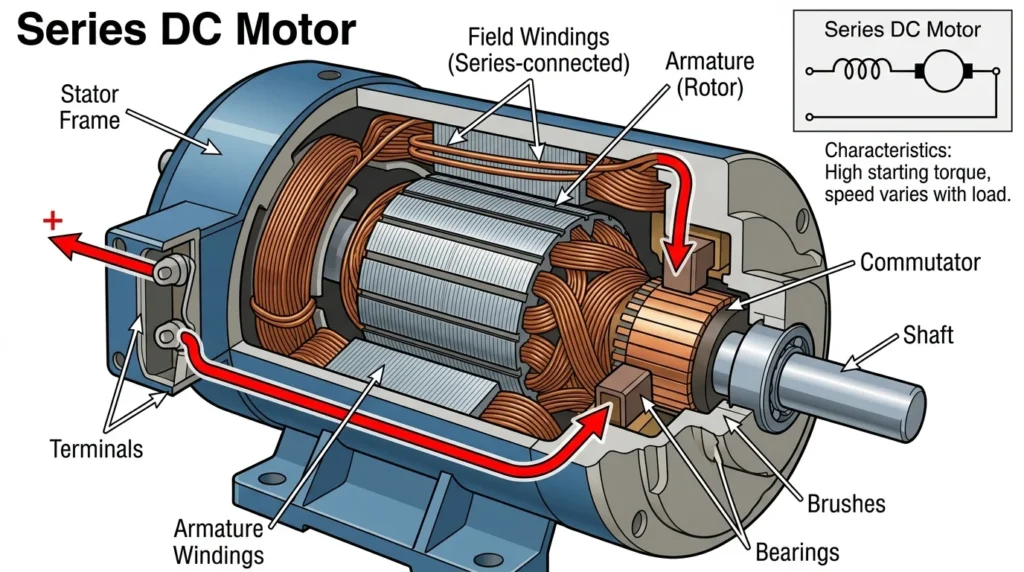
In a series motor, the field winding is connected in series with the armature.
A Series DC Motor is a type of direct current (DC) motor in which the field winding is connected in series with the armature winding. This means the same current flows through both the field coil and the armature. Because of this arrangement, the motor produces very high starting torque, making it ideal for heavy-load applications.
In a series DC motor, when power is supplied, current flows through the field winding first and then through the armature. Since both are in series, any increase in load causes an increase in current, which strengthens the magnetic field. This results in higher torque. That is why series motors are commonly used where strong starting force is required, such as in electric trains, cranes, hoists, and elevators.
The working principle of a series DC motor is based on electromagnetic force. When current flows through the armature conductors placed in a magnetic field, a force is produced that causes rotation. In this motor, both the magnetic field strength and armature current increase together under load, producing a powerful turning effect. However, at no load, the current becomes very low, and the motor speed increases rapidly to a dangerous level. This is why a series motor should never be operated without load.
One of the main advantages of a series DC motor is its extremely high starting torque. It can easily start heavy machines and carry large loads. It is also simple in construction and easy to maintain. However, it has poor speed regulation, meaning its speed varies significantly with load. It can become unstable and unsafe if not properly controlled.
In conclusion, the series DC motor is a powerful and efficient machine designed for applications requiring high starting torque. While it offers excellent performance under load, it must be used carefully to avoid damage due to excessive speed under no-load conditions.
Characteristics
- Very high starting torque
- Speed varies with load
- Not suitable for no-load operation
Common Uses
- Electric traction
- Cranes
- Hoists
- Electric vehicles
Compound DC Motor: Construction, Working Principle, Types, Characteristics, and Applications
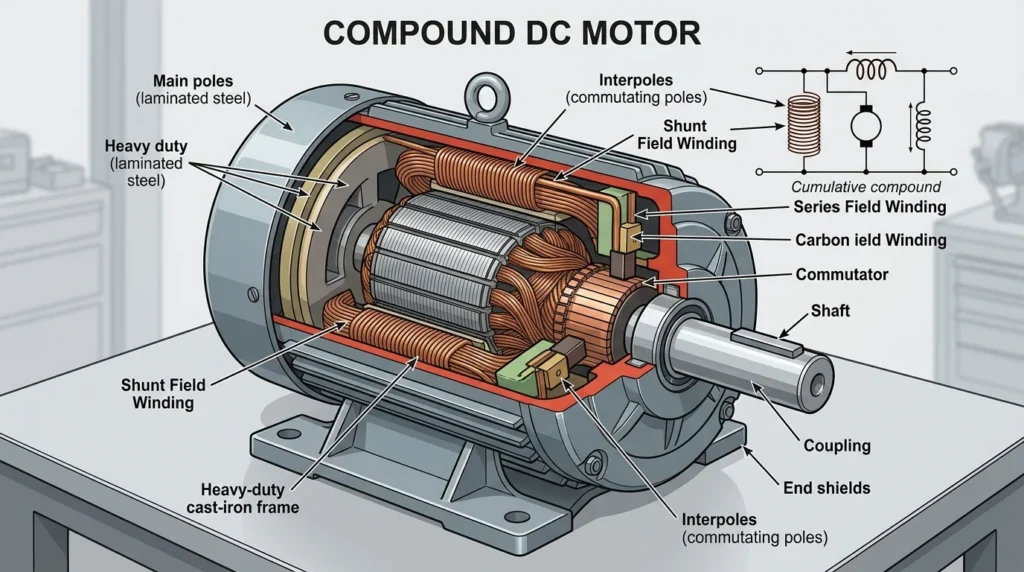
A compound motor combines both series and shunt windings.
A Compound DC Motor is a type of direct current (DC) motor that combines the features of both series DC motor and shunt DC motor. It uses two field windings: one connected in series with the armature and the other connected in parallel (shunt). This combination helps achieve a balance between high starting torque and good speed regulation.
In a compound DC motor, the series winding provides strong starting torque, while the shunt winding helps maintain nearly constant speed during operation. Because of this dual-field structure, the motor can handle varying loads more efficiently than pure series or shunt motors. This makes it a very practical choice for real-world industrial applications.
The working principle of a compound DC motor is based on electromagnetic interaction. When current flows through both windings, magnetic fields are produced in the series and shunt coils. These fields combine to create a strong and stable overall magnetic flux. The armature then rotates under this magnetic influence, producing mechanical output. Depending on how the windings are connected, the motor performance can be adjusted for different requirements.
There are two main types of compound DC motors: cumulative compound motor and differential compound motor. In a cumulative compound motor, both series and shunt fields work in the same direction, improving torque and stability. In a differential compound motor, the fields oppose each other, which is rarely used due to unstable performance.
One of the main advantages of a compound DC motor is its ability to provide both good starting torque and stable speed control. It is widely used in applications such as presses, rolling mills, conveyors, and heavy machinery. However, it is more complex in design compared to simple DC motors, and it requires more maintenance.
In conclusion, the compound DC motor is a versatile and efficient machine that combines the strengths of both series and shunt motors. Its balanced performance makes it suitable for industrial applications where both power and speed stability are required.
It provides the advantages of both motor types.
Two main types exist:
- Cumulative compound motor
- Differential compound motor
Common Uses
- Elevators
- Press machines
- Rolling mills
Main Components of a Self-Excited DC Motor: Detailed Explanation
A Self-Excited DC Motor is made up of several essential components that work together to convert electrical energy into mechanical energy. Each part has a specific role in ensuring smooth operation, continuous rotation, and efficient torque production. Understanding these components helps in learning how a DC motor functions in practical applications.
Armature
The armature is the rotating part of the DC motor and is one of the most important components in energy conversion. It consists of a laminated core with conductors placed in slots.
Function of Armature:
- Carries current supplied through the brushes and commutator
- Interacts with the magnetic field to produce electromagnetic force
- Generates torque that causes the rotor to rotate
- Converts electrical energy into mechanical energy
The continuous rotation of the armature is the main source of mechanical output in the motor.
Field Winding
The field winding is responsible for producing the magnetic field required for motor operation. It is mounted on the stator poles and is energized by the DC supply.
Function of Field Winding:
- Creates a strong and stable magnetic field
- Provides the necessary flux for torque generation
- Works with the armature current to produce motion
- Controls motor performance depending on excitation level
Without the field winding, no magnetic field would exist, and the motor would not operate.
Commutator
The commutator is a cylindrical, segmented copper ring attached to the armature shaft. It acts as a mechanical rectifier.
Function of Commutator:
- Reverses the direction of current in the armature windings
- Ensures that torque always acts in one direction
- Maintains continuous and smooth rotation of the motor
- Works together with brushes to supply current
The commutator is essential for converting DC supply into alternating current within the armature.
Brushes
The brushes are usually made of carbon or graphite and are placed in contact with the commutator.
Function of Brushes:
- Transfer electrical current from the stationary supply to the rotating armature
- Maintain continuous electrical contact during rotation
- Reduce wear on the commutator due to friction
- Ensure stable and reliable current flow
Proper brush contact is important for efficient motor performance.
Shaft
The shaft is a mechanical component that is connected to the armature and rotates along with it.
Function of Shaft:
- Transfers mechanical power from the motor to the external load
- Supports the rotating assembly of the motor
- Ensures smooth transmission of torque
- Connects the motor to machines such as fans, pumps, and conveyors
The shaft is the final output part that delivers usable mechanical energy.
The main components of a Self-Excited DC Motor—including the armature, field winding, commutator, brushes, and shaft—work together to ensure efficient conversion of electrical energy into mechanical motion. Each part plays a vital role in producing torque, maintaining rotation, and delivering mechanical output for various industrial and commercial applications.
Self Excited DC Motor Advantages
The Self Excited DC Motor advantages and disadvantages are important when selecting a motor for applications.
Advantages include:
- Simple design
- Easy installation
- Reliable operation
- Good speed control
- Lower cost compared to separately excited motors
- No external excitation supply needed
- Suitable for many industrial machines
These benefits make self excited motors popular in industrial environments.
Disadvantages / Limitations
Despite their advantages, these motors also have limitations.
- Speed control may be limited in some designs
- Brushes require maintenance
- Commutator wear over time
- Not suitable for very high-speed applications
- Efficiency can decrease under heavy load
Regular maintenance can reduce many of these issues.
Applications of Self-Excited DC Motor: Industrial and Practical Uses
The Self-Excited DC Motor is widely used in various industries due to its excellent speed control, high starting torque, and reliable performance. These motors are suitable for applications where smooth and adjustable operation is required. Because the field winding is energized by the same power source as the armature, the motor provides stable and efficient operation under different load conditions.
Industrial Equipment Applications
Self-excited DC motors are commonly used in industrial machines where precise speed control and consistent torque are essential.
Common uses include:
- Conveyor belt systems for material handling
- Machine tools such as lathes, drills, and milling machines
- Rolling mills used in metal processing industries
- Printing machines requiring uniform speed and accuracy
These applications benefit from the motor’s ability to maintain steady performance under varying loads.
Transportation Systems
In the transportation sector, self-excited DC motors are valued for their high torque and controllable speed characteristics.
Applications include:
- Electric locomotives for rail transport
- Electric vehicles (older and some specialized systems)
- Urban transit systems and traction equipment
Their ability to provide strong starting torque makes them suitable for heavy transport applications.
Lifting and Hoisting Systems
Self-excited DC motors are widely used in equipment that involves lifting heavy loads, where safety and torque control are critical.
Common applications include:
- Cranes used in construction and industries
- Hoists for lifting materials in factories
- Elevators in buildings
These motors ensure smooth lifting and controlled movement of heavy loads.
Household and Light-Duty Applications
In smaller-scale applications, self-excited DC motors are used in household and light electrical equipment.
Examples include:
- Electric fans
- Small water pumps
- Domestic appliances requiring variable speed control
Their simple speed regulation makes them suitable for everyday use.
The applications of self-excited DC motors cover a wide range of industrial, transportation, lifting, and household systems. Their ability to deliver high torque, stable operation, and good speed control makes them highly useful in both heavy-duty and light-duty applications. This versatility is the main reason they remain an important part of electrical machinery in modern systems.
Comparison: Self Excited vs Separately Excited DC Motor
Understanding the difference between self excited and separately excited DC motor helps engineers select the right motor.
| Feature | Self Excited DC Motor | Separately Excited DC Motor |
|---|---|---|
| Field Supply | Same as armature supply | Separate external supply |
| Complexity | Simple | More complex |
| Cost | Lower | Higher |
| Control | Moderate control | Excellent control |
| Applications | General industrial machines | Precision speed control systems |
Both motors have their own advantages depending on the application.
DC Motor Selection Guide: How to Choose the Right Self-Excited DC Motor
Selecting the correct self-excited DC motor is very important for achieving efficient performance, long service life, and safe operation. Different types of DC motors are designed for different load conditions, speed requirements, and control needs. A proper selection ensures better efficiency and reduces maintenance issues.
1. Determine Load Requirements
The first step in selecting a DC motor is to clearly understand the load conditions.
You should identify:
- Required torque to move the load
- Desired speed range for operation
- Type of load (constant, variable, or heavy starting load)
For example, heavy machinery needs high torque motors, while light equipment requires lower torque motors.
2. Check Power Supply Compatibility
DC motors operate on specific voltage levels, so it is important to match the motor with the available power source.
Ensure:
- Motor rated voltage matches the DC supply
- Power supply can handle the required current
- Proper protection devices are installed
Incorrect voltage selection can damage the motor or reduce its efficiency.
3. Consider Speed Control Requirements
Speed control is one of the main advantages of DC motors.
- For constant speed applications, a shunt DC motor is preferred because it maintains nearly constant speed under varying loads.
- For applications requiring wide speed variation, other motor types or control systems may be needed.
4. Evaluate Starting Torque Requirements
Starting torque is critical for heavy-load applications.
- Series DC motors are ideal for high starting torque applications such as cranes, hoists, and electric traction systems.
- They provide strong initial force, making them suitable for heavy industrial loads.
Choosing the wrong motor type may result in poor starting performance.
5. Consider Maintenance Requirements
DC motors use brushes and commutators, which require regular maintenance.
Points to consider:
- Brush wear and replacement frequency
- Commutator condition and cleaning
- Accessibility for inspection and servicing
Motors with easier maintenance access are preferred for continuous industrial use.
Selecting the right DC motor depends on load requirements, voltage compatibility, speed control needs, starting torque, and maintenance factors. By carefully evaluating these parameters, users can choose the most suitable self-excited DC motor for efficient, reliable, and long-lasting performance in industrial and commercial applications.
Common Problems and Solutions
Motor Not Starting
Possible causes:
- Power supply failure
- Loose connections
- Worn brushes
Solution:
- Check wiring
- Replace brushes if needed
Excessive Sparking at Brushes
Causes:
- Dirty commutator
- Incorrect brush pressure
Solution:
- Clean commutator
- Adjust brush tension
Overheating
Causes:
- Overloading
- Poor ventilation
- Shorted windings
Solution:
- Reduce load
- Improve cooling
- Inspect winding insulation
Speed Fluctuation
Causes:
- Field winding damage
- Voltage variation
Solution:
- Check field circuit
- Stabilize supply voltage
Future Trends
Although modern industries increasingly use AC drives and brushless motors, DC motors still remain important.
Future improvements include:
- Advanced motor controllers
- Improved brush materials
- Smart monitoring systems
- Integration with automation systems
- Energy efficient designs
Industrial automation and robotics are creating new opportunities for improved motor technologies.
Conclusion
The Self Excited DC Motor is one of the most important machines in electrical engineering. It offers a simple design, reliable operation, and practical speed control for many industrial applications.
In this article, we explored the Self Excited DC Motor working principle, types, components, advantages and disadvantages, and applications. Understanding these concepts helps engineers and technicians choose the right motor for different machines and maintain equipment effectively.
Although newer technologies like brushless motors are growing, self excited DC motors remain widely used in industries such as manufacturing, transportation, and lifting systems.
For electrical students and beginners, learning about DC motors builds a strong foundation for understanding more advanced electrical machines and motor control systems.