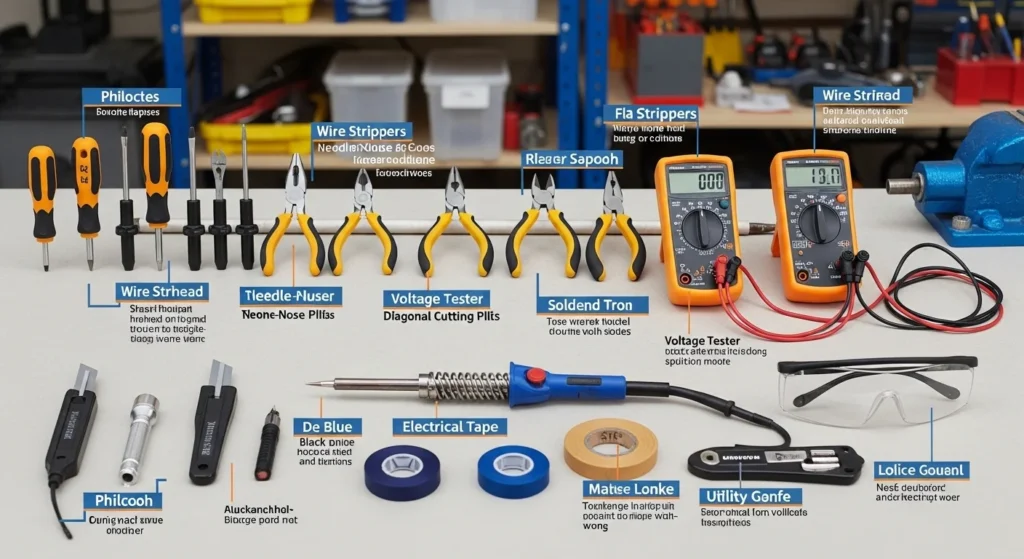

Imagine you arrive at a site to install a new distribution board. The wiring plan is ready, cables are pulled, and the client is waiting. But when you open your bag, you realize you forgot your voltage tester and proper crimping tool. You try to manage with limited tools, but the work becomes slow, unsafe, and unprofessional.
This situation is common for beginners and even experienced technicians who do not maintain a proper electrical tool kit. In electrical work, your tools are your foundation. A complete and organized tool kit improves safety, speed, and confidence on every job.
In this Electrical Tool Kit Guide, you will learn what an electrical tool kit is, the electrical tool kit working principle, types, main components, electrical tool kit applications, and electrical tool kit advantages and disadvantages. You will also understand the difference between basic and advanced electrical tool kits, how to choose the right kit, and how to solve common problems.
Let’s build your knowledge step by step, just like building a strong electrical system.
2. What is an Electrical Tool Kit?
An electrical tool kit is a collection of essential tools used by electricians, engineers, and technicians to install, repair, test, and maintain electrical systems.
In simple words, it is a ready-to-use toolbox that contains all necessary hand tools and measuring instruments required for electrical work.
Clear Definition
An electrical tool kit is a structured set of insulated and non-insulated tools designed specifically for safe and efficient electrical installation, testing, and maintenance.
Practical Example
When installing a ceiling fan, you may need:
- Screwdrivers
- Pliers
- Wire stripper
- Voltage tester
Instead of searching for tools separately, a complete electrical tool kit keeps everything organized in one place. This saves time and increases safety.
3. Electrical Tool Kit Working Principle
You may wonder: how does an electrical tool kit have a working principle?
The electrical tool kit working principle is based on combining different tools that perform specific mechanical and electrical functions together to complete a task safely and efficiently.
Step-by-Step Explanation
- Measurement Tools detect electrical values (voltage, current, continuity).
- Cutting Tools cut wires and cables.
- Stripping Tools remove insulation safely.
- Holding Tools grip components.
- Driving Tools tighten or loosen screws.
- Safety Tools protect the user from shock.
Easy Analogy
Think of an electrical tool kit like a medical kit:
- A doctor uses different instruments for diagnosis and treatment.
- An electrician uses different tools for testing and installation.
Each tool has a specific role, but together they complete the job properly.
4. Types / Classification of Electrical Tool Kits
Electrical tool kits can be classified based on usage level and application area.
Basic Electrical Tool Kit (Beginner Level)
Designed for students and home electricians.
Usually includes:
- Insulated screwdrivers
- Combination pliers
- Wire stripper
- Voltage tester
- Measuring tape
Best for:
- Small home repairs
- Basic installations
- Training practice
Professional Electrical Tool Kit
Used by trained electricians and technicians.
Includes:
- Insulated screwdrivers set
- Long nose pliers
- Side cutter
- Crimping tool
- Digital multimeter
- Insulation tape
- Adjustable wrench
Best for:
- Distribution boards
- Industrial panels
- Motor connections
Industrial Electrical Tool Kit
Used in factories and heavy electrical systems.
Includes:
- Torque screwdriver
- Advanced multimeter
- Clamp meter
- Cable cutter
- Hydraulic crimping tool
- Insulation resistance tester (Megger)
Best for:
- Industrial maintenance
- High voltage systems
- Control panel assembly
Specialized Electrical Tool Kit
Used for specific tasks like:
- Solar installation
- PLC wiring
- PCB repair
- EV charging station setup
These kits are customized for special applications.
5. Main Components of an Electrical Tool Kit
A complete electrical tool kit contains several important tools.
1. Screwdrivers (Insulated)
Insulated screwdrivers are special hand tools used in electrical work to tighten or loosen screws safely while protecting the user from electric shock. They are designed for electricians, technicians, and engineers who work on live or potentially live electrical systems. Unlike normal screwdrivers, insulated screwdrivers have a protective layer that covers the shaft and handle to prevent electric current from reaching the user.
The working principle of an insulated screwdriver is based on mechanical torque with electrical insulation. When force is applied to the handle, the metal tip turns the screw, while the insulated coating prevents electricity from passing through the tool to the user’s hand. This makes it safe to work on electrical panels, switches, and wiring systems.
Insulated screwdrivers are usually made with high-quality steel tips and coated with strong insulating materials like rubber or plastic. They are tested for specific voltage ratings, such as 1000V, to ensure safety in electrical environments. Common types include flat-head screwdrivers, Phillips screwdrivers, and precision insulated screwdrivers for small electronic components.
The main advantage of insulated screwdrivers is safety. They reduce the risk of electric shock and allow safe handling of electrical equipment. They are also durable, easy to use, and essential for professional electrical work. However, if the insulation is damaged or cracked, the tool becomes unsafe and must not be used.
Insulated screwdrivers are widely used in household electrical repairs, industrial control panels, maintenance work, and electronic device servicing.
Overall, insulated screwdrivers are essential safety tools in electrical engineering that ensure secure operation, prevent accidents, and improve working confidence in live electrical environments.
Function:
- Tighten and loosen terminal screws.
- Prevent electric shock when working on live circuits.
2. Pliers (Combination, Long Nose, Side Cutter)
Pliers are essential hand tools used in electrical, mechanical, construction, and maintenance work. They are mainly used for gripping, bending, twisting, cutting, and holding wires or small components. For electricians and technicians, pliers are one of the most basic yet most important tools because they support safe and precise handling of electrical wiring tasks.
There are different types of pliers, each designed for specific functions. The most common types are combination pliers, long nose pliers, and side cutter pliers. Combination pliers are multi-purpose tools used for gripping, twisting, and light cutting of wires. They have a strong jaw and are suitable for general electrical work. Long nose pliers have long, pointed jaws that help in reaching tight spaces and holding small wires or components. They are especially useful in panel wiring and electronics work. Side cutter pliers, also called diagonal cutters, are designed for cutting wires cleanly and accurately. They are widely used for trimming excess wire ends during installation.
The working principle of pliers is based on simple mechanical leverage. When force is applied to the handles, the jaws multiply that force to grip or cut materials efficiently. This makes it easier to handle tough electrical wires or components with minimal effort.
The main advantage of pliers is their versatility and durability. They are simple to use, require no power supply, and can perform multiple tasks in electrical work. However, improper use, such as using cutting pliers for very thick wires, can damage the tool or reduce its efficiency.
Pliers are widely used in home wiring, industrial electrical panels, automotive repair, electronics assembly, and maintenance work.
Overall, pliers are fundamental tools in electrical and technical fields that provide strong grip, precise control, and reliable performance for a wide range of applications.
Function:
- Hold wires
- Cut wires
- Bend cables
3. Wire Stripper
A wire stripper is a small but very important electrical hand tool used to remove the insulation layer from electrical wires without damaging the inner conductor. It is commonly used by electricians, technicians, and students during wiring, installation, and repair work. Proper stripping of wire insulation is essential for safe and strong electrical connections.
The working principle of a wire stripper is based on controlled cutting pressure. The tool has sharp notches or blades of different sizes that match various wire gauges. When the wire is placed inside the correct notch and the handles are pressed, the insulation is cut and removed while keeping the metal conductor intact. This ensures clean and safe wire preparation for further connections.
Wire strippers are available in different types such as manual wire strippers, automatic wire strippers, and adjustable wire strippers. Manual types are simple and low-cost, while automatic strippers adjust themselves according to wire size and make the work faster. Adjustable strippers are commonly used in professional electrical work for better accuracy and flexibility.
The main advantage of a wire stripper is that it provides quick, safe, and precise removal of insulation without damaging the wire. It improves connection quality and reduces the risk of loose or faulty joints. However, incorrect use or using the wrong size notch can damage the conductor, which may lead to overheating or poor electrical performance.
Wire strippers are widely used in home wiring, industrial electrical panels, automotive wiring, electronics repair, and communication systems.
Overall, a wire stripper is an essential electrical tool that ensures proper wire preparation, improves safety, and supports high-quality electrical installations.
Function:
- Remove insulation without damaging conductor.
- Ensures clean and safe connections.
4. Multimeter
A multimeter is a very important electrical measuring instrument used to measure voltage, current, and resistance in electrical and electronic circuits. It is widely used by electricians, engineers, technicians, and students for testing, troubleshooting, and repairing electrical systems. Because it combines multiple measurement functions in a single device, it is also called a “multi-function meter.”
The working principle of a multimeter is based on electrical measurement conversion. It detects electrical signals from a circuit and converts them into readable values on a digital or analog display. In voltage mode, it measures potential difference between two points. In current mode, it measures flow of electric charge in a circuit. In resistance mode, it checks how much a component resists current flow.
Multimeters are mainly classified into two types: analog multimeter and digital multimeter (DMM). Analog multimeters show readings using a moving needle, while digital multimeters display values on an LCD screen. Digital multimeters are more accurate, easy to use, and widely used in modern electrical work.
The main advantage of a multimeter is its versatility. It can perform multiple electrical tests using a single tool, which saves time and improves efficiency. It also helps in safe troubleshooting of electrical faults. However, incorrect setting or misuse can damage the device or give wrong readings.
Multimeters are commonly used in home electrical repair, industrial maintenance, electronics testing, battery checking, and circuit design work. They are essential tools for identifying faults like broken wires, short circuits, and voltage drops.
Overall, a multimeter is a must-have instrument in electrical and electronic fields that ensures accurate measurement, safe troubleshooting, and reliable system performance.
Function:
- Measure voltage, current, and resistance.
- Check continuity and faults.
5. Voltage Tester
A voltage tester is an important electrical safety tool used to check the presence of electrical voltage in a circuit, wire, socket, or electrical device. It is widely used by electricians, engineers, technicians, and beginners to ensure safety before working on any electrical system. The main purpose of a voltage tester is to confirm whether a circuit is live (energized) or safe to touch.
The working principle of a voltage tester is based on detecting electrical potential difference. When the tester probe touches a live wire, current flows through the tester and indicates voltage presence through a light, sound, or digital display depending on the type of tester. This simple process helps users quickly identify dangerous live circuits.
Voltage testers are available in different types such as non-contact voltage testers, neon voltage testers, digital voltage testers, and multimeter-based testers. Non-contact testers can detect voltage without touching the wire directly, making them very safe and easy to use. Digital testers provide accurate voltage readings and are commonly used in professional electrical work.
The main advantage of a voltage tester is improved safety. It helps prevent electrical shock by allowing users to identify live wires before starting any repair or installation work. It is also portable, easy to use, and provides quick results. However, it should always be used correctly, and users should not rely only on it for complex electrical diagnosis.
Voltage testers are widely used in home wiring, industrial maintenance, electrical panel testing, appliance repair, and troubleshooting electrical faults.
Overall, a voltage tester is a simple but essential safety tool in electrical work that ensures safe operation and protects users from dangerous electrical shocks.
Function:
- Detect presence of live voltage.
- Quick safety check before touching wires.
6. Crimping Tool
A crimping tool is a hand-operated electrical tool used to join or fix connectors to the end of electrical wires by applying strong pressure. It is widely used in electrical wiring, panel installation, networking, and industrial maintenance work. For electrical students, technicians, and engineers, a crimping tool is an essential instrument because it ensures safe, strong, and reliable wire connections without soldering.
The working principle of a crimping tool is based on mechanical pressure. When the handle of the tool is pressed, its jaws tightly compress the metal connector (called a lug or terminal) onto the stripped end of a wire. This creates a strong electrical and mechanical bond between the wire and the connector. A properly crimped joint prevents loose connections, overheating, and voltage loss.
Crimping tools are available in different types such as manual crimping tools, hydraulic crimping tools, and ratchet crimping tools. Manual tools are used for small electrical work, while hydraulic tools are used for heavy-duty industrial applications. Ratchet crimping tools provide controlled pressure and better accuracy.
The main advantage of a crimping tool is that it creates a fast, safe, and durable connection without the need for soldering or heating. It also improves electrical conductivity and reduces the risk of loose wiring. However, improper use of the tool can result in weak connections, which may cause overheating or failure in the circuit.
Crimping tools are widely used in electrical panels, battery terminals, automotive wiring, telecommunications, and control systems.
Overall, a crimping tool is a simple but highly important electrical instrument that ensures secure wiring connections and improves the safety and reliability of electrical installations.
Function:
- Attach lugs and terminals securely.
- Improve connection reliability.
7. Measuring Tape
A measuring tape is a simple and very important measuring tool used to measure length, distance, and dimensions of objects in construction, electrical work, carpentry, engineering, and daily life. It is flexible, portable, and easy to use, making it one of the most common tools for both professionals and beginners. In electrical and construction work, accurate measurement is very important, and a measuring tape helps ensure proper installation and fitting of equipment.
A standard measuring tape consists of a flexible metal or fiber strip marked with measurement units such as millimeters, centimeters, and inches. It is usually stored in a small plastic or metal case that allows the tape to roll back automatically after use. Some measuring tapes also include a locking system to hold the tape at a fixed length during measurement.
The working principle of a measuring tape is based on direct linear measurement. The user extends the tape along the object or surface, reads the scale marking, and records the exact length. This simple mechanism ensures fast and accurate measurement without requiring complex tools.
Measuring tapes are available in different types such as manual measuring tapes, steel tapes, fiberglass tapes, and digital measuring tapes. Each type is used according to the level of accuracy and application required.
The main advantage of a measuring tape is its simplicity, portability, and low cost. However, it may become less accurate if not handled properly or if the tape is bent or stretched.
Measuring tapes are widely used in home construction, electrical wiring layout, machine installation, furniture design, and surveying work.
Overall, a measuring tape is an essential tool in every technical field, helping professionals achieve accurate measurements and high-quality work results.
Function:
- Measure cable lengths.
- Plan installation layout.
Each component has a specific purpose. Removing one important tool can reduce efficiency.
6. Electrical Tool Kit Advantages and Disadvantages
Advantages
- Organized and ready-to-use
- Improves work speed
- Increases safety
- Reduces tool loss
- Professional appearance
- Suitable for multiple tasks
Real-World Benefits
- Faster troubleshooting
- Better connection quality
- Reduced risk of electric shock
- Increased job accuracy
Disadvantages / Limitations
- Initial cost can be high
- Heavy to carry (large kits)
- Tools require maintenance
- Cheap kits may contain low-quality tools
- Not all kits fit every application
Understanding electrical tool kit advantages and disadvantages helps you invest wisely.
7. Electrical Tool Kit Applications
Electrical tool kit applications are found in every electrical environment.
Home Applications
- Installing switches and sockets
- Repairing fans and lights
- Checking power supply
Industrial Applications
- Panel board wiring
- Motor maintenance
- Transformer testing
- Cable termination
Modern Technology Applications
- Solar system installation
- Smart home setup
- Electric vehicle charging systems
- Automation control panels
A proper electrical tool kit is essential for modern electrical systems.
8. Comparison Section
Difference Between Basic and Professional Electrical Tool Kit
| Feature | Basic Kit | Professional Kit |
| Tools Count | Limited | More complete |
| Measuring Devices | Simple tester | Digital multimeter |
| Safety Level | Moderate | High |
| Application | Home work | Industrial & commercial |
| Cost | Low | Medium to High |
Electrical Tool Kit vs Mechanical Tool Kit
| Feature | Electrical Tool Kit | Mechanical Tool Kit |
| Insulated Tools | Yes | Usually No |
| Measuring Devices | Multimeter | Torque wrench |
| Main Use | Electrical systems | Machines & engines |
| Shock Protection | High importance | Not required |
The difference between electrical and mechanical tool kits mainly lies in insulation and electrical safety equipment.
9. Selection Guide: How to Choose the Right Electrical Tool Kit
Choosing the correct electrical tool kit depends on your work level.
1. Identify Your Work Type
- Student → Basic kit
- Technician → Professional kit
- Industrial engineer → Advanced kit
2. Check Insulation Rating
Always choose insulated tools rated for proper voltage (for example, 1000V rating).
3. Quality Over Quantity
Better to buy:
- Fewer high-quality tools
Than - Many low-quality tools
4. Check Ergonomic Design
- Comfortable grip
- Anti-slip handles
- Durable case
5. For Beginners
- Start with essential tools
- Learn proper usage
- Maintain tools properly
Never compromise on safety tools like voltage tester and insulated screwdrivers.
10. Common Problems & Solutions (FAQs)
Q1: Why do tools rust inside my kit?
Reason:
- Moisture exposure
- Poor storage
Solution:
- Store in dry place
- Use silica gel packets
- Clean tools after use
Q2: Why does my multimeter give wrong readings?
Reason:
- Weak battery
- Incorrect range selection
Solution:
- Replace battery
- Select proper measurement range
Q3: Can I use mechanical tools for electrical work?
Not recommended.
Difference between electrical tool kit and mechanical tool kit is mainly insulation. Electrical work requires insulated tools.
Q4: Why do wire connections become loose?
Reason:
- Poor crimping
- Wrong screwdriver size
Solution:
- Use correct crimping tool
- Tighten with proper torque
11. Future Trends in Electrical Tool Kits
The electrical industry is changing rapidly.
1. Smart Measuring Tools
- Bluetooth multimeters
- Digital data recording
2. Lightweight Insulated Materials
- Improved shock protection
- Reduced weight
3. Multi-Function Tools
- Combination stripping and crimping
- Compact designs
4. Digital Torque Tools
- Accurate tightening
- Used in automation systems
The future of electrical tool kits focuses on safety, accuracy, and smart technology.
12. Conclusion
An electrical tool kit is more than just a box of tools. It is the backbone of safe and professional electrical work. From simple home installations to complex industrial systems, a complete and well-maintained kit ensures accuracy, efficiency, and protection.
Understanding the electrical tool kit working principle, types, electrical tool kit applications, and electrical tool kit advantages and disadvantages helps you become a confident electrician. Always choose quality tools, prioritize insulation, and maintain your equipment regularly.
As a student or technician, building your own professional electrical tool kit is an investment in your career. The right tools not only improve your work but also protect your life.