
Imagine a large factory where hundreds of machines work together every second. Conveyor belts move products, pumps circulate water, compressors supply air, and production lines operate continuously. If one motor slows down, the entire process can become inefficient. This is where a synchronous motor becomes important. Unlike many other electric motors, a synchronous motor runs at a constant speed regardless of load changes, making it ideal for applications where precision and reliability are essential.
Synchronous motors are widely used in industries, power plants, manufacturing facilities, and commercial buildings because they provide high efficiency, excellent power factor correction, and stable operation. They are also an important topic for electrical engineering students, technicians, and engineers because they demonstrate the principles of alternating current (AC) machines and electromagnetic fields.
In this article, you will learn what a synchronous motor is, its working principle, different types of synchronous motors, their main components, and practical applications. You will also understand the advantages and disadvantages of synchronous motors, compare them with induction motors, and learn how to select the right motor for different industrial applications.
What is a Synchronous Motor?
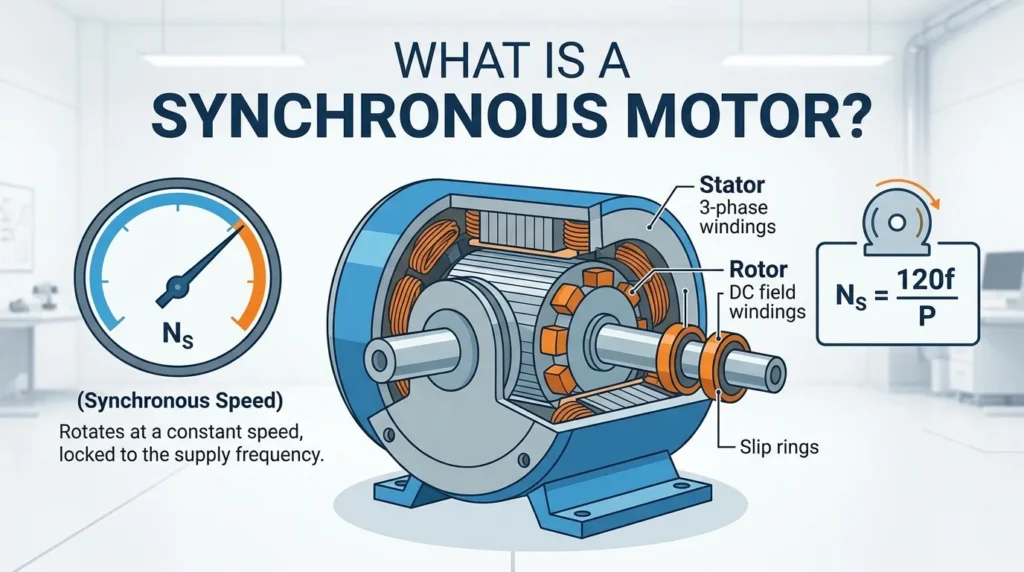
A synchronous motor is an AC motor that rotates at exactly the same speed as the rotating magnetic field produced by the stator. This constant speed is called the synchronous speed, and it does not change with normal load variations.
Unlike an induction motor, a synchronous motor requires a separate method to magnetize its rotor, usually by DC excitation or permanent magnets. Once the rotor locks with the rotating magnetic field of the stator, both rotate together at the same speed.
Simple Definition
A synchronous motor is an AC motor whose rotor rotates at the same speed as the stator’s rotating magnetic field without any slip during normal operation.
Simple Explanation
When three-phase AC power is supplied to the stator windings, it creates a rotating magnetic field. The rotor produces its own magnetic field using DC current or permanent magnets. The rotor then locks with the rotating magnetic field and rotates at exactly the same speed.
Because there is no slip, the motor maintains a constant speed even when the load changes within its rated capacity.
Practical Example
Imagine a large water treatment plant where pumps must run at a constant speed throughout the day. If the motor speed changes, water flow becomes unstable. A synchronous motor keeps the pump rotating at the required speed, ensuring smooth and efficient operation.
Synchronous Motor Working Principle
The synchronous motor working principle is based on the interaction between the rotating magnetic field produced by the stator and the magnetic field produced by the rotor.
When both magnetic fields rotate at the same speed, the rotor locks with the stator field and continues rotating without any slip.
Unlike induction motors, synchronous motors are not self-starting. They require an external starting method before reaching synchronous speed.
Step-by-Step Working Process
Step 1: AC Supply Is Applied to the Stator
When a three-phase AC supply is connected to the stator windings, current flows through them.
The stator begins producing a rotating magnetic field that rotates at synchronous speed.
Step 2: A Rotating Magnetic Field Is Created
The three stator windings are placed 120 degrees apart.
Because the AC currents are also 120 degrees apart, they generate a smooth rotating magnetic field inside the motor.
This magnetic field continuously rotates around the stator.
Step 3: Rotor Magnetic Field Is Produced
The rotor must also become a magnet.
This is achieved by:
- DC excitation through slip rings and brushes
- Permanent magnets
- Brushless excitation systems
The rotor now has north and south magnetic poles.
Step 4: Rotor Starts Rotating
Since the rotor is initially stationary, it cannot immediately lock with the rotating magnetic field.
An external starting mechanism is used, such as:
- Damper winding
- Pony motor
- Variable Frequency Drive (VFD)
The rotor accelerates until it reaches a speed close to synchronous speed.
Step 5: Magnetic Locking Takes Place
When the rotor speed nearly matches the rotating magnetic field, the magnetic poles attract each other.
The rotor locks with the stator field.
This condition is called synchronism.
Step 6: Motor Runs at Constant Speed
Once synchronized, the rotor rotates at exactly the same speed as the rotating magnetic field.
Even if the mechanical load increases, the motor maintains its speed unless the load exceeds its design limit.
There is virtually zero slip during normal operation.
Easy Analogy
Imagine two dancers performing together.
- The stator magnetic field is one dancer moving in a perfect circle.
- The rotor is the second dancer.
At first, the second dancer cannot match the rhythm.
Once both dancers move at exactly the same speed, they stay perfectly synchronized throughout the performance.
A synchronous motor works in the same way. After synchronization, the rotor follows the rotating magnetic field perfectly.
Why Is It Called a Synchronous Motor?
The word synchronous means happening at the same time or speed.
Since the rotor rotates exactly at the same speed as the rotating magnetic field, the motor is called a synchronous motor.
Synchronous Speed Formula
The synchronous speed depends on the supply frequency and the number of poles.
Formula:
Ns = (120 × f) / P
Where:
- Ns = Synchronous speed (RPM)
- f = Supply frequency (Hz)
- P = Number of poles
Example
For a 50 Hz supply and a 4-pole motor:
Ns = (120 × 50) ÷ 4
Ns = 1500 RPM
The motor will continue rotating at 1500 RPM under normal operating conditions.
Types of Synchronous Motor
Synchronous motors are classified according to their rotor construction and excitation method.
1. DC Excited Synchronous Motor
A DC excited synchronous motor uses direct current supplied to the rotor winding through slip rings and brushes.
Features
- Rotor excited by DC current
- High efficiency
- Adjustable power factor
- Common in heavy industries
Applications
- Cement plants
- Steel mills
- Power stations
- Large compressors
- Industrial pumps
2. Permanent Magnet Synchronous Motor (PMSM)
A Permanent Magnet Synchronous Motor uses strong permanent magnets instead of rotor windings.
Since no external DC excitation is required, the motor becomes more compact and efficient.
Features
- High efficiency
- Compact size
- Low maintenance
- High power density
Applications
- Electric vehicles
- Robotics
- CNC machines
- Air conditioners
- Industrial automation
3. Hysteresis Synchronous Motor
A hysteresis synchronous motor operates using the hysteresis property of magnetic materials.
It starts automatically and reaches synchronous speed smoothly.
Features
- Quiet operation
- Self-starting
- Constant speed
- Low vibration
Applications
- Electric clocks
- Timers
- Record players
- Precision instruments
- Laboratory equipment
4. Reluctance Synchronous Motor
A reluctance synchronous motor works because the rotor naturally aligns itself with the rotating magnetic field where magnetic reluctance is minimum.
The rotor contains no windings or permanent magnets.
Features
- Simple construction
- No brushes
- Low maintenance
- Good efficiency
Applications
- Industrial automation
- Fans
- Pumps
- Textile machinery
- Variable-speed drives
5. Brushless Synchronous Motor
A brushless synchronous motor uses an electronic excitation system instead of brushes and slip rings.
This eliminates wear and reduces maintenance.
Features
- No brushes
- Longer service life
- High reliability
- Reduced maintenance
Applications
- Modern industries
- Renewable energy systems
- High-speed machines
- Precision equipment
- Automated manufacturing
Main Components of a Synchronous Motor
A synchronous motor consists of several important parts that work together to convert electrical energy into mechanical energy. Each component has a specific function and contributes to the motor’s efficient and reliable operation.
1. Stator
The stator is the stationary outer part of the motor. It is made of laminated silicon steel to reduce energy losses caused by eddy currents.
The stator contains three-phase windings. When connected to a three-phase AC supply, these windings produce a rotating magnetic field that drives the motor.
Functions
- Produces the rotating magnetic field
- Supports the stator windings
- Converts electrical energy into magnetic energy
- Forms the outer structure of the motor
2. Rotor
The rotor is the rotating part of the motor located inside the stator.
Unlike an induction motor, the rotor of a synchronous motor produces its own magnetic field using DC excitation or permanent magnets. During operation, it locks with the rotating magnetic field of the stator and rotates at the same speed.
Functions
- Produces the rotor magnetic field
- Rotates the motor shaft
- Delivers mechanical power to the load
- Maintains synchronous speed
3. Rotor Windings or Permanent Magnets
Depending on the motor type, the rotor contains either:
- DC field windings
- Permanent magnets
The field winding is energized by direct current to create magnetic poles, while permanent magnet motors use high-strength magnets instead of electrical excitation.
Functions
- Generates magnetic poles
- Interacts with the stator field
- Maintains synchronization
- Produces continuous torque
4. Slip Rings and Brushes
In conventional synchronous motors, slip rings and carbon brushes supply DC current to the rotating field winding.
Modern brushless synchronous motors eliminate these components to reduce maintenance.
Functions
- Transfer DC current to the rotor
- Energize the field winding
- Maintain continuous excitation
5. Shaft
The shaft is attached to the rotor and rotates with it.
Mechanical power produced by the motor is transmitted through the shaft to the connected machine.
Functions
- Transfers mechanical power
- Supports rotating components
- Connects the motor to the driven equipment
6. Bearings
Bearings support the rotating shaft and minimize friction.
They help ensure smooth, quiet, and efficient operation while extending the motor’s service life.
Functions
- Reduce friction
- Support the rotor
- Maintain proper alignment
- Improve efficiency
7. Frame or Housing
The motor frame protects all internal components from dust, moisture, and accidental damage.
It also provides mechanical strength and helps dissipate heat.
Functions
- Protects internal parts
- Supports the entire motor
- Improves cooling
- Increases durability
8. Cooling Fan
Many synchronous motors include a cooling fan mounted on the shaft.
The fan circulates air around the motor to remove excess heat generated during operation.
Functions
- Maintains operating temperature
- Prevents overheating
- Improves motor life
- Enhances efficiency
9. Damper Winding
Most large synchronous motors include a damper winding, also called an amortisseur winding.
It helps the motor start like an induction motor and reduces oscillations during operation.
Functions
- Assists in starting
- Reduces hunting
- Improves stability
- Minimizes vibration
Advantages of Synchronous Motor
Synchronous motors offer several important advantages, making them a preferred choice for industrial and commercial applications where constant speed and efficiency are required.
1. Constant Speed
The motor operates at synchronous speed regardless of normal load changes.
This makes it ideal for applications requiring precise speed control.
2. High Efficiency
Synchronous motors convert electrical energy into mechanical energy with very little loss.
This reduces electricity consumption and operating costs.
3. Excellent Power Factor
One of the biggest advantages is the ability to improve the power factor of an electrical system.
The motor can operate at:
- Lagging power factor
- Unity power factor
- Leading power factor
This helps reduce reactive power and improve overall system efficiency.
4. Suitable for Heavy Loads
Synchronous motors can drive large industrial machines that require continuous operation at constant speed.
5. Low Operating Cost
Although the initial cost is higher, the high efficiency and reduced energy losses make operating costs lower over time.
6. Better Voltage Regulation
Power factor correction improves voltage stability throughout the electrical network.
7. Reliable Performance
When properly maintained, synchronous motors provide long service life and dependable operation.
8. Ideal for Precision Applications
Because speed remains constant, these motors are widely used in applications requiring accurate timing and synchronization.
Disadvantages of Synchronous Motor
Despite their many benefits, synchronous motors also have certain limitations.
1. Not Self-Starting
A synchronous motor cannot start by itself.
It requires an external starting method such as:
- Damper winding
- Pony motor
- Variable Frequency Drive (VFD)
2. Higher Initial Cost
These motors are generally more expensive than induction motors because of their more complex construction.
3. More Complex Design
Additional components such as excitation systems increase installation complexity.
4. Requires DC Excitation
Traditional synchronous motors require a separate DC supply for the rotor.
5. Maintenance Requirements
Brushes and slip rings require periodic inspection and maintenance in conventional designs.
6. Loss of Synchronism
If the load exceeds the motor’s pull-out torque, the rotor may lose synchronization and stop.
7. Unsuitable for Frequent Starting
Frequent starting and stopping may reduce motor life and increase wear.
Synchronous Motor Applications
Synchronous motors are widely used in industries where constant speed, high efficiency, and power factor improvement are essential.
Industrial Applications
- Cement plants
- Steel industries
- Paper mills
- Textile factories
- Chemical plants
- Sugar mills
- Oil refineries
- Food processing plants
Power Generation
Synchronous motors help improve power factor in electrical power systems and large substations.
Water Treatment Plants
Large pumps driven by synchronous motors maintain a constant water flow rate.
HVAC Systems
Used in:
- Chillers
- Large compressors
- Industrial ventilation systems
Mining Industry
Operate:
- Conveyors
- Crushers
- Heavy-duty pumps
Electric Vehicles
Permanent Magnet Synchronous Motors (PMSMs) are widely used because of their:
- High efficiency
- Compact size
- Excellent torque
Robotics and Automation
Used in:
- CNC machines
- Industrial robots
- Servo systems
- Precision manufacturing
Renewable Energy Systems
Applications include:
- Wind turbines
- Solar tracking systems
- Smart grid technologies
Difference Between Synchronous Motor and Induction Motor
| Feature | Synchronous Motor | Induction Motor |
|---|---|---|
| Operating Speed | Constant (Synchronous Speed) | Slightly below synchronous speed |
| Slip | Zero | Always present |
| Starting | Not self-starting | Self-starting |
| Rotor Excitation | DC or Permanent Magnet | Induced current |
| Power Factor | Can improve power factor | Usually lagging |
| Efficiency | Higher | Slightly lower |
| Cost | Higher | Lower |
| Maintenance | More | Less |
| Construction | More complex | Simpler |
| Applications | Constant-speed industrial loads | General-purpose industrial drives |
Selection Guide: How to Choose the Right Synchronous Motor
Selecting the correct synchronous motor depends on the application’s operating requirements.
Consider the Load Type
Choose a synchronous motor when the equipment requires:
- Constant speed
- Continuous operation
- High efficiency
Check the Required Power Rating
Select a motor with sufficient power to handle the maximum expected load.
Avoid undersized motors, as they may lose synchronism.
Consider the Supply Voltage
Ensure the motor voltage matches the available electrical supply.
Evaluate the Power Factor Requirement
If improving the plant’s power factor is important, a synchronous motor is often an excellent choice.
Select the Proper Cooling Method
For dusty or hot environments, choose motors with adequate cooling and enclosure protection.
Think About Maintenance
Brushless synchronous motors require less maintenance than conventional brush-type motors.
Match the Environment
Choose a motor suitable for:
- Indoor use
- Outdoor installations
- Hazardous areas
- High-temperature environments
Beginner Tips
- Determine the required speed before selecting the motor.
- Always calculate the load correctly.
- Choose a reputable manufacturer.
- Follow installation guidelines carefully.
- Perform regular maintenance for long service life.
Common Problems & Solutions of a Synchronous Motor
Like all electrical machines, a synchronous motor can develop problems during operation if it is not installed, operated, or maintained properly. Regular inspection and preventive maintenance help improve reliability, reduce downtime, and extend the motor’s service life.
Below are some of the most common problems, their possible causes, and practical solutions.
| Problem | Possible Cause | Solution |
|---|---|---|
| Motor does not start | No starting mechanism, low supply voltage, faulty starter | Check the starting system, verify the supply voltage, and inspect the starter circuit. |
| Motor fails to synchronize | Incorrect field excitation, excessive load, low voltage | Adjust the excitation current, reduce the load, and ensure the correct supply voltage. |
| Overheating | Overloading, poor ventilation, blocked cooling fan | Reduce the load, clean the cooling system, and improve ventilation. |
| Excessive vibration | Misalignment, worn bearings, loose foundation | Align the motor correctly, replace damaged bearings, and tighten mounting bolts. |
| Unusual noise | Loose components, bearing wear, rotor imbalance | Inspect internal parts, replace faulty bearings, and balance the rotor. |
| Low efficiency | Poor power factor, incorrect excitation, overloaded motor | Maintain proper excitation and operate the motor within its rated capacity. |
| Brush sparking (Brush-Type Motors) | Worn brushes, dirty slip rings, poor brush pressure | Replace brushes, clean slip rings, and adjust brush pressure. |
| Frequent tripping | Short circuit, overload, earth fault | Inspect the wiring, check insulation resistance, and identify the electrical fault before restarting. |
Frequently Asked Troubleshooting Questions
Why does a synchronous motor require a starter?
A synchronous motor is not self-starting because the rotor cannot instantly rotate at the same speed as the stator’s rotating magnetic field. A starting method such as a damper winding, pony motor, or Variable Frequency Drive (VFD) is required to bring the rotor close to synchronous speed before it locks into synchronism.
Why does a synchronous motor overheat?
Overheating may occur due to:
- Continuous overloading
- Poor ventilation
- Cooling fan failure
- Incorrect excitation
- High ambient temperature
- Low supply voltage
Routine maintenance and proper loading help prevent overheating.
What causes a synchronous motor to lose synchronism?
Loss of synchronism usually occurs when:
- The mechanical load exceeds the pull-out torque.
- The excitation current is too low.
- The supply voltage drops significantly.
- Sudden load changes occur.
When synchronism is lost, the motor may stop or trip to protect itself from damage.
Why is the motor vibrating?
Common reasons include:
- Misaligned shaft
- Loose foundation bolts
- Rotor imbalance
- Damaged bearings
- Bent shaft
Proper installation and periodic alignment checks help reduce vibration.
Why are the bearings getting hot?
Bearing overheating may be caused by:
- Lack of lubrication
- Contaminated grease
- Excessive mechanical load
- Misalignment
- Bearing wear
Replacing worn bearings and following the manufacturer’s lubrication schedule can solve this problem.
How often should a synchronous motor be maintained?
The maintenance schedule depends on the operating environment, but general recommendations include:
- Daily visual inspection
- Weekly cleaning
- Monthly vibration checks
- Quarterly electrical testing
- Annual complete inspection and servicing
Preventive maintenance significantly improves motor reliability and lifespan.
Preventive Maintenance Tips
Proper maintenance ensures that a synchronous motor operates safely, efficiently, and reliably for many years.
Daily Checks
- Listen for unusual sounds.
- Monitor temperature.
- Check voltage and current readings.
- Inspect indicator lights.
Weekly Checks
- Clean dust from the motor.
- Inspect cooling vents.
- Check for loose electrical connections.
- Observe vibration levels.
Monthly Checks
- Inspect bearings.
- Verify rotor alignment.
- Check insulation condition.
- Examine the shaft coupling.
Annual Maintenance
- Test insulation resistance.
- Replace worn bearings if necessary.
- Inspect the excitation system.
- Tighten all electrical and mechanical connections.
- Perform a complete performance test.
Future Trends in Synchronous Motor Technology
As industries move toward automation, energy efficiency, and smart manufacturing, synchronous motors continue to evolve with advanced technologies. Modern designs are becoming more efficient, compact, and environmentally friendly.
1. High-Efficiency Motors
Manufacturers are developing motors that meet international energy-efficiency standards, reducing electricity consumption and operating costs.
Benefits
- Lower energy bills
- Reduced heat generation
- Longer service life
- Improved environmental performance
2. Permanent Magnet Synchronous Motors (PMSMs)
Permanent Magnet Synchronous Motors are becoming increasingly popular due to their high efficiency and compact size.
These motors are widely used in:
- Electric vehicles
- Industrial robots
- CNC machines
- High-performance servo drives
- Automation systems
3. Brushless Excitation Systems
Modern synchronous motors are replacing brushes and slip rings with brushless excitation systems.
Advantages
- Less maintenance
- Higher reliability
- Longer operating life
- Reduced downtime
4. Smart Motor Monitoring
Industrial facilities are adopting smart sensors to continuously monitor motor health.
These systems measure:
- Temperature
- Vibration
- Current
- Voltage
- Bearing condition
- Operating efficiency
Predictive maintenance helps identify faults before failures occur.
5. Internet of Things (IoT)
IoT technology allows motors to communicate with central monitoring systems.
Engineers can:
- Monitor performance remotely
- Receive fault alerts
- Schedule maintenance
- Analyze operating data
This reduces downtime and improves productivity.
6. Artificial Intelligence in Motor Control
Advanced control systems use artificial intelligence to optimize motor performance automatically.
AI can:
- Predict failures
- Improve energy efficiency
- Optimize speed control
- Reduce maintenance costs
7. Variable Frequency Drives (VFDs)
Modern VFD technology allows smoother motor starting and improved process control.
Benefits include:
- Reduced starting current
- Better speed control
- Improved efficiency
- Lower mechanical stress
8. Renewable Energy Integration
Synchronous motors are playing an increasingly important role in renewable energy projects.
Applications include:
- Wind power plants
- Solar tracking systems
- Battery energy storage
- Smart electrical grids
Their excellent power factor characteristics make them valuable for modern power systems.
Conclusion
A synchronous motor is one of the most efficient and reliable AC motors used in modern electrical systems. Unlike induction motors, it operates at a constant synchronous speed with virtually zero slip, making it ideal for applications where precise speed control and high efficiency are essential. Its ability to improve the power factor is another major advantage, helping industries reduce energy losses and improve overall system performance.
Understanding the synchronous motor working principle, its components, types, applications, and maintenance requirements is essential for electrical students, technicians, and engineers. Although synchronous motors have a higher initial cost and require external starting methods, their long-term benefits often outweigh these limitations. As technology continues to advance, innovations such as permanent magnet motors, brushless excitation systems, smart monitoring, IoT integration, and AI-based control are making synchronous motors even more efficient and reliable. Learning about synchronous motors provides a strong foundation for understanding modern industrial automation and electrical power systems.