
Do you write everyday or every day? These two forms look almost identical, but they do different jobs in a sentence. Using the wrong one can make your writing look less polished.
People often search for “Everyday vs Every Day” because both forms are common in emails, school assignments, social media posts, websites, and everyday conversations. The confusion is understandable. The only visible difference is a small space, but that space changes the grammar and meaning.
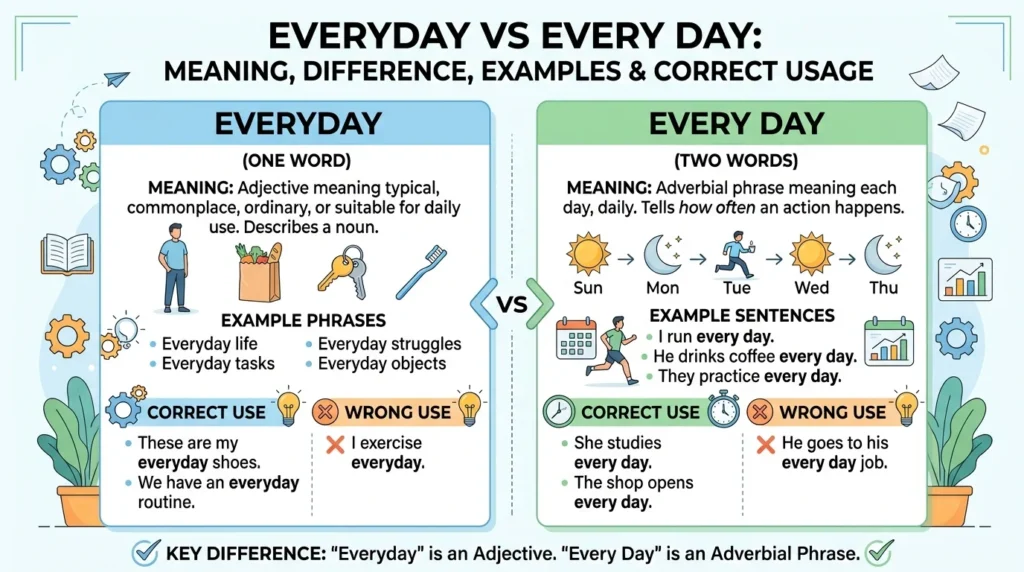
The simple rule is this: everyday is an adjective. It describes something that is common, normal, or used regularly. For example, “These are my everyday shoes.” Every day is a phrase that means “each day.” For example, “I walk every day.”
Once you know what role the word plays, the choice becomes much easier. In this guide, you will learn the meaning, origin, British and American usage, common mistakes, real-life examples, search trends, and simple memory tricks for using everyday and every day correctly.
Everyday vs Every Day – Quick Answer
The difference is simple:
- Everyday = ordinary, common, or normal. It is an adjective.
- Every day = each day. It is an adverbial phrase that tells when something happens.
Everyday Examples
Use everyday before a noun when you mean “ordinary” or “usual.”
- These are my everyday clothes.
- Walking is an everyday activity for many people.
- This is an everyday problem.
- We use everyday English at home.
Here, everyday describes a noun.
Every Day Examples
Use every day when you mean “each day.”
- I exercise every day.
- She reads every day.
- We go to work every day.
- He calls his parents every day.
Here, every day tells us how often something happens.
Easy Memory Trick
Try replacing the phrase with “each day.”
If the sentence still makes sense, use every day.
I study every day.
I study each day. ✓
But:
I wear everyday shoes.
You cannot say:
I wear each day shoes. ✗
So, everyday = ordinary, while every day = each day.
The Origin of Everyday vs Every Day
The forms everyday and every day come from the words every and day.
Origin of “Every”
The word every comes from Old English forms related to the idea of “each” or “all individually.” Over time, it developed into the common English determiner we use today.
For example:
- every person
- every house
- every morning
- every day
Origin of “Day”
Day comes from Old English dæg, referring to the period of daylight or a full daily period.
It is related to similar words in other Germanic languages.
How “Everyday” Developed
The compound adjective everyday developed from the combination of every and day.
It came to mean something ordinary or routine.
For example:
everyday life
means normal or ordinary life.
Over time, everyday became established as one word when used as an adjective.
Why Is “Every Day” Still Two Words?
When every modifies day in the literal sense of “each day,” the words remain separate.
For example:
She walks every day.
The phrase means “she walks each day.”
This is why the space matters. The two forms have different grammatical functions.
British English vs American English Spelling
There is no major spelling difference between British English and American English for everyday and every day.
Both varieties use:
- everyday as an adjective
- every day when meaning “each day”
| Usage | British English | American English | Meaning |
|---|---|---|---|
| Everyday clothes | Everyday clothes | Everyday clothes | Ordinary or usual clothes |
| Every day | Every day | Every day | Each day |
| Everyday life | Everyday life | Everyday life | Normal life |
| Exercise every day | Exercise every day | Exercise every day | Exercise each day |
| Everyday problems | Everyday problems | Everyday problems | Common problems |
British English Example
I wear these shoes every day.
These are my everyday shoes.
American English Example
I wear these shoes every day.
These are my everyday shoes.
The grammar and spelling are the same.
Which Spelling Should You Use?
You do not need to choose a British or American spelling. The correct form depends on meaning and grammar.
For US English
Use everyday as an adjective:
This is an everyday task.
Use every day when you mean each day:
I complete this task every day.
For UK and Commonwealth English
The same rule applies:
These are my everyday shoes.
I wear them every day.
For Global English
Use the same distinction.
The most useful question is:
Does “everyday” describe a noun?
If yes, use everyday.
everyday activities
If you mean each day, use every day.
I practice every day.
Common Mistakes with Everyday vs Every Day
Mistake 1: Using “Everyday” for Each Day
❌ I go to the gym everyday.
✅ I go to the gym every day.
Why?
The sentence means “I go to the gym each day.” Therefore, the two-word form is correct.
Mistake 2: Using “Every Day” Before a Noun
❌ These are my every day shoes.
✅ These are my everyday shoes.
Here, the word describes “shoes,” so everyday is correct.
Mistake 3: Confusing “Everyday” With “Daily”
In many situations, every day can be replaced with each day.
She studies every day.
She studies each day.
But everyday means ordinary or common.
It was an everyday problem.
You cannot replace it with “each day” in that sentence.
Mistake 4: Thinking “Everyday” Is Always Correct
Because people often pronounce the two forms similarly, writers sometimes use everyday everywhere.
❌ We meet everyday.
✅ We meet every day.
Mistake 5: Thinking “Every Day” Is Always Correct
The opposite mistake also happens.
❌ He wears every day clothes.
✅ He wears everyday clothes.
The word describes “clothes,” so it needs to be the adjective everyday.
Everyday vs Every Day in Everyday Examples
These forms appear frequently in different types of writing.
In Emails
Everyday:
We need to solve some everyday workplace problems.
Every day:
Please check your email every day.
In News
Everyday:
Rising prices are affecting everyday consumers.
Every day:
Thousands of people travel through the station every day.
On Social Media
Everyday:
Simple everyday habits can make a big difference.
Every day:
I try to learn something new every day.
In Academic Writing
Everyday:
The study examines how language is used in everyday communication.
Every day:
Participants recorded their activities every day.
In Formal Writing
Everyday:
The policy affects many everyday business activities.
Every day:
Employees should review the safety checklist every day.
Everyday vs Every Day – Google Trends & Usage Data
The search phrase “Everyday vs Every Day” is popular because this is a common English grammar question.
People search for this distinction when they are:
- Writing essays
- Learning English
- Editing articles
- Writing emails
- Preparing for exams
- Creating website content
- Checking grammar
- Improving professional communication
The individual forms also appear in different contexts.
Common Uses of Everyday
Everyday frequently appears in phrases such as:
- everyday life
- everyday activities
- everyday problems
- everyday clothes
- everyday language
- everyday use
- everyday situations
Common Uses of Every Day
Every day is common when describing routines and habits:
- work every day
- study every day
- exercise every day
- eat every day
- practice every day
- travel every day
Search interest can vary by country, season, education level, and language-learning demand. Exact Google Trends numbers also change over time, so specific figures should be checked for a defined country and date range.
Everyday vs Every Day Comparison Table
| Feature | Everyday | Every Day |
|---|---|---|
| Number of words | One | Two |
| Grammar | Adjective | Adverbial phrase |
| Meaning | Ordinary or usual | Each day |
| Usually modifies | A noun | A verb or action |
| Example | Everyday clothes | I exercise every day |
| Synonym | Ordinary, common | Each day, daily |
| Question it answers | What kind? | When/how often? |
| Memory clue | Ordinary | Each day |
How to Test Everyday vs Every Day
When you are unsure, use one of these quick tests.
Test 1: Replace With “Each Day”
If each day works, choose every day.
I practice English every day.
Replace it:
I practice English each day. ✓
Therefore, every day is correct.
Test 2: Look at the Next Word
If the word comes directly before a noun and describes it, everyday may be correct.
everyday work
everyday clothes
everyday activities
Test 3: Replace With “Ordinary”
If ordinary works, use everyday.
These are my everyday shoes.
These are my ordinary shoes. ✓
This tells you that everyday is the correct form.
FAQs About Everyday vs Every Day
1. What is the difference between everyday and every day?
Everyday means ordinary or usual and works as an adjective. Every day means each day and describes when something happens.
2. Is “everyday” one word or two?
Both forms are correct, but they have different meanings. Everyday is one word when it means ordinary. Every day is two words when it means each day.
3. Is “I work everyday” correct?
No, not in standard usage.
The correct sentence is:
I work every day.
It means “I work each day.”
4. Is “everyday life” correct?
Yes.
Everyday life can be busy.
Here, everyday describes “life” and means ordinary or normal.
5. Can everyday mean daily?
Sometimes everyday can suggest something that happens as part of normal daily life, but it does not directly mean “each day.” For frequency, use every day.
6. Is everyday an adjective?
Yes. Everyday is an adjective meaning ordinary, common, or usual.
Example:
These are my everyday clothes.
7. Is every day an adverb?
Every day is a two-word phrase that commonly functions adverbially to show frequency.
Example:
She reads every day.
8. Do British and American English use different forms?
No. Both British and American English use everyday and every day according to the same basic grammar rules.
Conclusion
Understanding Everyday vs Every Day is easy when you focus on the meaning. Although the two forms look almost the same, they have different grammatical jobs.
Everyday is one word and works as an adjective. It means ordinary, common, or usual. You can use it in phrases such as everyday life, everyday clothes, and everyday problems.
Every day is two words and means each day. It usually tells how often an action happens. For example, “I exercise every day” means “I exercise each day.”
There is no important difference between British and American English in this rule. Both varieties use the same forms.
When you are unsure, try replacing the phrase with “each day.” If the sentence still makes sense, use every day. If you can replace it with “ordinary,” use everyday.
Remember the simple rule: everyday = ordinary; every day = each day. This quick test will help you avoid one of the most common English usage mistakes.