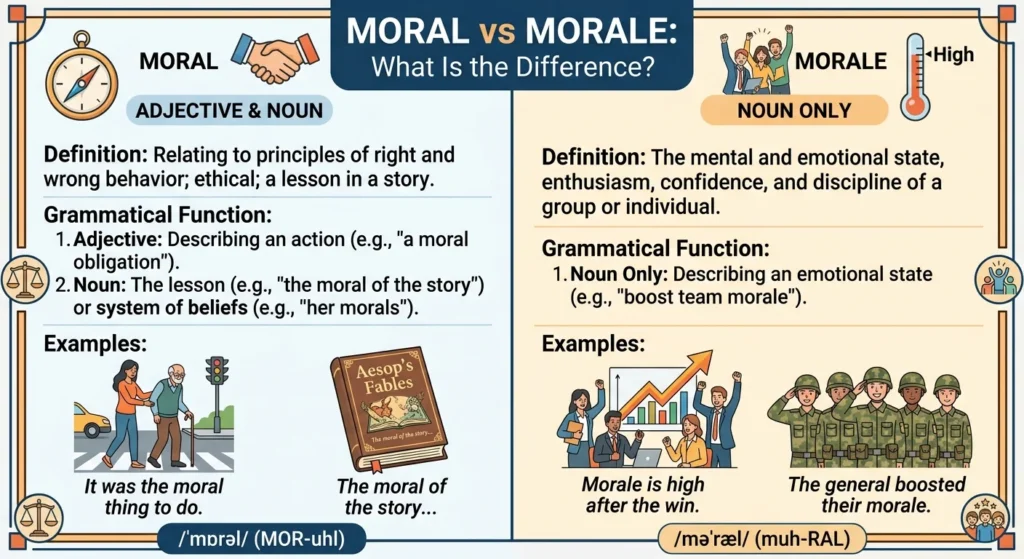

English has many words that look and sound almost the same but have very different meanings. Moral vs Morale is a common example. These two words can confuse students, writers, employees, and even native English speakers.
The main difference is simple: moral usually relates to right and wrong, while morale refers to confidence, enthusiasm, or the emotional state of a person or group. For example, a person can have strong moral values, while a sports team can have high morale.
People often search for “moral vs morale” because the words are spelled similarly and can sound alike when spoken. However, using the wrong word can change the meaning of a sentence. This can be especially important in school assignments, business emails, workplace reports, news articles, and professional communication.
In this guide, you will learn the meanings, origins, spelling differences, common mistakes, everyday examples, and correct usage of moral and morale. You will also get an easy comparison table and practical tips to remember the difference.
Moral vs Morale – Quick Answer
The quick answer is:
- Moral = related to right and wrong, good and bad behavior, or principles.
- Morale = the confidence, enthusiasm, and positive feelings of a person or group.
Examples of Moral
- She has strong moral values.
- The story teaches an important moral lesson.
- He made a moral decision.
- Honesty is an important moral principle.
Examples of Morale
- The team’s morale is high.
- Low morale can affect employee performance.
- The manager organized an event to improve staff morale.
- The team’s morale increased after the victory.
Easy Memory Trick
Think of:
Moral = principles
Morale = feelings
If you are talking about right and wrong, use moral.
If you are talking about confidence, motivation, or team spirit, use morale.
The Origin of Moral vs Morale
Although moral and morale have different meanings today, they are historically related.
Origin of Moral
The word moral comes from Latin moralis, meaning “of morals” or “relating to manners or character.” It is connected to the Latin word mos, meaning “custom” or “way of behaving.”
The word entered English through Old French and developed its connection with ideas about right and wrong behavior.
Today, moral can describe:
- Principles of right and wrong
- Good or bad behavior
- Ethical decisions
- Standards of behavior
- Lessons about behavior
For example:
The story has a strong moral message.
Here, moral refers to a lesson about right and wrong.
Origin of Morale
Morale also comes from French and is related to the same historical word family as moral. However, English developed a different meaning for it.
In modern English, morale refers to the emotional condition, confidence, enthusiasm, or spirit of a person or group.
For example:
The company’s employees have high morale.
This means the employees feel confident, motivated, or positive.
Why Are Moral and Morale Confusing?
The two words share similar spelling and historical roots.
However, English gave them different jobs:
- Moral → ethics, behavior, principles
- Morale → confidence, motivation, team spirit
This difference is important because replacing one with the other can make a sentence incorrect or change its meaning.
British English vs American English Spelling
There is no major spelling difference between British English and American English for moral and morale.
Both varieties use:
- moral
- morale
The meanings are also basically the same in both forms of English.
| Feature | American English | British English |
|---|---|---|
| Moral | Moral | Moral |
| Morale | Morale | Morale |
| Spelling difference | None | None |
| Moral meaning | Ethics or principles | Ethics or principles |
| Morale meaning | Confidence or team spirit | Confidence or team spirit |
| Employee morale | Correct | Correct |
| Moral values | Correct | Correct |
Examples in American English
The manager wants to improve employee morale.
The story teaches an important moral lesson.
Examples in British English
The manager wants to improve employee morale.
The story teaches an important moral lesson.
The spelling remains the same.
Moral vs Morale: Spelling Tip
The extra e in morale can help you remember that it is connected with emotional energy and team spirit.
Think:
Morale = motivation
This is not a formal spelling rule, but it is a useful memory trick.
Which Spelling Should You Use?
You do not need to choose a different spelling based on whether your audience is American or British.
The important choice is the meaning.
For US English
Use moral when discussing ethics or right and wrong.
The company has a moral responsibility to protect customers.
Use morale when discussing confidence or motivation.
The new reward system improved employee morale.
For UK and Commonwealth English
The same rules apply.
The book has a clear moral message.
Team morale improved after the win.
For Global English
For international readers, keep the distinction clear.
Use:
- moral values
- moral responsibility
- moral decision
- high morale
- low morale
- employee morale
- team morale
A simple rule works in almost every form of English:
Moral = what is right or wrong.
Morale = how confident or motivated people feel.
Common Mistakes with Moral vs Morale
Because the words look similar, writers often use one when they need the other.
Mistake 1: Using Moral for Team Spirit
❌ The team’s moral was low after the defeat.
✅ The team’s morale was low after the defeat.
A team’s confidence and enthusiasm are its morale.
Mistake 2: Using Morale for Ethics
❌ The company has strong morale values.
✅ The company has strong moral values.
Values about right and wrong are moral values.
Mistake 3: Confusing Moral Lesson and Team Morale
These phrases have completely different meanings:
Moral lesson = a lesson about right and wrong.
Team morale = the team’s confidence and enthusiasm.
For example:
The story has a powerful moral lesson.
The coach worked hard to improve team morale.
Mistake 4: Writing “Employee Moral”
❌ The manager wants to improve employee moral.
✅ The manager wants to improve employee morale.
When discussing employee motivation, confidence, or satisfaction, use morale.
Mistake 5: Writing “Moral of the Story” Incorrectly
❌ The morale of the story is to be honest.
✅ The moral of the story is to be honest.
The traditional phrase is “moral of the story.”
It means the lesson or message that the story teaches.
Mistake 6: Assuming the Words Are Pronounced the Same
They are not normally pronounced exactly the same.
Moral is commonly pronounced something like MOR-uhl.
Morale is commonly pronounced something like muh-RAL.
Pronunciation can vary by accent, but the distinction is useful when speaking.
Moral vs Morale in Everyday Examples
Understanding the words in real situations makes them easier to remember.
In Emails
Moral:
We have a moral responsibility to provide accurate information to our customers.
Morale:
The new recognition program has helped improve employee morale.
The first sentence discusses responsibility and ethics. The second discusses employee feelings and motivation.
In the Workplace
Moral:
Managers should consider the moral impact of important decisions.
Morale:
Regular feedback can help improve workplace morale.
A company’s moral standards relate to ethics.
A company’s employee morale relates to how positive and motivated workers feel.
In News
Moral:
The debate raised several moral questions.
Morale:
The team’s morale improved after its important victory.
The first concerns ethics. The second concerns confidence.
On Social Media
Moral:
The story has a powerful moral: always treat people with respect.
Morale:
That win gave the whole team a huge boost in morale!
Again, the difference is clear:
- Moral = lesson or principle
- Morale = confidence or spirit
In Formal Writing
Moral:
Organizations should consider the moral consequences of their actions.
Morale:
Effective communication can have a positive effect on employee morale.
Both words are common in professional writing, but they describe different ideas.
Moral vs Morale – Comparison Table
| Word | Part of Speech | Meaning | Common Phrases | Example |
|---|---|---|---|---|
| Moral | Adjective | Related to right and wrong | Moral values | She has strong moral values. |
| Moral | Noun | A lesson about behavior | Moral of the story | What is the moral of the story? |
| Morale | Noun | Confidence or enthusiasm | High morale | The team has high morale. |
| Morale | Noun | Group spirit | Team morale | The victory improved team morale. |
Side-by-Side Examples
| Situation | Correct Word | Example |
|---|---|---|
| Ethics | Moral | A moral decision |
| Right and wrong | Moral | Moral responsibility |
| Story lesson | Moral | The moral of the story |
| Employee confidence | Morale | Employee morale |
| Team spirit | Morale | Team morale |
| Workplace motivation | Morale | High workplace morale |
| Personal principles | Moral | Moral values |
| Ethical behavior | Moral | Moral behavior |
Moral vs Morale – Google Trends & Usage Data
Searches for “moral vs morale” usually come from people trying to understand the difference between these easily confused words.
Google Trends measures relative search interest, not exact worldwide search volume. Interest can change over time and can vary by country, language, education level, and context. Therefore, Trends data should be used to understand search patterns rather than as an exact count of searches.
The two words also appear in different contexts.
Where “Moral” Is Common
Moral is frequently used in:
- Education
- Philosophy
- Religion and ethics discussions
- Literature
- Law and public debate
- Business ethics
- Personal development
Common phrases include:
- moral values
- moral responsibility
- moral lesson
- moral standards
- moral principles
Where “Morale” Is Common
Morale is frequently used in:
- Business
- Human resources
- Sports
- Military discussions
- Leadership
- Management
- Team building
Common phrases include:
- employee morale
- team morale
- high morale
- low morale
- boost morale
- improve morale
Usage by Context
| Context | More Likely Word | Example |
|---|---|---|
| Ethics | Moral | Moral responsibility |
| Literature | Moral | Moral lesson |
| Philosophy | Moral | Moral principles |
| Business ethics | Moral | Moral standards |
| Workplace | Morale | Employee morale |
| Sports | Morale | Team morale |
| Leadership | Morale | Boost morale |
| Military | Morale | Troop morale |
| Motivation | Morale | High morale |
This context-based approach is more useful than simply asking which word is more popular.
FAQs About Moral vs Morale
1. What is the difference between moral and morale?
Moral relates to right and wrong, ethics, values, or principles. Morale means confidence, enthusiasm, or emotional spirit, especially within a group.
2. Is it moral of the story or morale of the story?
The correct phrase is “moral of the story.”
It refers to the lesson or message of a story.
3. Is employee moral or employee morale correct?
Employee morale is correct when you mean employee confidence, motivation, or enthusiasm.
4. What does high morale mean?
High morale means that people feel confident, positive, motivated, or enthusiastic.
For example:
The team has high morale after winning three games.
5. What does moral mean?
Moral can describe something related to right and wrong, ethical behavior, or principles of good behavior.
For example:
Honesty is an important moral value.
6. Can moral and morale be used interchangeably?
No. They usually have different meanings and should not be treated as interchangeable.
Use moral for ethics and principles.
Use morale for confidence and motivation.
7. Is morale only used for groups?
No. Morale can describe the emotional state or confidence of an individual or a group. However, it is especially common when discussing teams, employees, organizations, or other groups.
8. Is there a British spelling of morale?
No separate British spelling is normally used. Morale is spelled the same in American and British English.
9. How can I remember moral vs morale?
Use this simple trick:
Moral = principles.
Morale = confidence.
If you are talking about right and wrong, choose moral. If you are talking about motivation or team spirit, choose morale.
Conclusion
Understanding moral vs morale is easier when you focus on meaning instead of spelling. Although the words look similar and have related origins, they perform different jobs in modern English.
Moral usually relates to right and wrong, ethics, values, principles, or lessons about behavior. You can have moral values, make a moral decision, or learn the moral of a story.
Morale, on the other hand, refers to confidence, enthusiasm, motivation, or team spirit. You can improve employee morale, boost team morale, or work in an organization with high morale.
There is no major British or American spelling difference. Both use moral and morale in the same basic ways.
The easiest rule to remember is: moral is about principles, while morale is about feelings and confidence. Use this rule in emails, schoolwork, business writing, news articles, and everyday conversations to avoid common mistakes.