
Imagine placing a small iron nail near a magnet and watching it move without any physical contact. This invisible force acting around the magnet is called a magnetic field. We experience magnetic fields every day, whether in electric motors, transformers, or even in simple devices like speakers and compasses.
Understanding the magnetic field is very important in electrical engineering because it forms the foundation of many electrical machines and systems. Without magnetic fields, devices like generators, transformers, and motors would not work.
In this article, you will learn the magnetic field working principle, its types, components, advantages and disadvantages, applications, and practical troubleshooting. This guide is written in simple and clear English so beginners can easily understand while still providing valuable insights for engineers and technicians.
2. What is Magnetic Field?
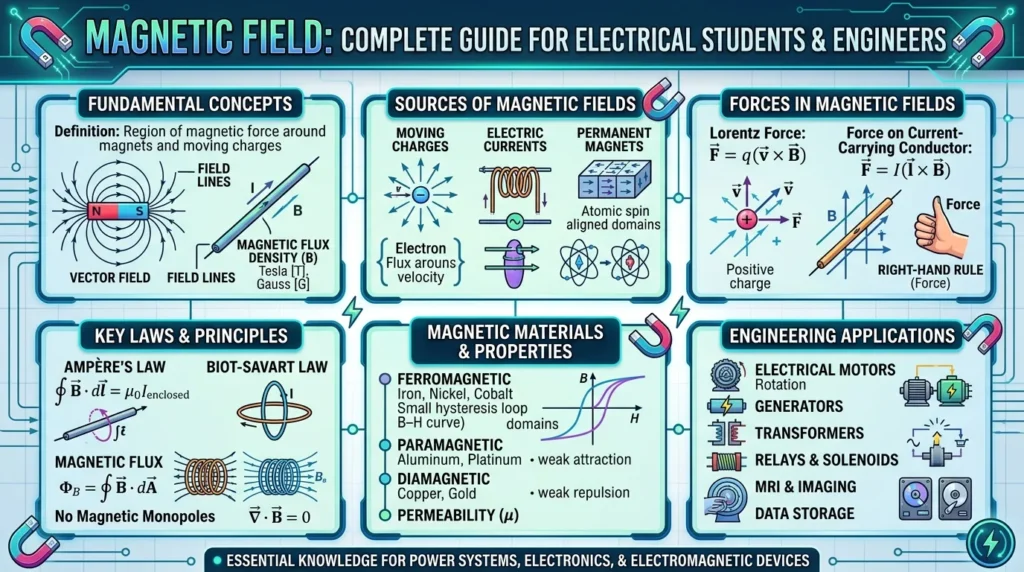
A magnetic field is a region around a magnet or a current-carrying conductor where magnetic forces can be felt. It is an invisible force field that affects magnetic materials like iron, nickel, and cobalt.
Simple Explanation
When electric current flows through a wire, it creates a magnetic field around it. Similarly, a permanent magnet naturally produces a magnetic field.
Practical Example
A compass needle aligns itself with Earth’s magnetic field. This shows that even our planet has a magnetic field.
3. Magnetic Field Working Principle
The magnetic field working principle is based on the interaction between electric current and magnetic forces, explained by Electromagnetism.
Step-by-Step Explanation
- When current flows through a conductor, it generates a magnetic field
- The direction of the field depends on current direction
- The strength of the field depends on current magnitude
- Magnetic lines form closed loops around the conductor
Easy Analogy
Think of a wire like a water pipe. When water flows, it creates movement around it. Similarly, current creates a magnetic effect around the wire.
Important Points
- Magnetic field lines never intersect
- Stronger fields have closer lines
- Field direction follows the right-hand rule
4. Types / Classification
Uniform Magnetic Field
A Uniform Magnetic Field is a type of magnetic field in which the strength and direction remain the same at every point within a specific region. In this field, the magnetic lines of force are parallel, equally spaced, and follow the same direction. This means any magnetic object placed in this region experiences the same magnetic force regardless of its position. Uniform magnetic fields are important in electrical engineering because they provide stable and predictable behavior in many devices and experiments.
The working principle of a uniform magnetic field is based on Magnetism. In such a field, the magnetic flux is evenly distributed, and there is no variation in field intensity. This uniformity ensures that the force acting on charged particles or conductors is constant throughout the region. For example, when a current-carrying conductor is placed in a uniform magnetic field, it experiences a steady force, which is the basic principle behind electric motors.
A common example of a uniform magnetic field can be seen inside a long solenoid (a coil of wire carrying current). Inside the solenoid, the magnetic field lines are nearly parallel and equally spaced, creating a uniform field. This is widely used in laboratory experiments and electromagnetic devices. Another example is the small region between the poles of a specially designed magnet, where the field can be made approximately uniform.
Uniform magnetic fields have several advantages. They provide consistent force and predictable behavior, which is useful in designing motors, generators, and measuring instruments. They also help in accurate scientific experiments and calibration processes. However, creating a perfectly uniform magnetic field is difficult in practice, and it usually exists only in limited regions.
In terms of applications, uniform magnetic fields are used in particle accelerators, electric motors, measuring instruments, and research equipment. They are also important in understanding fundamental concepts like electromagnetic force and motion of charged particles.
Overall, a uniform magnetic field is an ideal condition used in electrical engineering and physics to simplify analysis and design. Its stable and predictable nature makes it essential for many practical and experimental applications.
A uniform magnetic field has equal strength and direction at all points.
Example: Inside a solenoid
Non-Uniform Magnetic Field
A Non-Uniform Magnetic Field is a type of magnetic field in which the strength and direction vary from one point to another. Unlike a uniform magnetic field, where the field lines are parallel and evenly spaced, a non-uniform magnetic field has irregular spacing and direction of field lines. This means the magnetic force acting on an object changes depending on its position within the field.
The working principle of a non-uniform magnetic field is based on Magnetism. In such a field, magnetic lines of force are not evenly distributed. Where the lines are closer together, the magnetic field is stronger, and where they are farther apart, the field is weaker. Because of this variation, objects placed in a non-uniform magnetic field may experience unequal forces, which can cause movement or rotation.
A common example of a non-uniform magnetic field is the field around a bar magnet. Near the poles of the magnet, the field is strong, while farther away it becomes weaker. This type of field is also seen around irregularly shaped conductors or magnetic materials. In electrical machines like motors and transformers, non-uniform fields can exist due to design and operating conditions.
Non-uniform magnetic fields have important applications in engineering and technology. They are used in devices like magnetic separators, sensors, and actuators where controlled force variation is required. However, they can also cause issues such as uneven force distribution, vibrations, or inefficiency in electrical machines if not properly managed.
Overall, a non-uniform magnetic field is an important concept in understanding real-world magnetic behavior. It helps engineers design better systems by considering variations in magnetic strength and direction.
The strength and direction vary at different points.
Example: Around a bar magnet
Magnetic Field Due to Current
The magnetic field due to current is the magnetic effect produced around a conductor when electric current flows through it. This is one of the most important concepts in electrical engineering because it forms the basic principle behind devices like motors, transformers, relays, and generators. Whenever current flows in a wire, it automatically creates a magnetic field around that wire.
The working principle of the magnetic field due to current is based on Electromagnetism. When electrons move through a conductor, they generate a magnetic field in the surrounding space. The direction of this magnetic field can be determined using the right-hand thumb rule: if you hold the conductor in your right hand with the thumb pointing in the direction of current, the curled fingers show the direction of the magnetic field lines. These field lines form concentric circles around the conductor.
The strength of the magnetic field depends on several factors. It increases with higher current and decreases with distance from the conductor. If the conductor is shaped into a coil or solenoid, the magnetic field becomes stronger and more concentrated, similar to a bar magnet. This principle is widely used to create electromagnets.
This concept has many practical applications. It is used in electric motors to produce motion, in transformers for energy transfer, and in relays for switching operations. It is also the foundation of electromagnetic induction, which is used in power generation.
One of the main advantages of this phenomenon is that the magnetic field can be controlled by adjusting the current. However, it requires continuous power supply to maintain the field, and excessive current can cause heat losses.
Overall, the magnetic field due to current is a key concept that connects electricity and magnetism, making it essential for modern electrical systems and technologies.
Generated when electric current flows through a conductor.
Example: Current-carrying wire
Magnetic Field of Permanent Magnet
The magnetic field of a permanent magnet is the invisible region around the magnet where magnetic forces can be detected. A permanent magnet produces this field without the need for any external power source because of the alignment of magnetic domains within the material. These magnets are commonly made from materials like iron, nickel, cobalt, or special alloys, and they maintain their magnetism for a long time.
The working principle of the magnetic field of a permanent magnet is based on Magnetism. Inside the magnet, tiny regions called magnetic domains are aligned in the same direction. This alignment creates a strong overall magnetic effect. The magnetic field emerges from the North pole and enters the South pole, forming continuous closed loops around the magnet. The strength of the field is highest near the poles and decreases as the distance increases.
The magnetic field lines of a permanent magnet have some important properties. They never intersect each other and always form closed paths. The density of these lines indicates the strength of the field—closer lines mean a stronger magnetic field. This field can attract ferromagnetic materials and exert forces without physical contact.
Permanent magnets have many practical applications. They are used in electric motors, generators, loudspeakers, magnetic sensors, and door locks. Their main advantage is that they do not require electrical energy to produce a magnetic field, making them energy-efficient and reliable. However, their strength is fixed and cannot be easily adjusted like electromagnets, and they can lose magnetism under high temperature or physical damage.
Overall, the magnetic field of a permanent magnet is a fundamental concept in electrical and electronic systems. Its simple operation, reliability, and wide range of applications make it essential in modern technology.
Produced naturally by magnets without electricity.
Example: Bar magnet or horseshoe magnet
Electromagnetic Field
An Electromagnetic Field (EMF) is a physical field produced by the combination of electric fields and magnetic fields, typically generated by moving electric charges. It is a fundamental concept in electrical engineering and physics, forming the basis of power generation, wireless communication, and modern electronic systems. Electromagnetic fields exist around devices such as power lines, antennas, motors, and transformers.
The working principle of an electromagnetic field is based on Electromagnetism. When an electric current flows through a conductor, it creates a magnetic field around it. Similarly, a changing magnetic field can induce an electric field. These two fields are interconnected and continuously interact with each other. This interaction allows energy to travel through space in the form of electromagnetic waves, such as radio waves, microwaves, and light.
An electromagnetic field consists of two main components: the electric field and the magnetic field. The electric field is produced by stationary or moving electric charges, while the magnetic field is created by moving charges (current). Together, they form a dynamic field that can propagate through space, even in a vacuum.
Electromagnetic fields have a wide range of applications in daily life and industry. They are used in wireless communication systems like radio, television, and mobile networks. They are also essential in medical equipment such as MRI machines, as well as in electric motors, transformers, and generators. One of their key advantages is their ability to transfer energy without physical contact.
However, electromagnetic fields can also have some limitations. Strong EMFs may cause interference in sensitive electronic devices, and there are concerns about long-term exposure to high levels of electromagnetic radiation. Therefore, proper design and safety standards are important.
Overall, electromagnetic fields are a crucial part of modern technology. Their ability to carry energy and information makes them essential for communication, power systems, and advanced engineering applications.
Produced by electric current and can be controlled.
Example: Electric motors and relays
5. Main Components
Important elements of a magnetic field include:
- Magnetic Lines of Force – Show direction and strength
- Magnetic Flux – Total magnetic field passing through a surface
- Magnetic Poles – North and South ends of a magnet
- Magnetic Intensity – Strength of the field
- Permeability – Ability of material to support magnetic field
Each component helps in understanding how magnetic fields behave in real systems.
6. Advantages
- Enables operation of motors and generators
- Allows wireless communication technologies
- Supports energy conversion systems
- Essential for transformers and inductors
- Improves automation and control systems
7. Disadvantages / Limitations
- Magnetic losses in electrical machines
- Can cause interference in electronic devices
- Requires proper shielding in sensitive systems
- Heat generation in high magnetic fields
8. Applications
The magnetic field applications are widely seen in modern technology:
Home Applications
- Electric fans
- Speakers and headphones
- Doorbells
Industrial Applications
- Motors and generators
- Transformers
- Magnetic cranes
Modern Technology
- MRI machines
- Wireless charging
- Electric vehicles
- Robotics and automation
9. Comparison Section
Difference Between Magnetic Field and Electric Field
| Feature | Magnetic Field | Electric Field |
|---|---|---|
| Source | Moving charges | Static charges |
| Effect | Acts on magnets | Acts on charges |
| Unit | Tesla (T) | Volt/meter |
| Direction | Closed loops | From + to – |
10. Selection Guide
Choosing the right magnetic field setup depends on:
- Application type (motor, transformer, sensor)
- Required field strength
- Material properties
- Space and design constraints
Tips for Beginners
- Use soft iron for strong magnetic fields
- Avoid energy losses with proper design
- Always consider safety and shielding
11. Common Problems & Solutions
Q1: Why is magnetic field weak?
Answer: Low current or poor material quality.
Q2: How to increase magnetic field strength?
Answer: Increase current or use better magnetic materials.
Q3: Why do losses occur?
Answer: Due to heat, eddy currents, and hysteresis.
Q4: How to reduce interference?
Answer: Use shielding and proper grounding.
12. Future Trends
Magnetic field technology is rapidly evolving:
- High-efficiency electric motors
- Magnetic levitation (Maglev trains)
- Advanced medical imaging
- Wireless power transfer systems
- Smart electromagnetic devices
These innovations are shaping the future of electrical engineering.
13. Conclusion
The magnetic field is a fundamental concept in electrical engineering that powers modern technology. From simple magnets to complex machines, it plays a key role in energy conversion and automation. Understanding its working principle, types, and applications helps engineers design efficient systems. By mastering this topic, students and professionals can build strong technical knowledge and improve practical skills. Continue exploring and applying these concepts to advance in the electrical field.