
Imagine preparing clothes for an important meeting or school event, but when you plug in your electric iron, nothing happens. The iron does not heat up, the indicator light stays off, and your clothes remain wrinkled. Situations like this are common in homes and workshops, and they often require electric iron repair.
Electric irons are simple yet essential household appliances. They use electrical energy to produce heat that removes wrinkles from clothes. Because they operate frequently and handle high temperatures, faults such as heating problems, thermostat failure, or damaged cords can occur.
For electrical students, technicians, and beginners, learning how to repair an electric iron is a practical skill. Understanding the internal components and the electric iron working principle makes troubleshooting easier and safer.
In this guide, you will learn the fundamentals of electric iron repair, including how an iron works, common types of irons, major components, typical faults, and practical troubleshooting steps. By the end of this article, you will have a clear understanding of how to diagnose problems, repair common issues, and maintain electric irons efficiently.
Iron Repair
Iron repair refers to the process of fixing and restoring a damaged or malfunctioning electric iron so that it works properly again. An electric iron is a common household appliance used for removing wrinkles from clothes by applying heat and pressure. Over time, irons can develop problems due to electrical faults, overheating, worn-out components, or improper handling. Understanding iron repair is important for electricians, technicians, and even beginners who want to troubleshoot basic home appliances safely.
The repair process usually starts with identifying the main fault. Common problems include the iron not heating, overheating, power indicator not working, or a damaged power cord. In many cases, the issue is related to the heating element, thermostat, or internal wiring. The thermostat controls temperature by switching the current on and off, and if it fails, the iron may either stop heating or become too hot. The heating element is responsible for generating heat, and if it burns out, the iron will not work at all. Technicians also check the power cord and plug for any cuts or loose connections, as these are common failure points.
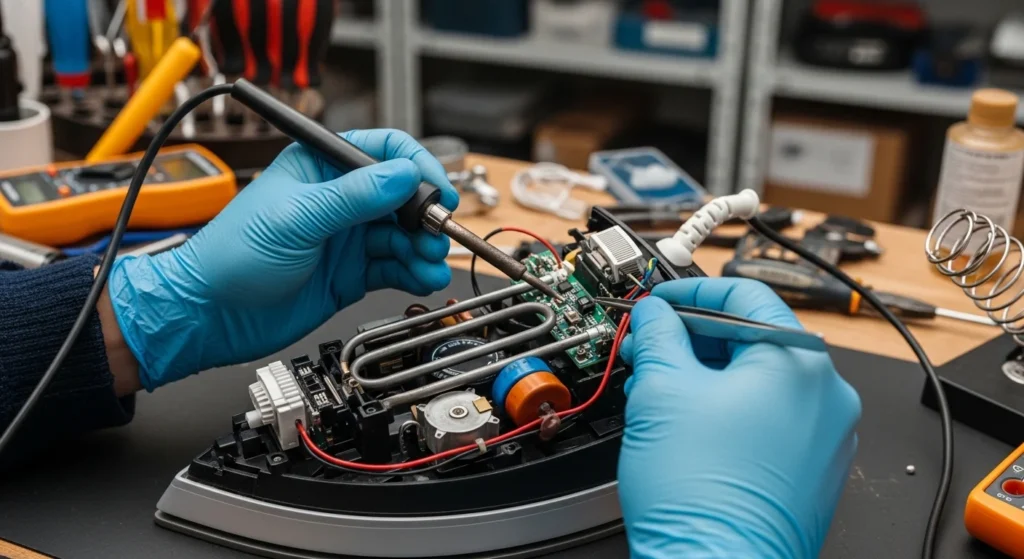
Iron repair involves careful disassembly of the appliance, inspection of internal components, and replacement of faulty parts. Safety is very important because irons operate on high voltage electricity. Before opening the device, the power must always be disconnected. After repairing or replacing parts, the iron is tested to ensure proper heating and temperature control.
Simple repairs like cleaning contacts or tightening connections can often restore functionality, while complex issues may require replacing the thermostat or heating coil. Regular maintenance, such as proper cleaning and avoiding overheating, can extend the life of an electric iron. Overall, iron repair is a practical skill that helps save money, reduce waste, and improve understanding of basic electrical appliance working principles.
What Is Electric Iron Repair? Complete Guide (2026)
Electric Iron Repair is the process of inspecting, diagnosing, troubleshooting, and repairing faults in an electric iron to restore its normal heating and ironing performance. Whether the iron is not heating, overheating, producing uneven heat, or failing to switch on, proper repair helps identify the root cause and restore safe operation.
Electric irons are among the most commonly used household appliances. Over time, continuous use, electrical faults, overheating, moisture, or worn-out components can cause them to malfunction. Instead of replacing the appliance immediately, many common problems can be repaired by testing individual components and replacing faulty parts.
Understanding electric iron repair is important for electrical students, technicians, appliance repair professionals, and beginners because it provides practical knowledge of electrical circuits, heating elements, thermostats, and safety devices used in everyday appliances.
Simple Explanation
In simple terms, electric iron repair means finding the faulty component inside the iron and repairing or replacing it so the appliance can operate safely and efficiently again.
A complete repair process may include:
- Inspecting the power cord for damage.
- Testing electrical continuity with a multimeter.
- Checking the thermostat operation.
- Examining the heating element.
- Inspecting the thermal fuse.
- Tightening loose electrical connections.
- Cleaning carbon deposits and internal components.
- Replacing worn or damaged parts.
- Performing a final safety and performance test.
Proper repair not only restores the iron’s performance but also improves safety and extends its service life.
Practical Example
Suppose you plug an electric iron into a wall socket, but the indicator light does not turn on and the soleplate remains cold. Instead of assuming the iron is completely damaged, a technician performs a systematic inspection.
The repair process may include:
- Testing the power cord for continuity.
- Checking whether electricity reaches the thermostat.
- Inspecting the heating element for an open circuit.
- Examining the thermal fuse for damage.
- Looking for loose or burnt wire connections.
- Testing the thermostat to ensure it opens and closes correctly.
After identifying the faulty component, the technician replaces or repairs it, reassembles the iron, and performs a final heating test to confirm that it operates safely and efficiently.
Electric Iron Working Principle (2026)
Understanding the electric iron working principle is essential before attempting any troubleshooting or repair. Knowing how the iron operates makes it much easier to identify faulty components and repair them correctly.
An electric iron works by converting electrical energy into heat energy. This heat is generated by a heating element installed beneath the metal soleplate. The thermostat continuously controls the temperature by switching the heating element ON and OFF, ensuring that the selected temperature is maintained for different types of fabrics.
Although the working process appears simple, several electrical and mechanical components operate together to produce safe, controlled heating.
Step 1: Electrical Power Supply
The process begins when the electric iron is plugged into a household electrical outlet.
Electrical energy travels through the power cord and enters the internal electrical circuit of the iron.
Step 2: Current Flows Through the Heating Element
When the temperature control is switched on, electric current passes through the heating element.
The heating element is made from a high-resistance material such as Nichrome wire, which is specially designed to produce heat when current flows through it.
Step 3: Heat Generation
As electricity passes through the resistance wire, electrical resistance converts electrical energy into thermal energy.
The heating element quickly becomes hot and transfers this heat to the metal soleplate.
The soleplate gradually reaches the temperature selected by the user.
Step 4: Temperature Regulation
The thermostat continuously monitors the soleplate temperature.
When the selected temperature is reached, the thermostat automatically opens the electrical circuit, stopping current flow to the heating element.
As the iron cools slightly during use, the thermostat closes the circuit again, allowing the heating element to reheat the soleplate.
This automatic ON-OFF cycle maintains a stable ironing temperature while preventing overheating.
Step 5: Heat Transfer to Clothes
The heated soleplate transfers thermal energy directly to the fabric.
The combination of heat and gentle pressure relaxes fabric fibers, removes wrinkles, and leaves clothes smooth and neatly pressed.
In steam irons, steam further softens the fabric, making wrinkle removal even more effective.
Simple Analogy
Think of an electric iron as a controlled electric heater.
Just as an electric room heater uses a heating element to produce warmth, an electric iron uses a resistance heating element to heat its soleplate. The thermostat acts like an automatic temperature controller, switching the heater on and off whenever necessary to maintain the desired heat level.
This simple but effective operating principle allows an electric iron to provide safe, efficient, and consistent heating for everyday ironing tasks.
Types of Electric Irons (2026): Complete Classification, Features & Uses
Electric irons are available in several types based on their working principle, heating technology, features, and intended applications. Each type is designed to meet different ironing needs, from simple household use to professional garment care and industrial laundry services.
Understanding the different types of electric irons helps users choose the right appliance based on fabric type, ironing frequency, budget, and convenience. Below are the most common types of electric irons used today.
Dry Iron
A dry iron is the simplest and most traditional type of electric iron. It uses only electrical heat to remove wrinkles and does not produce steam. Because of its simple construction and affordable price, it remains one of the most popular choices for everyday household use.
Dry irons have fewer internal components, making them reliable, durable, and easy to maintain.
Working Principle
When the iron is connected to the power supply, electric current flows through the heating element. The heating element converts electrical energy into heat, which is transferred to the metal soleplate. A built-in thermostat continuously controls the temperature by switching the heating element on and off to maintain the selected heat level.
Key Features
- Operates without a steam system.
- Adjustable temperature control.
- Lightweight and easy to handle.
- Quick heating performance.
- Simple internal construction.
- Low maintenance requirements.
- Energy-efficient for daily use.
Advantages
- Affordable purchase cost.
- Easy to repair and maintain.
- Long operating life.
- Suitable for most everyday fabrics.
- Reliable performance for regular ironing.
Limitations
- Less effective on heavy wrinkles.
- Requires more manual effort.
- Not suitable for thick fabrics without repeated ironing.
Best Applications
- School uniforms
- Cotton shirts
- Office clothing
- Trousers
- Light household garments
Steam Iron
A steam iron is one of the most widely used modern electric irons. It combines heat with steam to remove wrinkles quickly and efficiently. Steam softens fabric fibers, allowing the soleplate to glide smoothly over clothes while reducing ironing time.
Because of its excellent performance, the steam iron is suitable for both home and professional use.
Working Principle
Water stored inside the built-in tank is heated by the heating element until it becomes steam. The steam exits through multiple holes in the soleplate and penetrates the fabric, making wrinkles easier to remove.
The thermostat regulates the temperature while the steam control system adjusts the amount of steam according to the selected fabric.
Key Features
- Built-in water reservoir.
- Multiple steam vents.
- Adjustable steam output.
- Burst steam function.
- Vertical steam capability.
- Anti-drip technology.
- Self-cleaning system in modern models.
Advantages
- Removes stubborn wrinkles quickly.
- Suitable for thick fabrics.
- Faster ironing with less effort.
- Better fabric care.
- Professional-quality results.
Limitations
- Heavier than dry irons.
- Requires regular descaling.
- More expensive than basic dry irons.
- Additional maintenance for the water system.
Best Applications
- Cotton garments
- Denim clothing
- Curtains
- Bed sheets
- Professional laundry services
- Garment factories
Cordless Iron
A cordless iron provides greater flexibility by eliminating the power cord during ironing. Instead of remaining connected continuously, it heats on a charging base and retains enough heat for short ironing sessions.
This design improves comfort and freedom of movement.
Working Principle
The iron is placed on a powered heating base where it quickly reaches the selected temperature. After heating, it is removed from the base and used wirelessly. When the temperature begins to drop, it is returned to the base for reheating.
Key Features
- Cord-free operation.
- Charging base station.
- Lightweight design.
- Improved mobility.
- Easy storage.
- Enhanced user safety.
Advantages
- Greater freedom of movement.
- No tangled power cord.
- Comfortable ironing experience.
- Reduced risk of cord damage.
- Easy handling around large garments.
Limitations
- Limited heating duration.
- Requires frequent reheating.
- Less suitable for continuous heavy-duty ironing.
- Higher purchase cost.
Best Applications
- Small ironing jobs.
- Home users.
- Delicate fabrics.
- Quick touch-up ironing.
Travel Iron
A travel iron is specially designed for portability. Its compact size and lightweight construction make it ideal for travelers who need wrinkle-free clothes while away from home.
Many travel irons support dual-voltage operation, allowing them to be used in different countries.
Working Principle
A travel iron operates similarly to a standard dry or steam iron but uses a smaller heating element and compact soleplate. Despite its size, it provides sufficient heat for light ironing tasks.
Key Features
- Compact and lightweight.
- Foldable handle.
- Dual-voltage compatibility.
- Easy to pack.
- Fast heating.
- Available in dry and steam models.
Advantages
- Easy to carry.
- Convenient for business trips.
- Suitable for international travel.
- Saves luggage space.
- Quick setup.
Limitations
- Smaller soleplate.
- Lower power rating.
- Longer ironing time for large garments.
- Not suitable for continuous heavy use.
Best Applications
- Business travel.
- Hotel stays.
- Vacations.
- Emergency garment care.
Steam Generator Iron
A steam generator iron is a high-performance ironing system designed for heavy-duty and professional applications. Unlike a standard steam iron, it has a separate boiler that generates high-pressure steam continuously.
Working Principle
Water is heated inside an external boiler unit, producing high-pressure steam that travels through a hose to the iron. Continuous steam output removes wrinkles quickly from even the thickest fabrics.
Key Features
- Separate water tank.
- High-pressure steam.
- Continuous steam generation.
- Large water capacity.
- Professional performance.
- Faster ironing.
Advantages
- Excellent wrinkle removal.
- Ideal for large quantities of clothes.
- Long continuous operation.
- Reduced ironing time.
- Professional-quality finish.
Limitations
- Expensive.
- Larger size.
- Requires more storage space.
- Higher maintenance requirements.
Best Applications
- Commercial laundries.
- Garment factories.
- Hotels.
- Textile industries.
- Professional ironing services.
Smart Electric Iron
A smart electric iron represents the latest advancement in ironing technology. These irons include intelligent electronic controls that improve safety, efficiency, and ease of use.
Working Principle
Built-in sensors monitor temperature, movement, and operating conditions. The iron automatically adjusts heating and may switch off if left unattended.
Key Features
- Automatic temperature adjustment.
- Auto shut-off function.
- Digital display.
- Motion sensors.
- Energy-saving operation.
- Advanced safety protection.
Advantages
- Improved safety.
- Better energy efficiency.
- Reduced risk of fabric damage.
- User-friendly operation.
- Modern smart features.
Limitations
- Higher purchase cost.
- More complex electronics.
- Repairs may require specialized technicians.
Best Applications
- Modern homes.
- Premium garment care.
- Frequent household ironing.
- Users seeking advanced safety features.
Electric irons are available in dry irons, steam irons, cordless irons, travel irons, steam generator irons, and smart electric irons, each designed for specific applications. Dry irons are economical and simple, steam irons provide excellent wrinkle removal, cordless irons offer greater flexibility, travel irons are ideal for portability, steam generator irons deliver professional performance, and smart irons combine advanced technology with enhanced safety. Choosing the right electric iron depends on your ironing needs, fabric types, budget, and frequency of use. This ensures efficient, safe, and comfortable ironing for both home and professional environments.
Main Components of an Electric Iron: Detailed Explanation
An electric iron is a simple but important household appliance that works by converting electrical energy into heat energy. It is made up of several key components that work together to provide smooth, efficient, and safe ironing performance. Understanding these components is also helpful for basic electric iron repair and troubleshooting.
Heating Element
The heating element is the most important part of the electric iron. It is responsible for producing heat required for ironing clothes.
Function:
- Converts electrical energy into heat energy
- Made of resistance wire (usually nichrome)
- Embedded in an insulating material for safety and durability
- Heats the soleplate evenly for effective ironing
Without the heating element, the iron cannot generate heat and becomes non-functional.
Thermostat
The thermostat controls the temperature of the iron and ensures safe operation.
Function:
- Maintains the selected temperature automatically
- Turns the heating element ON and OFF based on heat level
- Prevents overheating and fabric damage
- Allows adjustment for different types of fabrics
It is a critical safety and control component in the iron.
Soleplate
The soleplate is the flat metal base of the iron that directly contacts the fabric.
Function:
- Transfers heat evenly to clothes
- Provides smooth gliding over fabric
- Helps remove wrinkles effectively
- Made of materials like stainless steel, ceramic, or non-stick coatings
A good-quality soleplate improves ironing performance and fabric protection.
Power Cord
The power cord supplies electrical power from the outlet to the iron.
Function:
- Delivers electricity to internal components
- Must be heat-resistant and flexible
- Common failure point due to bending or wear
- Damaged cords can cause safety hazards or power failure
Proper cord maintenance is important for safe operation.
Indicator Light
The indicator light shows the operational status of the iron.
Function:
- Indicates when the iron is heating
- Turns OFF when the desired temperature is reached
- Helps users know when the iron is ready for use
It improves user convenience and safety.
Water Tank (Steam Irons Only)
Steam irons include a water tank for producing steam during ironing.
Function:
- Stores water for steam generation
- Helps remove tough wrinkles more effectively
- Produces continuous or burst steam during operation
- Enhances ironing efficiency for heavy fabrics
It is a key feature in modern steam iron designs.
The main components of an electric iron, including the heating element, thermostat, soleplate, power cord, indicator light, and water tank, work together to ensure efficient and safe operation. Each part plays an important role in heat generation, temperature control, and fabric care. Understanding these components helps in better usage, maintenance, and troubleshooting of the electric iron.
Electric Iron Advantages and Disadvantages
Understanding electric iron advantages and disadvantages helps users maintain and repair them effectively.
Advantages
- Simple and reliable appliance
- Easy to operate
- Affordable household tool
- Fast heating capability
- Widely available spare parts
Disadvantages / Limitations
- Heating element may burn out over time
- Power cord damage is common
- Scale buildup in steam irons
- Risk of overheating if thermostat fails
Regular maintenance helps reduce these issues.
Applications of Electric Iron: Complete Overview
An electric iron is a widely used household and commercial appliance designed to remove wrinkles from fabric using heat and pressure. Although it is commonly associated with home use, its applications extend across several industries where fabric finishing and appearance are important. The versatility of electric irons makes them essential in both domestic and professional environments.
Household Use
The most common application of an electric iron is in homes for daily clothing care. People use it to remove wrinkles from shirts, trousers, uniforms, and other garments. Regular ironing helps maintain a neat appearance and improves personal presentation in daily life, school, and work environments.
Laundry Services
In commercial laundry shops, electric irons are used on a large scale to handle bulk clothing. These businesses often use heavy-duty steam irons that can operate continuously for long hours. This ensures quick and efficient ironing of large quantities of clothes while maintaining professional quality.
Textile Industry
In the textile and garment manufacturing industry, electric irons play an important role in fabric finishing. Industrial-grade irons are used during production to shape, press, and finish garments before packaging. This step ensures that clothes meet quality standards and have a polished appearance before reaching customers.
Hotels and Hospitality Sector
In the hospitality industry, especially in hotels, electric irons are used to provide professional ironing services for guests. Many hotels offer in-room ironing facilities or dedicated laundry services to ensure that guests have neatly pressed clothing during their stay. This enhances customer satisfaction and service quality.
Electric irons have a wide range of applications beyond household use. From domestic ironing to industrial garment production and professional laundry services, they play a vital role in maintaining fabric appearance and quality. Their efficiency, simplicity, and versatility make them an essential appliance in both personal and commercial settings.
Comparison Section
Difference Between Dry Iron and Steam Iron
| Feature | Dry Iron | Steam Iron |
|---|---|---|
| Steam Function | No | Yes |
| Water Tank | Not required | Required |
| Wrinkle Removal | Moderate | More effective |
| Maintenance | Simple | Requires cleaning |
| Cost | Lower | Higher |
Understanding the difference between dry iron and steam iron helps users choose the right appliance.
Electric Iron Selection Guide: How to Choose the Right Iron
Choosing the right electric iron is important for achieving good ironing results, saving energy, and ensuring safety. Different types of irons are designed for different needs, so selecting the correct model depends on usage, performance requirements, and safety features. A proper selection helps improve efficiency and extends the lifespan of the appliance.
Type of Use
The first factor to consider is how frequently and for what purpose the iron will be used.
- For basic or occasional ironing, a dry iron is sufficient. It is simple, lightweight, and easy to use.
- For heavy wrinkles or regular use, a steam iron is a better option because it produces steam that removes creases more effectively and quickly.
Power Rating (Wattage)
The power rating of an iron determines how fast it heats up and how efficiently it works.
- Higher wattage irons heat up faster and provide consistent performance, making them suitable for frequent use.
- Lower wattage irons take more time to heat but consume less electricity.
Choosing the right wattage depends on your usage pattern and energy preference.
Safety Features
Modern electric irons come with several safety features that protect both the user and the appliance.
Important features include:
- Automatic shut-off system to prevent overheating
- Adjustable temperature control for different fabrics
- Thermal safety fuse for extra protection
These features reduce the risk of accidents and fabric damage.
Build Quality and Durability
The durability of an iron depends on its construction and materials.
- A high-quality soleplate ensures smooth gliding over clothes and even heat distribution
- A strong and heat-resistant power cord improves safety and lifespan
- A well-built body ensures long-term reliability
Better build quality results in longer service life and consistent performance.
Beginner-Friendly Selection
For beginners, it is recommended to choose:
- Simple and easy-to-use models
- Basic temperature control systems
- Irons that are easy to repair and maintain
This helps in learning proper usage without complications.
Selecting the right electric iron depends on usage type, power rating, safety features, and build quality. Steam irons are best for heavy use, while dry irons suit simple tasks. By choosing a reliable and easy-to-use model, users can ensure safe, efficient, and long-lasting ironing performance.
Common Electric Iron Problems and Solutions (2026): Complete Troubleshooting Guide
Like any household electrical appliance, an electric iron can develop faults after long-term use. These problems may result from worn-out components, electrical failures, overheating, improper maintenance, or incorrect operation. Understanding the most common electric iron problems helps users diagnose faults quickly, perform basic troubleshooting, and decide whether a repair or replacement is necessary.
Regular inspection and preventive maintenance can significantly improve the performance, efficiency, and lifespan of an electric iron while ensuring safe operation.
Why Is the Electric Iron Not Heating?
One of the most common problems is an iron that does not produce heat after being plugged into the power supply. Without proper heating, the iron cannot remove wrinkles or perform its intended function.
Possible Causes
- Burned or damaged heating element.
- Faulty thermostat.
- Blown thermal fuse.
- Loose or broken internal wiring.
- Defective power cord or plug.
- No electrical power supply.
Solutions
- Check the wall outlet using another electrical appliance.
- Test the power cord for continuity.
- Inspect the heating element with a multimeter.
- Replace the faulty thermostat or thermal fuse.
- Tighten loose electrical connections.
- Replace damaged internal wiring if necessary.
Why Is the Electric Iron Overheating?
If the iron becomes excessively hot, it can scorch fabrics, damage internal components, and create a safety hazard.
Possible Causes
- Defective thermostat.
- Faulty temperature control knob.
- Thermostat contacts stuck in the closed position.
- Damaged temperature sensor.
- Continuous operation at maximum temperature.
Solutions
- Replace the defective thermostat.
- Check the temperature control mechanism.
- Test thermostat operation before reassembly.
- Avoid using the highest temperature unnecessarily.
- Replace damaged control components immediately.
Why Is the Indicator Light Not Working?
The indicator light shows whether the heating element is receiving electrical power. If it fails, users may not know whether the iron is heating correctly.
Possible Causes
- Burned-out indicator lamp.
- Loose internal wire connection.
- Damaged power cord.
- Faulty thermostat.
- Electrical circuit failure.
Solutions
- Verify that power reaches the iron.
- Replace the indicator light if damaged.
- Inspect all internal wiring connections.
- Test the thermostat for proper operation.
- Repair damaged electrical components.
Why Is Steam Not Coming Out?
Steam irons may stop producing steam due to mineral deposits, clogged steam holes, or problems within the water system.
Possible Causes
- Blocked steam vents.
- Mineral scale inside the water tank.
- Low water level.
- Dirty steam channels.
- Faulty steam control valve.
Solutions
- Clean the steam vents thoroughly.
- Remove mineral deposits using the self-cleaning function.
- Fill the water tank properly.
- Use distilled water whenever possible.
- Replace damaged steam valves if necessary.
Why Is Water Leaking from the Iron?
Water leakage is a common issue in steam irons and can damage clothing or reduce ironing performance.
Possible Causes
- Overfilled water tank.
- Damaged water tank seal.
- Incorrect temperature setting.
- Blocked steam chamber.
- Cracked internal water reservoir.
Solutions
- Fill the tank only to the recommended level.
- Replace damaged seals.
- Allow the iron to reach operating temperature before using steam.
- Clean the steam system regularly.
- Replace damaged water tanks if necessary.
Why Does the Iron Produce a Burning Smell?
A burning smell often indicates overheating or accumulated dirt inside the appliance.
Possible Causes
- Dust accumulation on the heating element.
- Burnt fabric residue on the soleplate.
- Overheated electrical wiring.
- Damaged insulation.
- Faulty heating element.
Solutions
- Clean the soleplate carefully.
- Remove burnt fabric deposits.
- Inspect internal wiring.
- Replace damaged insulation.
- Disconnect the iron immediately if the smell persists.
Why Is the Soleplate Not Heating Evenly?
Uneven heating affects ironing quality and may leave wrinkles on clothing.
Possible Causes
- Partially damaged heating element.
- Carbon deposits.
- Loose electrical connections.
- Poor heat distribution.
Solutions
- Test the heating element.
- Clean the soleplate regularly.
- Tighten loose electrical connections.
- Replace faulty heating components.
Why Does the Power Cord Become Hot?
A hot power cord may indicate excessive electrical resistance or an unsafe electrical connection.
Possible Causes
- Damaged insulation.
- Loose plug connection.
- Undersized wiring.
- Internal short circuit.
Solutions
- Replace damaged power cords immediately.
- Tighten loose plug terminals.
- Avoid using damaged extension cords.
- Inspect for internal electrical faults.
Why Does the Thermostat Keep Switching Frequently?
Frequent thermostat switching can reduce heating efficiency and affect ironing performance.
Possible Causes
- Faulty thermostat calibration.
- Worn thermostat contacts.
- Incorrect temperature setting.
- Aging electrical components.
Solutions
- Adjust the thermostat correctly.
- Replace worn thermostat contacts.
- Install a new thermostat if necessary.
- Perform regular maintenance inspections.
Preventive Maintenance Tips
Following simple maintenance practices helps prevent most electric iron problems before they occur.
Best Maintenance Practices
- Clean the soleplate after regular use.
- Empty the water tank before storing a steam iron.
- Use distilled water to reduce mineral deposits.
- Inspect the power cord for damage.
- Keep steam vents clean.
- Store the iron in a dry place.
- Avoid dropping the iron.
- Test the thermostat periodically.
- Replace damaged components immediately.
- Disconnect the iron after use.
Proper maintenance improves safety, extends the appliance’s lifespan, reduces repair costs, and ensures reliable ironing performance for many years.
Most electric iron problems are caused by faulty heating elements, defective thermostats, damaged power cords, blocked steam systems, loose electrical connections, or worn-out internal components. Fortunately, many of these faults can be diagnosed and repaired through systematic troubleshooting and regular maintenance. By inspecting the iron periodically, cleaning it properly, and replacing damaged parts promptly, users can maintain safe, efficient, and long-lasting performance while avoiding unnecessary repairs or replacements.
Future Trends in Electric Iron Technology (2026): Smart Features, Energy Efficiency & Modern Innovations
Electric iron technology is advancing rapidly as manufacturers focus on developing appliances that are smarter, safer, more energy-efficient, and easier to use. Traditional electric irons were designed simply to generate heat, but modern models now incorporate intelligent electronics, advanced steam systems, and automated safety features that improve both performance and user experience.
The future of electric irons is being driven by the growing demand for energy conservation, smart home integration, eco-friendly designs, and enhanced fabric protection. These innovations help users save time, reduce electricity consumption, and achieve better ironing results while minimizing the risk of damaging clothes.
Smart Electric Irons with Intelligent Sensors
One of the biggest innovations in modern ironing technology is the development of smart electric irons equipped with intelligent sensors and microprocessor-based control systems.
These sensors automatically detect the type and thickness of fabric and adjust the soleplate temperature accordingly. This eliminates guesswork and greatly reduces the chances of burning delicate materials such as silk, wool, or synthetic fabrics.
Modern smart irons may also include:
- Automatic fabric recognition.
- Digital LCD or LED displays.
- Touch-button temperature controls.
- Memory settings for frequently used fabrics.
- Mobile app connectivity in premium models.
- Voice-assisted operation for smart homes.
These intelligent features improve ironing quality while making the appliance easier and safer to operate.
High-Efficiency Heating Systems
Energy efficiency has become one of the primary goals in appliance manufacturing. New-generation electric irons use advanced heating elements and improved thermal insulation to produce more heat while consuming less electricity.
Modern heating technologies provide several benefits:
- Faster heat-up times.
- Lower electricity consumption.
- More consistent soleplate temperature.
- Reduced standby power usage.
- Improved heat distribution.
- Longer heating element lifespan.
These improvements help reduce household energy bills while supporting global energy-saving initiatives.
Advanced Steam Generation Technology
Steam technology continues to evolve, making wrinkle removal faster and more effective than ever before.
Modern electric irons now feature powerful steam systems capable of generating continuous, high-pressure steam for professional-quality ironing. Improved steam distribution ensures that heat reaches every part of the fabric evenly.
Many advanced models now include:
- Continuous steam output.
- Powerful steam boost function.
- Vertical steaming for hanging garments.
- Precision steam tips.
- Anti-drip technology.
- Self-cleaning steam chambers.
- Anti-scale systems to reduce mineral buildup.
These innovations significantly reduce ironing time while improving fabric care.
Automatic Safety Systems
Safety remains one of the most important areas of development in modern electric irons.
New safety technologies help prevent accidents caused by overheating, unattended operation, or electrical faults.
Common safety features include:
- Automatic shut-off when left unattended.
- Motion detection sensors.
- Overheat protection circuits.
- Thermal fuse protection.
- Child safety locking systems.
- Heat-resistant handles.
- Improved electrical insulation.
These features greatly reduce the risk of fire, electric shock, and accidental fabric damage.
Eco-Friendly and Sustainable Designs
Manufacturers are increasingly adopting environmentally friendly production methods to reduce environmental impact.
Modern electric irons are now being designed with:
- Recyclable materials.
- Energy-saving electronic circuits.
- Lead-free electrical components.
- Environmentally safe manufacturing processes.
- Reduced plastic usage.
- Longer product lifespan.
These sustainable designs support global environmental conservation while improving product durability.
Ceramic and Advanced Soleplate Materials
Future electric irons will continue using improved soleplate materials that provide better heat transfer and smoother movement across fabrics.
Popular modern soleplate technologies include:
- Ceramic-coated soleplates.
- Titanium-coated surfaces.
- Stainless steel soleplates.
- Scratch-resistant coatings.
- Non-stick finishes.
- Multi-layer heat distribution systems.
These materials improve durability, reduce friction, and provide more uniform heating during ironing.
Integration with Smart Home Technology
As smart homes become increasingly popular, electric irons are also becoming connected appliances.
Future smart irons may integrate with home automation systems, allowing users to:
- Monitor temperature remotely.
- Receive maintenance notifications.
- Control heating through mobile applications.
- Schedule automatic shut-off.
- Track electricity consumption.
- Perform software updates for improved performance.
This connectivity enhances convenience while improving appliance management.
Predictive Maintenance Technology
Artificial intelligence and smart sensors are expected to play a greater role in appliance maintenance.
Future electric irons may monitor their own operating condition and notify users when maintenance is required.
Potential predictive maintenance features include:
- Heating element health monitoring.
- Steam system diagnostics.
- Thermostat performance monitoring.
- Scale buildup detection.
- Internal fault reporting.
- Maintenance reminders.
These systems can reduce unexpected failures and extend the overall lifespan of the appliance.
Improved User Experience
Manufacturers continue to focus on making electric irons more comfortable and convenient for everyday use.
Future models are expected to include:
- Lightweight ergonomic designs.
- Better-balanced construction.
- Larger water tanks.
- Faster reheating technology.
- Quieter steam generation.
- Improved grip handles.
- Easier temperature selection.
- Enhanced cord management systems.
These improvements reduce user fatigue and make ironing faster and more enjoyable.
The Future of Electric Iron Technology
The future of electric irons lies in combining smart electronics, artificial intelligence, energy-efficient heating, advanced steam generation, and enhanced safety systems into a single appliance. As technology continues to evolve, electric irons will become more intelligent, reliable, and environmentally friendly while delivering professional-quality ironing with minimal effort.
Future innovations will not only improve performance but also reduce maintenance requirements, lower electricity consumption, and provide greater convenience for households, commercial laundries, hotels, and garment industries. Modern electric irons are rapidly transforming from simple heating devices into intelligent home appliances that offer exceptional efficiency, safety, and ease of use.
Conclusion
Electric iron repair is an important skill for electrical students, technicians, and beginners who want practical knowledge of household appliances. Electric irons operate using a simple heating system where electrical energy is converted into heat energy.
In this article, we discussed the electric iron working principle, types of irons, main components, advantages, disadvantages, and common electric iron applications. We also examined typical problems such as heating failure, thermostat faults, and power cord damage, along with practical solutions.
Understanding how electric irons function helps technicians diagnose problems quickly and perform effective repairs. With proper maintenance and correct troubleshooting techniques, most electric iron problems can be solved easily.
Learning appliance repair not only saves money but also develops valuable technical skills for anyone working in electrical maintenance and repair.