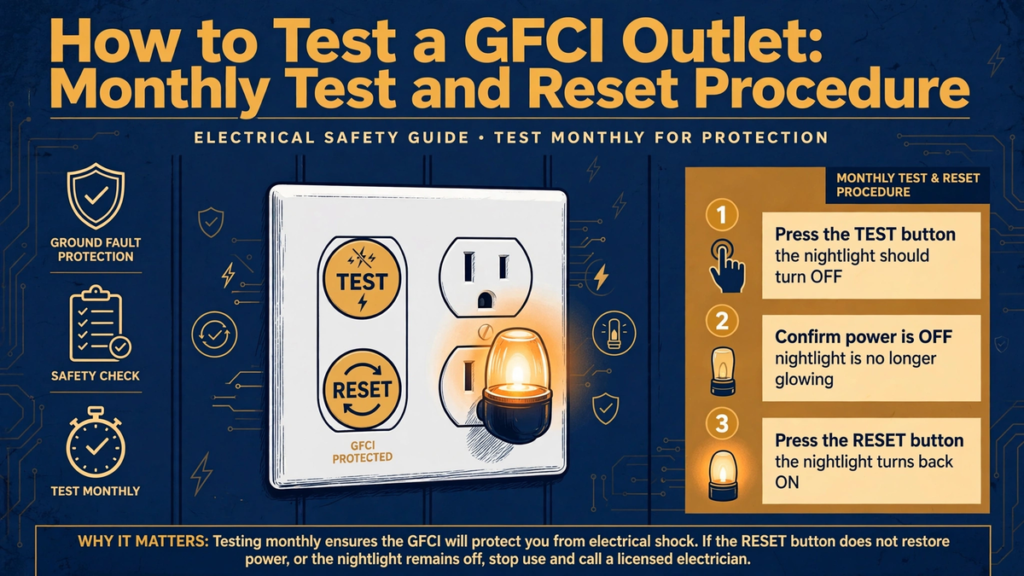

A ground fault circuit interrupter (GFCI) outlet is one of the few devices in your home whose only job is to save your life. It compares the current flowing out on the hot wire with the current returning on the neutral, and if as little as 4 to 6 milliamperes leaks through an unintended path — water, a damaged cord, a person — it shuts off power in about one-fortieth of a second. But a GFCI can wear out silently, and the only way to know it still works is to test it yourself.
Manufacturers, the Electrical Safety Foundation International, and the Consumer Product Safety Commission all recommend testing every GFCI monthly. The test takes about a minute, needs no tools, and uses the built-in TEST and RESET buttons. Here is the exact procedure, what each result means, and what to do when a GFCI fails.
What the TEST and RESET Buttons Do
The TEST button creates a small current imbalance — a simulated ground fault. If the sensing electronics are healthy, they trip the outlet, cutting power to the receptacle face and everything downstream.
The RESET button restores power after a trip; when the outlet trips, RESET typically pops out. If a GFCI will not reset, that is diagnostic: either no power is reaching the device or a genuine ground fault is still present on the circuit.
The Monthly Test, Step by Step
Step 1 — Plug in a test load. Plug a lamp or nightlight into the GFCI and switch it on. If it does not light at all, stop: the outlet has no power, and the GFCI cannot be tested until the breaker and wiring are checked.
Step 2 — Press TEST. A working GFCI trips instantly with a click, the lamp goes out, and RESET pops out. This confirms the sensing mechanism can detect a fault and interrupt the circuit.
Step 3 — Press RESET. Push RESET until it clicks flush. The lamp should come back on, confirming power is restored.
If the lamp stays on in Step 2, the GFCI is not protecting you — replace it immediately. If it goes off but will not come back on in Step 3, the device has failed or lost power. Keep a simple log of which outlets you tested and when.
Where GFCIs Are Required
The NEC has expanded GFCI requirements steadily since 1971, because each new location kept proving dangerous. Knowing the history shows why older homes may have unprotected outlets worth upgrading.
| NEC Edition | New GFCI Locations |
|---|---|
| 1971 | Outdoor receptacles |
| 1975 | Bathroom receptacles |
| 1978 | Garage wall receptacles |
| 1987 | Kitchen countertops within 6 ft of sink; one basement receptacle |
| 1996 | All kitchen countertop receptacles; all outdoor receptacles |
| 2005 | Within 6 ft of laundry/utility sinks |
| 2014 | Laundry areas; near bathtubs/showers; dishwashers |
| 2020 | Outdoor hardwired outlets; sump pumps; dryers and ranges |
Current requirements live in NEC 210.8, and NEC 406.4(D) requires GFCI protection when replacing receptacles in these locations. The Electrical Safety Foundation International credits GFCI use with an 80% drop in electrocutions since their introduction.
Testing Downstream Outlets
One GFCI can protect several ordinary outlets wired to its LOAD terminals — common in kitchens and bathrooms. Pressing TEST on the GFCI should kill power at those downstream outlets too; verify with your lamp. If a downstream outlet stays live, it is not actually protected and the wiring needs correction. Downstream outlets should be labeled “GFCI Protected.” Related protective devices worth knowing include the RCCB vs ELCB comparison and arc-fault breakers, which guard against fire-causing arcing faults rather than shock.
When a GFCI Keeps Tripping
Repeated tripping usually means the GFCI is doing its job — something is leaking current. Unplug everything, reset, then plug items back one at a time to find the culprit. Heating appliances, old motors, outdoor equipment in damp conditions, and damaged extension cords are frequent offenders. If it trips with nothing plugged in, the wiring itself may be at fault — call an electrician. For diagnostics beyond the button test, see our electrical testing tools guide. Never bypass a GFCI to stop nuisance tripping, and remember a proper equipment ground wire complements but never replaces GFCI personnel protection.
What to Do When a GFCI Fails the Monthly Test
A failed test is not a reason to panic, but it is a reason to act the same day. Start by confirming the result: press RESET firmly, wait a few seconds, then press TEST again. If the outlet trips on the second try, the first failure may have been a sticky button or a momentary fault, and you can resume monthly testing as normal. If it fails again, do not keep using that outlet as if it were protected.
Next, check the obvious causes before you replace anything. Make sure the circuit breaker is on and fully seated, and try the test with nothing plugged in, because a faulty appliance can mask the result. Test a second GFCI on the same circuit if one is available, and note whether other outlets on the circuit also lose power when you press TEST. If the outlet still will not trip, or if RESET will not stay in, the device has reached the end of its life. Replace a failed GFCI promptly, and choose a self-testing model, which runs its own internal check and alerts you if protection is lost. If you are not comfortable working inside an electrical box, or if the wiring looks damaged, scorched, or loose, call a licensed electrician rather than forcing the outlet. A GFCI that cannot trip is worse than no outlet at all, because it looks safe while offering no protection.
Frequently Asked Questions
How often should I test GFCI outlets?
Monthly, plus after any major electrical storm. GFCIs can fail silently while the outlet still delivers power, so the calendar reminder is what keeps the protection real.
What if the TEST button does nothing?
The internal protection has failed. The outlet may still supply power — which makes this especially dangerous, since it looks normal but protects nothing. Replace it immediately.
Why won’t my GFCI reset?
First confirm the breaker is on and power reaches the outlet — a GFCI cannot reset without incoming power. If power is present and RESET will not hold, the device has failed or a real ground fault exists downstream. Unplug everything, try once more, then call an electrician.
Can a plug-in tester replace the button test?
No. A plug-in tester is a useful supplement for verifying wiring, but only the built-in TEST button exercises the GFCI’s own internal sensing circuit. Use both.
Do GFCI breakers need testing too?
Yes — monthly. With the handle ON, press TEST, confirm it trips to the middle position, then switch fully OFF and back ON. Replace it if it fails to trip.
Will a GFCI work without a ground wire?
Yes. A GFCI compares hot and neutral current and needs no equipment ground to detect a fault — which is why the NEC allows GFCI protection as a safety upgrade for old two-wire circuits (labeled “No Equipment Ground”).
Conclusion
The monthly GFCI test is a one-minute habit: lamp in, TEST, confirm the power dies, RESET, confirm it returns. Any other result means replacement or professional diagnosis. Put it on your calendar, test breaker-type GFCIs too, and consult a licensed electrician — under your locally adopted NEC edition — for any failure you cannot explain.
For more on home electrical safety, see the Electrical Safety Foundation International website.