
Imagine you have a water tank at home. Sometimes it overflows because you forget to turn off the pump. Other times, the tank runs empty because the pump is not switched on at the right time. This common problem can lead to water wastage, higher electricity bills, and even damage to equipment.
This is where a float switch becomes very useful. It automatically controls the water level in tanks, preventing overflow and dry running. In industries, float switches are even more critical because they help maintain liquid levels in large systems like boilers, cooling towers, and chemical tanks.
Understanding the float switch working principle is important for electrical students, technicians, and engineers. It helps in designing safe and efficient control systems.
In this article, you will learn what a float switch is, how it works, its types, components, applications, advantages and disadvantages, and how to select the right one for your needs.
2. What is Float Switch?
A float switch is an electrical device used to detect the level of liquid inside a tank or container and control equipment like pumps based on that level.
Simple Explanation:
It is a switch that turns ON or OFF depending on the liquid level.
Practical Example:
In a home water tank:
- When water level is low → pump turns ON
- When tank is full → pump turns OFF
This automation saves time, water, and electricity.
3. Float Switch Working Principle
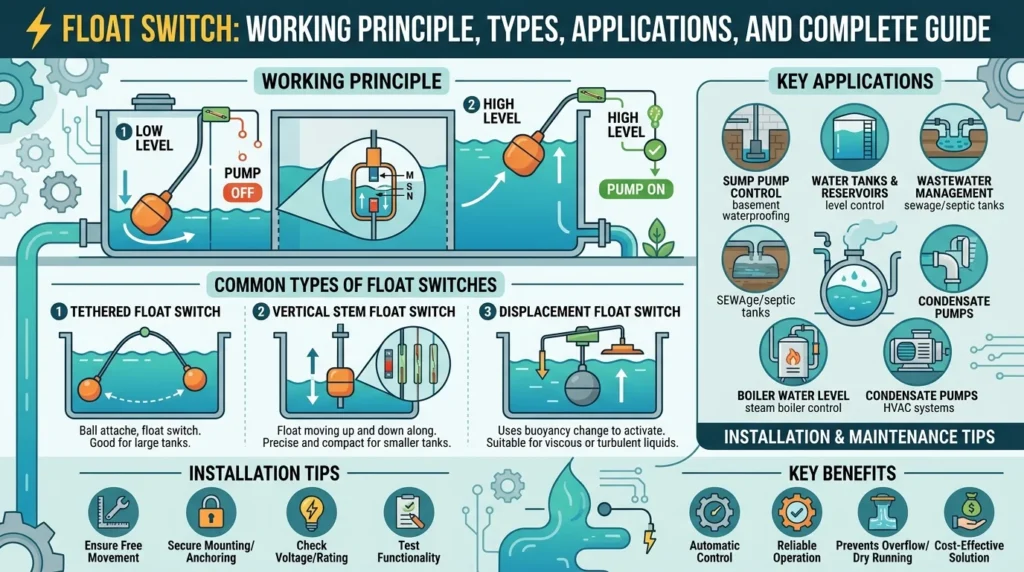
The float switch working principle is based on buoyancy. When the liquid level rises or falls, the float moves and activates a switch.
Step-by-Step Working:
- A float (hollow object) rests on the liquid surface
- As liquid level increases, the float rises
- This movement triggers an internal switch
- The switch completes or breaks the electrical circuit
- The connected device (like a pump) turns ON or OFF
Easy Analogy:
Think of it like a small boat floating on water. As water level changes, the boat moves up and down, and this movement controls a switch.
4. Types / Classification of Float Switch
🔹 1. Mechanical Float Switch
A Mechanical Float Switch is an electromechanical device used to automatically control the level of liquids in tanks, reservoirs, and water systems. It is commonly used in water pumps, overhead tanks, industrial storage tanks, and sump systems to prevent overflow or dry running of pumps. The device works by sensing the liquid level through a floating object that moves up and down with the water.
The working principle of a mechanical float switch is based on buoyancy, which is explained by Archimedes’ Principle. When the liquid level rises, the float also rises due to buoyant force. This movement changes the position of a mechanical lever or magnetic switch inside the device. When the float reaches a certain level, it either opens or closes the electrical contacts, switching the pump ON or OFF automatically.
A mechanical float switch consists of key components such as a float (hollow buoyant body), connecting rod or cable, switching mechanism, and electrical contacts. The float is usually made of lightweight, water-resistant material, while the switching unit is designed to operate safely in wet conditions.
One of the main advantages of a mechanical float switch is its simple design and reliable operation. It does not require complex electronics and is cost-effective for water level control. However, it may wear out over time due to mechanical movement and is less precise compared to electronic sensors.
Overall, a mechanical float switch is an essential device for automatic water level control. It ensures efficient pump operation, prevents water wastage, and protects equipment from damage caused by improper water levels.
- Uses a physical float and switch
- Simple and low cost
- Common in water tanks
🔹 2. Magnetic Float Switch
A Magnetic Float Switch is an advanced type of level control device used to detect and control liquid levels in tanks, reservoirs, and industrial systems. It operates using a combination of a floating element and magnetic sensing, making it more reliable and precise than simple mechanical float switches. Magnetic float switches are widely used in water systems, chemical tanks, fuel storage, and automation processes where accurate level detection is important.
The working principle of a magnetic float switch is based on buoyancy and Magnetism. The float, which contains a permanent magnet, moves up and down with the liquid level. Inside a sealed stem or tube, there is a reed switch or magnetic sensor. When the float rises or falls to a certain level, the magnetic field from the float activates the reed switch, causing it to open or close the electrical contacts. This action controls the connected device, such as turning a pump ON or OFF.
A magnetic float switch consists of key components such as a float with an embedded magnet, a stem or guide tube, a reed switch, electrical contacts, and an outer protective casing. The reed switch is usually enclosed in a sealed glass tube, which protects it from moisture and corrosion. This design makes the device suitable for harsh environments and different types of liquids.
One of the main advantages of a magnetic float switch is its high reliability and long service life, as there are minimal mechanical parts in direct contact with the switching mechanism. It provides accurate level detection and can be used in clean or contaminated liquids. It is also easy to install and requires low maintenance. However, it may be more expensive than basic float switches and must be properly selected according to the type of liquid and operating conditions.
Overall, a magnetic float switch is a modern and efficient solution for liquid level control. Its combination of magnetic sensing and simple operation makes it ideal for industrial, commercial, and residential applications where safe and automatic level monitoring is required.
- Uses magnet and reed switch
- More accurate and reliable
- Used in industrial systems
🔹 3. Vertical Float Switch
A Vertical Float Switch is a type of liquid level control device in which the float moves up and down along a vertical stem to detect and control the level of liquids. It is commonly used in water tanks, sump pumps, chemical containers, and industrial storage systems. This switch is designed for compact spaces and provides accurate level control in applications where side mounting is not possible.
The working principle of a vertical float switch is based on buoyancy and Magnetism. The float contains a small magnet and moves vertically along a guide stem as the liquid level changes. Inside the stem, there is a sealed reed switch. When the float reaches a certain level, the magnetic field activates the reed switch, causing the contacts to open or close. This action automatically turns connected devices, such as pumps or alarms, ON or OFF.
A vertical float switch consists of key components such as a float with a built-in magnet, a vertical stem or guide tube, a reed switch, mounting threads, and electrical connections. The float is usually made of plastic or stainless steel, depending on the application. The sealed reed switch ensures safe operation by protecting internal parts from moisture and corrosion.
One of the main advantages of a vertical float switch is its compact design and high accuracy. It is easy to install, requires minimal maintenance, and works reliably in both clean and slightly contaminated liquids. It is also suitable for automatic pump control and overflow protection. However, it may not be ideal for highly viscous liquids or environments with heavy debris, as these can restrict float movement.
Overall, a vertical float switch is an efficient and reliable device for liquid level detection and control. Its simple design, durability, and precise operation make it widely used in residential, commercial, and industrial fluid management systems.
- Moves up and down vertically
- Installed inside tanks
🔹 4. Horizontal Float Switch
A Horizontal Float Switch is a liquid level control device designed to be mounted on the side (wall) of a tank or container. It uses a floating element that moves horizontally with the liquid level to control electrical contacts. This type of switch is widely used in water tanks, chemical storage systems, fuel tanks, and industrial processes where side mounting is more practical than top mounting.
The working principle of a horizontal float switch is based on buoyancy and Magnetism. The float contains a small permanent magnet and is attached to a pivoted arm. As the liquid level rises or falls, the float moves up or down, causing the arm to rotate horizontally. Inside the stem or body of the switch, there is a sealed reed switch. When the float reaches a certain position, the magnetic field activates the reed switch, which opens or closes the electrical circuit. This action is used to control pumps, alarms, or valves automatically.
A horizontal float switch consists of key components such as a float with an embedded magnet, pivot arm, mounting body, reed switch, and electrical terminals. The float is typically made from plastic or stainless steel, depending on the liquid type. The sealed reed switch is protected from moisture and corrosion, ensuring reliable operation over time.
One of the main advantages of a horizontal float switch is its easy installation on the side of tanks, making it suitable for applications where vertical space is limited. It is compact, reliable, and requires low maintenance. It is also effective in detecting specific liquid levels for automation and safety control. However, it may be less suitable for very turbulent liquids, as excessive movement can affect accuracy.
Overall, a horizontal float switch is a practical and efficient solution for liquid level control. Its simple design, durability, and automatic operation make it widely used in residential, commercial, and industrial fluid management systems.
- Mounted on tank walls
- Suitable for side installation
🔹 5. Cable Float Switch
A Cable Float Switch is a widely used liquid level control device designed to automatically start or stop electrical equipment such as pumps based on the liquid level. It is commonly used in water tanks, sumps, sewage systems, drainage systems, and industrial liquid handling applications. This type of float switch is suspended by a flexible cable, allowing it to move freely with the liquid level, making it suitable for large tanks and open water systems.
The working principle of a cable float switch is based on buoyancy and mechanical switching. When the liquid level rises or falls, the float moves along with it due to the buoyant force, which follows Archimedes’ Principle. Inside the float, there is a small switch mechanism, usually a micro switch or mercury switch. As the float tilts at a certain angle, the internal switch changes its position, either opening or closing the electrical circuit. This action is used to turn pumps ON or OFF automatically.
A cable float switch consists of key components such as a sealed float body, internal switching mechanism, flexible cable, and a counterweight. The counterweight is used to control the switching angle and level point. The float body is usually made of durable plastic or rubber to withstand water, chemicals, and rough conditions.
One of the main advantages of a cable float switch is its simple design and high reliability. It is easy to install and works effectively even in dirty or contaminated liquids, such as wastewater or sewage. It is also cost-effective and suitable for large tanks where precise positioning is not required. However, it may have less accuracy compared to fixed float switches, and cable movement can sometimes be affected by obstacles inside the tank.
Overall, a cable float switch is a practical and efficient solution for automatic liquid level control. Its flexibility, durability, and ease of use make it ideal for residential, commercial, and industrial applications, especially in water and wastewater management systems.
- Float attached to a cable
- Common in sump pumps
5. Main Components
A float switch has several important parts:
🔸 Float
- Hollow body that floats on liquid
- Moves with liquid level
🔸 Switch Mechanism
- Electrical contacts
- Opens or closes circuit
🔸 Cable / Rod
- Connects float to system
- Transfers movement
🔸 Housing
- Protects internal parts
- Ensures durability
6. Float Switch Advantages and Disadvantages
✅ Advantages
- Automatic water level control
- Saves electricity and water
- Simple and low-cost device
- Easy installation
- Reliable operation
❌ Disadvantages
- Not suitable for very thick liquids
- Mechanical parts may wear out
- Can get stuck due to dirt
- Limited accuracy compared to sensors
7. Float Switch Applications
The float switch applications are wide and important:
🏠 Home Use:
- Water tanks
- Overhead tanks
- Sump pumps
🏭 Industrial Use:
- Boilers
- Cooling systems
- Chemical tanks
⚙️ Modern Technology:
- Wastewater treatment plants
- Oil level monitoring
- Automation systems
8. Comparison Section
Difference Between Float Switch and Level Sensor
| Feature | Float Switch | Level Sensor |
|---|---|---|
| Working | Mechanical movement | Electronic sensing |
| Cost | Low | Higher |
| Accuracy | Moderate | High |
| Maintenance | Medium | Low |
| Application | Basic systems | Advanced automation |
9. Selection Guide
Choosing the right float switch is very important.
Key Factors:
- Type of liquid (water, oil, chemical)
- Temperature conditions
- Tank size and shape
- Installation position
- Electrical rating
Beginner Tips:
- Use simple float switch for home
- Use magnetic type for industry
- Check durability and material
10. Common Problems & Solutions
Q1: Float switch not working?
Solution: Check wiring and power supply.
Q2: Float stuck in one position?
Solution: Clean dirt or debris.
Q3: Pump not turning OFF?
Solution: Check switch alignment.
Q4: False triggering?
Solution: Ensure proper installation.
11. Future Trends
Float switch technology is improving with modern systems.
New Developments:
- Smart float switches with IoT
- Wireless monitoring systems
- Integration with automation panels
- More durable materials
These advancements will make systems more efficient and reliable.
12. Conclusion
A float switch is a simple yet powerful device used for automatic liquid level control. It works on a basic principle but plays a critical role in both household and industrial systems.
Understanding the float switch working principle, types, applications, and advantages and disadvantages helps engineers and technicians design better systems. It also prevents water wastage, equipment damage, and unnecessary manual work.
For beginners, learning about float switches is a strong step toward understanding automation and control systems. Always choose the right type based on your application and maintain it regularly for long-lasting performance.