
Imagine opening a refrigerator and hearing the soft humming sound of a small fan circulating cold air inside the cooling chamber. That quiet movement of air helps maintain a consistent temperature and keeps food fresh. Behind this simple function is a small but reliable electric motor known as the Shaded Pole Motor.
Shaded pole motors are commonly used in low-power electrical devices where simplicity, low cost, and quiet operation are important. You can find them in household appliances such as exhaust fans, refrigerator fans, small blowers, and electric clocks. Although they are small compared to industrial motors, they play an essential role in many everyday devices.
For electrical students, technicians, and engineers, understanding the Shaded Pole Motor is important because it represents one of the simplest types of single-phase induction motors. Its design is easy to understand and provides a practical introduction to motor starting techniques.
In this article, we will explore the Shaded Pole Motor working principle, its types, main components, advantages and disadvantages, and common applications. By the end, you will have a clear understanding of how this motor works and why it remains useful in many low-power electrical systems.
What Is a Shaded Pole Motor? (2026 Complete Guide)
A Shaded Pole Motor is a single-phase induction motor that starts automatically by using a shading coil, also known as a shading ring. The shading coil is a thick copper ring fitted around a portion of each stator pole. Its purpose is to create a small time delay in the magnetic field, producing a weak rotating magnetic field that generates the starting torque required to rotate the motor.
Unlike capacitor-start motors or split-phase motors, a shaded pole motor does not require a capacitor, centrifugal switch, starting relay, or auxiliary winding. Its simple design makes it one of the easiest and most economical single-phase motors to manufacture and maintain. Although it produces relatively low starting torque and operates with lower efficiency, it is highly reliable for driving small, light-load applications.
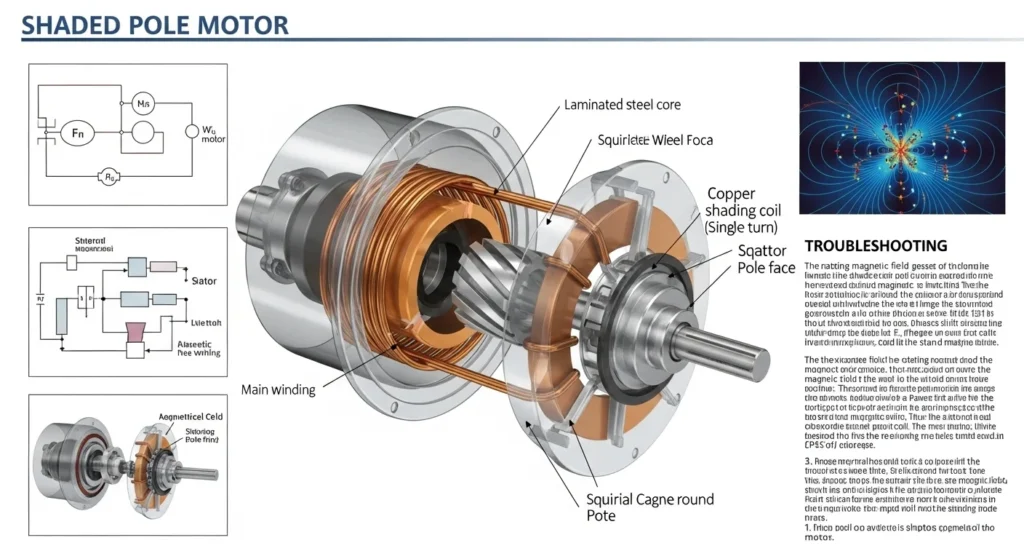
The motor consists of a stator, rotor, main winding, and shading coil. When single-phase AC power is supplied to the main winding, the stator produces an alternating magnetic field. The shading coil delays the magnetic flux in the shaded portion of the pole, causing the magnetic field to shift gradually across the pole face. This shifting magnetic field acts like a weak rotating magnetic field, inducing current in the squirrel-cage rotor and causing it to rotate.
Because of their simple construction, compact size, quiet operation, and low manufacturing cost, shaded pole motors are widely used in small household appliances, cooling fans, exhaust fans, refrigerator evaporator fans, microwave oven fans, air circulators, electric heaters, projectors, hair dryers, and other low-power equipment. They are best suited for applications that require continuous operation with a light mechanical load rather than high starting torque.
Understanding what a shaded pole motor is provides a solid foundation for learning single-phase motor technology and helps students understand how simple electromagnetic principles can produce reliable mechanical motion without complex starting circuits.
Simple Explanation
Think of a shaded pole motor as a person giving a gentle push to a revolving door. Instead of pushing the entire door at once, one side is pushed slightly before the other. This small delay creates movement in one direction.
A shaded pole motor works in the same way. The shading coil delays the magnetic field on one side of the stator pole, creating a weak rotating magnetic field that starts the rotor turning automatically.
Simple Practical Example
Imagine a bathroom exhaust fan installed on a wall. When you switch it on, the fan starts rotating smoothly without making much noise or requiring any additional starting device.
Inside the fan is a shaded pole motor. The motor uses its built-in copper shading coil to create the small rotating magnetic field needed to start the fan blades. Even though the starting torque is low, it is sufficient because the fan has a light mechanical load.
Other everyday appliances that commonly use shaded pole motors include:
- Small table fans.
- Refrigerator evaporator fans.
- Microwave cooling fans.
- Air fresheners.
- Hair dryers.
- Electric heaters.
- Display cabinet cooling fans.
- Small blowers.
These applications demonstrate why shaded pole motors remain popular for low-power equipment where simplicity, reliability, low cost, and quiet operation are more important than high efficiency or strong starting torque.
Shaded Pole Motor Working Principle (2026 Explained)
The Shaded Pole Motor working principle is based on the electromagnetic induction principle and the creation of a weak rotating magnetic field using a copper shading coil. Unlike other single-phase induction motors that require an auxiliary winding or starting capacitor, the shaded pole motor produces its own starting torque through the delayed magnetic flux created by the shading ring.
When single-phase AC power is supplied to the stator winding, an alternating magnetic field is generated around the stator poles. Each pole has a thick copper ring fitted around a small portion of its surface. This copper ring, known as the shading coil, acts like a short-circuited secondary winding.
As the magnetic field changes continuously with the AC supply, it induces a current in the shading coil. According to Lenz’s Law, the induced current creates its own magnetic field that opposes the change in the original magnetic field. This causes the magnetic flux in the shaded portion of the pole to lag slightly behind the flux in the unshaded portion.
As a result, the magnetic field appears to move gradually from the unshaded side of the stator pole toward the shaded side. Although this movement is relatively weak, it is enough to create a small rotating magnetic field. This rotating field induces current in the squirrel-cage rotor, producing electromagnetic torque that starts the rotor rotating in the direction of the shaded pole.
Once the rotor reaches its operating speed, the motor continues running smoothly using the continuously changing magnetic field produced by the AC supply.
Step-by-Step Working Process
Step 1: Single-Phase AC Supply Is Applied
The motor is connected to a single-phase AC power source. Electric current flows through the stator’s main winding, energizing the motor.
Step 2: The Stator Produces an Alternating Magnetic Field
As AC current flows through the stator winding, an alternating magnetic field is created around each stator pole. The magnetic field continuously changes direction according to the AC waveform.
Step 3: The Shading Coil Delays the Magnetic Flux
The copper shading ring surrounding part of each stator pole experiences a changing magnetic field, which induces current in the ring. This induced current creates another magnetic field that slightly delays the magnetic flux in the shaded portion of the pole.
Step 4: A Weak Rotating Magnetic Field Is Produced
Because the magnetic field in the shaded area lags behind the field in the unshaded area, the magnetic flux appears to sweep across the stator pole from the unshaded side to the shaded side. This creates a weak rotating magnetic field.
Step 5: Current Is Induced in the Rotor
The moving magnetic field cuts the rotor conductors and induces electric current in the squirrel-cage rotor according to Faraday’s Law of Electromagnetic Induction.
Step 6: Electromagnetic Torque Starts the Rotor
The interaction between the induced rotor current and the rotating magnetic field generates electromagnetic torque, causing the rotor to begin rotating.
Step 7: Continuous Motor Operation
After starting, the motor continues rotating smoothly in the same direction as long as the AC power supply remains connected.
Simple Analogy
Imagine a group of people performing “the wave” in a sports stadium. Instead of everyone standing up at exactly the same moment, each section rises a fraction of a second after the previous one. This slight delay creates the appearance of a wave moving around the stadium.
A shaded pole motor works in a similar way. The shading coil delays the magnetic field on one side of the stator pole, making the magnetic field appear to move across the pole. This moving magnetic field creates the torque needed to start the rotor and keep the motor running.
Types of Shaded Pole Motors (2026): Complete Classification and Applications
Shaded pole motors may have a simple operating principle, but they are available in several designs to meet different performance and application requirements. Although all shaded pole motors use a shading coil to create the starting torque, they differ in terms of speed, pole configuration, power rating, mounting style, and intended use.
Choosing the right type depends on factors such as load requirements, operating speed, available space, and continuous running conditions. The following are the most common types of shaded pole motors used in residential, commercial, and light industrial applications.
Small Appliance Shaded Pole Motor
The Small Appliance Shaded Pole Motor is the most widely used type of shaded pole motor. It is specifically designed for lightweight applications where only a small amount of starting torque is required. These motors are inexpensive, compact, and highly reliable, making them ideal for household electrical appliances.
Because they have a simple construction with very few moving parts, they require little maintenance and can operate continuously for long periods without frequent servicing.
Main Characteristics
- Low power rating, typically from a few watts to around 100 watts.
- Compact and lightweight design.
- Quiet and vibration-free operation.
- Self-starting without capacitors or starting switches.
- Low manufacturing and maintenance cost.
- Long service life under normal operating conditions.
Common Applications
Small appliance shaded pole motors are commonly used in:
- Table fans.
- Exhaust fans.
- Refrigerator evaporator fans.
- Microwave oven cooling fans.
- Air fresheners.
- Hair dryers.
- Small blowers.
- Electric heaters.
These motors are ideal wherever low cost, quiet operation, and dependable performance are more important than high efficiency.
Multi-Pole Shaded Pole Motor
A Multi-Pole Shaded Pole Motor contains more than two stator poles, allowing the magnetic field to be distributed more evenly around the motor. Increasing the number of poles improves smoothness of operation and reduces vibration while producing better torque characteristics at lower operating speeds.
This design is commonly selected when steady and continuous rotation is required.
Key Features
- Four, six, or more stator poles.
- More uniform magnetic field distribution.
- Reduced vibration and noise.
- Improved low-speed performance.
- Stable continuous operation.
- Longer operational life.
Advantages
- Smoother rotation.
- Better torque distribution.
- Lower mechanical stress.
- Improved reliability.
- Suitable for continuous-duty equipment.
Typical Applications
Multi-pole shaded pole motors are commonly found in:
- Ventilation equipment.
- Air circulation fans.
- Display cabinet cooling systems.
- Commercial refrigeration units.
- Small industrial cooling systems.
- Air-conditioning ventilation components.
High-Speed Shaded Pole Motor
A High-Speed Shaded Pole Motor is designed for applications where fast rotor speed is more important than high starting torque. These motors usually operate between 2,000 and 3,600 RPM, depending on the supply frequency, pole design, and load conditions.
They are built with lightweight rotors and optimized stator designs to achieve rapid acceleration and efficient airflow generation.
Main Characteristics
- High rotational speed.
- Compact construction.
- Lightweight rotor.
- Quick starting.
- Low starting torque.
- Designed for continuous operation.
Advantages
- Excellent airflow generation.
- Fast response.
- Quiet operation.
- Compact installation.
- Low maintenance.
Common Applications
High-speed shaded pole motors are widely used in:
- Cooling fans for electronic equipment.
- Computer cooling systems.
- Small exhaust fans.
- Air purifiers.
- HVAC ventilation systems.
- Portable air circulators.
Low-Speed Shaded Pole Motor
A Low-Speed Shaded Pole Motor is designed to operate at lower rotational speeds while delivering smooth and steady performance. These motors generally have more stator poles, which naturally reduce the operating speed.
Although they produce limited starting torque, they are suitable for equipment that requires continuous low-speed movement rather than rapid rotation.
Main Characteristics
- Lower operating speed.
- Smooth and stable rotation.
- Reduced vibration.
- Quiet operation.
- Long operating life.
Applications
Low-speed shaded pole motors are commonly used in:
- Display turntables.
- Small gear-driven mechanisms.
- Automatic timers.
- Slow-moving conveyors.
- Decorative rotating displays.
Open-Type Shaded Pole Motor
An Open-Type Shaded Pole Motor has an exposed frame that allows natural air circulation around the motor for cooling. This design is economical and suitable for clean, dry indoor environments.
Features
- Open frame construction.
- Better natural cooling.
- Lightweight design.
- Easy inspection and maintenance.
- Low manufacturing cost.
Applications
These motors are commonly installed in:
- Indoor ventilation systems.
- Educational laboratory equipment.
- Household appliances.
- Office equipment.
- Clean indoor machinery.
Enclosed Shaded Pole Motor
An Enclosed Shaded Pole Motor has a protective housing that shields the internal components from dust, moisture, and accidental contact. This design offers greater durability and reliability in harsh environments.
Features
- Fully enclosed housing.
- Better protection against dust and dirt.
- Improved operational safety.
- Longer service life.
- Reduced maintenance requirements.
Applications
Enclosed shaded pole motors are widely used in:
- Refrigeration equipment.
- Commercial cooling systems.
- Food display cabinets.
- Industrial ventilation units.
- Dusty workshop environments.
Comparison of Different Types of Shaded Pole Motors
| Type | Main Feature | Speed | Typical Applications |
|---|---|---|---|
| Small Appliance Shaded Pole Motor | Compact and economical | Medium | Fans, hair dryers, blowers |
| Multi-Pole Shaded Pole Motor | Smooth operation | Low to Medium | Ventilation and refrigeration |
| High-Speed Shaded Pole Motor | High RPM | High | Cooling fans, electronic devices |
| Low-Speed Shaded Pole Motor | Stable rotation | Low | Timers, displays, gear-driven equipment |
| Open-Type Shaded Pole Motor | Natural cooling | Medium | Indoor appliances and laboratory equipment |
| Enclosed Shaded Pole Motor | Dust and moisture protection | Medium | Commercial and industrial cooling systems |
Each type of shaded pole motor is designed for a specific purpose. Selecting the appropriate motor depends on the required speed, load, operating environment, cooling method, and application, ensuring reliable performance and a longer service life.
Main Components of a Shaded Pole Motor (2026): Construction and Functions Explained
A Shaded Pole Motor has a simple yet efficient construction consisting of a few essential components that work together to convert electrical energy into mechanical motion. Although its design is less complex than other single-phase motors, every part performs a specific function that ensures reliable starting and continuous operation.
Understanding these components helps students, technicians, and engineers learn the shaded pole motor working principle more easily and troubleshoot common motor problems effectively.
Stator
The stator is the stationary (non-rotating) part of the shaded pole motor and forms the main body of the motor. It is made of laminated silicon steel sheets to reduce eddy current losses and improve efficiency.
The stator contains the main winding and the shaded poles. When single-phase AC power is supplied to the winding, it produces an alternating magnetic field that interacts with the rotor to create motion.
Functions of the Stator
- Supports the main winding.
- Produces the alternating magnetic field.
- Holds the shaded poles securely.
- Guides magnetic flux through the motor.
- Provides structural strength to the motor.
The stator acts as the heart of the motor because it generates the magnetic field required for operation.
Main Winding
The main winding, also called the running winding, is wound around the stator poles. Unlike split-phase or capacitor motors, shaded pole motors use only one main winding and do not require an auxiliary starting winding.
When connected to the AC supply, the main winding creates the alternating magnetic field necessary for motor operation.
Functions of the Main Winding
- Produces the primary magnetic field.
- Receives electrical power from the AC supply.
- Works together with the shading coil.
- Maintains continuous motor operation.
- Converts electrical energy into magnetic energy.
Without the main winding, the motor cannot generate the magnetic field needed to rotate the rotor.
Shading Coil (Shading Ring)
The shading coil is the most distinctive component of a shaded pole motor. It is a thick copper ring placed around a portion of each stator pole.
When the magnetic field changes, current is induced in the shading coil. This creates a delayed magnetic flux in the shaded section of the pole, producing a weak rotating magnetic field that generates the motor’s starting torque.
Functions of the Shading Coil
- Delays magnetic flux in the shaded pole.
- Produces the rotating magnetic field.
- Generates starting torque.
- Determines the direction of rotation.
- Eliminates the need for a capacitor or starting switch.
The shading coil is the key component that makes shaded pole motors self-starting.
Rotor
The rotor is the rotating part of the motor and is usually constructed as a squirrel cage rotor. It consists of aluminum or copper bars placed inside laminated steel cores and connected by end rings.
When the rotating magnetic field produced by the stator cuts the rotor conductors, electric current is induced in the rotor. This interaction creates electromagnetic torque, causing the rotor to rotate.
Functions of the Rotor
- Rotates inside the stator.
- Produces mechanical output power.
- Receives induced current from the magnetic field.
- Drives the connected load.
- Converts electromagnetic energy into mechanical motion.
The squirrel cage rotor is highly durable because it contains no brushes or commutators.
Shaft
The shaft is a strong steel rod fixed to the center of the rotor. As the rotor rotates, the shaft transfers mechanical power to the external machine or equipment connected to the motor.
The shaft must be accurately balanced to reduce vibration and ensure smooth operation.
Functions of the Shaft
- Transfers mechanical power.
- Supports the rotor.
- Connects the motor to the load.
- Maintains rotational balance.
- Ensures efficient power transmission.
A properly aligned shaft improves motor efficiency and extends bearing life.
Bearings
Bearings support the rotating shaft and minimize friction between the moving and stationary parts of the motor. Most shaded pole motors use sleeve bearings or ball bearings, depending on their size and application.
Good-quality bearings ensure quiet operation and reduce wear.
Functions of Bearings
- Support the rotating shaft.
- Reduce friction.
- Minimize vibration.
- Improve operating efficiency.
- Extend motor service life.
Regular lubrication and maintenance help bearings operate smoothly for many years.
Frame (Motor Housing)
The frame, also called the motor housing, is the outer protective structure of the motor. It holds all internal components securely while protecting them from dust, accidental contact, and minor mechanical damage.
Motor frames are commonly made from cast iron, aluminum, or pressed steel, depending on the application.
Functions of the Frame
- Protects internal motor components.
- Provides mechanical strength.
- Supports the stator assembly.
- Helps dissipate heat.
- Maintains proper alignment of all parts.
A strong frame increases the motor’s durability and reliability in different operating environments.
Cooling Fan (Optional Component)
Some shaded pole motors include a cooling fan mounted on the shaft. As the motor rotates, the fan circulates air around the motor housing to remove excess heat.
This helps maintain a safe operating temperature during continuous operation.
Functions of the Cooling Fan
- Improves heat dissipation.
- Prevents overheating.
- Increases motor efficiency.
- Extends insulation life.
- Supports continuous-duty operation.
Cooling fans are commonly found in motors used for ventilation and refrigeration equipment.
Terminal Box
The terminal box provides a safe location for connecting the motor to the electrical power supply. It protects the electrical terminals from dust, moisture, and accidental contact.
Functions of the Terminal Box
- Houses electrical connections.
- Protects wiring terminals.
- Simplifies installation.
- Improves electrical safety.
- Makes maintenance easier.
A properly sealed terminal box ensures safe and reliable electrical connections.
Summary of Main Components
| Component | Primary Function |
|---|---|
| Stator | Produces the magnetic field |
| Main Winding | Generates the alternating magnetic field |
| Shading Coil | Creates delayed magnetic flux and starting torque |
| Rotor | Rotates and produces mechanical output |
| Shaft | Transfers mechanical power to the load |
| Bearings | Support the shaft and reduce friction |
| Frame | Protects and supports all motor components |
| Cooling Fan | Removes heat during operation |
| Terminal Box | Provides safe electrical connections |
Together, these components enable the shaded pole motor to operate with a simple design, reliable self-starting capability, quiet performance, and low maintenance, making it ideal for low-power household and commercial applications.
Advantages of Shaded Pole Motors (2026): Benefits Explained
Understanding the Shaded Pole Motor advantages and disadvantages is essential when selecting the right motor for a specific application. Although shaded pole motors are not designed for high-power industrial machines, they offer several practical benefits that make them one of the most popular choices for small electrical appliances and light-duty equipment.
Their simple construction, low manufacturing cost, and dependable performance make them ideal for applications where high starting torque is not required.
Simple Construction
One of the biggest advantages of a shaded pole motor is its extremely simple design. Unlike capacitor-start or split-phase motors, it contains only a main winding, a shading coil, and a squirrel cage rotor.
Since there are no complex starting components such as capacitors, centrifugal switches, or relays, the motor is easier to manufacture, install, and maintain.
Benefits:
- Fewer mechanical parts.
- Simple installation.
- Easy troubleshooting.
- Lower risk of component failure.
Low Manufacturing Cost
Because of its uncomplicated construction and fewer components, a shaded pole motor is inexpensive to produce. This low production cost makes it an economical choice for manufacturers of household appliances.
The affordability of these motors also helps reduce the overall cost of products such as fans, refrigerators, and small blowers.
Benefits:
- Cost-effective design.
- Affordable replacement.
- Lower equipment cost.
- Suitable for mass production.
Self-Starting Operation
A shaded pole motor starts automatically as soon as the AC power supply is connected. The built-in shading coil creates the starting torque, eliminating the need for an external starting mechanism.
This makes installation much simpler than many other single-phase motors.
Benefits:
- No capacitor required.
- No centrifugal switch.
- No starting relay.
- Reliable automatic starting.
Reliable Performance
Shaded pole motors are known for their dependable and continuous operation. Since they have very few moving parts, there is less mechanical wear and fewer chances of failure.
Many shaded pole motors can operate for years with only minimal maintenance.
Benefits:
- Long service life.
- Consistent performance.
- High reliability.
- Reduced downtime.
Compact and Lightweight Design
These motors are designed to be small and lightweight, making them easy to install where space is limited.
Their compact size makes them ideal for portable appliances and equipment with limited installation space.
Benefits:
- Easy transportation.
- Space-saving installation.
- Suitable for compact appliances.
- Lightweight construction.
Quiet and Smooth Operation
Shaded pole motors produce relatively low noise and vibration during operation. This makes them suitable for household appliances where quiet performance is important.
Examples include bedroom fans, refrigerator fans, and air circulation systems.
Benefits:
- Low operating noise.
- Smooth rotation.
- Reduced vibration.
- Improved user comfort.
Low Maintenance Requirements
Because shaded pole motors do not contain brushes, commutators, or complex starting devices, they require very little maintenance.
Routine cleaning and occasional bearing inspection are usually sufficient for reliable operation.
Benefits:
- Low maintenance cost.
- Fewer replacement parts.
- Easy servicing.
- Longer maintenance intervals.
Suitable for Continuous Operation
Shaded pole motors are capable of running continuously for long periods under light loads without overheating when properly ventilated.
This makes them suitable for equipment that operates throughout the day.
Applications include:
- Refrigerator fans.
- Ventilation systems.
- Cooling blowers.
- Display cabinet fans.
Summary of Advantages
Some of the major Shaded Pole Motor advantages include:
- Simple and rugged construction.
- Low manufacturing cost.
- Self-starting operation.
- Reliable performance.
- Compact and lightweight design.
- Quiet and smooth operation.
- No capacitor or starting switch required.
- Low maintenance requirements.
- Long service life.
- Ideal for small household appliances.
These advantages make shaded pole motors an excellent choice for low-power, continuous-duty applications where simplicity and reliability are more important than high efficiency or strong starting torque.
Disadvantages and Limitations of Shaded Pole Motors (2026)
Although shaded pole motors offer many advantages, they also have several limitations. Their simple design results in lower performance compared to capacitor-start and split-phase motors. For this reason, they are generally used only in small appliances and light-duty equipment.
Understanding these limitations helps engineers and technicians choose the right motor for the intended application.
Very Low Starting Torque
The most significant disadvantage of a shaded pole motor is its low starting torque. The shading coil produces only a weak rotating magnetic field, which limits the amount of torque available during startup.
Because of this, shaded pole motors cannot start heavy mechanical loads.
Limitations:
- Not suitable for compressors.
- Cannot drive heavy machinery.
- Limited starting capability.
- Performs best with light loads.
Low Efficiency
Shaded pole motors are less efficient than most other single-phase induction motors. A considerable amount of electrical energy is lost as heat in the shading coil and stator.
As a result, these motors consume more electricity relative to the mechanical power they produce.
Effects:
- Higher energy losses.
- Increased operating temperature.
- Lower overall performance.
- Reduced energy efficiency.
Limited Power Output
These motors are generally manufactured in small power ratings, usually ranging from a few watts up to about 100 watts.
They are not intended for applications requiring high horsepower or heavy-duty operation.
Suitable for:
- Fans.
- Blowers.
- Small pumps.
- Cooling systems.
Not suitable for:
- Industrial machinery.
- Large compressors.
- Heavy conveyors.
- High-power equipment.
Poor Power Factor
Shaded pole motors usually operate with a relatively low power factor compared to other induction motors.
A low power factor means the motor draws more current for the same useful output power, reducing overall electrical efficiency.
Higher Heat Generation
The shading coil continuously carries induced current, which produces additional heat during operation.
If cooling is inadequate or the motor is overloaded, excessive heating can reduce insulation life and shorten the motor’s service life.
Fixed Direction of Rotation
The direction of rotation in most shaded pole motors is determined by the position of the shading coil and cannot be reversed easily.
If reverse rotation is required, a different motor design is generally preferred.
Not Suitable for Heavy Loads
Because of their limited torque and power output, shaded pole motors cannot handle sudden load changes or heavy starting conditions.
They are designed only for applications with light and relatively constant loads.
Summary of Disadvantages
Some important Shaded Pole Motor disadvantages include:
- Very low starting torque.
- Low operating efficiency.
- Limited power output.
- Poor power factor.
- Higher heat generation.
- Fixed direction of rotation.
- Not suitable for heavy-duty applications.
- Reduced performance under high loads.
Despite these limitations, shaded pole motors remain an excellent solution for small fans, blowers, refrigerator cooling systems, and other low-power appliances, where their simple construction, quiet operation, reliability, and low cost outweigh the need for high efficiency or powerful starting torque.
Shaded Pole Motor Applications (2026): Common Uses in Home, Commercial, and Industrial Equipment
The Shaded Pole Motor applications are primarily found in low-power electrical devices that require quiet operation, continuous running, simple construction, and low maintenance. Although these motors have low starting torque and limited power output, they are highly reliable for light-duty applications where heavy loads are not involved.
Because shaded pole motors are compact, inexpensive, and self-starting, manufacturers widely use them in household appliances, commercial equipment, refrigeration systems, ventilation units, and electronic devices.
Below are the major applications of shaded pole motors in different industries.
Home Appliance Applications
Shaded pole motors are commonly used in household appliances because they operate quietly, require very little maintenance, and can run continuously for long periods. Their simple design also helps reduce manufacturing costs, making home appliances more affordable.
Common Household Applications
- Bathroom exhaust fans.
- Kitchen ventilation fans.
- Refrigerator evaporator fans.
- Refrigerator condenser cooling fans.
- Hair dryers.
- Electric room heaters.
- Air coolers.
- Small table fans.
- Air fresheners.
- Electric clocks.
- Food warming cabinets.
- Humidifiers.
These appliances require only a small amount of starting torque, making shaded pole motors an ideal choice.
Commercial Equipment Applications
Many commercial businesses use shaded pole motors in equipment that requires continuous airflow, cooling, or ventilation. Their dependable operation and long service life make them suitable for commercial environments.
Common Commercial Applications
- Supermarket display cabinet fans.
- Beverage coolers.
- Refrigerated display cases.
- Bakery display refrigerators.
- Office ventilation systems.
- Air circulation units.
- Ice cream freezers.
- Medical storage refrigerators.
- Hotel ventilation equipment.
- Restaurant cooling systems.
In these applications, the motor often operates for several hours each day with minimal maintenance.
Industrial Applications
Although shaded pole motors are not designed for heavy industrial machinery, they are widely used in light industrial equipment where only small mechanical loads need to be driven.
Industrial Uses
- Control panel cooling fans.
- Electrical cabinet ventilation.
- Instrument cooling systems.
- Small industrial blowers.
- Laboratory equipment.
- Packaging machines.
- Conveyor cooling systems.
- Industrial air circulation fans.
- Cooling units for control rooms.
Their compact design makes them especially useful where installation space is limited.
Refrigeration and HVAC Applications
One of the largest application areas for shaded pole motors is the refrigeration and HVAC (Heating, Ventilation, and Air Conditioning) industry.
These motors provide continuous airflow that helps maintain proper cooling efficiency.
Common Refrigeration Applications
- Refrigerator evaporator fans.
- Refrigerator condenser fans.
- Beverage cooler fans.
- Freezer cooling systems.
- Cold storage air circulation.
- Display refrigerator fans.
- Wine cooler ventilation.
- Ice machine cooling fans.
Their quiet operation is particularly important in homes, restaurants, hospitals, and supermarkets.
Electronics and Modern Devices
Modern electronic equipment often requires continuous cooling to prevent overheating. Shaded pole motors are commonly used in small cooling fans because they are compact, inexpensive, and reliable.
Applications in Electronics
- Computer cooling fans.
- Server cabinet ventilation.
- Audio amplifier cooling.
- Power supply cooling systems.
- Battery charging stations.
- Electronic control cabinets.
- Telecommunication equipment.
- Small electronic cooling units.
These motors help maintain safe operating temperatures and improve equipment reliability.
HVAC and Ventilation Systems
Ventilation equipment requires motors that can run continuously with low noise. Shaded pole motors meet these requirements and are commonly installed in residential and commercial ventilation systems.
Typical HVAC Applications
- Ceiling ventilation fans.
- Wall-mounted exhaust fans.
- Air circulation blowers.
- Fresh air ventilation units.
- Duct ventilation systems.
- Bathroom exhaust systems.
- Kitchen extractor fans.
- Air purification equipment.
Their smooth operation improves indoor air circulation while consuming relatively low power.
Medical and Laboratory Equipment
Certain medical and laboratory devices require small motors for cooling and ventilation rather than heavy mechanical work.
Common Medical Applications
- Laboratory incubators.
- Medical refrigeration units.
- Medicine storage cabinets.
- Air filtration systems.
- Laboratory ventilation equipment.
- Medical cooling fans.
Reliable operation is especially important in these environments where equipment often runs continuously.
Automotive Applications
Shaded pole motors are also used in selected automotive systems where small cooling or ventilation functions are required.
Examples
- Dashboard ventilation units.
- Cabin air circulation fans.
- Electronic module cooling.
- Battery cooling systems in small vehicles.
- Auxiliary ventilation equipment.
Why Shaded Pole Motors Are Widely Used
Manufacturers continue using shaded pole motors because they offer several practical benefits:
- Simple and compact construction.
- Self-starting operation.
- Quiet performance.
- Low manufacturing cost.
- Reliable continuous operation.
- Minimal maintenance.
- Long service life.
- Easy installation.
- Suitable for light-duty applications.
These advantages make shaded pole motors one of the most economical solutions for low-power equipment.
Summary of Shaded Pole Motor Applications
| Application Area | Common Equipment |
|---|---|
| Home Appliances | Exhaust fans, refrigerator fans, hair dryers, electric heaters, table fans |
| Commercial Equipment | Display cabinets, beverage coolers, ventilation systems, office cooling fans |
| Industrial Equipment | Control panel fans, laboratory equipment, small blowers, cabinet cooling |
| Refrigeration Systems | Evaporator fans, condenser fans, freezers, cold storage units |
| Electronics | Computer fans, server cooling, power supplies, electronic cabinets |
| HVAC Systems | Exhaust fans, air circulation units, ventilation systems, air purifiers |
| Medical Equipment | Medical refrigerators, laboratory ventilation, cooling systems |
| Automotive | Dashboard ventilation, electronic cooling, auxiliary air circulation |
Although shaded pole motors are relatively small, they play a vital role in countless everyday appliances and commercial systems. Their simple construction, reliable performance, low maintenance, and economical cost make them an excellent choice for applications requiring continuous operation with light mechanical loads.
9. Comparison Section
Difference Between Shaded Pole Motor and Capacitor Start Motor
| Feature | Shaded Pole Motor | Capacitor Start Motor |
|---|---|---|
| Starting Torque | Very low | High |
| Efficiency | Low | Higher |
| Cost | Low | Higher |
| Complexity | Simple | More complex |
| Applications | Small fans | Pumps and compressors |
Understanding the difference between shaded pole motor and capacitor start motor helps engineers select the correct motor type.
Selection Guide for Shaded Pole Motors (2026): How to Choose the Right Motor
Selecting the right Shaded Pole Motor is essential for achieving reliable performance, long service life, and efficient operation. Since these motors are designed primarily for light-duty applications, choosing the correct motor depends on factors such as power requirement, speed, operating environment, and load conditions.
Before purchasing or installing a shaded pole motor, carefully evaluate the application’s mechanical and electrical requirements. The following guidelines will help beginners, technicians, and engineers make the right selection.
Power Requirement
The first factor to consider is the power rating of the motor. Shaded pole motors are generally available in small power ratings, ranging from a few watts up to approximately 100 watts.
Always choose a motor that matches the power requirement of the equipment. An undersized motor may overheat and fail prematurely, while an oversized motor may consume unnecessary energy and increase costs.
Selection Tips
- Match the motor power with the equipment load.
- Avoid operating the motor above its rated capacity.
- Leave a small safety margin for continuous operation.
- Check the manufacturer’s power specifications.
Speed Requirement
Motor speed plays an important role in determining equipment performance. Shaded pole motors are available in different speed ratings depending on the number of poles and supply frequency.
Select a motor whose speed matches the application’s requirements to ensure smooth and efficient operation.
Selection Tips
- Choose high-speed motors for cooling fans and blowers.
- Select low-speed motors for gear-driven equipment.
- Verify the rated RPM before installation.
- Ensure the motor speed matches the connected load.
Load Requirement
Shaded pole motors are designed for light mechanical loads and should not be used where high starting torque is required.
Before selecting a motor, determine whether the equipment starts easily or requires significant force to begin moving.
Suitable Loads
- Exhaust fans.
- Refrigerator fans.
- Air circulation fans.
- Small blowers.
- Cooling systems.
Not Recommended For
- Air compressors.
- Water pumps with heavy starting loads.
- Industrial conveyors.
- Large machinery.
- High-torque applications.
Application Type
Consider how and where the motor will be used. Some applications require the motor to operate continuously for several hours, while others run only occasionally.
Choosing the correct motor for the intended duty cycle improves reliability and extends service life.
Typical Applications
- Continuous-duty ventilation fans.
- Refrigerator cooling systems.
- Office equipment.
- Small household appliances.
- Light commercial equipment.
Supply Voltage and Frequency
Always verify that the motor’s rated voltage and frequency match the available electrical supply.
Using an incorrect supply voltage can reduce efficiency, cause overheating, or permanently damage the motor.
Check Before Installation
- Rated voltage.
- Supply frequency (50 Hz or 60 Hz).
- Single-phase AC compatibility.
- Electrical connection requirements.
Cooling and Ventilation Requirements
Proper cooling is essential for maintaining safe operating temperatures and extending motor life. Since shaded pole motors generate heat during operation, adequate airflow around the motor should always be provided.
Cooling Tips
- Ensure good ventilation around the motor.
- Keep cooling openings free from dust.
- Avoid installing the motor in enclosed spaces without airflow.
- Clean cooling fans regularly if fitted.
Operating Environment
The environment where the motor operates significantly affects its lifespan. Dust, moisture, high temperatures, and corrosive chemicals can reduce motor performance if the wrong motor type is selected.
Selection Tips
- Choose enclosed motors for dusty environments.
- Use moisture-resistant designs in humid locations.
- Protect the motor from direct water exposure.
- Avoid excessive ambient temperatures.
Noise and Vibration
For applications such as homes, offices, hospitals, and libraries, quiet operation is important. Shaded pole motors naturally operate with relatively low noise, but selecting a high-quality motor further reduces vibration and sound.
Recommended Applications
- Bedroom fans.
- Office ventilation.
- Medical equipment.
- Home appliances.
- Refrigeration systems.
Maintenance Requirements
Although shaded pole motors require very little maintenance, choosing a motor with durable bearings and quality construction can further reduce servicing requirements.
Maintenance Considerations
- Select motors with high-quality bearings.
- Choose corrosion-resistant materials.
- Inspect bearings periodically.
- Keep the motor clean during operation.
Cost Considerations
One of the biggest advantages of shaded pole motors is their low purchase and maintenance cost. They are an excellent option when affordability is a priority and the application does not require high starting torque or high efficiency.
However, selecting a motor solely because it is inexpensive is not always the best decision. Consider performance, reliability, and expected service life in addition to the purchase price.
Cost Selection Tips
- Compare performance as well as price.
- Consider long-term operating costs.
- Purchase motors from reputable manufacturers.
- Select a model with a suitable warranty.
Quick Selection Checklist
Before purchasing a shaded pole motor, confirm the following:
- ✔ Correct power rating.
- ✔ Required operating speed (RPM).
- ✔ Suitable for light-load applications.
- ✔ Correct supply voltage and frequency.
- ✔ Adequate cooling and ventilation.
- ✔ Appropriate for the operating environment.
- ✔ Low noise and vibration if required.
- ✔ Easy maintenance and reliable construction.
- ✔ Good balance between cost and performance.
Choosing the correct shaded pole motor ensures safe operation, reliable performance, improved efficiency, and a longer service life. For beginners, these motors are an excellent starting point for learning single-phase motor technology because of their simple construction, easy maintenance, and dependable operation.
11. Common Problems & Solutions
Why does the motor run slowly?
Possible causes:
- Low voltage supply
- Mechanical load too high
Solution: Check voltage and reduce load.
Why does the motor overheat?
Possible causes:
- Poor ventilation
- Continuous heavy load
Solution: Improve airflow and reduce operating load.
Why does the motor produce noise?
Possible causes:
- Worn bearings
- Loose components
Solution: Inspect and replace damaged parts.
Future Trends in Shaded Pole Motor Technology (2026): Innovations and Industry Developments
Although Shaded Pole Motors have been used for decades, they continue to evolve as manufacturers improve their performance, reliability, and energy efficiency. Modern industries are focusing on developing motors that consume less electricity, operate more quietly, last longer, and meet increasingly strict environmental standards.
While advanced technologies such as brushless DC (BLDC) motors and electronically commutated (EC) motors are replacing shaded pole motors in some high-efficiency applications, shaded pole motors remain an economical and dependable solution for many low-power household, commercial, and refrigeration systems.
Below are some of the most important future trends shaping the development of shaded pole motor technology.
Energy-Efficient Motor Designs
Improving energy efficiency is one of the biggest goals for motor manufacturers. Engineers are redesigning shaded pole motors to reduce electrical losses while maintaining reliable performance.
Modern designs use optimized magnetic circuits and improved winding techniques to reduce heat generation and increase overall efficiency.
Future Improvements
- Lower power consumption.
- Reduced heat losses.
- Improved operating efficiency.
- Longer service life.
- Lower electricity costs.
These improvements help manufacturers meet global energy-efficiency standards.
Advanced Magnetic and Insulation Materials
Modern shaded pole motors are increasingly being built with high-quality silicon steel laminations, improved copper windings, and advanced insulation materials.
These materials reduce magnetic losses, improve thermal performance, and increase the motor’s lifespan.
Benefits
- Better heat resistance.
- Improved electrical insulation.
- Lower core losses.
- Greater mechanical strength.
- Increased reliability.
These material improvements allow motors to operate safely under demanding conditions.
Compact and Lightweight Designs
As electrical appliances become smaller and more portable, manufacturers continue developing compact shaded pole motors without sacrificing performance.
Modern manufacturing techniques allow motors to deliver reliable operation while occupying less space.
Applications
- Portable appliances.
- Compact cooling fans.
- Small ventilation systems.
- Consumer electronics.
- Space-saving home appliances.
Compact motors make it easier to design lightweight and modern electrical products.
Integration with Smart Home Appliances
The growth of smart home technology is creating new opportunities for shaded pole motors. Many household appliances now include intelligent control systems that automatically manage motor operation for improved efficiency and convenience.
Although the motor itself remains mechanically simple, it can work alongside electronic controllers, sensors, and automation systems.
Examples
- Smart refrigerators.
- Intelligent ventilation systems.
- Automated air circulation units.
- Smart kitchen appliances.
- Connected home cooling devices.
These systems improve user comfort while reducing unnecessary energy consumption.
Improved Cooling and Thermal Management
Future shaded pole motors are being designed with better ventilation systems and enhanced cooling methods to reduce operating temperatures.
Improved thermal management increases reliability and helps maintain consistent performance during continuous operation.
Expected Improvements
- Better airflow around the motor.
- Reduced overheating.
- Longer insulation life.
- Increased operational reliability.
- Lower maintenance requirements.
Eco-Friendly Manufacturing
Environmental sustainability has become an important priority in the electrical industry. Manufacturers are adopting greener production methods that reduce waste, lower carbon emissions, and improve material recycling.
Modern production also focuses on using environmentally friendly insulation materials and recyclable components whenever possible.
Sustainability Goals
- Reduced environmental impact.
- Greater use of recyclable materials.
- Lower manufacturing waste.
- Improved production efficiency.
- Compliance with international environmental regulations.
These initiatives support cleaner and more sustainable manufacturing practices.
Improved Reliability and Longer Service Life
Research continues to improve the durability of shaded pole motors through stronger bearings, better winding insulation, corrosion-resistant materials, and enhanced manufacturing precision.
These improvements reduce failures and extend maintenance intervals.
Advantages
- Longer operating life.
- Fewer mechanical failures.
- Lower maintenance costs.
- Increased equipment reliability.
- Better long-term performance.
Continued Use in Low-Power Applications
Although newer motor technologies offer higher efficiency, shaded pole motors remain the preferred choice for many low-cost, low-power applications because of their simplicity, reliability, and affordability.
They are expected to continue serving applications such as:
- Refrigerator evaporator fans.
- Exhaust fans.
- Air circulation units.
- Display cabinet cooling fans.
- Small household appliances.
- Commercial refrigeration equipment.
Their proven design ensures they will remain an important part of the electrical industry for years to come.
Summary of Future Trends
The future of shaded pole motors focuses on:
- Energy-efficient motor designs.
- Advanced magnetic and insulation materials.
- Smaller and lighter motor construction.
- Integration with smart home appliances.
- Improved cooling and thermal management.
- Eco-friendly manufacturing processes.
- Enhanced reliability and longer service life.
- Continued use in low-power residential and commercial applications.
These innovations will help Shaded Pole Motors remain a practical, reliable, and cost-effective solution for many everyday electrical appliances, even as newer motor technologies continue to evolve.
13. Conclusion
The Shaded Pole Motor is one of the simplest and most economical types of single-phase induction motors. Its easy design, low cost, and reliable performance make it ideal for small electrical appliances and low-power devices.
In this article, we explored the Shaded Pole Motor working principle, main components, classification, and real-world applications. We also discussed the Shaded Pole Motor advantages and disadvantages and compared it with other motor types.
Although it cannot handle heavy loads or high efficiency requirements, the shaded pole motor remains extremely valuable for small applications such as fans, blowers, and cooling systems.
For electrical students and technicians, understanding this motor provides a strong foundation in basic motor operation and electrical machine design.