
Imagine a small workshop where a technician is using a spray gun to paint a metal surface smoothly. Behind the scenes, a machine is quietly doing the hard work—supplying compressed air at the right pressure. That machine is an air compressor. From filling car tires at home to powering heavy industrial machines, air compressors are used everywhere.
The importance of an air compressor cannot be overstated in modern engineering and daily life. It converts electrical energy into compressed air, which can be used to perform mechanical work. This makes it an essential device in industries, garages, construction sites, and even homes.
In this article, you will learn everything about the air compressor, including its definition, air compressor working principle, types, components, advantages and disadvantages, applications, comparison with similar systems, and how to select the right compressor.
What is Air Compressor?
An air compressor is a machine that takes in air from the atmosphere and compresses it to a higher pressure. This compressed air is stored in a tank and used when needed.
Simple Explanation
In simple terms:
- It sucks air from the environment
- Compresses it (reduces its volume)
- Stores it under pressure
- Releases it for useful work
Practical Example
For example, when you use an air pump to fill a bicycle tire, you are compressing air manually. An air compressor does the same job automatically and more efficiently.
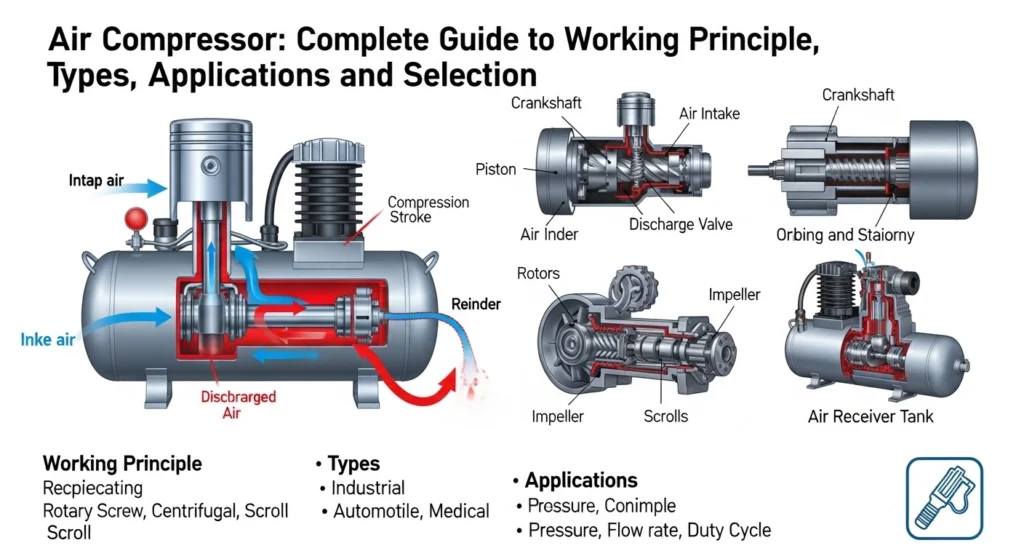
Air Compressor Working Principle
The air compressor working principle is based on reducing the volume of air to increase its pressure.
Step-by-Step Working
- Air Intake
Air is drawn into the compressor through an intake valve. - Compression Process
The air is compressed using a piston, screw, or vane mechanism. - Pressure Increase
As the air volume decreases, its pressure increases. - Storage
The compressed air is stored in a tank. - Air Delivery
When needed, the air is released through an outlet valve.
Simple Analogy
Think of a syringe:
- When you push the plunger, the air inside gets compressed
- The pressure increases
- The same concept is used in an air compressor
Types of Air Compressors
Air compressors are classified based on their working mechanism.
Reciprocating Air Compressor
This type uses a piston moving inside a cylinder.
- Works like a car engine
- Suitable for small to medium applications
- Common in workshops
Rotary Screw Air Compressor
Uses two rotating screws to compress air.
- Continuous operation
- High efficiency
- Used in industries
Centrifugal Air Compressor
Uses high-speed rotating impellers.
- Suitable for large-scale industries
- Provides high airflow
Scroll Air Compressor
Uses spiral-shaped components.
- Quiet operation
- Used in medical and laboratory applications
Main Components of Air Compressor
Understanding components helps in better operation and maintenance.
Motor
- Provides power to the compressor
- Can be electric or engine-driven
Compressor Pump
- Main unit where air is compressed
Air Tank
- Stores compressed air
- Maintains pressure
Intake Valve
- Allows air to enter
Discharge Valve
- Releases compressed air
Pressure Gauge
- Displays air pressure
Safety Valve
- Prevents overpressure
Air Compressor Advantages
The air compressor advantages and disadvantages are important for selection.
Advantages
- Easy to operate and maintain
- Provides continuous air supply
- Safe compared to electrical tools
- Versatile for multiple applications
- Portable models available
- Clean energy source (air-based)
Disadvantages / Limitations
Disadvantages
- Noise during operation
- Requires regular maintenance
- Energy losses due to heat
- Limited efficiency compared to hydraulic systems
- Moisture in air may cause damage
Air Compressor Applications
The air compressor applications are very wide.
Home Applications
- Filling tires
- Cleaning dust
- Spray painting
Industrial Applications
- Operating pneumatic tools
- Manufacturing processes
- Packaging machines
Modern Technology Uses
- Medical equipment
- Refrigeration systems
- Automation and robotics
Comparison: Air Compressor vs Hydraulic System
Understanding the difference between air compressor and hydraulic system is important.
| Feature | Air Compressor | Hydraulic System |
|---|---|---|
| Medium | Air | Liquid (oil) |
| Pressure | Moderate | Very high |
| Speed | Fast | Slower |
| Maintenance | Easier | Complex |
| Cleanliness | Clean | Can be messy |
| Applications | Light to medium | Heavy-duty |
Selection Guide
Choosing the right air compressor depends on your needs.
Key Factors to Consider
- Pressure Requirement (PSI)
Choose based on application - Airflow (CFM)
Higher airflow for industrial use - Tank Size
Larger tank for continuous use - Portability
Portable for home use - Power Source
Electric or fuel-based
Beginner Tips
- Start with a small compressor for learning
- Check noise level
- Ensure safety features
Common Problems & Solutions
Q1: Why is my air compressor not building pressure?
Solution:
- Check for air leaks
- Inspect valves
- Clean filters
Q2: Why is the compressor overheating?
Solution:
- Ensure proper ventilation
- Check oil level
- Avoid overuse
Q3: Why is water coming out with air?
Solution:
- Drain the tank regularly
- Use moisture filters
Q4: Why is it making too much noise?
Solution:
- Tighten loose parts
- Check motor condition
Future Trends in Air Compressors
The air compressor industry is evolving with new technologies.
Modern Developments
- Energy-efficient compressors
- Smart monitoring systems
- Oil-free compressors
- Eco-friendly designs
Industry Direction
- Automation integration
- Reduced power consumption
- Improved durability
Conclusion
An air compressor is a powerful and essential machine used in many fields, from small home tasks to large industrial operations. Understanding the air compressor working principle, types, and components helps in selecting and using the right system efficiently.
While it offers many benefits like flexibility, safety, and ease of use, it also has some limitations such as noise and maintenance needs. By choosing the right compressor and maintaining it properly, you can ensure long-term performance and efficiency.
For beginners and professionals alike, learning about air compressors is a valuable step toward mastering modern engineering tools and applications.