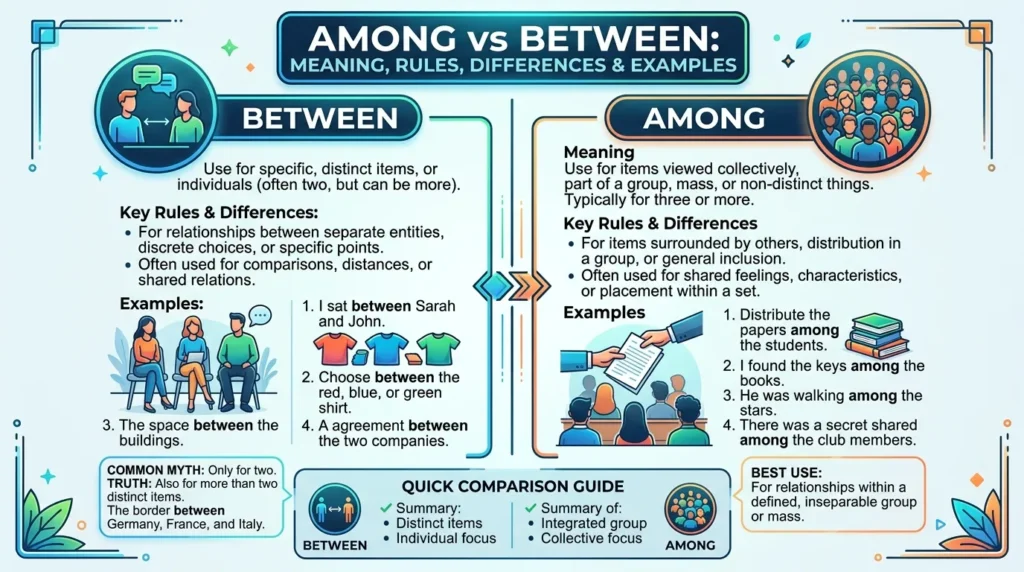

Among vs between is a common English grammar question. Many learners are taught a simple rule: use between for two people or things and among for three or more. While this rule is useful for beginners, it does not explain every situation. In modern English, between can also be used for more than two people or things when separate relationships or individual choices are involved.
For example, “The money was divided between John and Sarah” describes two people. But “The money was divided among the five children” describes a group. We can also say, “The agreement was made between three countries” when we are focusing on the countries as separate parties.
People search for among vs between because the words have similar meanings. Both can describe relationships, locations, choices, or distribution. The difference often depends on whether we see the subjects as separate individuals or as a group.
This guide explains among vs between with simple rules, examples, common mistakes, comparison tables, and practical advice for everyday and professional writing.
Among vs Between – Quick Answer
The basic difference is:
- Between = separates or connects distinct people, things, places, or choices.
- Among = refers to someone or something within a group or surrounded by a group.
Between Examples
The agreement was between John and David.
The road runs between two buildings.
Choose between tea and coffee.
Among Examples
She was sitting among her friends.
The teacher walked among the students.
The money was divided among the children.
Easy Memory Trick
Think:
Between = separate relationships
Among = within a group
However, remember that between is not limited to exactly two items.
For example:
The agreement was between France, Germany, and Italy.
Here, each country is treated as a separate party to the agreement.
The Origin of Among vs Between
The words among and between have been part of English for centuries.
Origin of Among
Among comes from Old English forms related to “among” and “onmang.” It developed with the meaning of being in the middle of or surrounded by other people or things.
Its modern meaning still reflects this idea.
For example:
She found herself among strangers.
The person is within a group of strangers.
Origin of Between
Between comes from Old English “betweonum,” meaning “in the space separating two” or “in the middle.”
The word has traditionally been associated with two distinct sides or points.
Over time, however, English speakers began using between for more than two distinct people or things when the relationship between each individual item matters.
For example:
Negotiations between the three companies continued.
The companies are treated as separate parties.
Why Are They Confused?
The confusion comes from the traditional grammar rule:
Between = two
Among = three or more
This rule is helpful but incomplete.
A better rule is:
Use between when the relationship involves distinct, separate items.
Use among when something is considered part of a group.
British English vs American English Spelling
There is no spelling difference between British and American English for among and between.
Both varieties use:
- among
- between
The main difference is not spelling. It is how the words are used in sentences.
Comparison Table
| Usage | British English | American English | Example |
|---|---|---|---|
| Relationship between two people | between | between | The choice is between Tom and Sam. |
| Something within a group | among | among | She was among friends. |
| Separate relationships involving several parties | between | between | Talks between three countries continued. |
| Distribution within a group | among | among | The prize was shared among the winners. |
| Location separating places | between | between | The house is between two stores. |
British English Examples
The agreement was between the three companies.
She was standing among the crowd.
American English Examples
The agreement was between the three companies.
She was standing among the crowd.
The rules are essentially the same.
Which Spelling Should You Use?
Your choice between among and between depends on meaning, not on whether you use American or British English.
Use Between for Two
When two distinct people, objects, or places are involved, between is usually correct.
The discussion was between the manager and the employee.
The shop is between the bank and the hotel.
Use Among for a Group
When someone or something is part of a group, use among.
He felt comfortable among his friends.
The documents were hidden among the files.
Use Between for More Than Two When Relationships Are Separate
This is an important advanced rule.
Correct:
The negotiations between the five countries continued.
The five countries are treated as separate parties.
Another example:
The competition between the three teams was intense.
Each team is considered separately.
Use Among for General Group Relationships
Use among when the group is treated as a whole.
The food was shared among the five guests.
There was disagreement among the team members.
For US Readers
American English follows these same principles.
For UK and Commonwealth Readers
British and Commonwealth English also use the same basic distinction.
For Global English
If you are writing for an international audience, focus on the relationship you want to describe rather than simply counting the number of items.
Common Mistakes with Among vs Between
Mistake 1: Always Using Between for Two
This is usually correct, but context still matters.
Correct:
The agreement is between John and Mary.
However, if the meaning is “within a group,” among may be better.
She felt comfortable among her two closest friends.
The focus is on being within a group, not on a relationship between two separate parties.
Mistake 2: Always Using Among for Three or More
This is another common mistake.
Incorrect:
The agreement was among the three countries.
Better:
The agreement was between the three countries.
Why?
The countries are separate parties in the agreement.
Mistake 3: Saying “Among You and Me”
Incorrect:
This is a secret among you and me.
Correct:
This is a secret between you and me.
Two distinct people are involved.
Mistake 4: Using Between for a Group
Incorrect:
She was standing between the crowd.
Better:
She was standing among the crowd.
The person is surrounded by or within a group.
Mistake 5: Using Among for Separate Choices
Incorrect:
You must choose among tea and coffee.
Correct:
You must choose between tea and coffee.
Two clear alternatives are being compared.
For several distinct choices, among can be natural:
You can choose among tea, coffee, and juice.
Among vs Between in Everyday Examples
In Emails
Between:
Please keep this discussion between you and the manager.
Among:
Please share the report among the team members.
In News
Between:
Talks between the two governments continued today.
Among:
There was growing concern among local residents.
On Social Media
Between:
I can’t decide between these two phones.
Among:
This is one of my favorite places among all the cities I have visited.
In Formal Writing
Between:
The study examined differences between the three groups.
Among:
The survey found strong agreement among participants.
In Everyday Conversation
What is the difference between these two?
She was sitting among her friends.
There is a strong connection between the two companies.
The teacher walked among the students.
Among vs Between – Comparison Table
| Situation | Correct Word | Example |
|---|---|---|
| Two distinct people | between | The decision is between John and Sarah. |
| Two places | between | The hotel is between the airport and the station. |
| Within a group | among | He was among his friends. |
| Shared within a group | among | The money was divided among the children. |
| Three separate countries | between | The agreement was between three countries. |
| Three separate companies | between | Talks between the three companies continued. |
| General group feeling | among | There was excitement among the fans. |
| Two choices | between | Choose between tea and coffee. |
| Several general choices | among | Choose among several options. |
How to Remember Among vs Between
A simple question can help:
Are the people or things separate parties?
If yes, use between.
The negotiations between the three companies continued.
Are you talking about being inside or part of a group?
If yes, use among.
She was among the employees.
The Traditional Rule
You may have learned:
Between = two
Among = three or more
This rule is useful for basic writing, but it is not always accurate.
A better rule is:
Between focuses on distinct relationships.
Among focuses on a group.
This rule works in many more situations.
Among vs Between – Google Trends & Usage Data
Search interest for among vs between is mainly related to English grammar, writing, education, and language learning.
Both words are common in everyday English, so people may encounter them frequently in books, news articles, emails, academic writing, and conversations. However, searches for the exact phrase among vs between are usually driven by people who want to understand the grammar difference.
Interest can vary across countries where English is taught as a first or second language. Students, teachers, writers, bloggers, and professionals may search for the phrase when checking sentence structure.
The topic is especially useful for educational and grammar websites because the traditional “two versus three” rule does not fully explain modern English usage.
Google Trends interest changes over time and by region. For exact current search data, writers should check Google Trends directly rather than relying on fixed search-volume numbers.
FAQs About Among vs Between
1. What is the difference between among and between?
Between usually describes a relationship involving distinct people or things. Among usually means within or surrounded by a group.
2. Is between only used for two people?
No. Between can be used for more than two people or things when they are treated as separate parties or relationships.
Example:
The agreement was between the four companies.
3. Is among used only for three or more people?
Not always. Among focuses on being within a group, so the number of people is not the only factor.
4. Should I say between you and me or among you and me?
The correct phrase is:
Between you and me.
The phrase describes a relationship between two distinct people.
5. Should I say among the three countries or between the three countries?
Both can be possible depending on meaning. Use between when the three countries are treated as separate parties. Use among when the focus is on the group as a whole.
6. Is “among friends” correct?
Yes.
She feels comfortable among friends.
It means she is within a group of friends.
7. Is there a British-American spelling difference?
No. Both British and American English spell these words among and between.
Conclusion
Understanding among vs between becomes much easier when you focus on meaning rather than simply counting people or things. The traditional rule says between is for two and among is for three or more. While this is useful for beginners, modern English is more flexible.
Use between when you are talking about distinct people, things, places, or relationships. It can also be used with more than two parties when each party is treated as separate. For example, “The agreement was between the three countries” is correct because the countries are individual parties.
Use among when someone or something is within a group or surrounded by a group. For example, “She was sitting among her friends” focuses on her position within the group.
British and American English use the same spelling and follow very similar rules. For clear writing, remember the simple idea: between focuses on separate relationships, while among focuses on groups. This approach is more reliable than simply counting the number of people or things involved.