
Imagine your teacher says, “There will be a test tomorrow,” while your school announces, “Final exams begin next month.” Many students wonder whether these words mean the same thing. This is why exam vs test is one of the most searched education-related topics online.
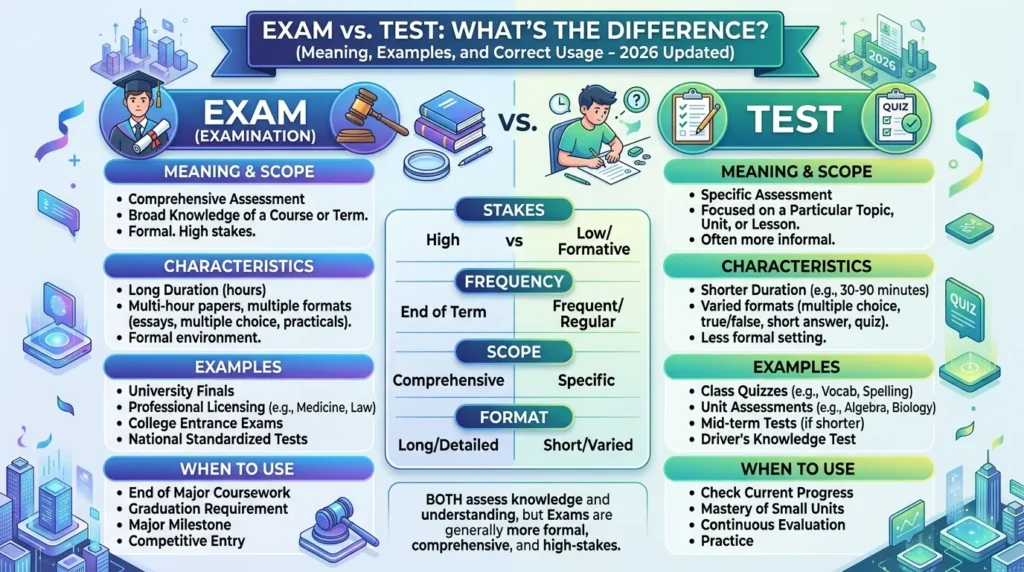
Although both an exam and a test measure knowledge or skills, they are not always identical. In many schools, a test is a smaller assessment used to check learning, while an exam is usually more comprehensive and often affects final grades. However, the exact meaning can vary depending on the country, school, or education system.
In this guide, you’ll learn the difference between exam and test, their origins, correct usage, British and American English preferences, everyday examples, common mistakes, FAQs, and practical advice. Whether you’re a student, teacher, parent, or English learner, this article will help you use both words correctly in conversation and writing.
Exam vs Test – Quick Answer
The main difference between exam and test is their purpose and importance.
- An exam is usually a formal assessment that covers a large amount of material and often contributes significantly to your final grade.
- A test is generally shorter and designed to check your understanding of a specific topic or lesson.
Simple Examples
- I have a math test on Friday.
- My final exams start next month.
In most schools, tests happen more frequently, while exams are held at the end of a term, semester, or academic year.
The Origin of Exam vs Test
Learning where these words came from helps explain how they are used today.
Origin of “Exam”
The word exam is a shortened form of examination, which comes from the Latin word examinare, meaning “to inspect,” “to weigh carefully,” or “to test.”
Over time, “exam” became the common short form used in schools, colleges, universities, and professional certifications.
Examples:
- Entrance exam
- Driving exam
- Medical exam
- Final exam
Origin of “Test”
The word test comes from the Latin word testum, referring to a clay container used in metal testing. It later came to mean checking the quality or ability of something.
Today, test is widely used in education, medicine, science, and technology.
Examples:
- Vocabulary test
- Blood test
- Driving test
- Software test
Why There Are No Spelling Differences
Unlike words such as colour/color, both exam and test are spelled the same in British and American English.
British English vs American English Spelling
There is no spelling difference between exam and test.
Both countries write:
- Exam
- Test
However, schools may use the words differently depending on the education system.
Examples
British English
- I have my GCSE exams next week.
- We had a spelling test yesterday.
American English
- I have my final exams next month.
- We took a science test today.
Comparison Table
| Word | British English | American English |
|---|---|---|
| Exam | Exam | Exam |
| Test | Test | Test |
Which Spelling Should You Use?
Since there is no spelling difference, use the same words everywhere.
For US Readers
Use test for quizzes or classroom assessments and exam for major evaluations like finals or standardized assessments.
For UK Readers
The same spelling applies. Schools commonly use exam for GCSEs, A-levels, and university assessments.
For Global Readers
Choose the word based on the type of assessment:
- Small assessment → Test
- Major assessment → Exam
Common Mistakes with Exam vs Test
Many English learners use these words incorrectly.
Mistake 1
Every test is an exam.
✅ Correct:
Many tests are small classroom assessments and are not formal exams.
Mistake 2
Exam and test always mean exactly the same thing.
✅ Correct:
They are similar but often differ in length, importance, and grading.
Mistake 3
Only schools use exams.
✅ Correct:
Professional organizations also conduct certification and licensing exams.
Examples:
- IELTS exam
- Medical licensing exam
- Bar exam
Mistake 4
Tests only happen in schools.
✅ Correct:
Tests are also common in medicine, laboratories, driving, and technology.
Examples:
- Blood test
- COVID-19 test
- Software test
Mistake 5
You should always say exam in formal writing.
✅ Correct:
Choose the word that accurately describes the assessment.
Exam vs Test in Everyday Examples
“I’ll miss tomorrow’s class because I have my driving test.”
News
“Students across the country began their final exams this week.”
Social Media
“I passed my math test today! 🎉”
Formal Writing
“The examination assessed students’ understanding of the complete course syllabus.”
Exam vs Test – Google Trends & Usage Data
The keyword exam vs test is searched throughout the year, especially before school and university examination periods.
Popular Search Queries
- Exam vs test
- Difference between exam and test
- Exam meaning
- Test meaning
- Is an exam harder than a test?
- Exam or test
- Final exam vs final test
Countries with High Search Interest
- United States
- United Kingdom
- India
- Canada
- Australia
Search volume usually increases during school semesters, university admissions, and competitive exam seasons.
Exam vs Test Comparison Table
| Feature | Exam | Test |
|---|---|---|
| Purpose | Final evaluation | Check learning progress |
| Length | Usually longer | Usually shorter |
| Coverage | Multiple topics | One or few topics |
| Importance | High | Moderate or low |
| Frequency | End of term or course | Throughout the course |
| Grading Impact | Often major | Usually smaller |
| Formality | Highly formal | Less formal |
Keyword Variations
| Search Keyword | Meaning |
|---|---|
| Exam vs Test | Main comparison |
| Test vs Exam | Same comparison |
| Difference between exam and test | Explanation |
| Exam meaning | Definition |
| Test meaning | Definition |
| Exam or test | Usage comparison |
| Final exam vs test | Academic comparison |
Frequently Asked Questions (FAQs)
1. What is the difference between an exam and a test?
An exam is usually a formal and comprehensive assessment, while a test is often shorter and checks understanding of specific topics.
2. Is an exam harder than a test?
In many schools, yes. Exams usually cover more material and have a greater impact on final grades.
3. Can a test be called an exam?
Sometimes. The meaning depends on the education system and the purpose of the assessment.
4. Which word is more common in schools?
Both are common. Teachers often give tests during the course and exams at the end of a term or semester.
5. Is there any spelling difference between exam and test?
No. Both words are spelled the same in British English and American English.
6. Are quizzes different from tests?
Yes. Quizzes are usually shorter and less formal than tests.
7. Which word should I use in formal writing?
Use the word that best describes the assessment. “Exam” is preferred for official evaluations, while “test” suits smaller assessments.
Conclusion
Understanding exam vs test helps you use the correct word in academic and everyday situations. Although both assess knowledge, they usually differ in purpose, length, and importance. A test is often a shorter assessment used during a course to measure progress, while an exam is a more formal evaluation that covers a wider range of topics and often contributes significantly to final grades. Both British and American English use the same spelling, making these words easy to understand worldwide. By learning the difference between exam and test, you can communicate more clearly in school, university, workplace training, and professional certifications. Whether you’re writing an email, preparing for classes, or improving your English vocabulary, choosing the right word will make your communication more accurate and confident.