
Music can express feelings that ordinary words cannot. A single song can sound joyful, peaceful, powerful, sad, romantic, or dramatic. But when you write about music, using the word “music” again and again can make your writing feel plain. That is why many people search for synonyms for music and better words to describe songs, sounds, melodies, and performances.
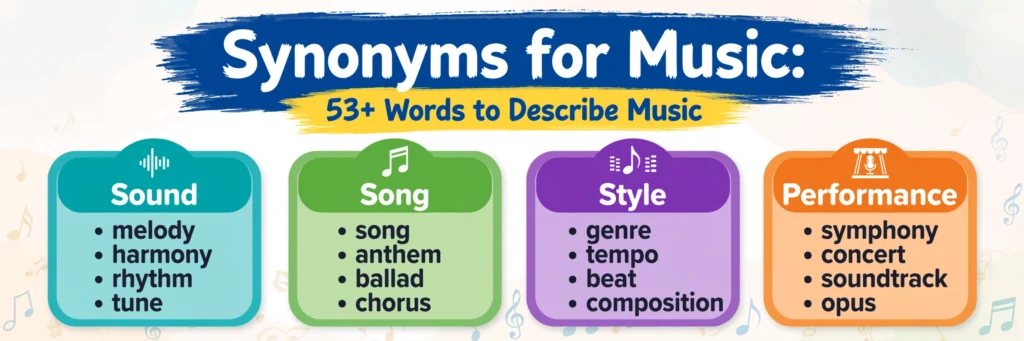
The good news is that there are many words related to music. Some describe the sound itself, while others describe a song, musical performance, style, or feeling. Words such as melody, harmony, rhythm, tune, song, composition, soundtrack, symphony, and sound can all work in different situations.
Choosing the right word can also make your writing more vivid. A music review may need words such as melody or composition. Creative writing may use harmony or rhythm. Casual conversation may simply use tune or song.
This guide explains 53+ synonyms and related words for music, their meanings, differences, common mistakes, and practical examples.
Synonyms for Music – Quick Answer
The word music refers to organized sound created through instruments, voices, rhythm, melody, harmony, or other musical elements.
There is no single perfect synonym for music. The best alternative depends on what you mean.
Some useful synonyms and related words include:
- Song – a piece of music, often with vocals
- Melody – a sequence of musical notes
- Tune – a simple or memorable melody
- Harmony – notes that sound together
- Rhythm – the pattern of beats and timing
- Composition – a piece of music created by a composer
- Soundtrack – music used with a film, show, or game
- Symphony – a large musical composition, usually for an orchestra
- Chorus – a repeated part of a song
- Performance – music played or sung for an audience
Example
Instead of:
The music in the movie was beautiful.
You could write:
The soundtrack in the movie was beautiful.
Or:
The melody was beautiful.
The correct choice depends on the exact part of the music you want to describe.
The Origin of Music
The English word music comes from Old French musique and Latin musica. The Latin term came from Greek mousikē, meaning the art or practice connected with the Muses.
The ancient Greek idea of music was broader than simply songs. It was connected with artistic and intellectual activities associated with the Muses, the figures linked with the arts and learning.
Over time, the word developed into the modern English music, which generally refers to organized sound and the art of creating, performing, or enjoying it.
The related words used to describe music also have different histories. For example, melody comes through French and Latin from Greek, while rhythm comes from Greek rhythmos.
Because English developed from many languages, musical vocabulary contains words with Greek, Latin, French, Italian, and other influences.
Why Are There Different Words for Music?
Music has many parts and forms. One word cannot describe all of them.
For example:
- A song may contain lyrics.
- A melody is a sequence of notes.
- A rhythm describes beats and timing.
- A harmony describes notes working together.
- A composition describes a created musical work.
- A soundtrack describes music connected with visual media.
These words are therefore related to music but are not always exact synonyms.
British English vs American English Spelling
The word music is spelled the same in standard British and American English.
There is no major British-American spelling difference for:
- music
- musical
- musician
- melody
- rhythm
- harmony
- song
- composition
Some related musical words can have different spellings in particular contexts. For example, programme is common in British English when referring to a planned broadcast or event, while program is standard in American English. However, the musical word program music is also used in English-language music terminology.
Comparison Table
| Word | British English | American English | Meaning |
|---|---|---|---|
| Music | Music | Music | Organized sound |
| Melody | Melody | Melody | Musical sequence of notes |
| Rhythm | Rhythm | Rhythm | Pattern of beats |
| Harmony | Harmony | Harmony | Combination of musical notes |
| Song | Song | Song | Musical piece, often with vocals |
| Tune | Tune | Tune | Melody |
| Musician | Musician | Musician | Person who creates or performs music |
| Programme | Programme | Program | General scheduled event or broadcast |
| Program music | Program music | Program music | Music linked to an idea or story |
The important point is simple: music does not have separate British and American spellings.
Which Spelling Should You Use?
Use music for both American and British audiences.
For US Audiences
Write:
I listen to music every day.
Music is the standard American spelling.
For UK Audiences
Write:
I listen to music every day.
The same spelling is correct in British English.
For Commonwealth Audiences
Countries such as Australia, Canada, and New Zealand also commonly use music.
For Global Audiences
Use music without changing the spelling. It is widely understood around the world.
For SEO, you should not create separate pages based only on a supposed British spelling of “music.” Instead, focus on useful related terms such as:
- synonyms for music
- words for music
- words to describe music
- another word for music
- musical synonyms
- words related to music
- types of music words
Common Mistakes with Synonyms for Music
Finding a related word does not always mean it can replace music.
1. Using “song” for all music
A song is usually a specific musical work, often involving vocals.
Incorrect:
Classical music is always called a song.
Better:
Classical music often includes compositions.
2. Using “melody” to mean the entire musical piece
A melody is only one part of music.
The song has a beautiful melody.
This is correct.
But:
I listened to a melody for two hours.
This may not express the intended meaning if you mean a complete album or performance.
3. Confusing rhythm with music
Rhythm is the pattern of beats and timing. It is an important part of music, but it is not the same as music.
4. Using “harmony” as a general synonym
Harmony refers to musical notes sounding together. It can also mean agreement or balance in a non-musical context.
5. Confusing “musical” with “music”
Music is a noun.
I love music.
Musical is usually an adjective.
She has musical talent.
It can also be a noun referring to a stage production.
We watched a musical.
6. Using “sound” in every situation
Sound is a much broader term than music.
Music is a type of organized sound.
Therefore, “sound” is related to music but is not always a direct synonym.
Synonyms for Music in Everyday Examples
The best word changes according to the situation.
In Emails
You might write:
Thank you for sharing the music from the event.
For a more specific message:
Thank you for sharing the playlist from the event.
Or:
I really enjoyed the performance.
In News Writing
News articles often use terms such as:
- performance
- concert
- composition
- soundtrack
- recording
- album
- song
Example:
The musician released a new composition on Friday.
On Social Media
Casual words are often more natural:
This song is amazing!
I love this tune.
The beat is incredible.
This track is on repeat.
In Formal Writing
Formal and academic writing may use:
- composition
- musical work
- performance
- melody
- harmony
- rhythm
- arrangement
Example:
The composition combines traditional instruments with modern rhythms.
53+ Synonyms and Related Words for Music
Here are useful words you can use when writing about music:
| # | Word | Meaning |
|---|---|---|
| 1 | Song | A piece of music, often with vocals |
| 2 | Melody | A sequence of musical notes |
| 3 | Tune | A recognizable melody |
| 4 | Harmony | Notes combined to support a melody |
| 5 | Rhythm | Pattern of beats and timing |
| 6 | Composition | A created piece of music |
| 7 | Soundtrack | Music connected with a film, show, or game |
| 8 | Symphony | Large composition, usually for orchestra |
| 9 | Chorus | Repeated section of a song |
| 10 | Verse | Section of a song with changing lyrics |
| 11 | Track | Recorded piece of music |
| 12 | Recording | Captured musical performance |
| 13 | Performance | Music presented to an audience |
| 14 | Concert | Live musical event |
| 15 | Recital | Performance by an individual or small group |
| 16 | Arrangement | Adapted version of a musical work |
| 17 | Score | Written music or music for a production |
| 18 | Beat | Basic pulse of music |
| 19 | Tempo | Speed of a musical piece |
| 20 | Chord | Several notes played together |
| 21 | Refrain | Repeated musical or lyrical passage |
| 22 | Lyric | Words of a song |
| 23 | Ballad | Song that tells a story |
| 24 | Anthem | Song representing a group or cause |
| 25 | Chant | Repeated rhythmic singing |
| 26 | Opera | Dramatic work combining singing and music |
| 27 | Oratorio | Large musical work for voices and orchestra |
| 28 | Concerto | Work featuring a solo instrument and orchestra |
| 29 | Overture | Introductory orchestral composition |
| 30 | Sonata | Composition usually for a solo instrument or small group |
| 31 | Nocturne | Musical composition associated with night |
| 32 | Lullaby | Gentle song used to help someone sleep |
| 33 | Hymn | Religious or devotional song |
| 34 | Carol | Traditional song, often linked with Christmas |
| 35 | Serenade | Musical work traditionally associated with an evening performance |
| 36 | Jazz | Musical genre based on rhythm and improvisation |
| 37 | Blues | Music genre with roots in African American musical traditions |
| 38 | Folk music | Traditional music of a community or culture |
| 39 | Melody line | Main sequence of musical notes |
| 40 | Instrumental | Music performed without vocals |
| 41 | Vocals | Singing in a musical recording |
| 42 | Beat | Rhythmic pulse |
| 43 | Groove | Strong rhythmic feel |
| 44 | Arrangement | Organized version of a composition |
| 45 | Repertoire | Collection of works a performer can perform |
| 46 | Musical work | A created piece of music |
| 47 | Sound | Audible element, including musical sound |
| 48 | Audio | Recorded or transmitted sound |
| 49 | Playlist | Collection of selected recordings |
| 50 | Jingle | Short memorable piece of music |
| 51 | Score | Written musical notation or accompanying music |
| 52 | Composition | Structured musical creation |
| 53 | Track | Individual recording |
| 54 | Piece | Individual work of music |
| 55 | Arrangement | Adapted form of a musical work |
Synonyms for Music – Google Trends & Usage Data
Search interest in “synonyms for music” is part of a larger group of vocabulary searches. People may search for this phrase when writing essays, articles, reviews, stories, school assignments, captions, or creative descriptions.
Related searches can include:
- synonyms for music
- words to describe music
- another word for music
- words related to music
- musical synonyms
- words for songs
- words to describe a song
- adjectives for music
Search behavior can also vary by country. English-language vocabulary searches are common across markets such as the United States, United Kingdom, Canada, Australia, and India. However, exact Google Trends interest changes over time and should be checked for the specific date range and country being targeted.
For SEO, it is better to cover the topic naturally rather than repeat the exact keyword many times. A useful page can target the main phrase “synonyms for music” while also answering related questions.
The search intent is usually simple:
The reader wants better words to describe music.
That means definitions, examples, comparison tables, and context-based recommendations are more useful than a long list of unrelated words.
FAQs About Synonyms for Music
What is a synonym for music?
There is no perfect single synonym for music. Depending on the context, words such as song, melody, composition, tune, soundtrack, and musical work can describe related ideas.
What is another word for music?
Common alternatives include song, melody, tune, composition, soundtrack, harmony, and musical work. The correct choice depends on what part or type of music you mean.
What is a good synonym for music in writing?
Composition is useful in formal writing. Song works well for vocal music, while melody works when you mean a sequence of musical notes.
What are some words to describe beautiful music?
You can use words such as melodic, harmonious, soothing, peaceful, moving, uplifting, powerful, captivating, and rhythmic.
Is “song” the same as “music”?
No. A song is a type of music. The word music is broader and can include instrumental works, compositions, performances, and songs.
Is “sound” a synonym for music?
Not exactly. Sound is a broad term that includes many things besides music. Music is one type of organized sound.
What is a formal word for music?
Depending on the context, composition, musical work, performance, or musical arrangement can be more formal alternatives.
What is the difference between melody and music?
A melody is a sequence of musical notes that forms a recognizable musical line. Music is a much broader concept that can include melody, rhythm, harmony, vocals, instruments, and structure.
Does music have a different British spelling?
No. Music has the same standard spelling in British and American English.
Conclusion
The best synonym for music depends on what you want to describe. Music is a broad term, so words such as song, melody, tune, rhythm, harmony, composition, soundtrack, performance, and musical work each cover a different part of the subject.
If you mean a vocal musical work, song is often the best choice. If you mean the main sequence of notes, use melody. For a written or created musical work, composition is more precise. For music connected to a movie or game, soundtrack works well. Words such as rhythm and harmony should be used when you are talking about specific musical elements.
Remember that music is spelled the same in British and American English. There is no need to create separate spelling versions for different audiences.
For SEO and everyday writing, focus on meaning rather than simply replacing the word “music.” Choose the word that fits the sentence, audience, and type of musical idea. This makes your content clearer, more natural, and more useful to readers.