
An adjective can turn a simple sentence into a clear picture. Compare “She bought a car” with “She bought a new red car.” The words new and red give us more information about the noun car.
If you are learning English grammar, one of the first questions you may have is what is an adjective? Adjectives are important because they help us describe people, places, animals, objects, ideas, and feelings. They can tell us about size, color, shape, age, number, quality, and other characteristics.
Students often search for adjective definition, adjective examples, and types of adjectives because the basic idea is easy to understand, but using different adjective forms correctly can become confusing. Learners may also wonder whether words such as beautiful, five, this, and my are adjectives.
In this complete guide, you will learn the adjective definition, common types of adjectives, adjective examples in sentences, comparison rules, adjective order, common mistakes, and everyday usage. The examples and spelling conventions are written primarily for American English readers.
Adjective – Quick Answer
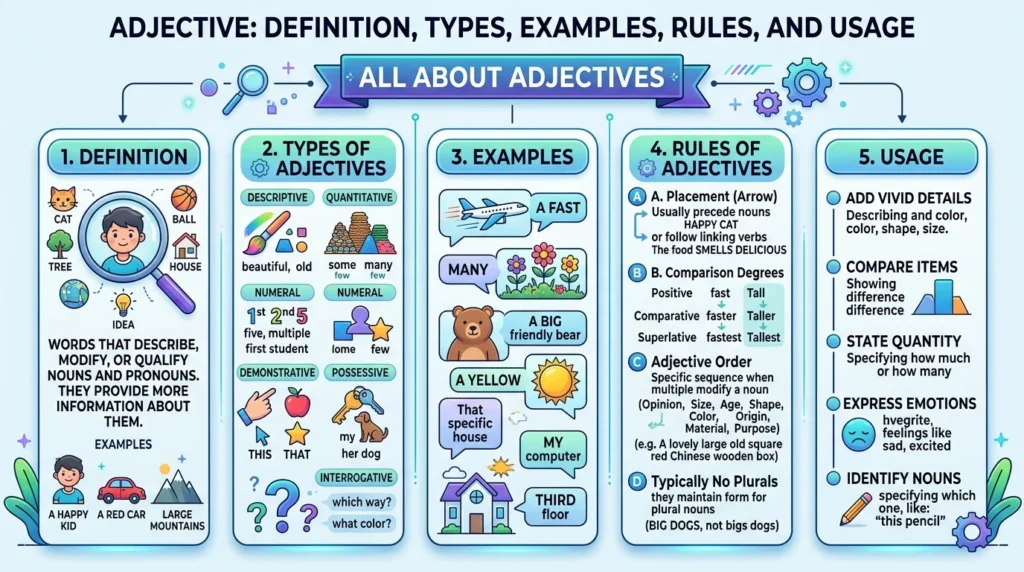
An adjective is a word that describes or gives more information about a noun or pronoun.
An adjective can tell us:
- What something is like
- Which one
- How many
- How much
- What color
- What size
- What age
- What quality
Adjective Examples
She has a beautiful dress.
Beautiful describes the noun dress.
He drives a fast car.
Fast describes the noun car.
We live in a large house.
Large describes the noun house.
I bought three books.
Three tells us how many books.
They saw a black dog.
Black describes the color of the dog.
Simple Adjective Definition
You can remember the meaning this way:
Adjective = a word that describes or gives information about a noun or pronoun.
The Origin of Adjective
The word adjective comes from the Latin word adiectivum, which means something that is “added” or “joined.”
It comes from the Latin verb adiicere, meaning “to add to.”
The name makes sense because an adjective adds information to a noun.
For example:
a house
This tells us very little.
a large house
The adjective large adds information.
a large white house
Now large and white provide more details about the house.
The grammatical term entered English through French and Latin grammatical traditions. Over time, adjective became the standard English term for words that modify or describe nouns and, in some structures, provide information about pronouns.
Examples of adjectives
Examples of adjectives include beautiful, happy, tall, small, red, clever, fast, kind, strong, bright, young, old, friendly, honest, brave, cold, hot, soft, rough, clean, dirty, expensive, cheap, interesting, boring, and helpful. These words describe people, places, animals, objects, feelings, or things.
Why Are Adjectives Important?
Adjectives make sentences more specific and descriptive.
Compare:
The man entered the room.
With:
The tall, tired man entered the quiet room.
The second sentence gives the reader more information about the man and the room.
Adjectives are useful in school assignments, emails, news writing, business communication, social media, technical writing, and everyday conversation.
Without adjectives, many sentences would still be grammatically correct, but they could provide less detail.
American English vs British English
For readers in the United States, American English spelling and usage are the primary conventions used in this guide.
The word adjective itself has the same spelling in American and British English.
| Feature | American English | British English |
|---|---|---|
| Word | adjective | adjective |
| Plural | adjectives | adjectives |
| Comparative | bigger | bigger |
| Superlative | biggest | biggest |
| Grammar term | adjective | adjective |
There is no spelling difference in the word adjective itself.
However, individual adjectives may have different spellings in American and British English.
Common American and British Spelling Differences
| American English | British English |
|---|---|
| color | colour |
| favorite | favourite |
| honor | honour |
| behavior | behaviour |
| center | centre |
For example:
American English:
This is my favorite book.
British English:
This is my favourite book.
Both forms are accepted in their respective varieties of English. If your audience is primarily in the United States, use American English consistently.
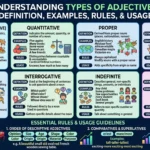
Types of Adjectives
There are several common types of adjectives in English grammar. Learning these categories can help you identify adjectives and understand how they work in sentences.
Descriptive Adjectives
Descriptive adjectives tell us what a person, place, animal, object, or idea is like.
Examples include:
- big
- small
- beautiful
- intelligent
- cold
- strong
- expensive
- useful
- quiet
Example:
He bought an expensive watch.
The adjective expensive describes the watch.
Another example:
The quiet classroom was clean.
The words quiet and clean give information about the classroom.
Quantitative Adjectives
Quantitative adjectives tell us about the amount or number of something.
Common examples include:
- some
- much
- little
- enough
- many
- several
Examples:
She has many books.
We have enough food.
There is little water left.
These words provide information about quantity.
Demonstrative Adjectives
Demonstrative adjectives point to particular nouns.
Common examples are:
- this
- that
- these
- those
Examples:
This book is interesting.
That car is expensive.
These shoes are comfortable.
Those houses are beautiful.
The demonstrative word helps identify which noun the speaker means.
Possessive Adjectives
Possessive adjectives show ownership or a relationship.
Common examples include:
- my
- your
- his
- her
- its
- our
- their
Examples:
This is my phone.
She brought her notebook.
They sold their house.
We finished our project.
These words tell us who something belongs to or is associated with.
Interrogative Adjectives
Interrogative adjectives are used with nouns in questions.
Common examples include:
- which
- what
- whose
Examples:
Which book do you want?
What color is the car?
Whose phone is this?
The interrogative word helps ask for information about a noun.
Comparative Adjectives
Comparative adjectives are used to compare two people, animals, objects, places, or things.
Examples:
John is taller than Mike.
This car is faster than that one.
My new phone is cheaper than my old phone.
Many short adjectives form the comparative by adding -er:
- tall → taller
- fast → faster
- small → smaller
- old → older
Some adjectives use more:
- beautiful → more beautiful
- expensive → more expensive
- comfortable → more comfortable
Superlative Adjectives
Superlative adjectives compare three or more people or things and show the highest or lowest degree.
Examples:
She is the tallest student in the class.
This is the most expensive option.
Common forms include:
- tall → tallest
- fast → fastest
- small → smallest
- old → oldest
- beautiful → most beautiful
Adjective Comparison Table
| Type of Adjective | Purpose | Example |
|---|---|---|
| Descriptive | Describes a quality or characteristic | a beautiful house |
| Quantitative | Shows amount or number | many books |
| Demonstrative | Points to a particular noun | this car |
| Possessive | Shows ownership or relationship | my phone |
| Interrogative | Used with nouns in questions | which book? |
| Comparative | Compares two | taller boy |
| Superlative | Compares three or more | tallest boy |
Comparative and Superlative Adjectives
Adjectives can change their form when making comparisons.
Short Adjectives
Many short adjectives use -er for the comparative and -est for the superlative.
small → smaller → smallest
fast → faster → fastest
tall → taller → tallest
Adjectives Ending in “y”
For many adjectives ending in a consonant followed by y, change y to i before adding -er or -est.
happy → happier → happiest
easy → easier → easiest
busy → busier → busiest
Longer Adjectives
Many longer adjectives use more and most.
beautiful → more beautiful → most beautiful
expensive → more expensive → most expensive
comfortable → more comfortable → most comfortable
Irregular Adjectives
Some adjectives do not follow the regular patterns.
| Base Adjective | Comparative | Superlative |
|---|---|---|
| good | better | best |
| bad | worse | worst |
| little | less | least |
| many | more | most |
These forms should be learned as individual grammar patterns.
Adjective Position in a Sentence
Adjectives often appear before the noun they describe.
Examples:
a red car
a large building
an interesting story
a friendly teacher
However, adjectives can also appear after linking verbs.
Examples:
The car is red.
The building looks large.
The story seems interesting.
The teacher is friendly.
This position is called the predicate position or predicative use of an adjective.
Understanding both positions helps English learners use adjectives naturally.
Order of Adjectives
When several adjectives appear before one noun, English usually follows a natural order.
A common pattern is:
Opinion → Size → Age → Shape → Color → Origin → Material → Noun
For example:
a beautiful small old wooden house
Another example:
a lovely large red Italian leather bag
You do not always need to use every category. The important point is that adjectives usually follow an established order rather than being placed randomly.
How to Identify an Adjective
A useful way to identify an adjective is to ask whether the word gives additional information about a noun or pronoun.
Consider:
The young boy carried a heavy bag.
- young describes boy
- heavy describes bag
Both words function as adjectives.
Another example:
She bought three beautiful flowers.
- three tells us how many flowers
- beautiful describes the flowers
Looking at the relationship between a word and the noun it modifies can help you identify adjectives.
Adjective and Adverb: What Is the Difference?
One common grammar question is the difference between an adjective and an adverb.
An adjective usually describes a noun or pronoun.
An adverb can modify a verb, adjective, or another adverb.
Compare:
She is a careful driver.
Here, careful describes the noun driver.
She drives carefully.
Here, carefully tells us how she drives.
Another example:
He is a quick runner.
He runs quickly.
Understanding this difference can help prevent common adjective and adverb mistakes.
Common Mistakes With Adjectives
Learners often make mistakes with adjective forms, comparison, position, and adjective-adverb differences.
Mistake 1: Confusing an Adjective With an Adverb
❌ She sings beautiful.
✅ She sings beautifully.
Beautiful is an adjective, while beautifully is an adverb.
However:
She has a beautiful voice.
Here, beautiful correctly describes the noun voice.
Mistake 2: Using “More” With Some Short Adjectives
❌ He is more tall than his brother.
✅ He is taller than his brother.
Many short adjectives use -er rather than more.
Mistake 3: Using “Most” With an “-est” Form
❌ She is the most tallest student.
✅ She is the tallest student.
Do not normally use most with an adjective that already has the -est form.
Mistake 4: Confusing an Adjective With a Noun
❌ The beauty girl smiled.
✅ The beautiful girl smiled.
Beauty is a noun, while beautiful is an adjective.
Mistake 5: Using the Wrong “-ed” or “-ing” Form
❌ The movie was bore.
✅ The movie was boring.
❌ I was boring by the movie.
✅ I was bored by the movie.
Boring describes something that causes boredom, while bored describes a person’s feeling.
Mistake 6: Incorrect Adjective Order
When several adjectives describe one noun, learners sometimes place them in an unnatural order.
For example:
a beautiful small old wooden house
Learning the common adjective order can make sentences sound more natural.
Adjective Examples in Everyday English
Adjectives appear in almost every type of communication.
Adjectives in Emails
Thank you for your quick response.
Please send the updated report.
We need a detailed explanation.
The meeting was productive.
These adjectives make professional communication more specific.
Adjectives in News Writing
The company announced a new product.
Heavy rain caused major damage.
Officials introduced strict safety rules.
Adjectives can provide useful descriptive details in news writing.
Adjectives on Social Media
What a beautiful day!
I just bought a new phone.
This food is amazing!
Adjectives help people describe experiences and express feelings or opinions.
Adjectives in Formal Writing
The study provides important information.
The system requires regular maintenance.
The company developed an efficient solution.
Adjectives can make professional and technical writing more precise.
Adjectives in Everyday Conversation
That is a good idea.
I need a small bag.
She has a new job.
It was a cold morning.
These examples show how frequently adjectives are used in everyday American English.
Adjective Examples in Sentences
Here are some simple sentences to help you understand how adjectives work:
- The blue sky looked beautiful.
- She bought a new laptop.
- The old house needs repairs.
- He has a friendly dog.
- We saw three large birds.
- This movie is interesting.
- My brother has a fast car.
- That restaurant serves delicious food.
- The weather is cold today.
- She wore a beautiful dress.
In each sentence, the adjective provides additional information about a noun or describes the subject through a linking verb.
Adjective – Search Interest and Related Keywords
The keyword adjective has broad search intent because adjectives are a fundamental part of English grammar.
People commonly search for:
- adjective definition
- what is an adjective
- what is an adjective in grammar
- adjective examples
- types of adjectives
- examples of adjectives
- adjective examples in sentences
- comparative adjectives
- superlative adjectives
- adjective and adverb
- adjective rules
- how to identify an adjective
These searches reflect common learning needs, including definitions, examples, types, comparison, and correct usage.
Search interest can vary by country, age group, education level, and school calendar. For a US-focused website, current keyword data should be checked specifically for Google searches in the United States rather than assuming worldwide search behavior is identical.
Who Searches for Adjective?
The topic can be useful for:
- School students
- English learners
- ESL students
- Teachers
- Parents
- Writers
- Exam candidates
- Grammar learners
- College students
Students may search for adjective examples and definitions, while English learners may focus on adjective rules, comparison, and sentence usage.
Why Is Adjective a Popular Grammar Topic?
Adjectives are introduced early in English grammar education. Students continue using them as they study more advanced topics.
Related grammar topics include:
- Parts of speech
- Sentence structure
- Comparative adjectives
- Superlative adjectives
- Descriptive writing
- Adjective clauses
- Adjective phrases
- Adverbs
- Degrees of comparison
Because adjectives are common in both spoken and written English, understanding them is useful for learners at different levels.
FAQs About Adjectives
1. What is an adjective?
An adjective is a word that describes or gives more information about a noun or pronoun.
Example:
She has a beautiful dress.
2. What are some examples of adjectives?
Common adjective examples include big, small, happy, sad, beautiful, fast, slow, red, old, new, expensive, and friendly.
3. What are the main types of adjectives?
Common types include descriptive, quantitative, demonstrative, possessive, interrogative, comparative, and superlative adjectives.
4. What is a descriptive adjective?
A descriptive adjective tells us what a person, place, animal, object, or idea is like.
Example:
It is a beautiful house.
5. What is a comparative adjective?
A comparative adjective compares two people or things.
Example:
John is taller than Peter.
6. What is a superlative adjective?
A superlative adjective compares three or more people or things and shows the highest or lowest degree.
Example:
John is the tallest student in the class.
7. What is the difference between an adjective and an adverb?
An adjective usually describes a noun or pronoun, while an adverb can modify a verb, adjective, or another adverb.
She is a careful driver.
She drives carefully.
8. Can an adjective describe a pronoun?
Yes. An adjective can provide information about a pronoun or an indefinite pronoun through sentence structure.
Example:
Something strange happened.
Here, strange gives more information about something.
9. Can a sentence have more than one adjective?
Yes.
She bought a beautiful red dress.
Both beautiful and red describe the noun dress.
10. Is “very” an adjective?
No. Very is usually an adverb because it modifies an adjective or another adverb.
Example:
She is very happy.
Here, very modifies the adjective happy.
An adjective can turn a plain sentence into a clear picture. Compare “She bought a car” with “She bought a new red car.” The words new and red give us more information about the noun car.
An adjective is one of the most useful parts of English grammar. It helps describe people, places, animals, objects, ideas, and feelings. Adjectives can tell us about size, color, shape, age, number, quality, and many other features.
People search for Adjective because the term can seem simple at first but becomes confusing when studying its types and correct position in a sentence. Learners may also wonder whether words such as beautiful, five, this, or my are adjectives.
In this guide, you will learn the Adjective definition, its types, common rules, examples, mistakes, British and American English usage, and everyday applications. You will also learn how to identify adjectives and understand their role in clear English sentences.
Adjective – Quick Answer
An adjective is a word that describes or gives more information about a noun or pronoun.
It can tell us:
- What something is like
- Which one
- How many
- How much
- What color
- What size
- What age
- What quality
Examples
She has a beautiful dress.
Beautiful describes the noun dress.
He drives a fast car.
Fast describes car.
We live in a large house.
Large describes house.
I bought three books.
Three tells us how many books.
They saw a black dog.
Black describes the color of the dog.
Simple Definition
You can remember it this way:
Adjective = a word that describes or gives information about a noun or pronoun.
The Origin of Adjective
The word adjective comes from the Latin word adiectivum, which means something that is “added” or “joined.”
It comes from the Latin verb adiicere, meaning “to add to.”
This name makes sense because an adjective adds information to a noun.
For example:
a house
This tells us very little.
a large house
The adjective large adds information.
a large white house
Now large and white add more details.
The word entered English through French and Latin grammatical traditions. Over time, adjective became the standard English term for this type of describing word.
Why Are Adjectives Important?
Without adjectives, English sentences can still be grammatically correct, but they may contain less detail.
Compare:
The man entered the room.
with:
The tall, tired man entered the quiet room.
The second sentence gives the reader a much clearer picture.
British English vs American English Spelling
The word adjective is spelled exactly the same in British and American English.
| Feature | American English | British English |
|---|---|---|
| Word | adjective | adjective |
| Plural | adjectives | adjectives |
| Comparative | bigger | bigger |
| Superlative | biggest | biggest |
| Common spelling | beautiful | beautiful |
| Grammar term | adjective | adjective |
There is no British-American spelling difference in the word adjective.
However, some adjectives may have different spellings because of broader regional spelling rules.
Common Spelling Differences
Some adjectives ending in -or in American English may use -our in British English.
| American English | British English |
|---|---|
| color | colour |
| favorite | favourite |
| honor | honour |
| behavior | behaviour |
For example:
American English:
This is my favorite book.
British English:
This is my favourite book.
Both forms are correct within their respective spelling systems.
Comparative and Superlative Forms
Many short adjectives form comparisons with -er and -est.
small → smaller → smallest
fast → faster → fastest
Longer adjectives often use more and most.
beautiful → more beautiful → most beautiful
expensive → more expensive → most expensive
These rules are generally the same in British and American English.
Which Spelling Should You Use?
The word adjective has only one standard spelling in both major varieties of English.
The main choice concerns the spelling of individual adjectives.
For US Audiences
Use American English spelling.
Examples:
favorite
color
center
behavior
For UK Audiences
Use British English spelling.
Examples:
favourite
colour
centre
behaviour
For Commonwealth Countries
Countries such as Australia, New Zealand, and many other Commonwealth countries generally use British-based spelling, although local preferences can vary.
For Global Audiences
Choose one English variety and use it consistently.
If your website is aimed at American readers, American English is a practical choice. For British readers, use British English.
The most important point is consistency.
Common Mistakes With Adjective
Adjectives are easy to use, but learners often make mistakes with their position, comparison, and forms.
Mistake 1: Confusing an Adjective With an Adverb
❌ She sings beautiful.
✅ She sings beautifully.
Beautiful is an adjective. Beautifully is an adverb.
However:
She has a beautiful voice.
Here, beautiful correctly describes the noun voice.
Mistake 2: Using “More” With Some Short Adjectives
❌ He is more tall than his brother.
✅ He is taller than his brother.
For many short adjectives, use -er rather than more.
Mistake 3: Using “Most” Incorrectly
❌ She is the most tallest student.
✅ She is the tallest student.
Do not normally use most with an adjective that already has the -est form.
Mistake 4: Confusing Adjectives With Nouns
❌ The beauty girl smiled.
✅ The beautiful girl smiled.
Beauty is a noun, while beautiful is an adjective.
Mistake 5: Using the Wrong Adjective Form
❌ The movie was bore.
✅ The movie was boring.
❌ I was boring by the movie.
✅ I was bored by the movie.
Boring describes something that causes boredom, while bored describes how a person feels.
Mistake 6: Incorrect Adjective Order
When several adjectives describe one noun, English often follows a natural order.
a beautiful small old wooden house
Although several variations may be possible depending on context, learners should avoid randomly placing many adjectives.
Adjective in Everyday Examples
Adjectives are used in almost every form of communication.
In Emails
Thank you for your quick response.
Please send the updated report.
We need a detailed explanation.
The meeting was productive.
These adjectives make professional communication more precise.
In News Articles
The company announced a new product.
Heavy rain caused major damage.
Officials introduced strict safety rules.
News writing uses adjectives to provide useful details about events and people.
On Social Media
What a beautiful day!
I just bought a new phone.
This food is amazing!
Adjectives help social media users express opinions and feelings.
In Formal Writing
The study provides important information.
The system requires regular maintenance.
The company developed an efficient solution.
Adjectives can make technical and professional writing more specific.
In Everyday Conversation
That is a good idea.
I need a small bag.
She has a new job.
It was a cold morning.
These simple examples show how common adjectives are in everyday English.
Types of Adjectives
There are several common categories of adjectives.
Descriptive Adjectives
Descriptive adjectives tell us what a person, place, animal, object, or idea is like.
Examples:
- big
- small
- beautiful
- intelligent
- cold
- strong
- expensive
Example:
He bought an expensive watch.
Quantitative Adjectives
These adjectives tell us how much or how many.
Examples:
- some
- much
- little
- enough
- many
- several
Example:
She has many books.
Demonstrative Adjectives
These words point to particular nouns.
Common examples include:
- this
- that
- these
- those
Examples:
This book is interesting.
Those shoes are expensive.
Possessive Adjectives
Possessive adjectives show ownership or relationship.
Examples:
- my
- your
- his
- her
- its
- our
- their
Examples:
This is my phone.
They sold their house.
Interrogative Adjectives
These words are used with nouns in questions.
Common examples:
- which
- what
- whose
Examples:
Which book do you want?
Whose car is this?
Comparative Adjectives
Comparative adjectives compare two people or things.
Examples:
John is taller than Mike.
This car is faster than that one.
Superlative Adjectives
Superlative adjectives compare three or more things and identify the highest or lowest degree.
Examples:
She is the tallest student in the class.
This is the most expensive option.
Adjective Comparison Table
| Type | Purpose | Example |
|---|---|---|
| Descriptive | Describes quality | a beautiful house |
| Quantitative | Shows amount/number | many books |
| Demonstrative | Points to a noun | this car |
| Possessive | Shows ownership | my phone |
| Interrogative | Used in questions | which book? |
| Comparative | Compares two | taller boy |
| Superlative | Compares three or more | tallest boy |
Adjective Variations Comparison
| Base Adjective | Comparative | Superlative |
|---|---|---|
| tall | taller | tallest |
| small | smaller | smallest |
| fast | faster | fastest |
| big | bigger | biggest |
| happy | happier | happiest |
| easy | easier | easiest |
| beautiful | more beautiful | most beautiful |
| expensive | more expensive | most expensive |
| good | better | best |
| bad | worse | worst |
Some adjectives have irregular comparative and superlative forms.
For example:
good → better → best
bad → worse → worst
little → less → least
These forms should be learned as individual grammar patterns.
Adjective Position in a Sentence
Adjectives often appear directly before a noun.
a red car
a large building
an interesting story
But adjectives can also appear after linking verbs.
The car is red.
The building looks large.
The story seems interesting.
This is why adjective position is important when learning English grammar.
Adjective – Google Trends and Usage Data
The keyword Adjective has broad search interest because adjectives are one of the basic parts of speech taught in English grammar.
Common related searches include:
- adjective definition
- what is an adjective
- adjective examples
- types of adjectives
- adjective and adverb
- comparative adjectives
- superlative adjectives
- adjective examples in sentences
Who Searches for Adjective?
The topic is useful for:
- School students
- English learners
- ESL students
- Teachers
- Parents
- Writers
- Exam candidates
- Grammar learners
Why Is Adjective a Popular Grammar Topic?
Adjectives are introduced early in English education. Students later need them for more advanced topics such as:
- Sentence structure
- Comparisons
- Writing descriptions
- Adjective clauses
- Adverbs
- Degrees of comparison
Search interest can vary by country, education level, and school calendar. Exact popularity by country should be checked through current Google Trends data for a specific time period.
FAQs About Adjective
1. What is an adjective?
An adjective is a word that describes or gives more information about a noun or pronoun.
Example:
She has a beautiful dress.
2. What are some examples of adjectives?
Common adjectives include big, small, happy, sad, beautiful, fast, slow, red, old, new, and expensive.
3. What are the main types of adjectives?
Common types include descriptive, quantitative, demonstrative, possessive, interrogative, comparative, and superlative adjectives.
4. What is a descriptive adjective?
A descriptive adjective tells us what a person or thing is like.
Example:
It is a beautiful house.
5. What is a comparative adjective?
A comparative adjective compares two people or things.
Example:
John is taller than Peter.
6. What is a superlative adjective?
A superlative adjective compares three or more people or things.
Example:
John is the tallest student in the class.
7. What is the difference between an adjective and an adverb?
An adjective usually describes a noun or pronoun, while an adverb can describe a verb, adjective, or another adverb.
She is a careful driver.
She drives carefully.
8. Can an adjective describe a pronoun?
Yes. An adjective can provide information about a pronoun through sentence structure.
Something strange happened.
The adjective strange describes something.
9. Can a sentence have more than one adjective?
Yes.
She bought a beautiful red dress.
Both beautiful and red describe dress.
10. Is “very” an adjective?
No. Very is usually an adverb because it modifies an adjective or adverb.
She is very happy.
Here, very modifies happy.
Conclusion
An adjective is a word that adds useful information to a noun or pronoun. It can describe qualities such as size, color, age, shape, condition, or appearance. Examples include large, blue, old, beautiful, fast, and expensive.
Adjectives are essential because they make sentences clearer and more detailed. Instead of saying “I bought a car,” you can say “I bought a new blue car.” The adjectives new and blue help the reader understand the noun better.
There are several common types of adjectives, including descriptive, quantitative, demonstrative, possessive, interrogative, comparative, and superlative adjectives. Learning these types makes it easier to understand English sentence structure.
The spelling of adjective is the same in British and American English, although individual adjectives may have regional spelling differences such as favorite/favourite and color/colour.
Once you understand how adjectives work, you can describe ideas, people, objects, and experiences more accurately. This makes your everyday, academic, and professional English stronger.