
Imagine turning on your air conditioner during a hot summer afternoon. Within minutes, the room starts cooling down. While many components work together, the AC compressor is the main part responsible for making this cooling possible.
The compressor is often called the “heart” of an air conditioning system. It circulates refrigerant and helps remove heat from indoor air. Without it, the entire cooling process would stop.
Understanding the AC compressor working principle is very important for electrical students, technicians, and engineers. It helps in installation, maintenance, troubleshooting, and improving system performance.
In this article, you will learn everything about an AC compressor, including its definition, working process, types, components, advantages, disadvantages, and applications. By the end, you will have a clear and practical understanding of how compressors operate in real-world systems.
2. What is AC Compressor?
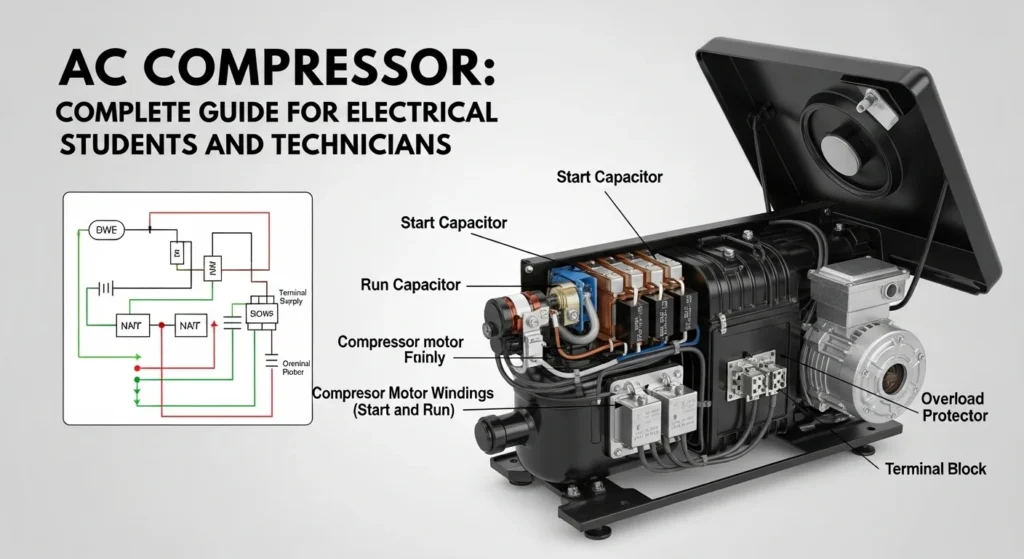
An AC compressor is a mechanical device used in air conditioning systems to compress refrigerant gas and circulate it through the system.
Simple Explanation
It increases the pressure and temperature of the refrigerant, allowing heat to be removed from indoor air and released outside.
Practical Example
In a split AC system:
- The compressor takes low-pressure refrigerant gas
- It compresses it into high-pressure gas
- This gas moves to the condenser for heat release
3. Working Principle of AC Compressor
The AC compressor working principle is based on compression and circulation of refrigerant.
Step-by-Step Working
- Refrigerant enters the compressor as low-pressure gas
- The compressor compresses the gas
- Pressure and temperature increase
- High-pressure gas moves to the condenser
- Heat is released outside
- Refrigerant returns to repeat the cycle
Key Points
- Compression increases energy level of refrigerant
- Continuous circulation ensures cooling
Easy Analogy
Think of a bicycle pump:
- When you press it, air gets compressed
- Pressure increases
Similarly, the compressor compresses refrigerant to make cooling possible.
4. Types / Classification of AC Compressor
Different types of compressors are used based on application and design.
1. Reciprocating Compressor
A reciprocating compressor is a mechanical device used to compress air or gas by reducing its volume using a piston inside a cylinder. It works on the same principle as an internal combustion engine, where a piston moves back and forth (reciprocating motion) to compress the gas. This type of compressor is widely used in industries, workshops, refrigeration systems, and pneumatic tools. The working principle of a reciprocating compressor is based on Boyle’s Law, which states that pressure of a gas increases when its volume decreases at constant temperature.
A reciprocating compressor mainly consists of a cylinder, piston, crankshaft, connecting rod, suction valve, and discharge valve. When the piston moves downward, a vacuum is created inside the cylinder, and the suction valve opens, allowing air or gas to enter. This is called the suction stroke. When the piston moves upward, the volume decreases, compressing the gas inside the cylinder. Once the pressure becomes higher than the outlet pressure, the discharge valve opens, and compressed gas is released. This process repeats continuously to produce a steady supply of compressed air.
One of the main advantages of a reciprocating compressor is its ability to produce high-pressure air efficiently. It is suitable for both small and medium-scale applications and can handle different types of gases. It is also reliable and has a simple operating principle. These compressors are commonly used in air conditioning systems, refrigeration plants, gas pipelines, and industrial manufacturing processes.
However, there are some disadvantages. Reciprocating compressors produce vibration and noise due to the piston movement. They also require regular maintenance because of moving parts like valves and pistons that experience wear and tear. Additionally, they are not suitable for very large flow rates compared to other compressor types.
Overall, a reciprocating compressor is a powerful and widely used machine for gas compression. Its simple design, high-pressure capability, and versatility make it an important equipment in many industrial and mechanical applications.
- Uses piston and cylinder
- Common in small systems
Features:
- Strong and reliable
- Suitable for domestic AC
2. Rotary Compressor
A rotary compressor is a type of compressor that compresses air or gas using rotating motion instead of a piston. It works continuously and smoothly, making it more efficient and quieter compared to reciprocating compressors. Rotary compressors are widely used in air conditioning systems, refrigeration units, industrial plants, and pneumatic tools. The working principle of a rotary compressor is based on Boyle’s Law, which states that when the volume of a gas decreases, its pressure increases.
In a rotary compressor, compression is achieved by rotating components such as vanes, screws, or lobes inside a casing. There are different types of rotary compressors, including rotary vane compressors, screw compressors, and scroll compressors. In a rotary vane compressor, a rotor with sliding vanes rotates inside a cylindrical chamber. As the rotor turns, the vanes trap air and gradually reduce its volume, increasing pressure before discharging it. In screw compressors, two helical rotors mesh together to compress the gas as it moves along the screw length.
One of the main advantages of rotary compressors is smooth and continuous airflow. Unlike piston compressors, they do not have strong vibrations or pulsations, making them quieter and more stable. They are also compact, energy-efficient, and suitable for continuous operation. Because of fewer moving parts, rotary compressors require less maintenance and have a longer service life.
However, there are some limitations. Rotary compressors are generally more expensive than simple reciprocating types. They may also require precise manufacturing and high-quality lubrication to operate efficiently. In some cases, they are not suitable for very high-pressure applications compared to piston-based systems.
Overall, a rotary compressor is a highly efficient and reliable machine for gas compression. Its smooth operation, low noise, and continuous performance make it ideal for modern industrial and commercial applications, especially where steady and efficient air supply is required.
- Uses rotating mechanism
- Compact design
Features:
- Smooth operation
- Low noise
3. Scroll Compressor
A scroll compressor is a type of positive displacement compressor used to compress air or refrigerant in a smooth and efficient way. It is widely used in air conditioning systems, heat pumps, refrigerators, and modern HVAC applications. The working principle of a scroll compressor is based on Boyle’s Law, which states that when the volume of a gas decreases, its pressure increases.
A scroll compressor consists of two spiral-shaped components called scrolls. One scroll is fixed (stationary scroll), while the other moves in an orbiting motion (orbiting scroll). When the compressor operates, gas enters from the outer edges of the scrolls. As the orbiting scroll moves, it traps the gas pockets and gradually pushes them toward the center. During this movement, the volume of the gas continuously decreases, causing compression. Finally, the highly compressed gas is discharged from the center outlet.
One of the main advantages of a scroll compressor is its smooth and quiet operation. Since it does not use pistons or valves, vibration and noise levels are very low. It also has fewer moving parts, which makes it highly reliable and reduces maintenance requirements. Scroll compressors are also known for high efficiency, especially in air conditioning and refrigeration systems, because they provide continuous and steady compression without pulsations.
Another benefit is its compact size and lightweight design, making it suitable for residential and commercial HVAC units. It also performs well under varying load conditions and offers good energy savings compared to some other compressor types.
However, there are some limitations. Scroll compressors are generally more expensive to manufacture. They also require precise engineering and cannot be easily repaired in case of internal damage. In addition, they are not ideal for very high-pressure industrial applications compared to heavy-duty compressors.
Overall, a scroll compressor is a modern, efficient, and reliable compression system. Its quiet operation, high efficiency, and low maintenance make it a popular choice in air conditioning and refrigeration technology today.
- Uses two spiral-shaped scrolls
- One fixed, one moving
Features:
- High efficiency
- Low vibration
4. Screw Compressor
A screw compressor is a type of positive displacement compressor that uses two rotating helical screws to compress air or gas. It is widely used in industrial applications such as manufacturing plants, power stations, refrigeration systems, and large-scale air supply systems. The working principle of a screw compressor is based on Boyle’s Law, which states that the pressure of a gas increases when its volume decreases.
A screw compressor consists of two main rotors: a male rotor and a female rotor. These rotors are precisely designed and mesh together inside a casing. When the compressor operates, air enters from the inlet side and gets trapped between the rotor grooves. As the rotors rotate, the trapped air moves along the length of the screws, and the space between them gradually decreases. This reduction in volume compresses the air, increasing its pressure. Finally, the compressed air is released through the outlet port.
One of the key advantages of a screw compressor is its continuous and smooth operation. Unlike reciprocating compressors, it does not produce pulsations, making it quieter and more stable. It is also highly efficient for large air demand applications and can operate for long periods without interruption. Screw compressors have fewer moving parts compared to piston compressors, which reduces wear and maintenance requirements. They are also reliable and suitable for heavy-duty industrial use.
Another advantage is their ability to handle large volumes of air at relatively constant pressure. Many screw compressors also come with oil-injected systems that help in cooling, sealing, and lubrication, improving performance and durability. Oil-free screw compressors are also available for applications requiring clean air, such as food processing and pharmaceuticals.
However, there are some disadvantages. Screw compressors are more expensive than simpler compressor types. They also require skilled maintenance and proper lubrication systems for efficient operation. In small-scale applications, they may not be cost-effective.
Overall, a screw compressor is a powerful and efficient machine for continuous air compression. Its durability, smooth operation, and high output capacity make it an essential equipment in modern industrial systems.
- Uses two rotating screws
- Used in large systems
Features:
- Continuous operation
- High capacity
5. Centrifugal Compressor
A centrifugal compressor is a type of dynamic compressor that uses high-speed rotating impellers to increase the pressure of air or gas. It is widely used in large industrial applications such as power plants, gas turbines, oil refineries, and HVAC systems. Unlike positive displacement compressors, it does not trap gas in a fixed volume; instead, it increases gas velocity and then converts that velocity into pressure. The working principle of a centrifugal compressor is based on Bernoulli’s Principle, which explains the relationship between pressure and velocity in a flowing fluid.
A centrifugal compressor consists of an impeller, diffuser, volute casing, and inlet. When the impeller rotates at high speed, air enters through the center (eye) of the impeller. The rotating blades accelerate the air outward due to centrifugal force, increasing its velocity. The high-speed air then enters the diffuser, where its velocity decreases, and kinetic energy is converted into pressure energy. Finally, the compressed air is collected in the volute casing and discharged at high pressure.
One of the main advantages of a centrifugal compressor is its ability to handle very large volumes of air continuously. It operates smoothly with low vibration because there are fewer moving parts compared to reciprocating compressors. It is also highly efficient for large-scale applications and requires less maintenance. Centrifugal compressors are compact for their capacity and are widely used in industries where a continuous and stable air supply is needed.
However, there are some limitations. Centrifugal compressors are not suitable for small-scale applications because they are expensive and designed for high-capacity systems. They also require precise engineering and operate efficiently only within a specific range of flow conditions. At low flow rates, they may suffer from performance issues like surging.
Overall, a centrifugal compressor is a powerful and efficient machine used for large-scale gas compression. Its smooth operation, high capacity, and reliability make it an important component in modern industrial and energy systems.
- Uses high-speed rotating impeller
- Used in industrial plants
Features:
- Very high capacity
- Suitable for large cooling systems
5. Main Components of AC Compressor
1. Motor
- Drives the compressor
- Provides mechanical power
2. Cylinder / Compression Chamber
- Where refrigerant is compressed
3. Piston or Rotating Element
- Performs compression action
4. Valves
- Control refrigerant flow
5. Lubrication System
- Reduces friction
- Improves lifespan
6. Advantages of AC Compressor
The AC compressor advantages and disadvantages are important for understanding performance.
Advantages
- Essential for cooling process
- Improves system efficiency
- Works in different environments
- Reliable and durable
- Supports various AC systems
- Provides continuous operation
7. Disadvantages / Limitations
Disadvantages
- High energy consumption
- Requires regular maintenance
- Can be expensive to repair
- Noise in some types
- Performance affected by improper use
8. Applications of AC Compressor
The AC compressor applications are widely used in different fields.
Home Applications
- Air conditioners
- Refrigerators
Industrial Applications
- Cold storage systems
- Food processing units
- Large HVAC systems
Modern Applications
- Data center cooling
- Automotive air conditioning
- Smart buildings
9. Comparison Section
Difference Between Reciprocating and Rotary Compressor
| Feature | Reciprocating Compressor | Rotary Compressor |
|---|---|---|
| Mechanism | Piston-based | Rotating mechanism |
| Noise Level | Higher | Lower |
| Efficiency | Moderate | High |
| Size | Larger | Compact |
| Maintenance | More | Less |
This shows the difference between reciprocating and rotary compressor clearly.
10. Selection Guide
Choosing the right compressor is important.
For Beginners
- Choose based on room size
- Prefer energy-efficient models
- Check compatibility
For Professionals
- Match system capacity
- Consider load requirements
- Check efficiency ratings
Key Tips
- Choose trusted brands
- Ensure proper installation
- Maintain regularly
11. Common Problems & Solutions
Compressor Not Starting
Solution:
- Check power supply
- Inspect motor
Poor Cooling
Solution:
- Check refrigerant level
- Inspect compressor performance
Overheating
Solution:
- Improve ventilation
- Check load conditions
Noise Issue
Solution:
- Tighten components
- Check internal parts
12. Future Trends
AC compressors are improving with new technology.
Innovations
- Inverter compressors
- Energy-efficient designs
- Smart control systems
Industry Direction
- Eco-friendly refrigerants
- Low power consumption
- Advanced automation
13. Conclusion
The AC compressor is a vital component of any air conditioning system. It compresses refrigerant and ensures proper heat transfer, making cooling possible. Understanding the AC compressor working principle helps in maintaining system efficiency and solving technical problems.
Although it requires maintenance and consumes energy, its importance in modern cooling systems cannot be ignored. With proper knowledge and handling, compressors can provide long-lasting and efficient performance.
For students and technicians, mastering this topic is essential for building strong skills in HVAC and electrical systems.