
Imagine you are working in a factory where heavy metal objects need to be lifted and moved quickly. Instead of using manual force, a machine picks up tons of scrap metal effortlessly using a powerful magnetic force—and then drops it instantly when needed. This is made possible by electromagnets.
Electromagnets are one of the most important inventions in electrical engineering. They are used in everyday devices like electric bells, motors, relays, and even large industrial machines. Unlike permanent magnets, electromagnets can be turned ON and OFF, making them highly useful and controllable.
In this article, you will learn everything about electromagnets in simple and clear language. We will cover the electromagnets working principle, types, components, applications, advantages and disadvantages, and much more. Whether you are a beginner or an engineering student, this guide will help you understand the concept deeply and practically.
What is an Electromagnet?
An electromagnet is a type of magnet that produces a magnetic field when electric current flows through it.
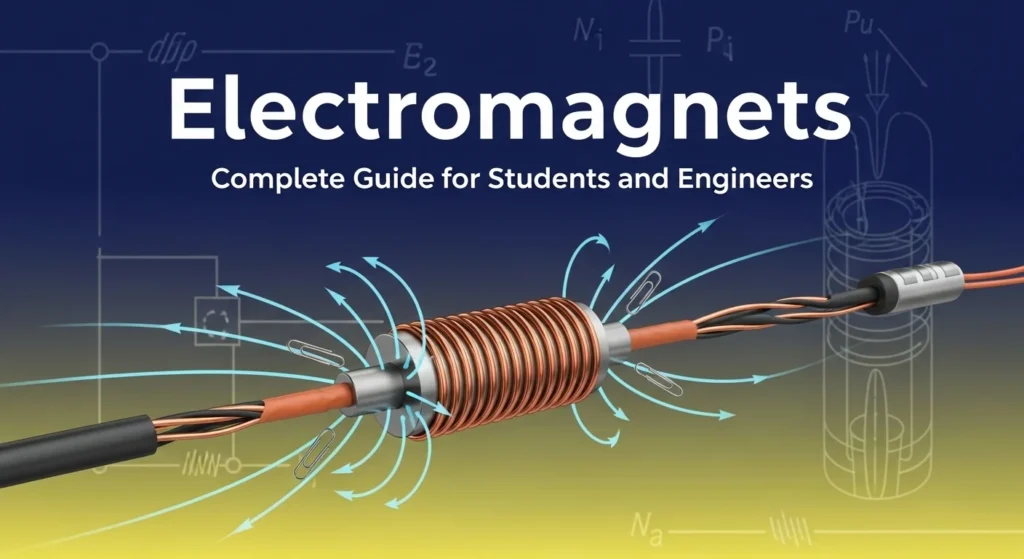
In simple words, when electricity passes through a wire coil, it creates a magnetic field around it. If we place an iron core inside this coil, the magnetic effect becomes much stronger. This combination is called an electromagnet.
Practical Example
A simple example is an electric doorbell. When you press the button, current flows through a coil, creating a magnetic field that pulls a metal striker to produce sound.
Working Principle of Electromagnets
The electromagnets working principle is based on the relationship between electricity and magnetism.
When current flows through a conductor, it produces a magnetic field around it. This phenomenon is known as electromagnetism.
Step-by-Step Working
- Electric current flows through a wire
- The wire generates a magnetic field
- The wire is shaped into a coil to strengthen the field
- An iron core is placed inside the coil
- The magnetic field becomes stronger due to the core
- When current stops, the magnetic field disappears
Simple Analogy
Think of it like a water pipe. The flow of water is like electric current, and the pressure created is like the magnetic field. More flow means more pressure—just like more current means a stronger magnetic field.
Types of Electromagnets
Electromagnets can be classified into different types based on their design and application.
DC Electromagnets
These operate using direct current (DC). They produce a steady and constant magnetic field.
Uses:
- Relays
- Electric bells
- Magnetic locks
AC Electromagnets
These work with alternating current (AC), where the magnetic field changes direction continuously.
Uses:
- Transformers
- AC motors
Superconducting Electromagnets
These are high-power electromagnets that use superconductors to carry current without resistance.
Uses:
- MRI machines
- Particle accelerators
Temporary Electromagnets
These work only when current is flowing.
Uses:
- Cranes for lifting scrap metal
Main Components of Electromagnets
Understanding the components helps in better design and troubleshooting.
Coil (Wire)
A copper wire wound in the form of a coil is the main part. It carries the electric current.
Core
Usually made of soft iron, the core increases the strength of the magnetic field.
Power Source
Provides electrical energy required for current flow.
Insulation
Prevents short circuits and protects the coil.
Advantages of Electromagnets
Electromagnets offer several practical benefits:
- Can be turned ON and OFF easily
- Magnetic strength can be controlled
- Stronger than permanent magnets in many cases
- Safe and flexible for different applications
- Widely used in automation and machines
Disadvantages / Limitations
Despite many benefits, there are some limitations:
- Requires continuous power supply
- Generates heat during operation
- Can fail during power outage
- Energy consumption can be high
- Not suitable for all permanent applications
Applications of Electromagnets
Electromagnets applications are vast and found in many fields.
Home Applications
- Electric doorbells
- Speakers and headphones
- Relays and switches
Industrial Applications
- Lifting cranes in scrap yards
- Electric motors
- Generators
Medical Applications
- MRI machines
- Medical imaging devices
Modern Technology
- Maglev trains
- Robotics
- Automation systems
Comparison: Electromagnet vs Permanent Magnet
| Feature | Electromagnet | Permanent Magnet |
|---|---|---|
| Power Requirement | Needs electricity | No electricity needed |
| Control | Can be controlled | Cannot be controlled |
| Strength | Adjustable | Fixed |
| ON/OFF Function | Yes | No |
| Applications | Machines, devices | Simple uses |
Difference between electromagnet and permanent magnet:
Electromagnets depend on electric current, while permanent magnets do not require any external power.
Selection Guide
Choosing the right electromagnet depends on your application.
Tips for Beginners
- Select proper voltage rating
- Choose suitable core material
- Check required magnetic strength
- Consider heat and cooling needs
- Ensure safety and insulation
For industrial use, always go for high-quality materials and proper design.
Common Problems & Solutions
Why is my electromagnet weak?
- Low current supply
- Poor coil winding
- Weak core material
Solution: Increase current or improve coil design.
Why is it overheating?
- Excess current
- Poor insulation
Solution: Use proper wire thickness and insulation.
Why is it not working?
- Broken circuit
- Power supply issue
Solution: Check wiring and voltage source.
Future Trends
Electromagnets are evolving with technology.
New Developments
- Energy-efficient electromagnets
- Advanced superconducting materials
- Use in renewable energy systems
- Integration with smart grids
Industry Direction
The future will see more compact, powerful, and efficient electromagnets used in robotics, AI systems, and automation.
Conclusion
Electromagnets are a key part of modern electrical and electronic systems. From simple devices like doorbells to advanced machines like MRI scanners, their applications are everywhere. The ability to control magnetic fields using electricity makes them extremely useful and flexible.
Understanding the electromagnets working principle, types, and applications helps students and engineers design better systems. While they have some limitations like power dependency, their advantages far outweigh the drawbacks.
As technology continues to grow, electromagnets will play an even bigger role in innovation and industrial development. Keep learning and exploring this important topic to strengthen your engineering knowledge.