
Imagine you are working on an electrical panel in a factory, and suddenly a machine stops working due to insulation failure. This kind of issue is common in electrical systems, and if not detected early, it can lead to serious damage, electric shocks, or even fire hazards. This is where a Digital Insulation Tester becomes an essential tool for electricians and engineers.
A digital insulation tester helps measure the insulation resistance of cables, motors, transformers, and other electrical equipment. It ensures that current flows safely without leakage. In modern electrical systems, safety and reliability are very important, and insulation testing plays a key role in maintaining both.
In this article, you will learn what a digital insulation tester is, how it works, its types, components, advantages, disadvantages, applications, and how to select the right one. This guide is designed to help beginners as well as professionals understand the concept clearly and practically.
What is a Digital Insulation Tester?
A Digital Insulation Tester is an electrical instrument used to measure the resistance of insulation in electrical systems. It checks whether the insulation around wires and equipment is strong enough to prevent leakage current.
In simple words, it tells you how good the insulation is.
Practical Example
For example, if you test a cable and the insulation resistance is very high (in megaohms), it means the insulation is good. If the value is low, it means there is leakage or damage.
Digital Insulation Tester Working Principle
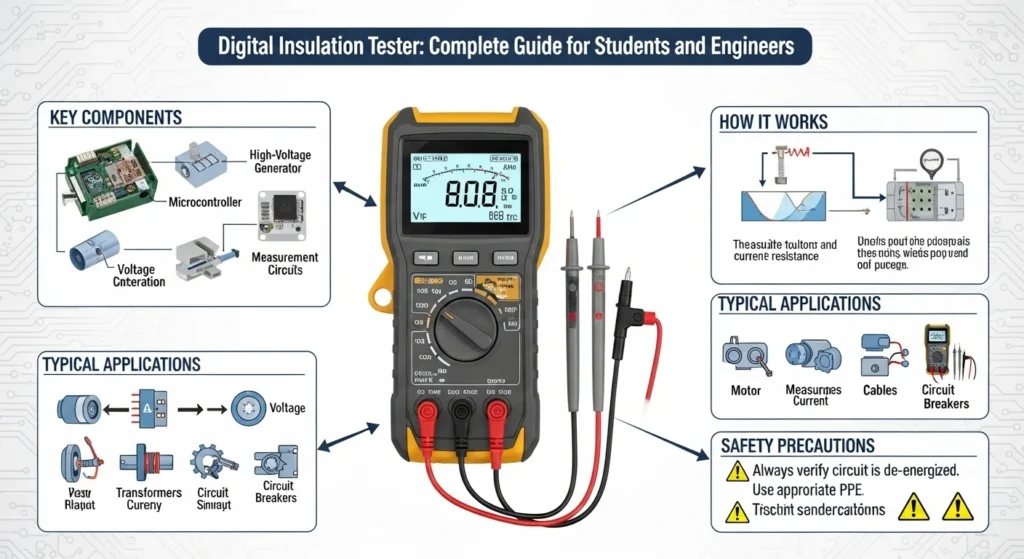
The digital insulation tester working principle is based on applying a high DC voltage and measuring the resistance of insulation.
Step-by-Step Working
- The tester generates a high DC voltage (like 250V, 500V, or 1000V)
- This voltage is applied across the insulation
- A very small current flows through the insulation
- The device measures this current
- Using Ohm’s Law, it calculates resistance:
[
R = \frac{V}{I}
]
Simple Analogy
Think of insulation like a wall and current like water. A strong wall does not allow water to pass, while a weak wall leaks. Similarly, good insulation blocks current flow.
Types of Digital Insulation Testers
Handheld Digital Insulation Tester
- Small and portable
- Used for fieldwork and maintenance
- Easy to carry and operate
Bench-Type Insulation Tester
- Larger and more accurate
- Used in laboratories and testing centers
- Provides detailed analysis
Battery-Operated Tester
- Works on internal batteries
- Useful in remote areas
- No external power required
Multi-Function Tester
- Combines insulation testing with other measurements
- Can measure voltage, continuity, and resistance
- Ideal for professional electricians
Main Components of Digital Insulation Tester
DC Voltage Generator
- Produces high test voltage
- Essential for testing insulation strength
Display Unit
- Shows readings digitally
- Easy to read and accurate
Measuring Circuit
- Measures leakage current
- Calculates insulation resistance
Test Leads (Probes)
- Connect the tester to the equipment
- Ensure proper contact
Control Buttons
- Used to select voltage and functions
- Simple user interface
Digital Insulation Tester Advantages
- High accuracy and reliable readings
- Easy to use with digital display
- Portable and lightweight
- Improves electrical safety
- Detects faults early
- Suitable for various equipment
Digital Insulation Tester Disadvantages
- More expensive than analog testers
- Requires battery power
- Sensitive to environmental conditions
- Needs proper handling and calibration
Digital Insulation Tester Applications
The digital insulation tester applications are very wide in electrical and industrial fields.
Home Use
- Checking house wiring
- Testing appliances insulation
Industrial Use
- Motors and generators testing
- Transformer insulation testing
- Cable insulation measurement
Modern Technology
- Renewable energy systems
- Electric vehicles
- Smart grid systems
Comparison: Digital vs Analog Insulation Tester
| Feature | Digital Insulation Tester | Analog Insulation Tester |
|---|---|---|
| Accuracy | High | Medium |
| Display | Digital screen | Needle type |
| Ease of Use | Easy | Requires experience |
| Portability | High | Medium |
| Cost | Higher | Lower |
Difference between digital and analog insulation tester is mainly in accuracy, usability, and features.
Selection Guide: How to Choose the Right Tester
Choosing the right insulation tester is very important.
Key Factors to Consider
- Voltage range (250V, 500V, 1000V)
- Measurement range (Megaohms to Gigaohms)
- Safety rating (CAT rating)
- Brand and quality
- Battery life
- Additional features
Beginner Tips
- Start with a basic handheld model
- Choose easy-to-read display
- Always check safety certifications
Common Problems & Solutions
Low Insulation Reading
Cause: Moisture or damaged insulation
Solution: Dry the equipment or replace insulation
No Reading Display
Cause: Battery issue
Solution: Replace or recharge battery
Fluctuating Values
Cause: Poor connection
Solution: Check test leads and connections
Device Not Powering On
Cause: Internal fault
Solution: Service or repair the tester
Future Trends in Insulation Testing
The future of insulation testing is becoming more advanced and digital.
- Smart testers with Bluetooth connectivity
- Data logging and cloud storage
- Integration with IoT systems
- AI-based fault detection
- Wireless testing technology
These innovations will make testing faster, safer, and more accurate.
Conclusion
A Digital Insulation Tester is an essential tool for ensuring electrical safety and system reliability. It helps detect insulation faults before they become dangerous problems. From simple home wiring to complex industrial systems, insulation testing plays a vital role.
Understanding the digital insulation tester working principle, types, components, and applications allows engineers and technicians to use this tool effectively. While it has some limitations, its advantages make it a must-have device in modern electrical work.
As technology continues to evolve, insulation testers will become smarter and more efficient, helping professionals maintain safe and reliable electrical systems. Learning how to use and select the right tester is a valuable skill for every electrical student and engineer.