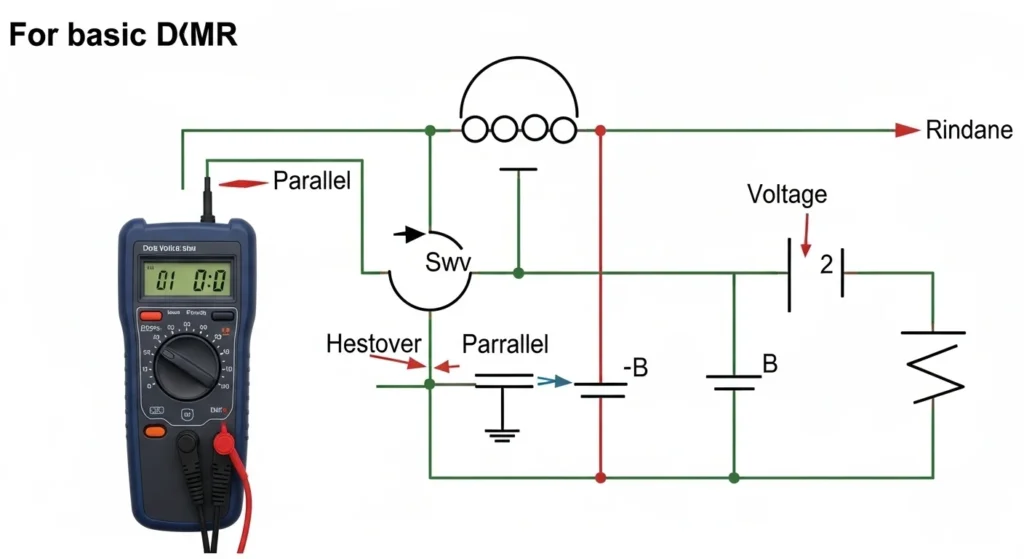

Imagine you are about to repair a faulty switchboard at home or in an industrial panel. You assume the power is off, but a hidden live wire can cause a serious electric shock. This is where a voltage detector becomes your first line of safety. It helps you quickly check whether a wire or device is live before touching it.
In electrical work, safety is not optional—it is essential. A voltage detector is a simple yet powerful tool that prevents accidents, protects equipment, and saves lives. Whether you are a beginner, technician, or experienced engineer, understanding how to use this tool properly is critical.
In this article, you will learn everything about voltage detectors, including their definition, voltage detector working principle, types, components, applications, advantages and disadvantages, and how to select the right one. By the end, you will have a clear and practical understanding of how voltage detectors are used in real-world electrical systems.
What is a Voltage Detector? Complete Guide (2026)
Definition of a Voltage Detector
A voltage detector is an electrical testing tool used to determine whether electrical voltage is present or absent in a wire, cable, outlet, switch, circuit, or electrical equipment. It helps identify whether a circuit is live (energized) or dead (de-energized) before maintenance, troubleshooting, or repair work.
Voltage detectors are among the most important safety tools for electricians, engineers, technicians, and DIY users because they help reduce the risk of electric shock and ensure that electrical systems can be serviced safely.
Simple Explanation
In simple terms, a voltage detector works as a safety tester. It checks whether electricity is flowing through a conductor or electrical device.
When the detector is brought close to a live wire—or touches it, depending on the type—it detects the presence of voltage and alerts the user through an LED light, audible buzzer, vibration, or digital display. If no voltage is detected, the device indicates that the circuit is likely de-energized, making it safer to begin electrical work.
Practical Example
Suppose you need to replace a wall switch or repair a power outlet. Before touching any wires, you first use a voltage detector to test the circuit.
- If the detector lights up, beeps, or displays a voltage reading, the circuit is still live and should not be handled until the power is turned off.
- If the detector shows no voltage, the circuit has likely been de-energized and is much safer to work on.
This simple safety check helps prevent accidental electric shock and protects both the user and electrical equipment.
Voltage Detector Working Principle (2026)
How Does a Voltage Detector Work?
The working principle of a voltage detector is based on detecting electrical voltage or the electromagnetic field produced by an energized conductor. Depending on the type of voltage detector, it may detect voltage without touching the conductor (non-contact type) or by making direct electrical contact (contact type).
When voltage is present, the detector senses the electrical signal, processes it using internal electronic circuitry, and provides a visual, audible, or digital indication to inform the user.
Step-by-Step Working Process
The operation of a voltage detector can be explained in the following steps:
Step 1: Position the Detector
Place the voltage detector near or on the electrical conductor, outlet, cable, or device you want to test.
Step 2: Voltage Detection
If the conductor is energized, it produces an electric field or electrical potential. The detector’s sensor identifies this voltage.
Step 3: Signal Processing
The internal electronic circuit analyzes the detected electrical signal to determine whether voltage is present.
Step 4: User Indication
Once voltage is detected, the detector alerts the user through one or more of the following:
- LED indicator light
- Audible buzzer
- Vibration alert
- Digital LCD display
Step 5: Safe Decision Making
Based on the detector’s indication, the user can determine whether the circuit is live or de-energized before performing electrical work.
Easy Analogy
A voltage detector works much like a metal detector.
A metal detector senses the presence of metal without needing to touch it directly. Similarly, a non-contact voltage detector senses the electric field around a live conductor without making direct electrical contact.
This ability allows electricians to quickly and safely identify energized wires while minimizing the risk of electric shock.
Key Points About the Working Principle
Improves safety during electrical installation, maintenance, and troubleshooting.
Detects the presence or absence of electrical voltage.
Works by sensing an electric field or direct electrical contact.
Internal electronic circuitry processes the detected signal.
Provides clear visual, audible, vibration, or digital indications.
Helps identify live and dead circuits safely.
Types / Classification of Voltage Detectors
Non-Contact Voltage Detector: Complete Guide (2026)
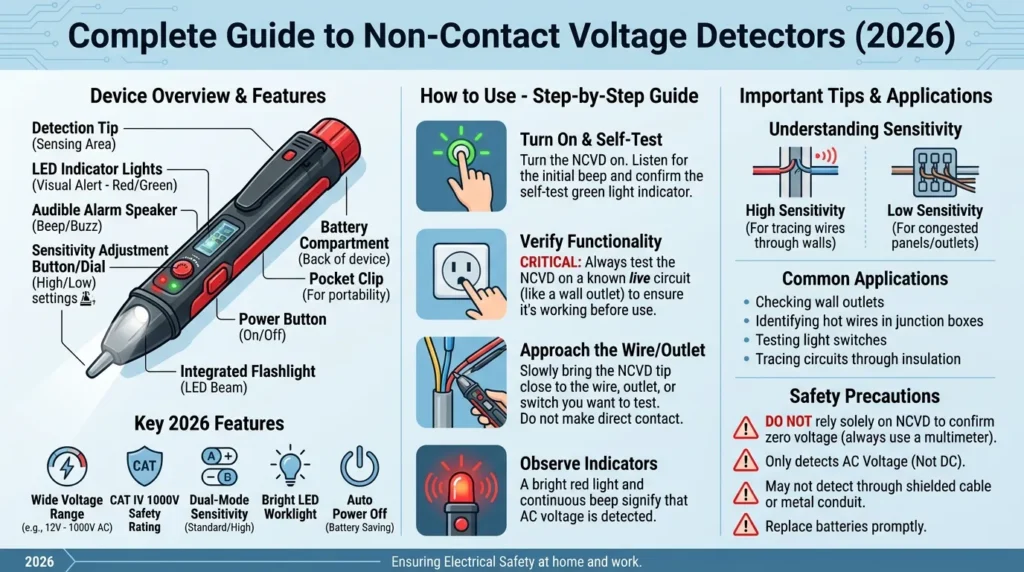
A Non-Contact Voltage Detector (NCVD) is an electrical testing tool that detects the presence of AC voltage without making direct contact with a wire, terminal, or electrical conductor. It works by sensing the electromagnetic (electric) field produced around an energized conductor, allowing users to determine whether a circuit is live safely and quickly.
Because it does not require direct contact with exposed conductors, a non-contact voltage detector is considered one of the safest tools for electricians, technicians, engineers, and homeowners. It is widely used during electrical installation, maintenance, troubleshooting, and safety inspections.
How Does a Non-Contact Voltage Detector Work?
A non-contact voltage detector operates by detecting the electric field surrounding an energized AC conductor.
When the detector’s sensing tip is brought close to a live wire, outlet, switch, or cable, it detects the alternating electric field generated by the AC voltage. The internal electronic circuit processes this signal and immediately alerts the user using an LED light, audible buzzer, vibration, or a combination of these indicators.
Since the detector senses the electric field instead of touching the conductor, there is no need for direct electrical contact during testing, making the process safer and faster.
Working Process
The operation of a non-contact voltage detector can be explained in the following steps:
- Bring the detector close to an electrical wire, socket, switch, or cable.
- If AC voltage is present, an electric field surrounds the energized conductor.
- The detector’s sensor picks up this electric field.
- The internal electronic circuitry analyzes the detected signal.
- The detector indicates the presence of voltage through:
- LED indicator light
- Audible buzzer
- Vibration alert (on some models)
- If no indication is given, the conductor is likely de-energized or outside the detector’s detection range.
Main Features of a Non-Contact Voltage Detector
- Detects AC voltage without touching the conductor.
- Provides fast and reliable voltage detection.
- Uses electric field sensing technology.
- Reduces the risk of electric shock.
- Lightweight, portable, and easy to operate.
- Suitable for quick safety inspections.
- Available with LED, buzzer, vibration, or LCD indicators.
- Requires minimal training to use.
Applications of a Non-Contact Voltage Detector
Non-contact voltage detectors are widely used in residential, commercial, and industrial electrical work.
Common applications include:
- Checking live wires before repair work.
- Testing wall sockets and electrical outlets.
- Identifying energized circuit breakers.
- Verifying power before replacing switches or light fixtures.
- Inspecting extension cords and power cables.
- Troubleshooting electrical faults.
- Routine electrical maintenance.
- Safety inspections in homes, offices, and factories.
Advantages of a Non-Contact Voltage Detector
- Safer because there is no direct contact with live conductors.
- Quick and easy to use.
- Portable and lightweight.
- Reduces the risk of accidental electric shock.
- Ideal for preliminary voltage checks.
- Suitable for beginners as well as professional electricians.
- Saves time during electrical troubleshooting.
Disadvantages of a Non-Contact Voltage Detector
- Typically detects AC voltage only and is not suitable for most DC voltage testing.
- Does not measure the exact voltage value.
- May produce false indications in areas with strong electromagnetic interference.
- Detection sensitivity varies between different models.
- Should not be used as the only method to verify that a circuit is completely de-energized before working on it.
Example of a Non-Contact Voltage Detector
Suppose you want to replace a ceiling light. Before touching the wires, hold the non-contact voltage detector near the electrical cable.
- If the detector lights up or beeps, the wire is still live, and you should switch off the power before proceeding.
- If there is no indication, the circuit is likely de-energized, making it safer to continue the work.
A Non-Contact Voltage Detector is an essential electrical safety tool that detects the presence of AC voltage without direct contact with a conductor. Using electric field sensing technology, it quickly identifies energized circuits and alerts the user through light, sound, or vibration. Its speed, convenience, and enhanced safety make it one of the most commonly used testing devices for household wiring, commercial electrical systems, and industrial maintenance.
Contact Voltage Tester: Complete Guide (2026)
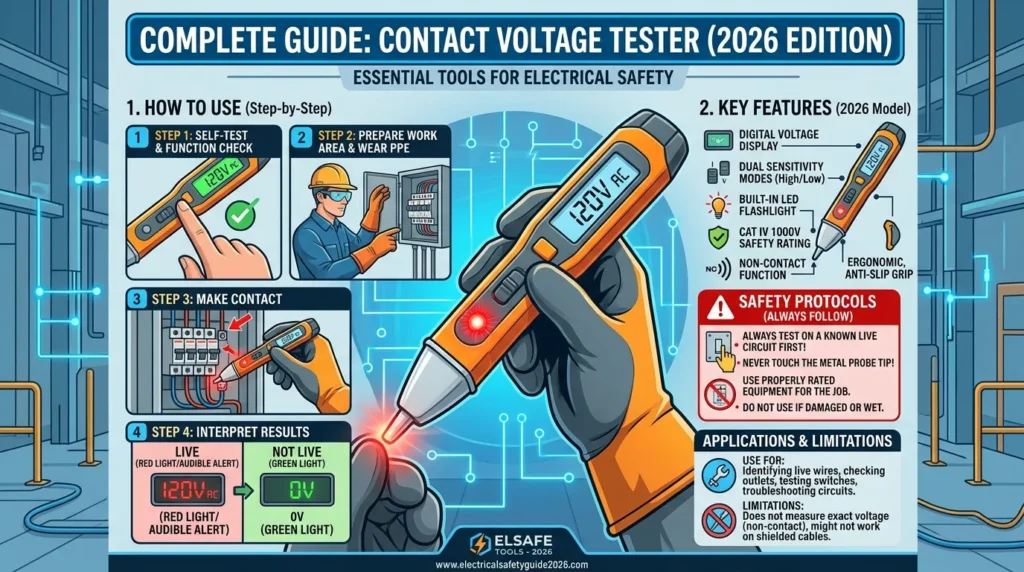
A Contact Voltage Tester is an electrical testing instrument that requires direct contact with an electrical conductor, terminal, outlet, or circuit to detect and measure the presence of voltage. Unlike a Non-Contact Voltage Detector, which senses an electric field from a distance, a contact voltage tester physically touches the electrical point being tested to provide more accurate and reliable results.
Contact voltage testers are widely used by professional electricians, electrical engineers, maintenance technicians, and industrial personnel for electrical installation, troubleshooting, commissioning, and maintenance work.
How Does a Contact Voltage Tester Work?
A contact voltage tester operates by making direct electrical contact with the conductor or terminal.
When the tester’s probe touches a live electrical point, electrical voltage enters the tester through the probe. The internal electronic circuitry analyzes the voltage and then displays the result using an LED indicator, digital display, analog meter, or audible signal.
Depending on the model, the tester can indicate whether voltage is present or measure the exact voltage level.
Working Process
The operation of a contact voltage tester can be explained in the following steps:
- Place the test probe on the conductor, terminal, outlet, or electrical equipment.
- The tester makes direct electrical contact with the energized circuit.
- The internal circuit detects the applied voltage.
- The tester processes the electrical signal.
- The measured voltage is indicated through:
- Digital LCD display
- LED indicators
- Analog scale (on some models)
- Audible buzzer
The user can then determine whether the circuit is energized and, in many cases, read the actual voltage value.
Main Features of a Contact Voltage Tester
- Requires direct contact with the conductor or terminal.
- Provides highly accurate voltage detection.
- Measures actual voltage levels on many models.
- Suitable for both AC and DC voltage testing (depending on the tester).
- Fast and reliable measurements.
- Available in digital and analog versions.
- Designed for professional electrical applications.
Applications of a Contact Voltage Tester
Contact voltage testers are commonly used in residential, commercial, and industrial electrical work.
Common applications include:
- Measuring AC and DC voltage.
- Testing electrical outlets and sockets.
- Checking switchboards and distribution panels.
- Troubleshooting electrical faults.
- Verifying power before equipment maintenance.
- Testing motors, transformers, and control panels.
- Inspecting batteries and power supplies.
- Commissioning new electrical installations.
Advantages of a Contact Voltage Tester
- Provides more accurate and reliable results than non-contact testers.
- Measures actual voltage values on many models.
- Suitable for testing both AC and DC circuits.
- Ideal for professional troubleshooting and maintenance.
- Helps identify voltage levels precisely.
- Reliable for industrial and commercial electrical systems.
Disadvantages of a Contact Voltage Tester
- Requires direct contact with live electrical conductors.
- Higher risk of electric shock if used improperly.
- Requires appropriate personal protective equipment (PPE).
- Takes slightly longer to use than non-contact testers.
- Not as convenient for quick preliminary voltage checks.
Example of a Contact Voltage Tester
Suppose an electrician needs to test the output voltage of a circuit breaker inside a distribution panel.
The electrician places the tester probes directly on the live and neutral terminals. The tester measures the voltage and displays 230 V AC, confirming that the circuit is energized and operating correctly.
This direct measurement provides more accurate information than a non-contact voltage detector.
A Contact Voltage Tester is a professional electrical testing tool that requires direct contact with a conductor or terminal to detect and measure electrical voltage. It provides accurate, reliable, and often precise voltage readings, making it ideal for electrical installation, troubleshooting, maintenance, and industrial applications. Although it requires greater care during use, its accuracy and versatility make it an essential instrument for professional electricians and engineers.
Neon Voltage Tester: Complete Guide (2026)
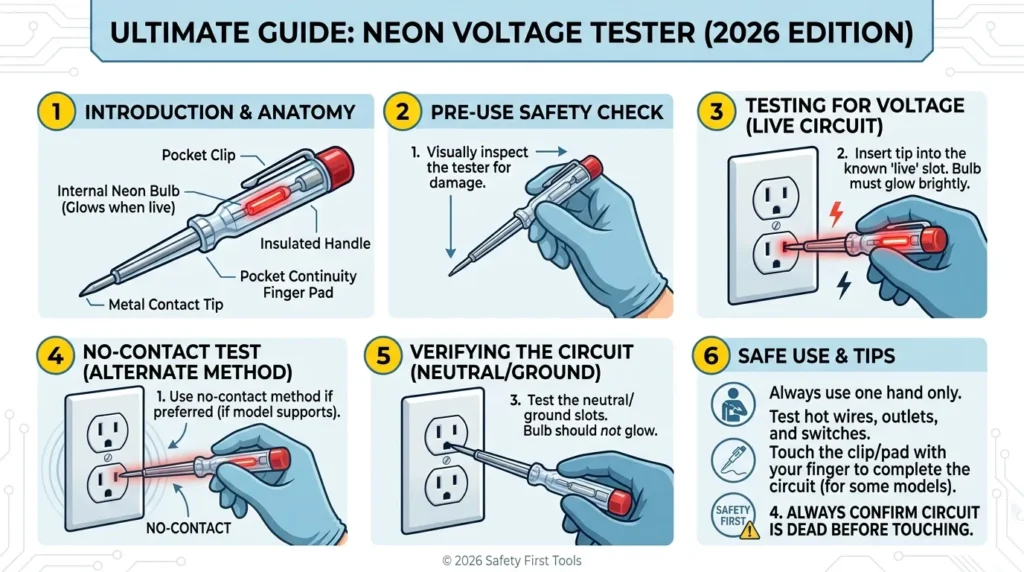
A Neon Voltage Tester is a simple handheld electrical testing tool that uses a small neon lamp to indicate the presence of electrical voltage. It is one of the oldest and most widely used voltage testers for quickly checking whether an electrical conductor, outlet, switch, or terminal is live (energized).
When the tester comes into contact with a live conductor, the neon lamp inside the tester glows, indicating that voltage is present. Due to its simple design, compact size, and low cost, the neon voltage tester is commonly used for basic electrical testing in homes, workshops, and light maintenance work.
How Does a Neon Voltage Tester Work?
The working principle of a neon voltage tester is based on the ionization of neon gas inside a small glass lamp.
When the metal tip of the tester touches a live conductor and the user places a finger on the tester’s contact cap (for models designed this way), a very small current flows through a high-value resistor and the neon lamp. This tiny current is enough to ionize the neon gas, causing the lamp to glow.
The glowing neon light indicates that electrical voltage is present in the conductor.
Working Process
The operation of a neon voltage tester can be explained in the following steps:
- Touch the tester’s metal tip to the conductor, terminal, or electrical outlet.
- Place your finger on the contact cap at the end of the tester (if required by the design).
- If voltage is present, a very small current flows through the tester.
- The neon gas inside the lamp becomes ionized.
- The neon lamp lights up, indicating that the circuit is energized.
- If the lamp does not glow, the circuit is likely de-energized or the voltage is below the tester’s operating range.
Main Features of a Neon Voltage Tester
- Simple and compact design.
- Uses a neon lamp as the voltage indicator.
- Quickly detects the presence of AC voltage.
- Lightweight and easy to carry.
- Does not require batteries.
- Easy to operate for basic electrical testing.
- Suitable for household and light electrical maintenance.
Applications of a Neon Voltage Tester
Neon voltage testers are commonly used for:
- Checking live electrical wires.
- Testing wall sockets and outlets.
- Identifying the live terminal in electrical circuits.
- Inspecting switches and light fittings.
- Basic household electrical maintenance.
- Quick troubleshooting of simple electrical faults.
Advantages of a Neon Voltage Tester
- Low cost and widely available.
- Simple and reliable construction.
- Does not require batteries or external power.
- Lightweight and portable.
- Easy to use for basic voltage detection.
- Ideal for quick checks in residential electrical systems.
Disadvantages of a Neon Voltage Tester
- Indicates only the presence of voltage; it does not measure the exact voltage value.
- Less accurate than digital voltage testers or multimeters.
- Generally suitable for AC voltage testing only.
- Requires direct contact with the conductor.
- Should not be relied upon as the sole method for confirming that a circuit is safe to work on.
Example of a Neon Voltage Tester
Suppose you want to identify the live terminal of a wall socket before replacing it.
You touch the tester’s metal tip to one terminal while placing your finger on the contact cap. If the neon lamp glows, it indicates that the terminal is live. If the lamp remains off, the tested terminal is either neutral, de-energized, or outside the tester’s operating range.
A Neon Voltage Tester is a simple, affordable, and easy-to-use electrical testing tool that uses a neon lamp to detect the presence of voltage. It is widely used for quick voltage checks in household electrical systems and basic maintenance tasks. Although it cannot measure the exact voltage and is less advanced than digital testers, its simplicity, portability, and reliability make it a useful tool for basic electrical testing.
Digital Voltage Detector: Complete Guide (2026)
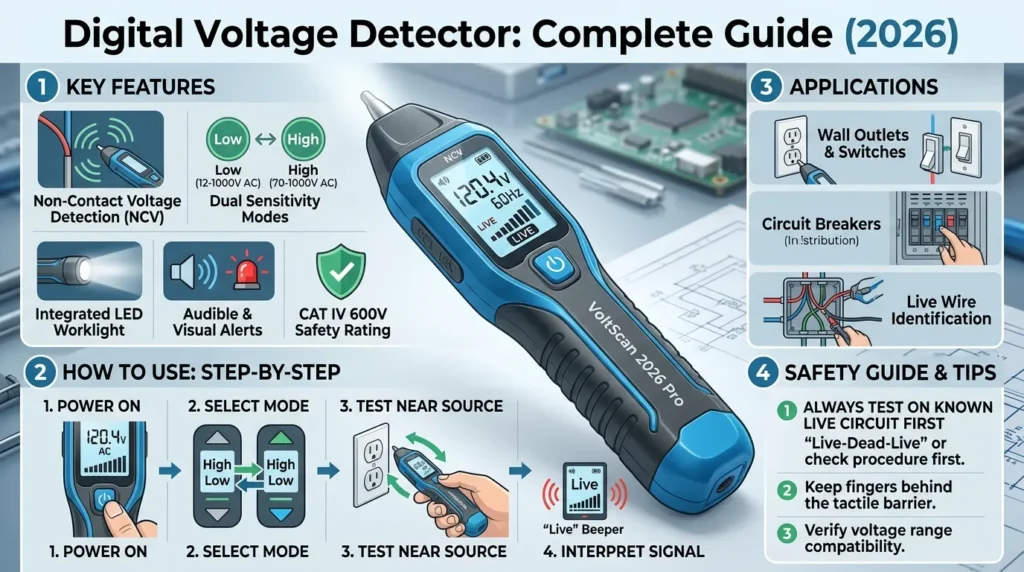
A Digital Voltage Detector is an advanced electrical testing instrument that detects and measures electrical voltage with high accuracy. Unlike traditional voltage testers that only indicate whether voltage is present, a digital voltage detector displays the actual voltage value on an LCD or LED screen, allowing users to obtain precise measurements.
Digital voltage detectors are widely used by electricians, electrical engineers, maintenance technicians, and industrial professionals for electrical installation, troubleshooting, testing, and preventive maintenance. They are suitable for measuring both Alternating Current (AC) and Direct Current (DC) voltage, depending on the model.
How Does a Digital Voltage Detector Work?
A digital voltage detector works by making direct contact with the electrical circuit using its test probes.
When the probes touch the electrical terminals or conductors, the detector senses the voltage present in the circuit. The internal electronic circuitry converts the electrical signal into digital data using an analog-to-digital converter (ADC). The processed value is then displayed on the digital screen, providing an accurate voltage reading.
Many modern digital voltage detectors also include additional functions such as automatic range selection, polarity indication, continuity testing, and overload protection.
Working Process
The operation of a digital voltage detector can be explained in the following steps:
- Connect the test probes to the conductor, terminal, or electrical equipment.
- The detector senses the electrical voltage.
- The internal electronic circuit processes the signal.
- The analog signal is converted into a digital value.
- The exact voltage is displayed on the LCD or LED screen.
- The user reads the voltage and determines the condition of the electrical circuit.
Main Features of a Digital Voltage Detector
- Displays the exact voltage value on a digital screen.
- High measurement accuracy.
- Suitable for both AC and DC voltage testing (depending on the model).
- Easy-to-read LCD or LED display.
- Fast response and reliable measurements.
- Automatic or manual measuring range.
- Compact, lightweight, and portable.
- Built-in overload protection in many models.
- Some models include continuity, resistance, and frequency measurement functions.
Applications of a Digital Voltage Detector
Digital voltage detectors are used in a wide range of electrical applications.
Common applications include:
- Residential electrical installations.
- Commercial building maintenance.
- Industrial electrical systems.
- Power distribution panels.
- Motor control centers (MCCs).
- Electrical substations.
- Generator and transformer testing.
- Renewable energy systems such as solar power installations.
- Electric vehicle (EV) maintenance.
- Electrical troubleshooting and preventive maintenance.
Advantages of a Digital Voltage Detector
- Provides highly accurate voltage measurements.
- Displays the exact voltage value.
- Suitable for professional electrical testing.
- Supports both AC and DC voltage measurement.
- Easy-to-read digital display.
- Fast and reliable operation.
- Improves troubleshooting efficiency.
- Reduces the chance of measurement errors.
Disadvantages of a Digital Voltage Detector
- More expensive than basic voltage testers.
- Requires batteries or an internal power source.
- Sensitive electronic components require careful handling.
- Not ideal for quick, non-contact voltage checks.
- May require periodic calibration for maximum accuracy.
Example of a Digital Voltage Detector
Suppose an electrician is inspecting a distribution panel in a commercial building.
The electrician places the detector’s probes on the live and neutral terminals. The digital display immediately shows 230 V AC, confirming that the circuit is energized and operating within the expected voltage range.
Similarly, a technician can measure the voltage of a 12 V battery, and the display will show the exact DC voltage, helping determine the battery’s condition.
A Digital Voltage Detector is a modern electrical testing device designed to detect and accurately measure electrical voltage. Its digital display provides precise voltage readings, making it far more informative than basic voltage testers. With high accuracy, advanced safety features, and the ability to measure both AC and DC voltage, digital voltage detectors are essential tools for professional electricians, engineers, technicians, and industrial maintenance personnel. They play a vital role in ensuring safe, accurate, and efficient electrical testing across residential, commercial, and industrial applications.
Main Components of a Voltage Detector (2026 Guide)
A voltage detector consists of several important components that work together to detect electrical voltage accurately and safely. Each component has a specific function, from sensing the presence of voltage to displaying the results and protecting the user. Understanding these components helps users operate the device correctly and appreciate how it ensures reliable electrical testing.
1. Sensor
What is the Sensor?
The sensor is the most important component of a voltage detector because it is responsible for detecting the presence of electrical voltage. In non-contact voltage detectors, the sensor detects the electromagnetic (electric) field produced around an energized conductor. In contact voltage testers, the sensor detects voltage through direct electrical contact with the conductor or terminal.
The sensor converts the detected electrical signal into an electronic signal, which is then sent to the internal circuit for processing.
Main Functions
- Detects AC or DC voltage (depending on the detector type).
- Senses the electric field around energized conductors.
- Converts electrical signals into electronic signals.
- Initiates the voltage detection process.
- Ensures fast and reliable voltage detection.
2. Indicator
What is the Indicator?
The indicator is the output component that informs the user whether voltage is present. After the internal circuit processes the detected signal, the indicator provides a clear warning or measurement using visual, audible, or digital methods.
Different voltage detectors use different types of indicators depending on their design and purpose.
Common Types of Indicators
- LED indicator light
- LCD digital display
- Audible buzzer
- Vibration alert
- Neon lamp (in neon voltage testers)
Main Functions
- Shows whether voltage is present or absent.
- Displays the measured voltage value (digital models).
- Provides audible or visual safety warnings.
- Helps users make safe electrical decisions quickly.
- Improves visibility during testing in different environments.
3. Circuit Board (Electronic Circuit)
What is the Circuit Board?
The Circuit Board, also known as the Printed Circuit Board (PCB), is the electronic control center of a voltage detector. It contains various electronic components, including resistors, capacitors, diodes, transistors, integrated circuits (ICs), microcontrollers, and signal-processing chips, which work together to analyze the electrical signal received from the sensor.
After the sensor detects an electric field or voltage, the circuit board processes the signal, filters unwanted electrical noise, determines whether voltage is present, and controls the output indicators such as the LED light, buzzer, vibration motor, or digital display. In modern digital voltage detectors, the PCB also converts analog electrical signals into digital readings, allowing the exact voltage value to be displayed.
The circuit board plays a vital role in ensuring that the voltage detector provides accurate, stable, and reliable results under different working conditions.
Main Functions
- Receives signals from the sensor.
- Processes and analyzes electrical signals.
- Determines whether voltage is present.
- Controls LED indicators, buzzers, vibration alerts, and digital displays.
- Filters electrical noise for improved measurement accuracy.
- Converts analog signals into digital values (digital models).
- Controls the overall operation of the voltage detector.
4. Power Source
What is the Power Source?
The power source supplies the electrical energy required to operate the voltage detector. Most modern voltage detectors are battery-powered, making them portable and convenient for field use. The battery powers the sensor, electronic circuit board, display, alarm system, and other internal components.
Different voltage detectors use different battery types depending on their size and features. Simple non-contact voltage testers often use AAA or AA batteries, while advanced digital models may use coin-cell batteries or rechargeable lithium-ion batteries.
A healthy battery is essential because low battery voltage can reduce the detector’s sensitivity and affect the accuracy of voltage detection. Many advanced detectors include a low-battery indicator to alert users when the battery needs replacement or recharging.
Common Power Sources
- AAA batteries
- AA batteries
- Coin-cell batteries
- Rechargeable lithium-ion batteries
Main Functions
- Supplies power to the electronic circuitry.
- Operates the voltage sensor.
- Powers the LED, buzzer, vibration motor, and display.
- Enables continuous and reliable voltage detection.
- Supports portable operation without external power.
- Maintains consistent detector performance.
5. Protective Casing
What is the Protective Casing?
The protective casing is the durable outer housing that encloses and protects all the internal components of the voltage detector. It is typically manufactured from high-quality insulating plastic, ABS plastic, or impact-resistant polymer materials that provide excellent electrical insulation and mechanical strength.
The casing protects the internal electronics from dust, moisture, accidental drops, and physical damage while also preventing users from accidentally touching live electrical parts. Many professional voltage detectors feature ergonomic, non-slip designs that provide a secure and comfortable grip during electrical testing.
Some industrial-grade voltage detectors also include IP-rated (Ingress Protection) casings that offer additional protection against water and dust, making them suitable for harsh working environments.
Main Functions
- Protects internal electronic components.
- Electrically insulates the user from live circuits.
- Reduces the risk of electric shock.
- Protects against dust, moisture, and impact damage.
- Improves the durability and lifespan of the device.
- Provides a comfortable and non-slip grip.
- Supports safe operation in residential, commercial, and industrial environments.
How the Components of a Voltage Detector Work Together
All the components of a voltage detector work together in a coordinated sequence to detect electrical voltage quickly, accurately, and safely.
Step-by-Step Working Process
Step 1: The sensor detects the electrical voltage or the electromagnetic field around a live conductor.
Step 2: The detected electrical signal is transmitted to the circuit board (PCB).
Step 3: The PCB processes, filters, and analyzes the signal to determine whether voltage is present.
Step 4: The processed information is sent to the indicator, which alerts the user using an LED light, buzzer, vibration, neon lamp, or digital display.
Step 5: The power source (battery) supplies electrical energy to all internal components, ensuring continuous operation.
Step 6: Throughout the entire process, the protective casing safeguards both the internal electronics and the user, reducing the risk of electrical hazards.
This integrated operation enables voltage detectors to provide fast, accurate, and dependable voltage detection for electrical installation, troubleshooting, maintenance, and safety inspections.
The main components of a voltage detector include the sensor, indicator, circuit board (PCB), power source, and protective casing. Each component performs a unique function, from detecting voltage and processing electrical signals to displaying results and protecting the user. Together, these components ensure that voltage detectors operate safely, accurately, and efficiently, making them essential tools for electricians, engineers, technicians, and anyone working with electrical systems.
Voltage Detector Advantages and Disadvantages (2026)
Understanding the advantages and disadvantages of a voltage detector helps users choose the right tool and use it effectively for electrical testing.
Advantages of a Voltage Detector
Voltage detectors offer several important benefits that improve electrical safety and troubleshooting.
- Quickly detects the presence of electrical voltage.
- Helps prevent electric shock by identifying live circuits.
- Easy to use, even for beginners.
- Lightweight, compact, and highly portable.
- Saves time during electrical inspections.
- Suitable for residential, commercial, and industrial applications.
- Reduces the need for direct contact with live wires (non-contact models).
- Available in a wide range of models for different applications.
- Improves workplace safety during maintenance and repairs.
Disadvantages of a Voltage Detector
Despite their usefulness, voltage detectors also have certain limitations.
- Non-contact models may produce false or weak indications in some environments.
- Basic voltage detectors cannot measure the exact voltage value.
- Battery-powered models stop working when the battery is discharged.
- Detection range varies depending on the model and voltage level.
- Not suitable for high-precision electrical measurements.
- Contact voltage testers require direct contact with energized conductors, increasing the need for proper safety precautions.
- Environmental factors such as strong electromagnetic interference can affect performance.
Voltage Detector Applications (2026)
Voltage detectors are widely used in residential, commercial, and industrial electrical systems to improve safety, verify voltage, and assist in troubleshooting.
Home Applications
Voltage detectors are commonly used in households for routine electrical maintenance.
Common home applications include:
- Checking wall sockets and electrical outlets.
- Identifying live and neutral wires.
- Testing switches before replacement.
- Repairing household electrical appliances safely.
- Inspecting extension cords and power strips.
- Verifying that circuits are de-energized before maintenance.
Commercial Applications
In commercial buildings, voltage detectors help ensure safe electrical operation.
Common applications include:
- Office electrical maintenance.
- Shopping malls and retail stores.
- Hotels and hospitals.
- Educational institutions.
- Building electrical inspections.
- Emergency electrical troubleshooting.
Industrial Applications
Professional electricians and maintenance technicians use voltage detectors extensively in industrial environments.
Common industrial applications include:
- Electrical panel maintenance.
- Motor control center (MCC) inspections.
- Distribution board testing.
- Transformer maintenance.
- Generator testing.
- Electrical equipment installation.
- Preventive maintenance programs.
- Troubleshooting electrical faults.
- Lockout/Tagout (LOTO) safety procedures.
Modern Applications
As electrical technology advances, voltage detectors are increasingly used in modern energy and automation systems.
Examples include:
- Smart electrical systems.
- Smart homes and buildings.
- Solar photovoltaic (PV) systems.
- Wind energy installations.
- Electric vehicle (EV) charging stations.
- Battery energy storage systems (BESS).
- Industrial automation and PLC control panels.
- IoT-enabled electrical monitoring systems.
- Renewable energy maintenance and diagnostics.
Voltage detectors have become indispensable tools in today’s electrical industry. From checking household outlets to maintaining high-voltage industrial equipment, they provide a fast, reliable, and safe method of identifying electrical voltage. With advancements in digital technology, modern voltage detectors now offer greater accuracy, enhanced safety features, and broader applications, making them essential instruments for electricians, engineers, technicians, and maintenance professionals.
Comparison Between Contact and Non-Contact Voltage Detectors (2026)
Choosing between a Contact Voltage Tester and a Non-Contact Voltage Detector depends on the type of electrical work, required accuracy, and safety level. While both tools are designed to detect electrical voltage, they operate differently and are suited for different applications.
The following comparison highlights the key differences between the two.
| Feature | Contact Voltage Tester | Non-Contact Voltage Detector |
|---|---|---|
| Detection Method | Requires direct contact with the conductor or terminal | Detects voltage without touching the conductor |
| Working Principle | Measures voltage through direct electrical connection | Detects the electromagnetic field around AC conductors |
| Safety | Moderate (requires proper safety precautions) | High (no direct contact with live wires) |
| Accuracy | Very high | Moderate to high (depends on the model) |
| Voltage Measurement | Can measure the actual voltage value | Usually indicates only the presence of voltage |
| Suitable For | Professional electricians and technicians | Homeowners, beginners, and professionals |
| Applications | Electrical panels, motors, transformers, industrial systems | Household wiring, outlets, switches, quick safety checks |
| AC/DC Support | Most models support both AC and DC voltage | Most models detect AC voltage only |
| Ease of Use | Requires electrical knowledge | Very simple and beginner-friendly |
| Cost | Medium to high | Low to medium |
Which One Should You Choose?
- Choose a Non-Contact Voltage Detector if you need a quick, safe, and convenient way to identify live wires before beginning electrical work.
- Choose a Contact Voltage Tester if you require precise voltage measurements or work on professional electrical installations, industrial equipment, or troubleshooting tasks.
How to Choose the Right Voltage Detector (Buying Guide 2026)
Selecting the right voltage detector depends on your experience level, work environment, and the type of electrical testing you perform. Choosing the appropriate tool improves safety, accuracy, and efficiency.
Things to Consider Before Buying
- Type of voltage detector (contact or non-contact)
- AC or AC/DC voltage compatibility
- Voltage detection range
- Measurement accuracy
- Safety certification (CAT III or CAT IV rating)
- Display type (LED, LCD, buzzer, vibration)
- Battery life
- Build quality and durability
- Ease of operation
- Brand reputation and warranty
Best Choice for Beginners
If you are new to electrical work, safety should be your top priority.
Recommended features:
- Non-contact voltage detection
- Bright LED indicator
- Audible buzzer or vibration alert
- Compact and lightweight design
- Automatic power-off feature
- Low-battery indicator
- Easy one-button operation
These features allow beginners to perform basic voltage checks safely without direct contact with live conductors.
Best Choice for Professional Electricians
Professional users require greater accuracy, reliability, and advanced features.
Recommended features:
- Digital voltage display
- High measurement accuracy
- AC and DC voltage testing
- Wide voltage measurement range
- CAT III or CAT IV safety rating
- Rugged, impact-resistant housing
- Auto-ranging capability
- Continuity and resistance testing
- Overload protection
- Long battery life
These features make professional voltage detectors suitable for residential, commercial, and industrial electrical work.
Common Voltage Detector Problems and Solutions (2026)
Like any electrical testing device, voltage detectors may occasionally experience problems. Understanding the common issues and their solutions helps ensure safe and accurate operation.
Problem 1: Voltage Detector Is Not Working
Possible Causes
- Dead battery
- Damaged internal components
- Faulty sensor
- Incorrect operation
Solution
- Replace or recharge the battery.
- Test the detector on a known live circuit.
- Inspect the detector for visible damage.
- Replace the device if it fails to operate correctly.
Problem 2: False Voltage Indication
Possible Causes
- Electromagnetic interference
- Static electricity
- Excessive detector sensitivity
- Nearby energized conductors
Solution
- Test the detector on a known live source before use.
- Keep the detector away from strong electromagnetic fields.
- Follow the manufacturer’s operating instructions.
- Use a contact voltage tester or multimeter for confirmation if needed.
Problem 3: Weak or Inconsistent Voltage Detection
Possible Causes
- Low battery
- Weak electric field
- Excessive distance from the conductor
- Sensor contamination
Solution
- Replace the battery.
- Move the detector closer to the conductor.
- Clean the sensing tip if necessary.
- Verify the result using another approved voltage tester.
Problem 4: Digital Display Is Blank or Fading
Possible Causes
- Weak battery
- Display malfunction
- Internal circuit fault
Solution
- Install a new battery.
- Restart the device if possible.
- Replace the detector if the display remains faulty.
Problem 5: Continuous Beeping Without Voltage
Possible Causes
- Electrical interference
- Faulty sensor
- Internal electronic fault
Solution
- Move away from high electromagnetic fields.
- Test the detector on a known live circuit.
- Replace or repair the detector if the problem continues.
Future Trends in Voltage Detectors (2026 and Beyond)
Voltage detection technology is evolving rapidly with advances in electronics, digital communication, and smart electrical systems. Future voltage detectors will offer greater accuracy, enhanced safety, and intelligent features that improve electrical testing and maintenance.
Emerging Technologies
Modern voltage detectors are expected to include:
- Bluetooth connectivity
- Wi-Fi-enabled testing
- Mobile app integration
- Smart digital displays
- Voice alerts
- Vibration notifications
- Automatic voltage range detection
- Rechargeable lithium-ion batteries
- USB-C charging
- AI-assisted fault detection
Advanced Features
Future voltage detectors will provide:
- Higher measurement accuracy
- Faster voltage detection
- Improved sensor sensitivity
- Better immunity to electrical interference
- Automatic self-testing functions
- Data logging and report generation
- Cloud-based maintenance records
- Wireless firmware updates
Growing Applications
As electrical systems become more advanced, voltage detectors will play an even greater role in:
- Smart homes
- Smart buildings
- Industrial automation
- Renewable energy systems
- Solar photovoltaic installations
- Wind power plants
- Electric vehicle (EV) charging stations
- Battery energy storage systems (BESS)
- Internet of Things (IoT) electrical monitoring
- Predictive maintenance programs
The future of voltage detectors lies in smarter, safer, and more connected technologies. Innovations such as wireless communication, artificial intelligence, mobile app integration, and enhanced digital measurement capabilities will make electrical testing faster, more accurate, and more efficient. As electrical systems continue to modernize, advanced voltage detectors will remain essential tools for improving workplace safety, reducing maintenance time, and ensuring the reliable operation of residential, commercial, and industrial electrical installations.
Conclusion
A voltage detector is one of the most essential tools in electrical work. It ensures safety by detecting the presence of voltage before handling wires or devices. Understanding the voltage detector working principle, types, and applications helps both beginners and professionals work confidently.
From simple neon testers to advanced digital detectors, each type has its own importance. While they offer many advantages, it is also important to understand their limitations. Choosing the right detector and using it properly can prevent accidents and improve efficiency.
As electrical systems continue to evolve, voltage detectors will also become smarter and more reliable. For anyone working in the electrical field, mastering this tool is a basic yet powerful step toward professional success.