
Think about your daily life—from charging your smartphone to watching television or using a computer. All these devices work because of electronics. Even something as simple as a remote control or as advanced as a robot depends on electronic systems to function properly.
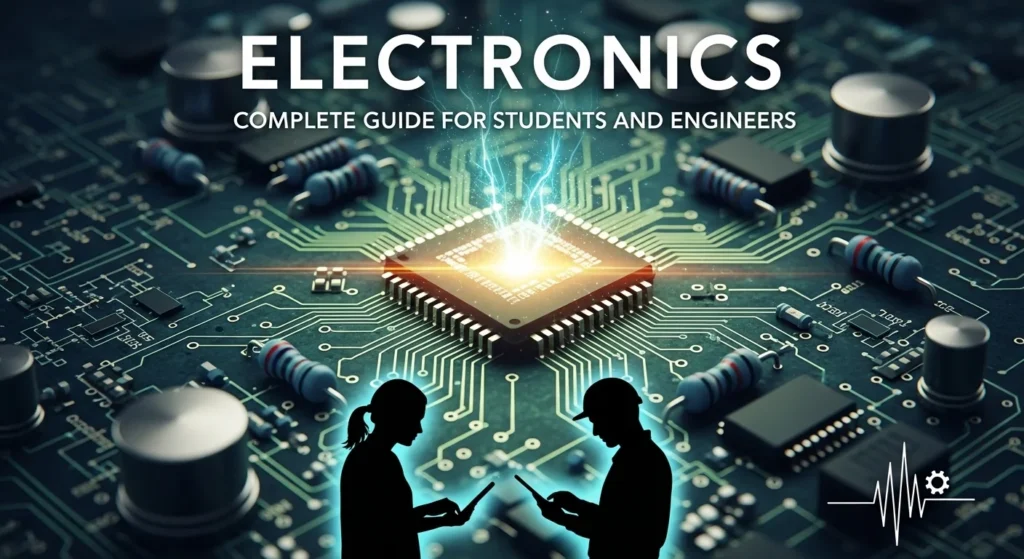
Electronics is one of the most important fields in electrical engineering. It deals with controlling the flow of electrons to perform useful tasks such as communication, automation, and data processing. Without electronics, modern technology like mobile phones, computers, medical devices, and smart systems would not exist.
In this article, you will learn everything about electronics in simple and clear language. We will cover the electronics working principle, types, components, applications, advantages and disadvantages, and practical tips for beginners. Whether you are a student, technician, or engineer, this guide will help you build a strong foundation in electronics and understand how it works in real-world systems.
What is Electronics?
Electronics is the branch of science and engineering that deals with the flow and control of electrons in circuits and devices.
In simple words, electronics is about using electrical signals to perform useful functions like switching, amplifying, or processing information.
Practical Example
A smartphone is a perfect example of electronics. Inside it, tiny electronic circuits process signals, store data, and allow communication through calls and the internet.
Working Principle of Electronics
The electronics working principle is based on controlling the movement of electrons in a circuit using different electronic components.
Unlike simple electrical systems that only carry power, electronics focuses on controlling and manipulating signals.
Step-by-Step Explanation
- A power source provides voltage
- Electrons start moving in a circuit
- Components like resistors control current
- Devices like transistors amplify or switch signals
- Output devices produce the desired result
Simple Analogy
Think of electronics like traffic control on a road:
- Electrons = Vehicles
- Circuit = Road
- Components = Traffic signals and rules
These components control how electrons move, just like signals control traffic.
Types / Classification of Electronics
Electronics can be classified into different types based on application and signal type.
Analog Electronics
Analog electronics deals with continuous signals.
Examples:
- Audio amplifiers
- Radio systems
Features:
- Smooth signal variation
- Used in sound and signal processing
Digital Electronics
Digital electronics works with discrete signals (0 and 1).
Examples:
- Computers
- Microcontrollers
Features:
- High accuracy
- Easy data processing
Power Electronics
Power electronics deals with controlling and converting electrical power.
Examples:
- Inverters
- Rectifiers
Features:
- High efficiency
- Used in industrial systems
Embedded Electronics
These are electronics systems built into devices.
Examples:
- Washing machines
- Cars
Main Components of Electronics
Every electronic system is made of basic components.
Resistor
Controls the flow of current.
Capacitor
Stores electrical energy temporarily.
Inductor
Stores energy in a magnetic field.
Diode
Allows current to flow in one direction only.
Transistor
Acts as a switch or amplifier.
Integrated Circuit (IC)
A small chip containing many components working together.
Advantages of Electronics
Electronics provides many benefits in real-world applications:
- Enables automation and smart systems
- Improves efficiency and accuracy
- Supports communication technologies
- Compact and lightweight designs
- High-speed data processing
Disadvantages / Limitations
Electronics also has some limitations:
- Sensitive to temperature and environment
- Requires proper maintenance
- Can fail due to voltage fluctuations
- Complex design for beginners
- Repair can be difficult in advanced systems
Applications of Electronics
Electronics applications are found in almost every field.
Home Applications
- Televisions
- Smartphones
- Kitchen appliances
Industrial Applications
- Automation systems
- Robotics
- Control systems
Medical Applications
- ECG machines
- MRI scanners
- Monitoring devices
Communication Systems
- Mobile networks
- Satellite communication
- Internet systems
Comparison: Analog vs Digital Electronics
| Feature | Analog Electronics | Digital Electronics |
|---|---|---|
| Signal Type | Continuous | Discrete (0,1) |
| Accuracy | Less accurate | Highly accurate |
| Noise Effect | High | Low |
| Applications | Audio systems | Computers |
| Complexity | Simple | Complex |
Difference between analog and digital electronics:
Analog uses continuous signals, while digital uses binary signals for better accuracy and processing.
Selection Guide
Choosing the right electronics system depends on your needs.
Tips for Beginners
- Use digital electronics for computing tasks
- Use analog electronics for signal processing
- Choose proper components based on ratings
- Ensure safety and proper design
- Start with simple circuits before advanced ones
Common Problems & Solutions
Why is my circuit not working?
- Loose connections
- Wrong component values
Solution: Check wiring and verify components.
Why is the device overheating?
- Excess current
- Poor ventilation
Solution: Use proper ratings and cooling.
Why is there noise in signals?
- Interference
- Poor grounding
Solution: Improve shielding and grounding.
Future Trends
Electronics is rapidly evolving with new technologies.
New Developments
- Internet of Things (IoT)
- Artificial Intelligence (AI)
- Wearable devices
- Smart homes
Industry Direction
Future electronics will focus on miniaturization, energy efficiency, and smart automation. Advanced chips and embedded systems will dominate the industry.
Conclusion
Electronics is a fundamental part of modern life and engineering. From simple circuits to advanced systems, it plays a key role in communication, automation, and innovation. Understanding the electronics working principle, components, and applications helps students and engineers build strong technical skills.
Although electronics has some limitations like complexity and sensitivity, its advantages far outweigh the drawbacks. With continuous advancements, electronics will continue to shape the future of technology.
As a beginner or engineer, investing time in learning electronics will open many opportunities in both industry and research. Keep practicing and exploring to master this essential field.