
Imagine an electrical technician installing a cable tray in an industrial building. During installation, metal brackets and pipes often need to be cut or shaped to fit properly. Using manual tools for this task can be slow and physically demanding. This is where a powerful tool called an angle grinder becomes extremely useful.
An angle grinder is one of the most commonly used power tools in electrical work, construction, metal fabrication, and mechanical workshops. It helps technicians cut, grind, polish, and smooth different materials quickly and accurately.
For electrical engineers and technicians, an angle grinder is especially useful when working with metal conduits, cable trays, brackets, bolts, and steel frames. With the right disc attachment, the same tool can perform many different tasks.
Understanding the angle grinder working principle, types, components, and angle grinder applications is very important for beginners and professionals. It allows technicians to work safely and efficiently.
In this article, you will learn everything about the angle grinder, including its definition, working principle, types, main components, angle grinder advantages and disadvantages, comparison with similar tools, and practical tips for choosing the right one.
2. What is an Angle Grinder?
An angle grinder is a versatile handheld power tool designed for cutting, grinding, polishing, sanding, sharpening, and surface finishing on a wide range of materials, including metal, concrete, stone, tiles, bricks, wood (with suitable accessories), and masonry. It is one of the most commonly used power tools in construction, metal fabrication, automotive repair, electrical installation, welding, and maintenance work. The tool operates using a high-speed electric or battery-powered motor that rotates a disc at thousands of revolutions per minute (RPM), enabling it to remove material quickly and efficiently. The cutting or grinding disc is mounted at a 90-degree (right-angle) position to the motor shaft, which gives the tool its name, angle grinder. By changing the type of disc or attachment, the same tool can perform multiple tasks, making it a valuable addition to both professional workshops and DIY toolkits. Modern angle grinders are equipped with safety features such as adjustable guards, side handles, spindle locks, overload protection, and anti-restart functions to improve user safety and control during operation. Available in both corded and cordless models, angle grinders provide excellent flexibility for indoor and outdoor applications. Their ability to perform heavy-duty cutting, grinding, and polishing with speed and precision makes them an essential tool for technicians, engineers, electricians, welders, contractors, and maintenance professionals.
Practical Example
Imagine an electrician installing a steel conduit system inside a commercial building. Several metal conduit pipes must be cut accurately before installation. Instead of using a manual hacksaw, the electrician uses an angle grinder fitted with a metal cutting disc to make fast, clean, and precise cuts. This saves time, reduces physical effort, and ensures the conduit fits perfectly during installation.
3. Angle Grinder Working Principle
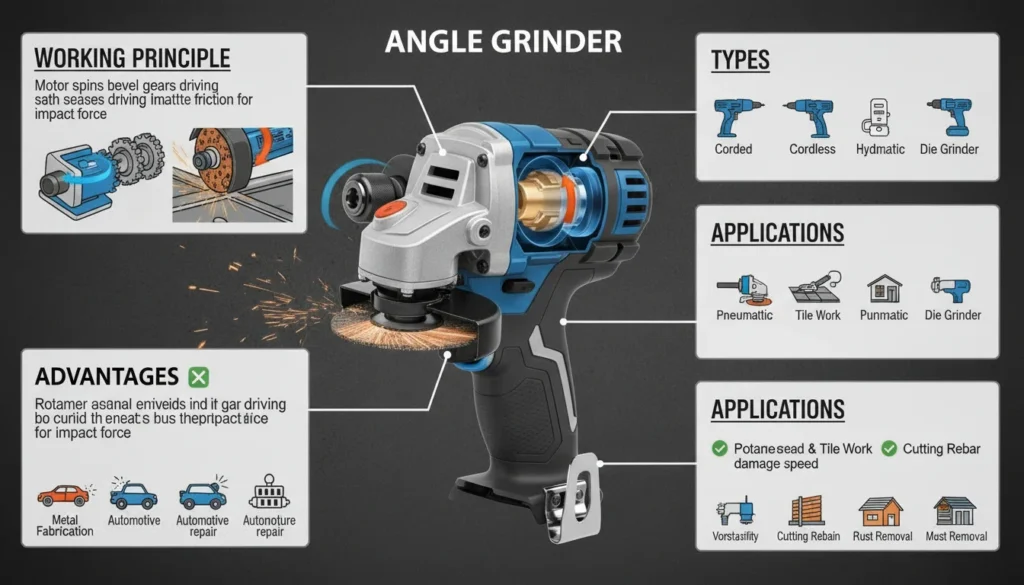
The working principle of an angle grinder is based on converting electrical energy into mechanical rotational energy. When the tool is switched on, electricity from a power outlet or rechargeable battery powers the electric motor. The motor generates high-speed rotational motion, which is transmitted through a right-angle gear mechanism to the spindle. The spindle rotates the attached cutting, grinding, or polishing disc at speeds that typically range from 8,000 to 12,000 RPM, depending on the tool’s size and model. As the disc spins at high speed, it creates sufficient friction and cutting force to remove material from the workpiece. Different types of discs are used for specific applications, such as cutting metal, grinding welds, polishing surfaces, removing rust, or cutting concrete and tiles. The efficiency of an angle grinder depends on factors such as motor power, disc type, rotational speed, and the amount of pressure applied by the operator. Modern angle grinders often include electronic speed control, soft-start systems, overload protection, and vibration-reduction technology to improve performance, safety, and user comfort.
Step-by-Step Working Process
1. Power Supply
The angle grinder receives electrical power either from a mains power outlet (corded model) or a rechargeable lithium-ion battery (cordless model).
2. Motor Operation
The electric motor converts electrical energy into high-speed mechanical rotation, producing the power required to drive the grinding or cutting disc.
3. Right-Angle Gear Transmission
A bevel gear system transfers the motor’s rotational motion through a 90-degree angle, allowing the disc to rotate perpendicular to the motor housing for better control and easier access to the workpiece.
4. High-Speed Disc Rotation
The spindle rotates the selected disc at a very high speed, enabling it to perform cutting, grinding, sanding, polishing, or surface preparation efficiently.
5. Material Removal
When the rotating disc comes into contact with the workpiece, abrasion, friction, or cutting action removes material from the surface. The type of operation depends on the disc installed, such as a cutting wheel, grinding wheel, flap disc, or polishing pad.
Simple Analogy
Think of using sandpaper to smooth the surface of a piece of wood. An angle grinder performs the same basic task but uses a rapidly spinning abrasive disc instead of hand movement. Because the disc rotates at thousands of revolutions per minute, it removes material much faster, more accurately, and with significantly less effort, making it ideal for professional construction, fabrication, and maintenance work.
4. Types of Angle Grinders
Angle grinders are available in several types, each designed to meet specific cutting, grinding, polishing, and finishing requirements. The most suitable angle grinder depends on factors such as the power source, disc size, portability, and intended application. Whether used in construction, metal fabrication, automotive repair, electrical installation, or industrial maintenance, selecting the correct type improves efficiency, safety, and overall performance.
Corded Angle Grinder
A corded angle grinder is powered directly from an electrical outlet, providing a continuous and reliable power supply for extended operation. Since it does not rely on batteries, it can run for long periods without interruption, making it ideal for demanding tasks in workshops, construction sites, and industrial facilities. Corded models are generally more powerful than cordless versions and are commonly used for cutting steel, grinding welds, polishing metal surfaces, removing rust, and preparing concrete. Their consistent performance makes them the preferred choice for professionals who require maximum power and uninterrupted operation.
Cordless Angle Grinder
A cordless angle grinder operates using a rechargeable lithium-ion battery, offering excellent portability and flexibility. Because it does not require a power cable, it is ideal for working in remote locations, outdoor job sites, rooftops, and areas where electrical outlets are unavailable. Modern cordless angle grinders provide impressive performance with brushless motors and high-capacity batteries, making them suitable for cutting, grinding, and polishing a wide range of materials. Although battery runtime is limited compared to corded models, their convenience and mobility make them extremely popular among electricians, maintenance technicians, and construction professionals.
Pneumatic Angle Grinder
A pneumatic angle grinder, also known as an air angle grinder, is powered by compressed air supplied through an air compressor. These grinders are lightweight, durable, and capable of operating continuously without overheating, making them ideal for industrial production lines and automotive repair shops. Pneumatic models are commonly used for precision grinding, deburring, polishing, and surface preparation. Because they produce no electrical sparks, they are also suitable for certain hazardous environments where electrical tools may not be appropriate.
Small Angle Grinder
A small angle grinder typically uses discs ranging from 4 to 5 inches (100–125 mm) in diameter. Its compact size, lightweight design, and excellent maneuverability make it suitable for precision work, light-duty grinding, cutting, polishing, and finishing tasks. Small angle grinders are widely used by electricians, plumbers, welders, fabricators, and DIY users for working in confined spaces and handling delicate materials with greater control.
Large Angle Grinder
A large angle grinder is designed for heavy-duty applications and usually accommodates 7 to 9-inch (180–230 mm) discs. These powerful tools are capable of cutting thick steel, concrete, masonry, stone, and other hard materials with ease. Large angle grinders are commonly used in construction projects, shipbuilding, mining, heavy fabrication, and industrial maintenance. Their high motor power and larger disc size enable faster material removal and greater cutting depth, making them ideal for demanding professional applications.
Brushless Angle Grinder
A brushless angle grinder uses an advanced brushless electric motor instead of traditional carbon brushes. This design improves efficiency, reduces maintenance, generates less heat, and extends the tool’s lifespan. Brushless angle grinders also offer better battery performance in cordless models, making them increasingly popular for both professional and industrial use.
Type Summary
Angle grinders are available in several configurations, including corded, cordless, pneumatic, small, large, and brushless models. Each type is designed to meet different operational needs, from lightweight precision work to heavy-duty industrial cutting and grinding. Choosing the right angle grinder depends on the required power, portability, work environment, and the type of material being processed.
5. Main Components of an Angle Grinder
An angle grinder is made up of several mechanical and electrical components that work together to deliver high-speed cutting, grinding, polishing, and surface finishing. Each component has a specific function that ensures the tool operates efficiently, safely, and reliably. Understanding these parts helps users operate the grinder correctly, perform proper maintenance, and troubleshoot common problems.
Electric Motor
The electric motor is the heart of the angle grinder and the primary source of power. It converts electrical energy from a mains power supply or rechargeable battery into high-speed rotational motion. The motor is designed to deliver the torque and speed required for demanding cutting and grinding applications. Modern angle grinders often feature brushless motors, which provide higher efficiency, longer service life, reduced maintenance, and improved battery performance in cordless models.
Gearbox
The gearbox transfers the motor’s rotational power to the spindle through a right-angle bevel gear system. This mechanism changes the direction of rotation by 90 degrees, allowing the grinding disc to be positioned perpendicular to the motor housing. The gearbox also increases torque while maintaining smooth and efficient power transmission, making it possible to cut and grind hard materials with greater control and precision.
Spindle
The spindle is the rotating shaft that securely holds the grinding, cutting, polishing, or sanding accessory. It rotates at very high speeds and transfers power directly from the gearbox to the attached disc. Most angle grinders include a spindle lock button, allowing users to quickly and safely replace discs or other accessories during maintenance or when switching between applications.
Grinding Disc or Wheel
The grinding disc or wheel is the main working component of the angle grinder. Different types of discs are available for specific tasks, including cutting discs, grinding wheels, flap discs, wire brushes, diamond blades, polishing pads, and sanding attachments. The correct disc selection determines the tool’s performance and ensures safe, efficient operation on materials such as metal, concrete, stone, tiles, and masonry.
Protective Guard
The protective guard is an essential safety feature designed to shield the operator from flying sparks, metal fragments, dust, and broken disc particles. It surrounds part of the rotating disc and helps reduce the risk of injury during operation. The guard should always be properly installed and adjusted before using the angle grinder, and it should never be removed while the tool is in operation.
Side Handle
The side handle, also known as the auxiliary handle, provides additional stability, balance, and control while operating the angle grinder. It helps the user maintain a secure grip, reduces fatigue, and improves accuracy during cutting and grinding tasks. Many angle grinders allow the handle to be mounted on either side, making the tool suitable for both right-handed and left-handed users.
Power Switch
The power switch controls the operation of the angle grinder by turning the motor on and off. Depending on the model, it may include a slide switch, paddle switch, trigger switch, or lock-on feature for continuous operation. Modern grinders often incorporate anti-restart protection and soft-start technology, preventing accidental startup after a power interruption and ensuring smoother, safer operation.
Cooling Vents
The cooling vents allow air to circulate through the motor and internal components, preventing overheating during prolonged use. Proper ventilation improves motor efficiency, extends the lifespan of the tool, and ensures reliable performance under heavy workloads.
Carbon Brushes (Brushed Models)
In traditional angle grinders, carbon brushes transfer electrical current to the rotating motor armature. Over time, these brushes wear out and require replacement as part of routine maintenance. Brushless models eliminate this component, resulting in higher efficiency and reduced maintenance requirements.
Component Summary
All of these components work together to ensure efficient and safe operation. The electric motor generates rotational power, the gearbox changes the direction of rotation and increases torque, the spindle holds and rotates the disc, the grinding wheel performs the cutting or grinding task, the protective guard enhances safety, the side handle improves control, the power switch operates the tool, and the cooling system protects the motor from overheating. Together, these components make the angle grinder one of the most versatile and widely used power tools in construction, fabrication, maintenance, and industrial applications.
Angle Grinder Advantages and Disadvantages
Understanding angle grinder advantages and disadvantages helps technicians use the tool effectively.
Advantages
- Multi-purpose tool for cutting, grinding, and polishing
- High-speed operation saves time
- Suitable for different materials such as metal and concrete
- Portable and easy to handle
- Available in many sizes and power levels
- Improves efficiency in electrical installation work
These advantages make angle grinders essential tools in construction and electrical industries.
Disadvantages / Limitations
Although angle grinders are powerful tools, they also have some limitations.
- Produces sparks and dust during operation
- Requires safety equipment such as gloves and goggles
- Can be dangerous if used incorrectly
- High noise level
- Discs wear out and require replacement
Proper training and safety precautions are necessary when using an angle grinder.
8. Applications of an Angle Grinder
An angle grinder is one of the most versatile power tools used across numerous industries for cutting, grinding, polishing, sanding, sharpening, and surface preparation. By simply changing the disc or accessory, the same tool can perform a wide range of tasks on materials such as metal, concrete, stone, tiles, bricks, wood (with suitable attachments), and masonry. Its versatility, speed, and efficiency make it an indispensable tool for professionals, technicians, engineers, and DIY users alike.
Electrical Installation
Electricians frequently use angle grinders during electrical installation projects to cut metal conduits, cable trays, mounting brackets, strut channels, threaded rods, and electrical enclosures. They are also used to remove rust from metal surfaces and prepare steel structures before installing electrical equipment. Their ability to make fast and accurate cuts helps improve productivity and installation quality.
Construction Industry
In the construction industry, angle grinders are widely used for cutting and shaping concrete, bricks, ceramic tiles, paving stones, steel reinforcement bars (rebar), pipes, and masonry blocks. Builders also use them for smoothing rough concrete edges, removing excess mortar, and preparing surfaces before finishing work. Their powerful cutting capability makes them an essential tool on construction sites.
Metal Fabrication
Metal fabrication workshops rely heavily on angle grinders for cutting steel plates, grinding welds, deburring sharp edges, polishing metal surfaces, removing rust, and preparing materials for welding or painting. Fabricators use different grinding wheels and flap discs to achieve smooth, high-quality finishes while improving the appearance and durability of metal products.
Automotive Repair and Maintenance
Mechanics and automotive technicians use angle grinders for a variety of repair and maintenance tasks. Common applications include cutting rusted bolts, removing damaged fasteners, trimming exhaust pipes, cleaning welded joints, removing corrosion, polishing metal parts, and restoring vehicle components. Their compact size allows them to work efficiently in confined spaces within vehicles.
Industrial Manufacturing
Manufacturing plants and industrial workshops use angle grinders for machine maintenance, equipment repair, surface preparation, metal finishing, pipe fabrication, and structural steel work. They play an important role in maintaining production equipment and ensuring the smooth operation of industrial machinery.
Home Improvement and DIY Projects
Homeowners and DIY enthusiasts use angle grinders for renovation projects, metal cutting, tile trimming, sharpening garden tools, removing old paint or rust, polishing surfaces, and general household repairs. With the appropriate accessories, an angle grinder becomes a versatile tool for many home maintenance tasks.
Stone and Masonry Work
Masons and stone workers use angle grinders equipped with diamond blades to cut and shape natural stone, granite, marble, concrete slabs, paving stones, and ceramic tiles. They also use polishing pads to produce smooth, professional-quality finishes on stone surfaces.
Plumbing and Pipe Installation
Plumbers use angle grinders to cut metal pipes, plastic pipes (with suitable blades), brackets, and mounting hardware during installation and maintenance work. They are also useful for removing damaged fittings and preparing pipe surfaces for welding or joining.
Application Summary
Angle grinders are widely used in electrical installation, construction, metal fabrication, automotive repair, industrial manufacturing, plumbing, masonry, stone cutting, and home improvement projects. Their ability to perform multiple tasks with different accessories makes them one of the most essential and versatile power tools for professionals and beginners, providing fast, accurate, and efficient material processing across a wide range of applications.
Difference Between Angle Grinder and Bench Grinder
Understanding the difference between bench grinder and angle grinder helps beginners choose the correct tool.
| Feature | Angle Grinder | Bench Grinder |
|---|---|---|
| Portability | Portable handheld tool | Fixed machine |
| Main Use | Cutting and grinding | Sharpening tools |
| Mobility | Can be used anywhere | Installed on a workbench |
| Power | Moderate to high | Usually constant power |
| Flexibility | Very versatile | Limited functions |
An angle grinder is more flexible, while a bench grinder is mainly used for sharpening tools.
10. Selection Guide: How to Choose the Right Angle Grinder
Choosing the right angle grinder is essential for achieving safe, efficient, and high-quality cutting, grinding, polishing, and finishing results. The ideal grinder depends on the type of work, the materials being processed, the operating environment, and the frequency of use. Selecting the correct tool improves productivity, extends tool life, and reduces operator fatigue while ensuring maximum safety.
Disc Size
The disc size is one of the most important factors when selecting an angle grinder. Common disc sizes include 4-inch (100 mm), 4.5-inch (115 mm), 5-inch (125 mm), 7-inch (180 mm), and 9-inch (230 mm). Smaller grinders are lightweight, easier to control, and ideal for precision cutting, grinding, and polishing. Larger grinders offer deeper cutting capacity and greater material removal, making them suitable for heavy-duty industrial and construction applications.
Motor Power
The motor power determines the grinder’s cutting and grinding capability. Higher-powered motors can handle thicker metals, concrete, stone, and other hard materials with greater efficiency. Light-duty tasks generally require motors between 500 and 900 watts, while professional and industrial applications often require grinders with 1,000 watts or more for continuous heavy-duty operation.
Speed Rating (RPM)
The speed rating, measured in revolutions per minute (RPM), affects cutting speed and grinding performance. Higher RPM allows faster material removal and smoother surface finishing. However, the grinder’s speed should always match the maximum speed rating of the installed disc to ensure safe operation and prevent disc failure.
Corded vs. Cordless Models
Choose between a corded and a cordless angle grinder based on your working environment. Corded models provide continuous power and are ideal for workshops, fabrication shops, and industrial applications where electrical outlets are available. Cordless models use rechargeable lithium-ion batteries and offer excellent portability, making them suitable for outdoor work, construction sites, maintenance tasks, and locations without direct access to electricity.
Type of Material
Consider the materials you will work with most frequently. Different applications require different types of discs and motor capacities. Metal fabrication, concrete cutting, tile installation, masonry work, and polishing each require specific accessories and performance levels. Selecting a grinder designed for your primary application improves efficiency and extends tool life.
Safety Features
Modern angle grinders include several safety features that improve operator protection. Look for models equipped with adjustable blade guards, spindle locks, soft-start technology, anti-restart protection, overload protection, electronic brake systems, kickback control, and vibration-reduction handles. These features reduce the risk of accidents and provide greater comfort during prolonged use.
Ergonomics and Weight
The grinder should be comfortable to hold and easy to control. Lightweight models reduce operator fatigue during extended use, while ergonomic handles with rubber grips provide better stability and improve accuracy. Adjustable side handles also allow safer operation from different working positions.
Build Quality and Brand Reliability
Choose an angle grinder manufactured by a reputable brand that offers durable construction, quality components, and reliable after-sales support. High-quality grinders generally provide better performance, longer service life, and easier access to replacement parts and accessories.
Budget and Maintenance
Consider both the initial purchase price and the long-term maintenance costs. A slightly higher investment in a durable, high-quality grinder often results in lower repair costs, longer service life, and improved productivity. Also, ensure that replacement discs, brushes, batteries, and spare parts are readily available.
Tips for Beginners
If you are new to using angle grinders, start with a 4.5-inch or 5-inch model because it is lightweight, easier to control, and suitable for most general-purpose applications. Always use the correct disc for the job, wear appropriate personal protective equipment (PPE), inspect the grinder before each use, and follow the manufacturer’s safety instructions. Learning proper handling techniques and regular maintenance will improve both safety and performance.
Selection Summary
The best angle grinder is selected by carefully evaluating disc size, motor power, RPM, power source, material type, safety features, ergonomics, build quality, and budget. Choosing the right tool for the intended application ensures efficient operation, improved safety, longer service life, and professional-quality results in construction, metal fabrication, electrical installation, automotive repair, and industrial maintenance.
Safety Features
Choose grinders with safety guards, anti-vibration handles, and overload protection.
11. Common Angle Grinder Problems and Solutions (FAQs)
An angle grinder is a powerful and reliable tool, but improper use, poor maintenance, worn components, or unsuitable accessories can lead to operational problems. Identifying these issues early and performing regular maintenance helps improve safety, extend the tool’s lifespan, and maintain efficient performance. Below are some of the most common angle grinder problems along with their causes and practical solutions.
Q1: Why Is the Angle Grinder Not Starting?
An angle grinder may fail to start due to a disconnected power supply, damaged power cable, faulty switch, worn carbon brushes (in brushed models), a discharged battery (for cordless models), or an internal motor fault.
Solution:
- Check that the power cable is securely connected.
- Inspect the plug, switch, and electrical outlet.
- Recharge or replace the battery if using a cordless grinder.
- Replace worn carbon brushes if necessary.
- If the problem persists, have the grinder inspected by a qualified technician.
Q2: Why Is the Angle Grinder Overheating?
Overheating usually occurs because of continuous heavy-duty operation, blocked ventilation openings, excessive pressure during grinding, or motor overload. High ambient temperatures can also contribute to overheating.
Solution:
- Turn off the grinder and allow it to cool completely.
- Clean the cooling vents to improve airflow.
- Avoid applying excessive pressure during operation.
- Operate the grinder within its recommended duty cycle.
- Use the correct grinder size and power rating for the application.
Q3: Why Is the Cutting Disc Breaking?
A cutting disc can break if the wrong disc type is used, the disc is damaged, mounted incorrectly, operated above its maximum RPM rating, or subjected to excessive side pressure during cutting.
Solution:
- Always use the correct disc designed for the material being cut.
- Inspect the disc for cracks or damage before use.
- Ensure the disc is installed correctly and tightened securely.
- Never exceed the disc’s maximum speed rating.
- Allow the disc to cut naturally without excessive force.
Q4: Why Are There Excessive Sparks During Grinding?
Some sparks are normal when grinding metal. However, excessive sparks may indicate a worn grinding disc, incorrect grinding angle, excessive pressure, or worn motor carbon brushes.
Solution:
- Replace worn or damaged grinding discs.
- Maintain the recommended grinding angle.
- Apply steady, moderate pressure instead of forcing the tool.
- Inspect and replace worn carbon brushes if required.
Q5: Why Does the Angle Grinder Vibrate Excessively?
Excessive vibration may result from an unbalanced or damaged disc, loose mounting flanges, worn spindle bearings, or improper disc installation. Continued use under these conditions can reduce cutting accuracy and increase the risk of accidents.
Solution:
- Inspect the grinding or cutting disc for damage.
- Tighten the spindle nut and mounting flanges securely.
- Replace worn bearings or damaged accessories.
- Always use high-quality, balanced discs that match the grinder’s specifications.
Q6: Why Is the Grinder Producing Unusual Noise?
Grinding, rattling, or squealing noises may indicate worn gears, damaged bearings, insufficient lubrication, or loose internal components.
Solution:
- Stop using the grinder immediately.
- Inspect the gearbox and bearings for wear.
- Lubricate the gearbox according to the manufacturer’s recommendations.
- Replace damaged internal components through authorized service if necessary.
Problem-Solving Summary
Most angle grinder problems can be prevented through regular inspection, proper maintenance, correct disc selection, adequate cooling, and safe operating practices. Keeping the tool clean, replacing worn accessories, inspecting electrical components, and following the manufacturer’s guidelines will improve performance, extend service life, and ensure safe operation in construction, fabrication, electrical work, automotive repair, and industrial applications.
12. Future Trends in Angle Grinder Technology
Angle grinder technology is advancing rapidly as manufacturers develop more powerful, efficient, and safer tools for professional and industrial applications. Modern innovations focus on improving performance, reducing maintenance, enhancing user safety, and increasing portability. With the integration of smart electronics, advanced materials, and high-performance battery systems, the next generation of angle grinders will offer greater productivity while providing a safer and more comfortable working experience for users.
Brushless Motor Technology
One of the most significant advancements is the widespread adoption of brushless motors. Unlike traditional brushed motors, brushless motors generate less heat, require minimal maintenance, and deliver higher efficiency. They also provide longer service life, increased power output, improved speed control, and extended battery runtime in cordless angle grinders, making them the preferred choice for modern professional tools.
Smart Safety Systems
Future angle grinders are being equipped with advanced electronic safety features that help reduce workplace accidents. These include automatic shut-off systems, electronic brakes, anti-kickback technology, overload protection, soft-start mechanisms, restart protection, vibration control, and drop detection. These intelligent safety systems improve operator protection and reduce the risk of injuries during demanding cutting and grinding tasks.
Lightweight and Ergonomic Designs
Manufacturers are increasingly using high-strength lightweight materials, such as magnesium alloys and advanced composite materials, to reduce the overall weight of angle grinders without compromising durability. Improved ergonomic handles, anti-vibration technology, and better weight distribution reduce operator fatigue and increase comfort during prolonged use, leading to greater productivity and precision.
Advanced Battery Technology
Cordless angle grinders continue to improve through the development of high-capacity lithium-ion and next-generation battery technologies. Modern battery systems offer faster charging, longer operating time, higher power output, and intelligent battery management systems that optimize performance while protecting against overheating and overcharging. These advancements make cordless grinders increasingly capable of replacing corded models in many professional applications.
Smart Connectivity and IoT Integration
Future angle grinders may incorporate Bluetooth and Internet of Things (IoT) connectivity, allowing users to monitor tool performance through mobile applications. Smart features may include maintenance reminders, battery health monitoring, operating statistics, fault diagnostics, and tool tracking for improved fleet management in industrial environments.
Improved Dust Collection Systems
Dust control is becoming an important focus in power tool development. Advanced angle grinders are expected to feature integrated dust extraction systems that reduce airborne dust, improve visibility, and create healthier working conditions, particularly when cutting concrete, masonry, and stone materials.
Artificial Intelligence (AI) Assistance
Artificial intelligence is expected to enhance future power tools by automatically adjusting motor speed, torque, and power output based on the material being processed. AI-powered systems may also detect unsafe operating conditions, provide real-time user guidance, and optimize cutting and grinding performance for greater efficiency and safety.
Sustainable Manufacturing
Manufacturers are also focusing on sustainability by using recyclable materials, energy-efficient motors, environmentally friendly manufacturing processes, and longer-lasting components. These improvements reduce environmental impact while extending the service life of power tools.
Future Outlook
The future of angle grinder technology will be shaped by brushless motors, smart electronic safety systems, lightweight ergonomic designs, advanced battery technology, IoT connectivity, AI-assisted operation, improved dust management, and sustainable manufacturing. These innovations will make angle grinders more powerful, efficient, durable, and user-friendly, enabling professionals and DIY users to perform cutting, grinding, and polishing tasks with greater safety, accuracy, and productivity.
Conclusion
An angle grinder is one of the most versatile and powerful tools used in electrical, construction, and mechanical industries. It allows technicians to perform cutting, grinding, polishing, and surface preparation tasks quickly and efficiently.
Understanding the angle grinder working principle, types, components, and angle grinder applications helps professionals use the tool safely and effectively. Although angle grinders have some limitations, their flexibility and high-speed operation make them essential in many technical fields.
By choosing the right grinder and using proper safety precautions, electrical technicians and engineers can greatly improve productivity and work quality. Learning how to properly use an angle grinder is an important skill for anyone involved in modern technical and industrial work.