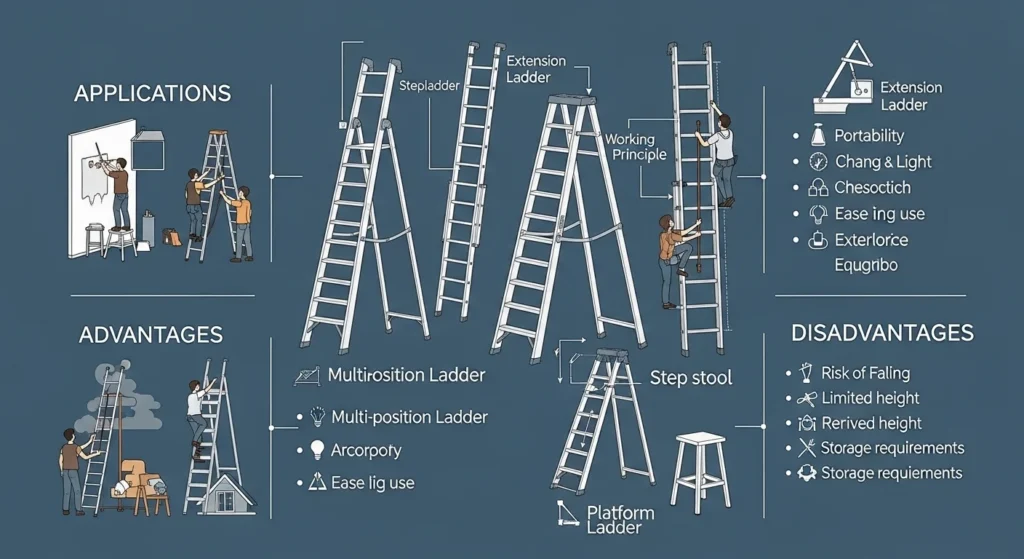

Imagine an electrician installing a ceiling fan or repairing wiring on a high wall. Without a safe way to reach that height, the job becomes difficult and dangerous. In such situations, one simple tool becomes extremely important — the ladder.
A ladder is one of the most commonly used tools in electrical work, construction, and maintenance. Electricians, technicians, engineers, and even homeowners rely on ladders every day to reach elevated areas safely. Whether installing lights, fixing cable trays, or performing maintenance work, ladders make high places accessible.
Understanding ladders is more important than many beginners think. Choosing the wrong ladder can lead to accidents, while selecting the right one improves safety and efficiency at work.
In this article, you will learn everything about ladders in simple and practical language. We will discuss the ladder working principle, different types of ladders, ladder applications, major components, advantages, disadvantages, and how to select the right ladder. By the end of this guide, electrical students, engineers, and technicians will clearly understand how ladders work and how to use them safely in real-world situations.
2. What is a Ladder?
A ladder is a vertical or inclined structure used to climb up or down between different heights. It typically consists of two side rails connected by horizontal steps called rungs.A ladder is a simple but very useful tool designed to help people climb up or down safely between different heights. It is commonly used in homes, workplaces, construction sites, and electrical maintenance tasks. A typical ladder consists of two long vertical sides, called rails, connected by horizontal steps known as rungs. These rungs provide support for the feet, allowing a person to stand or climb comfortably. Ladders are usually made from materials such as wood, aluminum, or fiberglass, each chosen based on strength, durability, and safety requirements. For example, fiberglass ladders are often used in electrical work because they do not conduct electricity.
There are different types of ladders designed for specific purposes. A step ladder is self-supporting and can stand on its own, making it ideal for indoor tasks like painting or changing light bulbs. An extension ladder can be adjusted in length and is commonly used for reaching high places such as rooftops or tall walls. Other types include platform ladders and telescopic ladders, each offering unique features for convenience and safety. Proper use of a ladder is very important to prevent accidents. It should always be placed on a stable, flat surface, and users should maintain balance by keeping their body centered between the rails.
Ladders play an essential role in daily life and professional work by providing easy access to areas that are otherwise difficult to reach. Whether it is for simple household chores or complex industrial jobs, ladders help improve efficiency and safety when used correctly.
The basic purpose of a ladder is to provide temporary access to elevated areas such as ceilings, roofs, electrical panels, or tall machines.
Simple Explanation
A ladder works like a portable staircase. Instead of building permanent stairs, a ladder allows a person to reach higher places quickly and safely.
Practical Example
Suppose an electrician needs to install LED lights on a warehouse ceiling that is 4 meters high. Without a ladder, reaching that height would be impossible. By placing a ladder against the wall or opening it as a step ladder, the electrician can safely climb and perform the task.
3. Ladder Working Principle
The ladder working principle is based on stability, balance, and weight distribution. When a person climbs a ladder, their weight transfers through the ladder structure to the ground.
A ladder works safely when these forces are balanced.
1. Placement on a Stable Surface
The ladder must always be placed on a firm, solid, and level surface before use. Uneven, soft, or slippery ground can cause the ladder to shift, tilt, or collapse during climbing. Proper placement ensures that all ladder feet remain in full contact with the ground, providing maximum stability and safety. Before climbing, users should inspect the area for obstacles, loose materials, water, or other hazards that could affect the ladder’s balance.
2. Angle Positioning
For extension and leaning ladders, the recommended angle is approximately 75 degrees. This angle provides the best balance between stability and ease of climbing. A ladder placed too steeply may tip backward, while a ladder positioned too flat may slide away from the wall. A common safety guideline is the 4-to-1 rule, meaning the ladder base should be placed 1 foot away from the wall for every 4 feet of ladder height. Proper angle positioning reduces the risk of accidents and improves user confidence while climbing.
3. Weight Distribution
When a person climbs the ladder, their weight is transferred through the ladder rungs to the side rails and finally down to the ground. The ladder is designed to distribute this load evenly across its structure. Standing in the center of the rungs helps maintain balance and prevents excessive stress on one side. Proper weight distribution ensures the ladder remains stable and minimizes the chances of twisting, bending, or tipping during use.
4. Friction Support
Most modern ladders are equipped with rubber feet, anti-slip pads, or textured base materials that create friction between the ladder and the ground surface. This friction helps prevent unwanted movement while climbing or working. On smooth surfaces such as tiles, concrete, or polished floors, friction becomes especially important for safety. Regular inspection of ladder feet is necessary because worn or damaged anti-slip pads can significantly reduce grip and increase the risk of slipping.
5. Structural Strength
The side rails are the primary load-bearing components of a ladder. They support the user’s weight and transfer the load safely to the ground while maintaining the ladder’s shape. High-quality ladders are manufactured from strong materials such as aluminum, fiberglass, or steel to resist bending, cracking, and deformation. The combination of sturdy side rails, securely attached rungs, and reinforced joints ensures that the ladder can safely support its rated load capacity without collapsing during operation.
Simple Analogy
Think of a ladder like a bridge for climbing. The side rails act as support beams, while the rungs act like steps that allow a person to move upward safely.
4. Types of Ladders
There are many types of ladders used in electrical and industrial work. Each type is designed for specific situations.
Step Ladder: Features, Working Principle, Benefits, and Common Applications
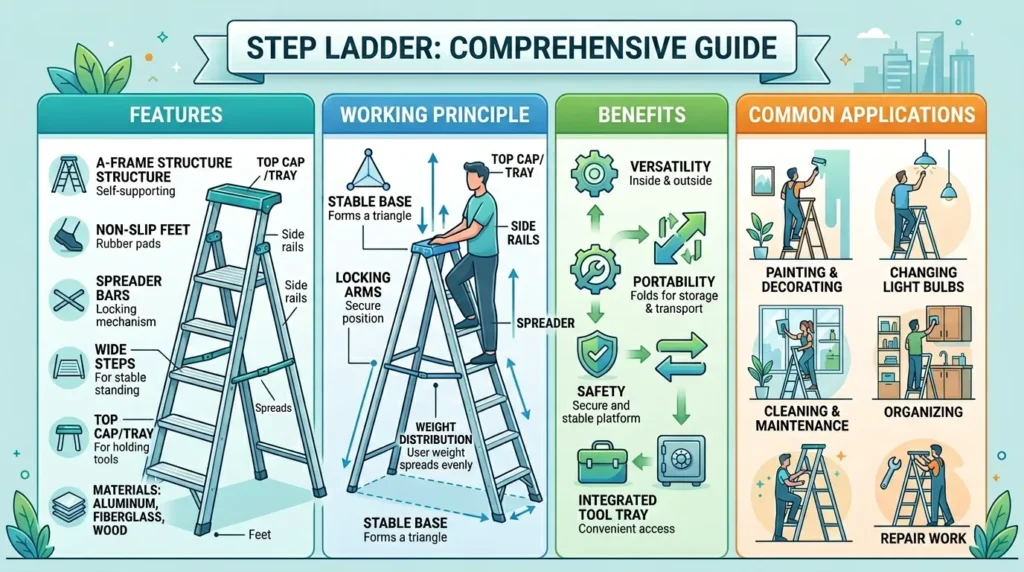
A step ladder is a self-supporting ladder shaped like the letter “A”. It does not need to lean against a wall.
A step ladder is one of the most commonly used types of ladders in homes, workplaces, construction sites, warehouses, and maintenance environments. Unlike extension ladders that require support from a wall or structure, a step ladder is self-supporting and can stand independently because of its A-frame design. This unique structure makes it highly convenient for tasks that require mobility and stability in areas where no supporting surface is available. Step ladders are available in various sizes and materials, including aluminum, fiberglass, steel, and lightweight composite materials, allowing users to select a ladder based on their specific needs and working conditions.
The working principle of a step ladder is based on stability, weight distribution, and structural support. When the ladder is opened, the front and rear sections form a triangular shape, which provides excellent balance and strength. The user’s weight is transferred from the steps through the side rails and support braces to the ground. This balanced load distribution helps prevent tipping and ensures safe operation. Most modern step ladders also include anti-slip feet, locking spreaders, and reinforced hinges that increase safety and prevent accidental folding during use.
One of the major advantages of a step ladder is its versatility. It can be used for a wide range of tasks such as painting walls, changing light bulbs, cleaning windows, reaching high shelves, electrical work, and performing maintenance activities. In commercial and industrial settings, step ladders are commonly used by electricians, technicians, warehouse workers, and construction professionals. Fiberglass step ladders are especially popular among electricians because they provide electrical insulation and reduce the risk of electric shock when working near energized equipment.
Safety is an important consideration when using a step ladder. The ladder should always be placed on a flat, stable surface, and users should avoid standing on the top cap or highest step unless specifically designed for that purpose. Maintaining three points of contact while climbing and ensuring the ladder is fully opened and locked before use can significantly reduce the risk of accidents. Regular inspections should also be performed to check for damaged steps, loose hinges, bent rails, or worn anti-slip feet.
Overall, the step ladder remains one of the most practical and reliable access tools available today. Its self-supporting design, ease of use, portability, and wide range of applications make it an essential piece of equipment for both professional and household tasks. Whether used for simple home repairs or demanding industrial work, a properly selected and maintained step ladder provides a safe and efficient solution for reaching elevated areas.
Features:
- Portable and easy to move
- Common in indoor electrical work
- Often made of aluminum or fiberglass
Example use: Installing ceiling lights.
Extension Ladder: Design, Working Principle, Advantages, and Applications
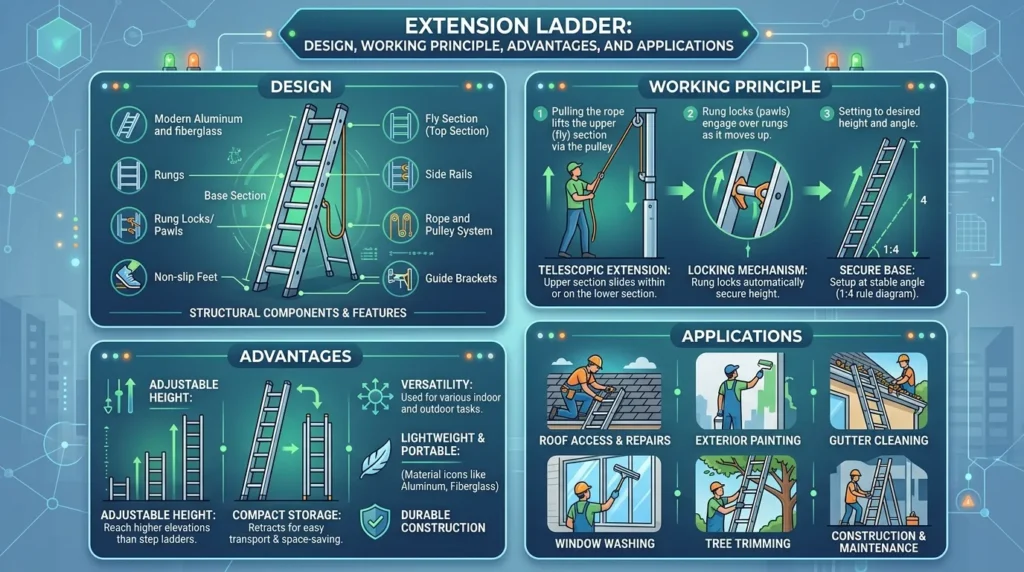
An extension ladder consists of two or more sections that slide to increase height.
An extension ladder is a versatile and widely used climbing tool designed to provide access to elevated areas that cannot be reached with a standard step ladder. It consists of two or more ladder sections that slide along one another, allowing the ladder’s length to be adjusted according to the required working height. Extension ladders are commonly used in construction, building maintenance, roofing, painting, electrical work, firefighting, and various industrial applications. Because they can reach significant heights while remaining relatively compact for storage and transportation, extension ladders are an essential piece of equipment for professionals and homeowners alike.
The working principle of an extension ladder is based on adjustable sections that extend and lock securely into position. The ladder is placed against a stable structure such as a wall, pole, or building. Using a rope-and-pulley system or manual sliding mechanism, the upper section is raised to the desired height. Once extended, locking mechanisms engage to hold the sections securely in place and prevent unexpected movement. The user’s weight is transferred through the rungs and side rails to the ground, while the upper support point helps maintain stability. Proper angle positioning, typically around 75 degrees, ensures safe operation and reduces the risk of slipping or tipping.
Extension ladders are manufactured from durable materials such as aluminum, fiberglass, and steel. Aluminum ladders are lightweight and easy to transport, making them ideal for general-purpose tasks. Fiberglass extension ladders are preferred by electricians and utility workers because they provide excellent electrical insulation. Steel ladders offer exceptional strength but are generally heavier and less portable than other options.
One of the primary advantages of an extension ladder is its ability to reach high elevations without requiring excessive storage space. It can be adjusted to various heights, making it suitable for a wide range of jobs. These ladders are commonly used for roof access, exterior painting, window cleaning, building inspections, maintenance work, and tree trimming. Their adjustable design provides flexibility while maintaining strength and stability when used correctly.
Safety is extremely important when working with an extension ladder. The ladder should always be placed on firm, level ground and inspected for damaged rungs, loose hardware, or worn locking mechanisms before use. The 4-to-1 rule should be followed, meaning the ladder base should be positioned 1 foot away from the wall for every 4 feet of ladder height. Users should maintain three points of contact while climbing and avoid overreaching, which can cause instability.
Overall, the extension ladder is a practical, reliable, and highly effective tool for accessing elevated work areas. Its adjustable height, strong construction, portability, and wide range of applications make it one of the most valuable ladders used in residential, commercial, and industrial environments.
Features:
- Adjustable height
- Used for tall buildings
- Requires wall support
Example use: Exterior building maintenance.
Straight Ladder: Construction, Working Principle, Advantages, and Applications
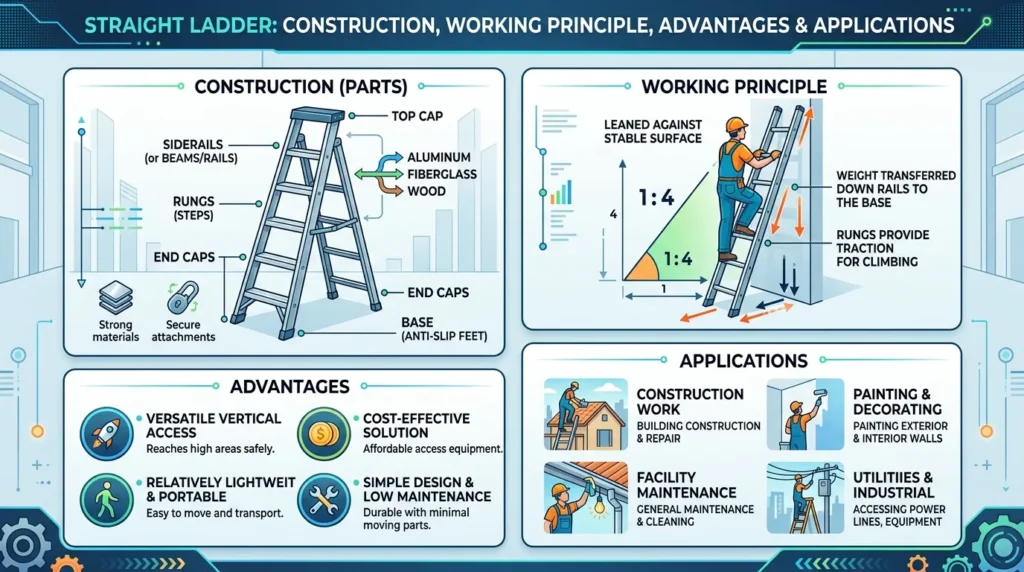
A straight ladder is a single long ladder that must lean against a wall or structure.
A straight ladder, also known as a single ladder, is one of the simplest and most traditional types of ladders used for reaching elevated areas. It consists of a single section with two side rails connected by evenly spaced rungs. Unlike a step ladder, a straight ladder is not self-supporting and must lean against a stable structure such as a wall, building, pole, or other solid surface during use. Straight ladders are commonly used in homes, construction sites, warehouses, farms, and maintenance operations because of their simple design, durability, and ease of use.
The working principle of a straight ladder is based on proper support, load distribution, and stability. When the ladder is positioned against a structure, the user’s weight is transferred from the rungs through the side rails and then down to the ground. The ladder must be placed at a safe angle, usually around 75 degrees, to provide maximum stability and reduce the risk of slipping. The side rails act as the primary load-bearing members, while the rungs provide secure footing for climbing. Anti-slip feet at the base help increase friction with the ground, preventing unwanted movement during operation.
Straight ladders are manufactured from various materials, including aluminum, fiberglass, wood, and steel. Aluminum ladders are lightweight and resistant to corrosion, making them easy to transport and suitable for general-purpose use. Fiberglass ladders are preferred for electrical work because they are non-conductive and provide protection against electric shock. Wooden straight ladders are still used in some industries, while steel ladders offer high strength for heavy-duty applications.
One of the biggest advantages of a straight ladder is its simple and strong construction. It has fewer moving parts than extension ladders, which reduces maintenance requirements and increases reliability. Straight ladders are commonly used for painting, cleaning windows, accessing roofs, maintenance work, tree trimming, and other tasks that require temporary access to elevated locations. Their lightweight design allows users to move and position them quickly.
Safety is an important consideration when using a straight ladder. The ladder should always be inspected before use to ensure that the rungs, side rails, and feet are in good condition. It should be placed on a firm, level surface and secured whenever possible. Users should maintain three points of contact while climbing and avoid carrying heavy tools by hand. Overreaching should also be avoided, as it can cause the ladder to become unstable.
Overall, the straight ladder remains a practical and reliable access tool for residential, commercial, and industrial applications. Its simple design, durability, portability, and ease of use make it an essential piece of equipment for safely reaching elevated work areas.
Features:
- Simple design
- Lightweight
- Easy to transport
Example use: Roof access.
Platform Ladder Explained: Features, Safety Benefits, and Common Applications
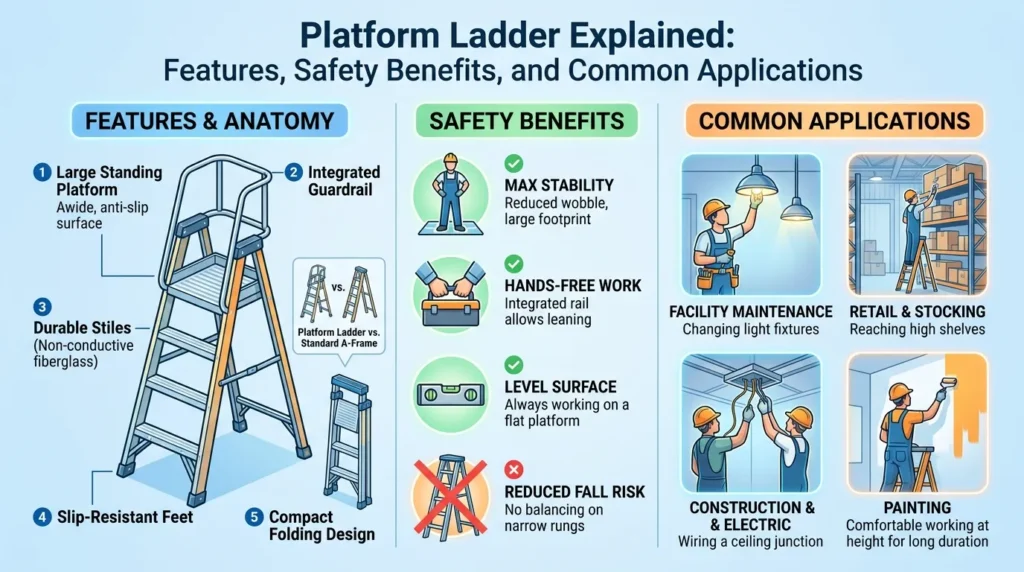
A platform ladder is a specialized type of ladder designed to provide a larger, more stable standing surface for users who need to work at height for extended periods. Unlike traditional step ladders, which have narrow steps, a platform ladder features a wide standing platform near the top, allowing workers to stand comfortably and maintain better balance while performing tasks. This design significantly reduces fatigue and improves safety, making platform ladders a popular choice in construction, maintenance, warehousing, retail stores, manufacturing facilities, and household projects. The sturdy structure of a platform ladder typically includes reinforced side rails, slip-resistant steps, handrails, and a spacious platform that offers enhanced support and security. Many models are constructed from lightweight yet durable materials such as aluminum or fiberglass, making them easy to transport while remaining strong enough to handle demanding work environments. Fiberglass platform ladders are particularly useful for electrical work because they do not conduct electricity, providing an additional layer of protection for workers. One of the greatest advantages of a platform ladder is the increased confidence it gives users when working at elevated heights. The wide platform allows both feet to be positioned securely, reducing the risk of slips and improving overall stability. Handrails often extend above the platform, providing extra support and helping users maintain three points of contact whenever possible. These safety features make platform ladders ideal for jobs that require reaching, lifting, installing, painting, stocking shelves, or performing detailed tasks that demand concentration and precision. Proper use of a platform ladder involves placing it on a stable, level surface, ensuring all locking mechanisms are fully engaged, and never exceeding the manufacturer’s weight capacity. Regular inspections should also be performed to identify damaged components, loose fittings, or worn anti-slip surfaces. When used correctly, platform ladders offer a safe and efficient solution for accessing elevated work areas while minimizing physical strain. Their combination of comfort, stability, and safety has made them an essential tool across various industries. Whether used by professional tradespeople or homeowners tackling DIY projects, platform ladders provide a reliable working platform that enhances productivity and reduces the risks commonly associated with working at height.
A platform ladder includes a standing platform near the top where the worker can stand comfortably.
Features:
- Provides better balance
- Suitable for long-duration work
- Common in warehouses
Fiberglass Ladder Explained: Features, Advantages, Safety, and Applications
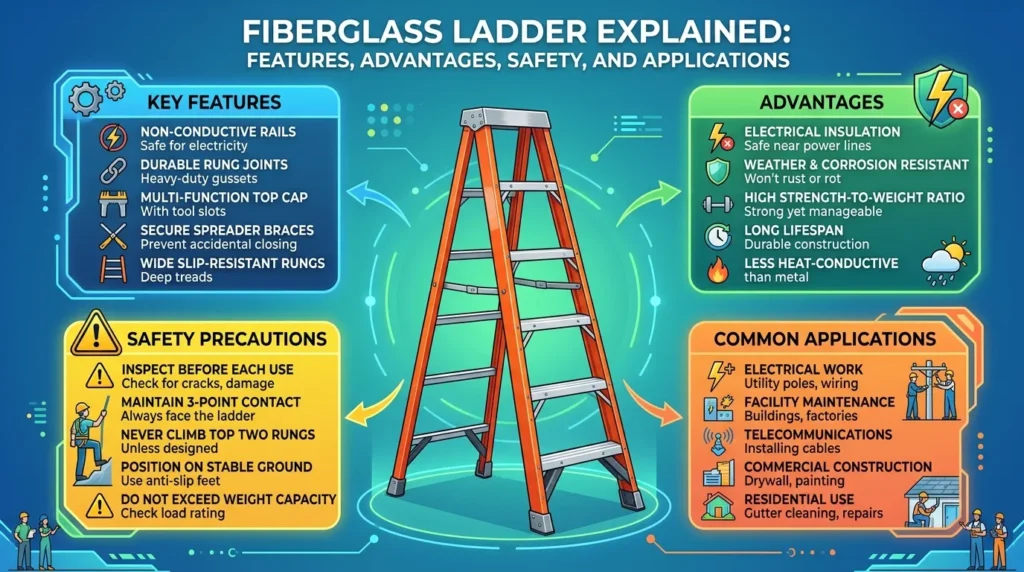
A fiberglass ladder is specially designed for electrical work.
A fiberglass ladder is a strong, durable, and non-conductive ladder designed for professional and residential use where safety and reliability are essential. Unlike aluminum ladders, fiberglass ladders are made from reinforced fiberglass material that does not conduct electricity, making them the preferred choice for electricians, utility workers, maintenance technicians, and construction professionals who work near electrical equipment or power lines. The unique composition of fiberglass provides excellent strength while resisting corrosion, rust, moisture, and many environmental factors that can damage other ladder materials over time. As a result, fiberglass ladders are highly valued for their long service life and dependable performance in both indoor and outdoor environments.
One of the most important advantages of a fiberglass ladder is its superior electrical safety. Because fiberglass is a non-conductive material, it significantly reduces the risk of electrical shock when working around energized systems. This safety feature has made fiberglass ladders a standard requirement in many industries where electrical hazards are present. In addition to electrical protection, these ladders are designed to support heavy loads and demanding work conditions. Many fiberglass ladders are rated for professional-duty use and can safely accommodate workers carrying tools, equipment, and materials. Their rigid construction helps maintain stability while climbing and working at elevated heights.
Fiberglass ladders are available in several styles, including step ladders, extension ladders, platform ladders, and combination ladders, allowing users to choose the most suitable design for their specific tasks. The ladders often feature slip-resistant rungs, reinforced side rails, non-slip feet, and secure locking mechanisms to enhance user safety. Although fiberglass ladders are generally heavier than aluminum models, this added weight often contributes to greater stability during use. Proper handling and storage are important to maintain their condition and performance. Users should inspect the ladder regularly for cracks, damaged rungs, loose hardware, or signs of wear before each use.
These ladders are commonly used in electrical installations, building maintenance, telecommunications, industrial facilities, construction projects, and home improvement tasks. Their combination of strength, durability, weather resistance, and electrical safety makes them one of the most versatile ladder types available. When used according to manufacturer guidelines and established safety practices, a fiberglass ladder provides a secure and reliable solution for reaching elevated work areas while helping reduce workplace accidents and improving overall efficiency.
Features:
- Non-conductive material
- High electrical safety
- Strong and durable
Electricians prefer fiberglass ladders because they reduce electric shock risk.
5. Main Components of a Ladder
Understanding the main components of a ladder is essential for safe operation, proper maintenance, and effective inspections. Each part of a ladder has a specific function that contributes to its strength, stability, and overall safety. By becoming familiar with these components, users can identify potential damage, perform routine checks, and ensure the ladder remains in good working condition before use.
Side Rails
Side rails are the two long vertical supports that form the main framework of a ladder. They run from the bottom to the top and are responsible for carrying most of the load applied to the ladder. The side rails provide structural strength and maintain the ladder’s shape during use. They are typically made from materials such as aluminum, fiberglass, steel, or wood, depending on the ladder type and intended application. Strong and undamaged side rails are essential for maintaining stability and preventing ladder failure. Regular inspections should check for cracks, bends, corrosion, or other signs of wear that could compromise the ladder’s strength.
Rungs
Rungs are the horizontal bars or steps that connect the side rails and provide a surface for climbing. They support the user’s feet and help distribute body weight evenly throughout the ladder structure. Most ladders feature evenly spaced rungs designed to provide a comfortable and secure climbing experience. High-quality ladders often include slip-resistant surfaces on the rungs to improve grip and reduce the risk of falls. Before using a ladder, users should inspect each rung for damage, looseness, excessive wear, or contamination from oil, grease, or other slippery substances.
Feet
Ladder feet are located at the bottom ends of the side rails and play a critical role in preventing slips and maintaining stability. They are designed to create secure contact with the ground and help distribute the ladder’s weight evenly. Many ladder feet are equipped with rubber pads, non-slip grips, or specialized traction surfaces that improve stability on different types of flooring and terrain. Some extension ladders feature swivel feet that can adapt to uneven surfaces. Damaged or worn ladder feet should be replaced immediately, as they can significantly increase the risk of accidents.
Spreaders
Spreaders are metal braces commonly found on step ladders. Their primary purpose is to hold the front and rear sections of the ladder securely in an open position during use. By preventing the ladder from collapsing inward, spreaders provide additional stability and support. Most spreaders automatically lock into place when the ladder is fully opened, ensuring a secure working position. Users should always verify that the spreaders are fully extended and locked before climbing. Bent, damaged, or loose spreaders can reduce ladder stability and should be repaired or replaced promptly.
Locks
Locks are important safety mechanisms primarily used on extension ladders and multi-position ladders. These devices secure the movable sections of the ladder at the desired height and prevent unintended movement while the ladder is in use. Locking systems may include spring-loaded catches, rung locks, or automatic locking mechanisms that engage when the ladder is extended. Properly functioning locks ensure that the ladder remains stable and capable of supporting the intended load. Before use, users should carefully inspect the locks to confirm they engage fully, operate smoothly, and show no signs of wear, damage, or corrosion. Reliable locking mechanisms are essential for maintaining safety when working at elevated heights.
6. Ladder Advantages
The ladder advantages and disadvantages are important to understand before using them in professional work.
Advantages
- Easy to use and portable
- Quick access to elevated areas
- No electricity required
- Available in many sizes and materials
- Low cost compared to scaffolding
- Lightweight and easy to transport
- Suitable for indoor and outdoor work
For electricians, ladders provide fast access to wiring, lighting, and ceiling equipment.
7. Disadvantages / Limitations
Although ladders are useful tools, they also have some limitations.
- Limited working height
- Risk of falling if used incorrectly
- Not suitable for heavy equipment lifting
- Requires stable ground
- Long working hours can cause fatigue
Because of these limitations, larger construction projects often use scaffolding or lifts instead of ladders.
8. Ladder Applications in Various Industries
Ladders are versatile access tools used across many industries for reaching elevated work areas safely and efficiently. Their portability, ease of use, and ability to provide temporary access make them essential for technicians, electricians, maintenance personnel, construction workers, and homeowners. Different types of ladders are designed to meet specific job requirements, allowing workers to perform tasks at various heights while maintaining safety and productivity.
Home Applications
In residential settings, ladders are commonly used for a wide range of household maintenance and improvement tasks. Homeowners often use ladders for cleaning roofs and gutters, removing debris, and inspecting roofing materials. They are also useful for changing light bulbs, replacing smoke detector batteries, and reaching high shelves or storage areas. During home renovation projects, ladders provide safe access for painting walls and ceilings, installing ceiling fans, hanging curtains, decorating rooms, and performing general maintenance tasks. Their convenience makes them one of the most valuable tools in any household.
Electrical Applications
Ladders play a critical role in electrical installation and maintenance work. Electricians frequently use fiberglass ladders because of their non-conductive properties, which help reduce the risk of electrical shock. Common electrical applications include installing ceiling wiring, connecting electrical fixtures, fixing cable trays, mounting CCTV cameras, and servicing electrical panels. Ladders are also used for the maintenance and repair of indoor and outdoor lighting systems, communication networks, and security equipment. Reliable ladder access allows technicians to work safely and efficiently at elevated locations.
Industrial Applications
Industrial facilities rely heavily on ladders for maintenance, inspection, and operational activities. Workers use ladders to access machinery for routine maintenance, repairs, and troubleshooting. In warehouses, ladders help employees reach shelving systems for inventory management and stock retrieval. They are also used during equipment installation, production line servicing, and facility inspections. In industries such as oil and gas, manufacturing, and utilities, ladders provide access to pipelines, valves, control systems, and other elevated infrastructure that requires regular monitoring and maintenance.
Construction Applications
The construction industry is one of the largest users of ladders. Construction workers depend on ladders for tasks such as wall painting, plastering, structural inspections, plumbing installations, electrical work, and building maintenance. Ladders provide temporary access to areas where scaffolding or lifts may not be practical or cost-effective. They are also used during finishing work, roofing projects, window installation, and site inspections. Proper ladder selection and safe usage practices are essential on construction sites to reduce workplace accidents and improve productivity.
Because of their wide range of applications, ladders remain essential tools for electricians, technicians, maintenance personnel, construction workers, and homeowners. Their ability to provide quick, reliable, and safe access to elevated work areas makes them indispensable in both professional and everyday environments.
9. Comparison Section
Difference Between Ladder and Scaffolding
| Feature | Ladder | Scaffolding |
|---|---|---|
| Structure | Portable climbing tool | Temporary work platform |
| Height access | Limited | Very high |
| Stability | Moderate | Very stable |
| Setup time | Very quick | Longer setup |
| Best use | Short tasks | Long construction work |
| Cost | Low | Higher |
This difference between ladder and scaffolding shows that ladders are better for quick jobs, while scaffolding is better for long projects.
10. Ladder Selection Guide: Choosing the Right Ladder for Safety and Efficiency
Selecting the right ladder is a critical step in ensuring workplace safety, productivity, and comfort while working at height. A ladder that is too short, too weak, or unsuitable for the job can increase the risk of accidents and reduce work efficiency. Before purchasing or using a ladder, several important factors should be carefully evaluated, including height requirements, material type, load capacity, and built-in safety features. Choosing the correct ladder helps users complete tasks more effectively while minimizing potential hazards.
Height Requirement
The ladder’s height should match the intended working height to ensure safe access. Users should never stand on the top rung or top cap of a ladder to gain extra reach. For extension ladders, safety standards generally recommend selecting a ladder that extends at least 1 meter (approximately 3 feet) above the landing or working surface. This extra length provides a secure handhold when climbing on or off the ladder. Using a ladder with the proper height reduces overreaching, which is one of the most common causes of ladder-related accidents.
Material Selection
Ladders are manufactured from different materials, each offering unique advantages for specific applications.
Aluminum Ladders are lightweight, corrosion-resistant, and easy to transport, making them ideal for general maintenance and household tasks.
Fiberglass Ladders provide excellent electrical insulation and are commonly used by electricians, utility workers, and maintenance technicians working near electrical systems. Their non-conductive properties significantly improve safety in electrical environments.
Steel Ladders are extremely strong and durable, making them suitable for heavy-duty industrial applications. However, they are generally heavier and less portable than aluminum or fiberglass ladders.
Because of their superior electrical safety, fiberglass ladders are often the preferred choice for electrical work.
Load Capacity
Every ladder is designed to support a specific maximum load, known as its duty rating. This rating includes the combined weight of the user, tools, equipment, and materials being carried. Common ladder duty ratings include:
- Light Duty (Type III) – Suitable for occasional household use.
- Medium Duty (Type II) – Designed for general maintenance and commercial tasks.
- Heavy Duty (Type I) – Intended for professional construction and industrial work.
- Industrial Duty (Type IA and IAA) – Built for demanding industrial environments and heavier loads.
Always choose a ladder with a load capacity that exceeds the expected working load to ensure maximum safety.
Safety Features
Modern ladders incorporate several safety features designed to improve stability and reduce accident risks. Important features to look for include anti-slip feet that provide better traction on various surfaces, wide slip-resistant rungs for secure footing, reliable locking mechanisms that prevent unexpected movement, and a stable base that enhances balance during use. Additional features such as handrails, platform tops, and reinforced side rails can further improve user safety and comfort.
By carefully considering height, material, load rating, and safety features, users can select the most appropriate ladder for their specific tasks, ensuring safer and more efficient work at elevated locations.
11. Common Problems & Solutions (Ladders)
Understanding common ladder problems and their solutions is essential for preventing accidents and ensuring safe working conditions. Many ladder-related incidents occur due to improper setup, worn-out components, or incorrect usage. By identifying these issues early, users can take corrective actions and maintain a safe working environment.
Why does a ladder slip?
A ladder may slip when it is placed on a smooth, oily, wet, or unstable surface. Another common reason is damaged or worn ladder feet that fail to provide proper grip. Slipping is one of the most dangerous ladder hazards because it can lead to serious falls.
Solution:
To prevent slipping, always place the ladder on a firm, dry, and level surface. Use rubber pads or anti-slip ladder grips to improve traction. Ensure that the ladder feet are in good condition before use, and replace them if they are worn or damaged. In outdoor environments, avoid placing ladders on loose soil or uneven ground without proper support.
Why does a ladder wobble?
Ladder wobbling usually occurs when the ladder is not placed correctly or when the ground surface is uneven. It can also happen if the ladder is extended beyond its safe height or if one of the support points is weak. Wobbling reduces stability and increases the risk of losing balance while working.
Solution:
To fix this issue, reposition the ladder on a flat and stable surface. Adjust the angle according to safety guidelines (commonly the 4:1 rule for extension ladders). If needed, use ladder stabilizers or leveling devices to balance the structure properly. Always ensure all locking systems are engaged before climbing.
Can ladders conduct electricity?
Metal ladders, such as aluminum or steel ladders, are good conductors of electricity. This makes them extremely dangerous when used near live wires, electrical panels, or power lines. Accidental contact with electricity can result in severe injury or fatal shocks.
Solution:
For electrical work, always use fiberglass ladders because they are non-conductive and provide better protection against electrical hazards. Electricians and maintenance workers should strictly avoid using metal ladders in energized environments.
How often should ladders be inspected?
Ladders should be inspected regularly to ensure they are safe for use. Damage or wear may not always be visible at a glance, so routine checks are necessary to prevent accidents. Inspection is especially important for ladders used in industrial or construction environments.
Ladders should be checked before every use and also undergo periodic detailed inspections depending on usage frequency.
During inspection, look for:
- Cracks in side rails or rungs
- Loose, bent, or missing rungs
- Damaged or worn ladder feet
- Rust, corrosion, or structural weakness
- Faulty locking mechanisms
Regular inspection ensures the ladder remains safe, reliable, and suitable for work at height.
12. Future Trends in Ladder Technology
Although ladders are among the simplest tools used in construction, maintenance, and industrial work, modern engineering and material science are continuously improving their design. The future of ladders is focused mainly on enhancing safety, increasing durability, reducing weight, and improving overall usability for workers in different environments. These advancements aim to reduce workplace accidents and make working at height more efficient and secure.
Smart Ladders
One of the most promising developments in ladder technology is the introduction of smart ladders. These advanced ladders are equipped with built-in sensors that can detect instability, incorrect setup angles, excessive load, or unsafe surface conditions. Some smart systems may even provide alerts or warning signals to users in real time, helping prevent accidents before they occur. This technology is especially useful in industrial and construction environments where safety risks are higher and continuous monitoring is essential.
Lightweight Materials
Future ladder designs are also focusing on the use of advanced lightweight materials such as carbon fiber and high-strength composite alloys. These materials offer excellent strength-to-weight ratios, making ladders both stronger and significantly lighter than traditional aluminum or steel models. Lighter ladders are easier to transport, position, and store, which improves efficiency for workers who frequently move between job sites. At the same time, these materials maintain high durability and resistance to corrosion and environmental damage.
Foldable Multi-Purpose Ladders
Another major trend is the development of foldable and multi-purpose ladder systems. These modern ladders are highly versatile and can be adjusted or transformed into different configurations depending on the task. A single ladder unit can function as a step ladder, extension ladder, or even a temporary scaffolding platform. This flexibility reduces the need for multiple tools, saves storage space, and provides greater convenience for professionals working in dynamic environments.
Improved Safety Design
Manufacturers are also prioritizing improved safety features in ladder design. Future ladders are expected to include wider and more comfortable steps, enhanced anti-slip surfaces, and stronger, more reliable locking systems. Additional improvements such as reinforced side rails, better weight distribution, and ergonomic handrails will further enhance user stability and reduce fatigue during prolonged use.
Overall, these innovations in ladder technology are making modern ladders safer, smarter, and more efficient. As industries continue to evolve, these improvements will play an important role in supporting technicians, engineers, and workers by providing safer access solutions for working at height.
13. Conclusion
A ladder may look like a simple tool, but it plays a critical role in electrical work, construction, and maintenance. From installing lights to performing building inspections, ladders allow technicians to safely reach elevated areas.
In this guide, we explored the ladder working principle, different ladder types, components, ladder applications, and the ladder advantages and disadvantages. We also discussed how to choose the right ladder and how to avoid common safety problems.
For electrical students and technicians, understanding ladders is not just about climbing safely. It is about selecting the correct ladder for each job and using it responsibly.
Always remember that safety comes first. A properly selected and correctly used ladder can prevent accidents and make your work faster, easier, and more efficient.
Continuous learning about tools like ladders helps engineers and technicians become more professional and confident in the field.