
Lay vs lie is one of the most confusing grammar questions in English. The two words look and sound similar, but they follow different rules. Even native English speakers sometimes mix them up. The confusion becomes greater because the past forms of lie include lay, while the past form of lay is laid.
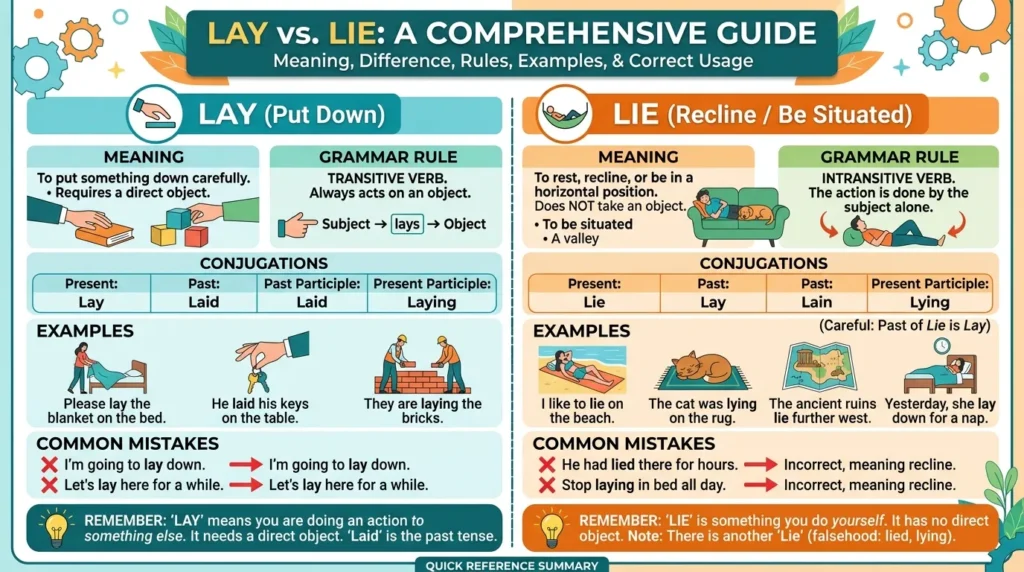
The good news is that the basic difference is simple. Lay usually means to put or place something somewhere, and it normally needs an object. For example, “Please lay the book on the table.” Lie usually means to rest or be in a flat position, and it does not normally take an object. For example, “I need to lie down.”
People search for lay vs lie because these words appear often in everyday English. They are used in conversations, emails, books, news reports, and professional writing. Using the wrong form can make a sentence sound incorrect or unclear.
This guide explains lay vs lie with simple rules, examples, common mistakes, tables, and practical tips.
Lay vs Lie – Quick Answer
The easiest way to understand lay vs lie is:
- Lay = to put or place something somewhere.
- Lie = to rest or be in a flat position.
Lay Examples
Please lay the keys on the table.
She laid the baby on the bed.
He is laying the documents on the desk.
In these examples, something is being placed somewhere.
Lie Examples
I need to lie down.
She is lying on the sofa.
He lay on the bed all morning.
Here, the person or thing is resting or being in a position.
The Most Important Rule
Ask:
Is someone putting something somewhere?
If yes, use lay.
Lay the phone on the table.
Is someone or something resting?
If yes, use lie.
Lie on the bed.
Lay vs Lie Verb Forms
This is where the biggest confusion happens.
| Verb | Present | Past | Past Participle | -ing Form |
|---|---|---|---|---|
| Lay | lay | laid | laid | laying |
| Lie | lie | lay | lain | lying |
Lay
Lay → laid → laid
Examples:
I lay the book on the desk.
Yesterday, I laid the book on the desk.
I have laid the book on the desk.
Lie
Lie → lay → lain
Examples:
I lie on the sofa.
Yesterday, I lay on the sofa.
I have lain on the sofa for an hour.
This is the main reason lay vs lie can feel confusing. The past tense of lie is lay.
The Origin of Lay vs Lie
The words lay and lie have different historical roots, even though their modern forms can be confusing.
Origin of Lay
Lay comes from Old English “lecgan,” meaning to place, put, or set something down.
Its basic meaning has remained connected to placing something in a particular position.
For example:
Lay the book on the table.
The verb requires an object: the book.
Origin of Lie
Lie comes from Old English “licgan,” meaning to rest or be in a horizontal position.
The meaning developed around being in a particular position rather than actively placing something there.
For example:
The book lies on the table.
The book is already in that position.
Why Are They Confused?
The biggest problem is the past tense:
Lie → lay
This means lay can be either:
- the present tense of lay, or
- the past tense of lie.
Compare:
I lay the book down every evening.
Here, lay is the present tense of the verb lay.
Yesterday, I lay on the sofa.
Here, lay is the past tense of lie.
British English vs American English Spelling
There is no major spelling difference between British and American English for lay and lie.
Both varieties use:
- lay
- laid
- lie
- lay
- lain
- laying
- lying
The grammar rules are also essentially the same.
Comparison Table
| Verb Form | British English | American English | Meaning |
|---|---|---|---|
| lay | lay | lay | Put something down |
| laid | laid | laid | Past of lay |
| lie | lie | lie | Rest or recline |
| lay | lay | lay | Past of lie |
| lain | lain | lain | Past participle of lie |
| laying | laying | laying | -ing form of lay |
| lying | lying | lying | -ing form of lie |
Examples
British English:
I laid the papers on the desk.
American English:
I laid the papers on the desk.
British English:
She is lying on the bed.
American English:
She is lying on the bed.
The forms are the same in both varieties.
Which Spelling Should You Use?
Unlike words such as colour/color, choosing between lay and lie is not about regional spelling. It is about grammar and meaning.
For US English
Use the standard rules:
Please lay the clothes on the bed.
I need to lie down.
For UK and Commonwealth English
Use the same rules:
She laid the baby in the crib.
He is lying on the sofa.
For Global English
The same distinction works for international readers.
Remember:
Lay = put something somewhere.
Lie = rest somewhere.
If you are writing for a professional audience, correct use is more important than regional preference.
Common Mistakes with Lay vs Lie
Mistake 1: “I Need to Lay Down”
This is one of the most common errors.
Incorrect:
I need to lay down.
Correct:
I need to lie down.
Why?
Because you are describing your own action of resting. There is no object.
Mistake 2: “Lay on the Bed”
If you mean the present action of resting, use lie.
Incorrect:
I am going to lay on the bed.
Correct:
I am going to lie on the bed.
Mistake 3: “I Have Laid Down”
Incorrect:
I have laid down for an hour.
Correct:
I have lain down for an hour.
The past participle of lie is lain.
Mistake 4: “He Has Lain the Book”
Incorrect:
He has lain the book on the table.
Correct:
He has laid the book on the table.
The verb lay means to put something somewhere, so its past participle is laid.
Mistake 5: “She Is Laying on the Sofa”
If she is resting, the correct form is:
She is lying on the sofa.
Laying requires an object.
Correct:
She is laying the blanket on the sofa.
Mistake 6: Confusing the Past Forms
Remember:
Lay → laid → laid
Lie → lay → lain
This small chart solves many common errors.
Lay vs Lie in Everyday Examples
In Emails
Lay:
Please lay the documents on my desk.
Lie:
I am feeling tired, so I may lie down after the meeting.
In News
Lay:
Workers laid new cables along the road.
Lie:
The damaged equipment lay on the ground after the accident.
On Social Media
Lay:
I laid my phone on the table and forgot about it.
Lie:
Weekend plan: lie on the sofa and watch movies.
In Formal Writing
Lay:
The technician laid the equipment on a secure surface.
Lie:
The components lie inside the protective enclosure.
In Everyday Conversation
Please lay the plate on the table.
I want to lie down.
Yesterday, I lay in bed all afternoon.
She has laid the clothes on the chair.
He has lain there for hours.
Lay vs Lie – Comparison Table
| Situation | Correct Word | Example |
|---|---|---|
| Put an object somewhere | lay | Lay the book on the desk. |
| Rest yourself | lie | Lie on the sofa. |
| Past of lay | laid | She laid the book down. |
| Past of lie | lay | She lay on the sofa. |
| Past participle of lay | laid | She has laid the book there. |
| Past participle of lie | lain | She has lain there for hours. |
| Present continuous of lay | laying | He is laying the papers down. |
| Present continuous of lie | lying | He is lying on the bed. |
A Simple Trick to Remember Lay vs Lie
Use the object test.
If There Is an Object → Lay
Ask:
What are you laying?
I am laying the book on the table.
She laid the baby in the crib.
If There Is No Object → Lie
Ask:
Are you resting?
I am lying on the bed.
He lay on the floor.
Another Memory Trick
Think:
Lay = place
Lie = rest
If you can replace the verb with put, use lay.
Lay the phone on the desk.
Put the phone on the desk.
If you can replace it with rest, use lie.
Lie on the sofa.
Rest on the sofa.
Lay vs Lie – Google Trends & Usage Data
Search interest for lay vs lie is mainly connected to English grammar and language learning. Unlike weather or news-related terms, these searches are usually driven by people who want to understand correct English usage.
Interest can be found across English-speaking countries and countries where English is widely studied as a second language. Searches may increase among students, writers, teachers, bloggers, and professionals who want to improve their grammar.
The keyword is especially useful for educational content because lay and lie have several verb forms that can confuse learners.
Search trends can change over time, so exact Google Trends numbers should be checked directly when current statistics are needed. The broader pattern is clear: lay vs lie remains a common English grammar question because the words overlap in form and pronunciation.
FAQs About Lay vs Lie
1. What is the difference between lay and lie?
Lay means to put or place something somewhere. Lie means to rest or be in a horizontal position.
Lay the book down.
Lie on the bed.
2. Is it “lay down” or “lie down”?
The standard form is lie down when you mean to rest.
I need to lie down.
3. Is “I laid down” correct?
Usually, if you mean that you rested, the standard form is:
I lay down.
Laid is used when something is being placed.
I laid the book down.
4. What is the past tense of lie?
The past tense of lie is lay.
Today I lie on the sofa.
Yesterday I lay on the sofa.
5. What is the past tense of lay?
The past tense of lay is laid.
I lay the book here every day.
Yesterday, I laid the book here.
6. Is it “lying” or “laying” on the bed?
Use lying when someone is resting.
She is lying on the bed.
Use laying when someone is putting something somewhere.
She is laying the clothes on the bed.
7. What is the easiest way to remember lay vs lie?
Remember:
Lay = put something down.
Lie = rest.
Also remember the forms:
Lay → laid → laid
Lie → lay → lain
Conclusion
The difference between lay vs lie becomes much easier when you focus on whether an object is involved. Lay means to put or place something somewhere, while lie means to rest or remain in a position.
The most useful rule is simple: lay takes an object, while lie normally does not. For example, “Lay the book on the table” is correct because the book is being placed somewhere. “I need to lie down” is correct because the person is resting.
The verb forms create most of the confusion. Remember that lay → laid → laid, while lie → lay → lain. The past tense of lie is lay, which explains why the words can be difficult to distinguish.
British and American English follow the same basic rules. There is no important regional spelling difference here. Whether you are writing an email, article, school assignment, or professional report, use lay for placing something and lie for resting. Once you remember lay = place and lie = rest, most common mistakes become easy to avoid.