
Imagine you are using your computer, television, or industrial machine when suddenly a lightning strike or power surge hits the electrical system. Within a fraction of a second, the voltage in the electrical line rises far above its normal level. Sensitive equipment may burn, circuits may fail, and expensive systems may stop working. This situation is more common than many people think, especially in areas where lightning, switching operations, or unstable power grids occur.
To prevent such damage, electrical systems use a special safety device called a Surge Protection Device (SPD). This device protects electrical and electronic equipment from sudden voltage spikes by diverting excess energy safely to the ground.
Surge protection devices are used in homes, industries, communication systems, data centers, and modern smart buildings. Without proper surge protection, even a small voltage spike can damage computers, automation systems, medical devices, and power electronics.
In this article, you will learn the Surge Protection Device working principle, types, components, Surge Protection Device applications, and the Surge Protection Device advantages and disadvantages. The goal is to provide a clear and practical understanding of SPDs for electrical students, engineers, technicians, and beginners.
2. What Is a Surge Protection Device (SPD)?
A Surge Protection Device (SPD) is an electrical protection device designed to protect electrical systems, wiring, and connected equipment from transient overvoltages, commonly known as electrical surges. These voltage spikes can occur suddenly and may damage sensitive electronic equipment, insulation, control circuits, and other electrical components.
Meaning of SPD
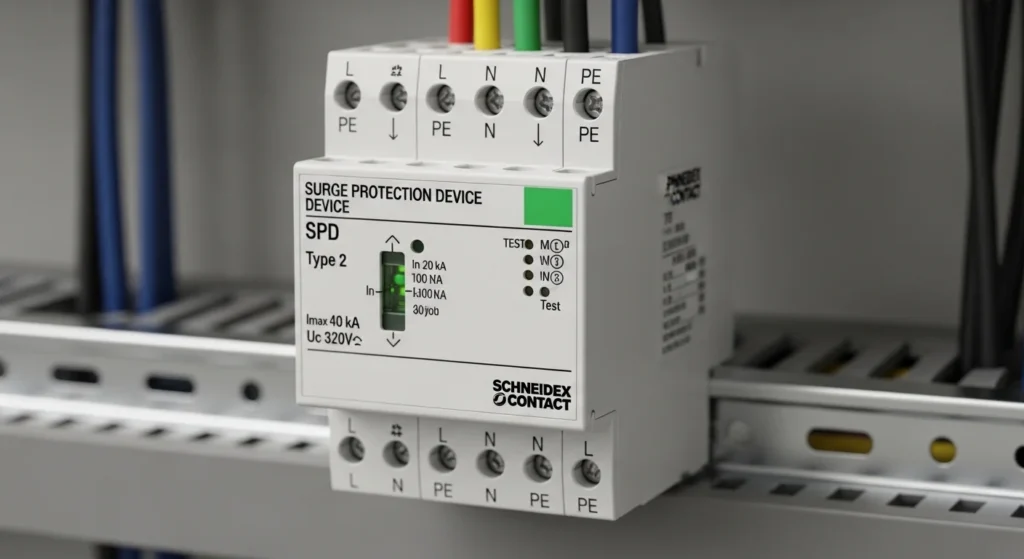
The meaning of SPD is Surge Protection Device. It is an electrical safety device designed to protect electrical systems and connected equipment from sudden voltage surges. An SPD helps control excess voltage by redirecting surge energy to the grounding system, reducing the risk of damage to appliances, wiring, and sensitive electronic devices.
In modern electrical installations, many devices contain sensitive electronic circuits. Computers, televisions, routers, PLCs, inverters, communication equipment, smart appliances, and industrial control systems can be particularly vulnerable to sudden increases in voltage. An SPD helps reduce this risk by providing a controlled path for the surge current.
Simple Explanation
In simple terms, an SPD works like a safety valve for an electrical system.
Under normal operating conditions, the SPD remains inactive and allows the electrical system to operate normally. When a sudden voltage surge occurs, the SPD responds very quickly and provides a low-impedance path for the excess surge current. This helps limit the voltage reaching the protected equipment.
The surge energy is diverted through the appropriate protective path, normally toward the grounding or bonding system, depending on the installation and SPD configuration.
Once the surge has passed and the voltage returns to a normal level, the SPD returns to its normal operating state.
What Is SPD in Electrical?
An SPD, or Surge Protection Device, is an electrical safety device designed to protect equipment from sudden voltage surges. What is an SPD? Simply put, it acts as a first line of defense when excess voltage enters an electrical system.Electrical SPD
An electrical SPD is a device used to protect electrical systems and connected equipment from sudden voltage surges. It works by diverting excess electrical energy away from sensitive components, helping reduce the risk of damage to appliances, wiring, and electronic devices.
How does an SPD work? During a surge, the device provides a low-resistance path for the excess electrical energy and directs it safely to the ground. This helps keep the voltage at a safer level and protects appliances, wiring, and sensitive electronic equipment from potential damage.
Why Are Voltage Surges Dangerous?
Electrical equipment is designed to operate within a specific voltage range. A sudden and short-duration increase in voltage can exceed the insulation and electronic component ratings.
For example, a sensitive electronic device may normally operate from a supply of around 230 V. A transient voltage spike that rises far above the normal operating level, even for a very short period, can stress or damage its internal components.
Possible effects of electrical surges include:
- Damage to electronic circuits
- Breakdown of insulation
- Failure of power supplies
- Damage to control boards
- Reduced equipment lifespan
- Unexpected equipment shutdown
- Data loss in electronic systems
- Permanent failure of sensitive devices
This is why surge protection is important in both residential and industrial electrical installations.
Common Causes of Electrical Surges
Surges can originate from several sources. One of the most serious sources is lightning, but not every surge is caused by a direct lightning strike.
Common causes include:
Lightning
Lightning can produce extremely high electrical energy. A nearby lightning strike can induce a transient voltage into power, communication, or other conductive systems.
A direct lightning event is particularly severe and requires a properly designed lightning protection and grounding system in addition to SPDs.
Switching Operations
Electrical equipment such as motors, transformers, capacitors, and large industrial loads can produce transient overvoltages when they are switched ON or OFF.
These switching surges can occur even during normal operation of an electrical system.
Utility Network Disturbances
Changes in the utility power network, switching operations, and faults can sometimes produce transient voltage disturbances that enter a building’s electrical installation.
Motor and Transformer Switching
Large inductive loads can produce voltage transients when their current is interrupted. These disturbances may affect nearby electrical and electronic equipment.
Practical Example
Consider a modern home containing:
- Computers
- Televisions
- Wi-Fi routers
- Gaming systems
- Smart appliances
- Security cameras
- Solar inverters
- Battery systems
Suppose lightning occurs near an overhead power line. The lightning event can cause a transient voltage disturbance that travels or becomes induced into connected electrical systems.
Without suitable surge protection, the transient may reach sensitive electronic equipment and damage its internal components.
With a correctly selected and installed Surge Protection Device, the transient voltage can be limited and the surge current directed through the intended protective path.
This reduces the stress placed on connected equipment.
How Does an SPD Protect Equipment?
An SPD continuously monitors the voltage condition of the electrical system.
Under normal voltage conditions:
Normal voltage → SPD remains in normal state → Equipment operates normally
When a surge occurs:
Voltage surge → SPD responds → Surge current is diverted → Voltage is limited → Equipment receives better protection
After the transient:
Voltage returns to normal → SPD returns to normal operating condition
The exact internal operating mechanism depends on the type of SPD. Common surge protection technologies include Metal Oxide Varistors (MOVs) and other surge-limiting components designed for transient protection.
Internal SPD
Internal SPD
An internal SPD is a surge protection device installed inside an electrical system or equipment to help control voltage surges. It protects connected components by diverting excess electrical energy away from sensitive circuits. Internal SPDs are often used as part of a wider surge protection system.
External and Integral SPDs
External and integral SPDs provide surge protection at different points within an electrical installation. An external SPD is typically installed separately to protect the electrical system from incoming surges, while an integral SPD is built into or installed as part of equipment. Both help limit excess voltage and reduce the risk of electrical damage.
SPD Does Not Normally Interrupt the Power Supply Like a Circuit Breaker
It is important to understand the difference between an SPD and other electrical protection devices.
A circuit breaker primarily protects electrical circuits against conditions such as overload and short circuit.
An SPD is primarily designed to protect against short-duration transient overvoltages.
For example:
| Device | Main Protection |
|---|---|
| Circuit Breaker | Overload and short circuit |
| Fuse | Overcurrent |
| RCD/RCCB | Leakage/residual current protection |
| SPD | Transient overvoltage/surge protection |
These devices perform different functions and may be used together in a properly designed electrical installation.
How Do SPDs Work?
How do SPDs work? Surge Protection Devices work by detecting excess voltage and providing a safe path for the extra electrical energy. During a voltage surge, the SPD redirects the excess energy toward the grounding system, helping keep the voltage at a safer level. This reduces the risk of damage to electrical equipment and sensitive electronic devices.
Where Is an SPD Installed?
SPDs can be installed at different points within an electrical system depending on the protection requirements.
Common installation locations include:
- Main distribution boards
- Sub-distribution boards
- Industrial control panels
- Data and communication systems
- Solar PV systems
- Generator installations
- Telecommunications systems
- Sensitive electronic equipment
A properly designed system may use more than one SPD to provide protection at different levels of the installation.
Importance of Proper Grounding
An SPD depends on the installation’s protective conductor, grounding, and bonding arrangement to perform its intended function.
A poor grounding or bonding system can reduce the effectiveness of surge protection.
Therefore, installing an SPD is not simply a matter of connecting a device inside a distribution board. The complete protection system should be designed properly, including:
- Appropriate SPD selection
- Correct conductor sizing
- Short and suitable connection paths
- Proper grounding and bonding
- Correct protective device coordination
- Compliance with applicable electrical standards
Are SPDs Necessary for Modern Electrical Systems?
Modern electrical systems contain an increasing number of sensitive electronic devices. Even equipment that is not directly connected to the utility supply may communicate through data, control, or communication cables that can also be exposed to transient disturbances.
For this reason, surge protection is increasingly important in:
- Residential buildings
- Commercial buildings
- Data centers
- Manufacturing facilities
- Renewable energy installations
- Automation systems
- Telecommunications facilities
An SPD does not eliminate every possible surge-related risk, and it should not be considered a substitute for a complete lightning protection, grounding, or electrical protection system. Instead, it forms an important part of a comprehensive protection strategy.
Key Characteristics of a Surge Protection Device
A good SPD installation should provide:
- Very fast response to transient overvoltage
- Effective voltage limiting
- A suitable surge current handling capability
- Compatibility with the electrical system voltage
- Proper coordination with other protective devices
- Reliable grounding and bonding
- Clear status indication where provided
- Appropriate protection for the installation environment
Simple Real-Life Analogy
Imagine a water pipeline operating at normal pressure. If pressure suddenly becomes too high, a safety valve can provide a controlled path to reduce the dangerous pressure.
An SPD performs a similar protective function in an electrical system.
Normal voltage = Normal water pressure
Voltage surge = Sudden high water pressure
SPD = Safety valve
Protected equipment = Equipment connected to the pipeline
This analogy makes it easier to understand the basic purpose of an SPD.
Important Note for Beginners
An SPD should always be selected according to the electrical system configuration, operating voltage, expected surge environment, installation location, and applicable standards. Simply choosing the largest available SPD does not automatically provide the best protection.
Installation should be carried out by a qualified electrical professional, particularly in main distribution boards, industrial systems, and high-energy installations.
A Surge Protection Device (SPD) is an important component of modern electrical protection systems. Its primary purpose is to limit transient overvoltages and provide a controlled path for surge current, helping protect electrical equipment from potentially damaging voltage spikes.
SPDs are particularly valuable where sensitive electronic equipment, automation systems, communication equipment, solar installations, or other high-value electrical devices are present. When properly selected, installed, grounded, and coordinated with other protective devices, an SPD can significantly improve the overall resilience and reliability of an electrical installation.
3. Surge Protection Device Working Principle
The Surge Protection Device working principle is based on rapidly responding to a transient overvoltage and providing a controlled, low-impedance path for the surge current. Under normal operating conditions, the SPD has little or no effect on the electrical circuit. When a sudden voltage spike occurs, the SPD changes its electrical behavior and helps limit the voltage that reaches connected equipment.
The main purpose is not to stop normal current flow but to reduce the damaging effect of short-duration voltage surges caused by events such as lightning or switching operations.
Step-by-Step Operation of an SPD
Step 1: Normal Operating Condition
During normal operation, the electrical system operates within its designed voltage range.
The SPD remains in its normal standby state and does not intentionally conduct significant surge current. Electrical power therefore continues to supply the connected loads normally.
For example, in a typical low-voltage AC installation, the SPD remains ready to respond while appliances, motors, lighting, and electronic equipment operate normally.
Step 2: A Transient Voltage Surge Occurs
A sudden increase in voltage can occur because of:
- Nearby or direct lightning activity
- Utility switching operations
- Switching of motors and transformers
- Capacitor switching
- Electrical faults or disturbances
The voltage may rise much higher than the normal system voltage for a very short period.
Step 3: The SPD Responds to the Surge
When the transient voltage reaches the SPD’s operating threshold, its internal protective components respond rapidly.
Common SPD technologies include Metal Oxide Varistors (MOVs) and other voltage-limiting or switching components.
The important point is that the SPD changes from its normal high-impedance condition and provides a suitable path for the surge current.
Step 4: Surge Current Is Diverted
The SPD provides a low-impedance path that allows much of the surge current to be diverted away from the protected equipment through the intended protective conductor and bonding arrangement.
A simplified path can be represented as:
Voltage Surge → SPD → Protective Path → Grounding/Bonding System
This helps reduce the amount of transient energy and voltage stress imposed on downstream equipment.
Step 5: Voltage Is Limited
As the SPD conducts the surge current, it helps clamp or limit the voltage to a safer level for the protected electrical system.
The actual protection level depends on the SPD design, installation arrangement, wiring, grounding and bonding, and characteristics of the incoming surge.
It is important to understand that an SPD does not necessarily reduce the surge to zero. Instead, its purpose is to limit the transient to a level that reduces the risk of damage.
Step 6: The Surge Disappears
Once the transient voltage falls back toward the normal operating range, the SPD stops conducting the surge current.
It then returns to its normal standby condition and remains ready to respond to another transient event.
This allows the electrical system to continue operating normally after a temporary surge.
Simple Analogy: Pressure Relief Valve
An easy way to understand an SPD is to compare it with a pressure relief valve in a water pipeline.
Under normal conditions, water flows through the pipeline normally and the relief valve remains closed.
If pressure suddenly becomes too high, the relief valve opens and provides a path for the excess pressure, helping protect the pipeline from damage.
An SPD works in a similar way:
Normal voltage → SPD remains in standby
Excessive transient voltage → SPD conducts
Surge current → Diverted through the protective path
Voltage returns to normal → SPD returns to standby
This analogy helps explain why an SPD is sometimes described as a protective valve for an electrical system.
What Happens Inside a Typical SPD?
The exact operation depends on the SPD technology.
For example, an SPD using an MOV normally has high resistance at the system’s normal operating voltage. When a transient voltage rises above its designed operating region, the MOV’s resistance decreases significantly.
This allows surge current to pass through the protective device instead of allowing the full transient voltage to appear across the protected equipment.
After the transient disappears, the MOV returns toward its normal high-resistance state.
Modern SPDs may also use other technologies or combinations of components depending on the application and protection requirements.
Why Does an SPD Respond So Quickly?
Electrical surges are usually very short-duration events. Therefore, surge protection must respond extremely quickly.
Many SPDs are designed to respond on a microsecond-scale timescale, depending on the technology and test conditions.
This rapid response is important because sensitive electronic components can be damaged by a transient before a conventional protective device designed for overcurrent conditions has time to respond.
For this reason, an SPD and a circuit breaker should not be considered interchangeable.
Key Functions of an SPD
A properly selected SPD performs several important functions:
- Limits transient overvoltage
- Diverts surge current through an intended protective path
- Reduces voltage stress on connected equipment
- Protects sensitive electronic components
- Helps reduce the risk of surge-related equipment damage
- Returns to normal operation after a temporary transient
- Provides a first level of defense against electrical surges
SPD Working Principle in a Home
Consider a house containing a television, computer, refrigerator, Wi-Fi router, and other electronic equipment.
Under normal conditions:
Utility Supply → Distribution Board → SPD + Electrical Loads
The SPD remains in standby while the equipment operates normally.
If a nearby lightning event produces a transient on the electrical network, the voltage may rise suddenly.
The SPD responds and provides a low-impedance path for the surge current. This helps limit the transient voltage reaching the connected equipment.
The equipment may therefore experience significantly less electrical stress than it would without suitable surge protection.
SPD Working Principle in an Industrial System
In an industrial facility, large motors, transformers, contactors, variable-frequency drives, PLCs, sensors, and communication equipment can be exposed to switching transients.
For example, switching a large inductive motor can create a transient voltage disturbance.
A properly installed SPD can help limit these transient overvoltages and reduce the stress placed on sensitive control and automation equipment.
This is especially important in systems where an electronic failure could cause:
- Production downtime
- Equipment damage
- Data loss
- Control-system malfunction
- Expensive maintenance
SPD and Grounding System
The effectiveness of an SPD depends heavily on the overall installation.
An SPD must be connected using an appropriate protective path. Short, properly routed connections and effective grounding and bonding are important because excessive connection length or impedance can reduce the effectiveness of surge protection.
Therefore, installing an SPD without considering the grounding and bonding system may not provide the expected level of protection.
Important Difference Between Surge Protection and Overcurrent Protection
An SPD is primarily designed for transient overvoltage protection, while circuit breakers and fuses are primarily designed to protect against overcurrent conditions.
| Device | Primary Function |
|---|---|
| SPD | Limits transient overvoltage and diverts surge current |
| Circuit Breaker | Protects against overload and short-circuit current |
| Fuse | Provides overcurrent protection |
| RCD/RCCB | Detects residual/leakage current |
These devices often work together as part of a complete electrical protection system.
Important Note
An SPD does not guarantee that electrical equipment can never be damaged by a surge. Its effectiveness depends on correct device selection, installation, grounding, bonding, wiring arrangement, coordination with other SPDs, and the severity and source of the surge.
For high-risk installations, surge protection should be designed as part of a complete electrical and lightning protection strategy.
In Simple Words
The complete Surge Protection Device working principle can be summarized in six steps:
- Normal voltage: SPD remains in standby.
- Voltage surge: A transient voltage rises suddenly.
- Detection/response: SPD reacts when the voltage reaches its operating region.
- Conduction: The SPD provides a low-impedance path.
- Diversion: Surge current is directed through the intended protective path.
- Recovery: When the surge ends, the SPD returns to its normal state.
In simple terms, an SPD does not control the normal electrical supply; it acts quickly when a dangerous transient appears and helps prevent excessive voltage from reaching sensitive equipment.
4. Types of Surge Protection Devices
Surge protection devices are classified based on installation location and protection level.
Type 1 Surge Protection Device (SPD)
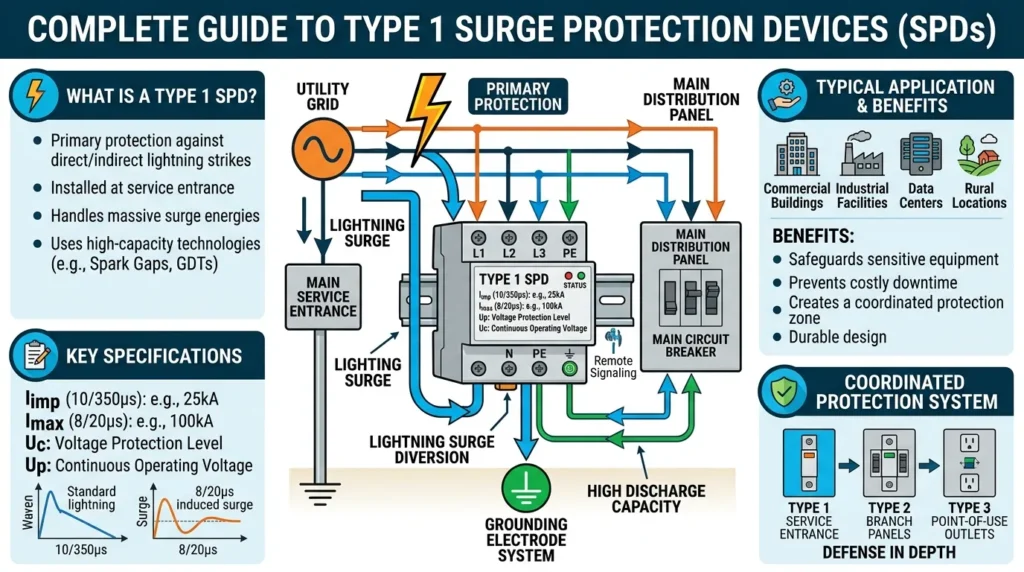
A Type 1 Surge Protection Device (SPD) is designed to provide the first level of surge protection for an electrical installation. It is typically installed at or near the main service entrance, where electrical power enters a building. Its primary purpose is to handle high-energy surge currents associated with lightning-related events and protect the building’s downstream electrical system.
Type 1 SPDs are especially important in buildings that have a lightning protection system or installations exposed to a high risk of lightning-related surges. They help reduce the amount of surge energy that can enter the internal electrical distribution network.
Where Is a Type 1 SPD Installed?
A Type 1 SPD is normally installed near the origin of the electrical installation, such as the main distribution board or service entrance.
A simplified arrangement is:
Utility Supply → Main Service Entrance → Type 1 SPD → Main Distribution Board → Building Loads
The exact installation arrangement depends on the electrical system, local regulations, and the protection strategy used for the building.
Working Principle of Type 1 SPD
Under normal operating conditions, the Type 1 SPD remains in its normal standby state.
When a high-energy transient caused by lightning or another major surge event reaches the installation, the SPD responds rapidly and provides a controlled path for the surge current. This helps limit the transient voltage and reduces the amount of surge energy entering the building’s internal electrical system.
The basic process is:
- Normal voltage enters the building.
- A high-energy surge occurs.
- The Type 1 SPD responds rapidly.
- Surge current is diverted through the intended protective path.
- The voltage reaching downstream equipment is limited.
- The SPD returns to its normal state after the transient.
Main Features of Type 1 SPD
Type 1 SPDs have several important characteristics:
- Designed for high-energy surge events
- Installed at or near the main service entrance
- Provides the first stage of surge protection
- Suitable for buildings exposed to significant lightning risk
- Can be used as part of a coordinated multi-stage SPD system
- Helps protect downstream distribution equipment
- Common in commercial and industrial installations
Type 1 SPD and Lightning Protection
Type 1 SPDs are particularly relevant where a building has an external lightning protection system or where lightning-related surge currents may enter through the electrical supply.
However, a Type 1 SPD should not be considered a complete substitute for a lightning protection system. Building protection may require coordinated measures involving air terminals, down conductors, grounding, bonding, and surge protection.
Applications of Type 1 SPD
Type 1 SPDs are commonly considered for:
- Industrial buildings
- Commercial buildings
- Large electrical installations
- Facilities with external lightning protection systems
- Main electrical service entrances
- Critical infrastructure
- Buildings in areas with significant lightning exposure
Important Note
The correct Type 1 SPD must be selected according to the electrical system configuration, voltage, expected surge environment, grounding arrangement, and applicable electrical standards. Installation should be performed by a qualified electrical professional.
In simple terms, a Type 1 SPD acts as the first protective barrier at the entrance of an electrical installation, helping manage high-energy surges before they travel deeper into the building’s electrical distribution system.
Type 2 Surge Protection Device (SPD)
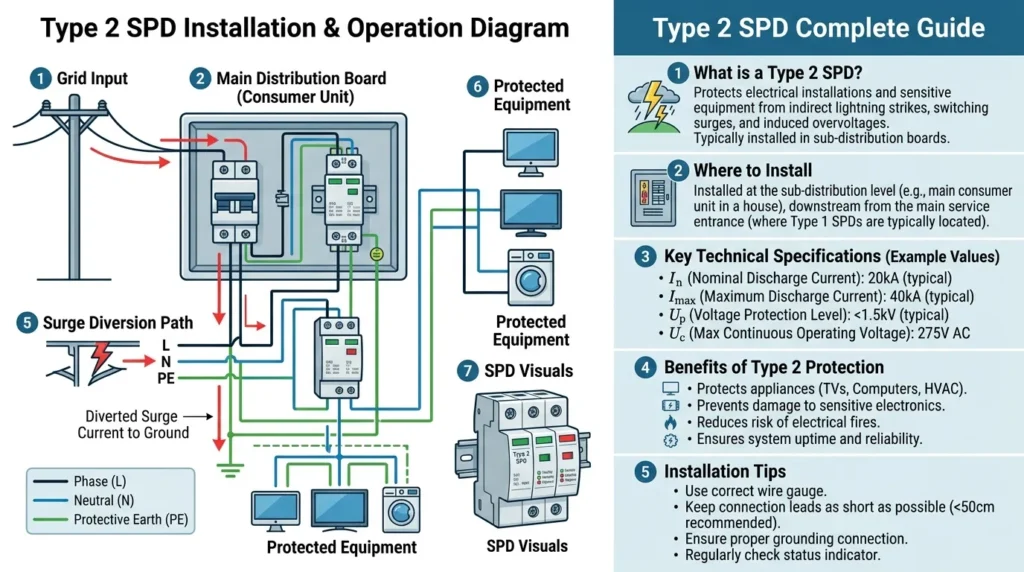
A Type 2 Surge Protection Device (SPD) is a secondary surge protection device installed within an electrical installation to protect downstream circuits, distribution boards, and connected equipment from transient overvoltages. It is commonly installed in main distribution boards (MDBs), sub-distribution boards, and consumer units, depending on the design of the electrical system.
While a Type 1 SPD is primarily intended to handle high-energy surge currents at the service entrance, a Type 2 SPD provides protection against residual surges and switching-related transient overvoltages that may remain within the electrical installation.
Type 2 SPDs are widely used in residential, commercial, and industrial electrical systems because modern buildings contain many sensitive electronic devices that can be affected by transient voltage disturbances.
Where Is a Type 2 SPD Installed?
A Type 2 SPD is normally installed inside the building’s electrical distribution system, such as a main distribution board or sub-distribution board.
A simplified arrangement can be shown as:
Utility Supply → Main Distribution Board → Type 2 SPD → Distribution Circuits → Electrical Loads
The exact location depends on the electrical installation design and the required protection level.
In larger installations, Type 2 SPDs may be installed at several distribution points to provide coordinated protection throughout the building.
Working Principle of Type 2 SPD
Under normal operating conditions, the Type 2 SPD remains in its normal standby state and allows the electrical system to operate normally.
When a transient overvoltage occurs, the SPD responds rapidly and provides a low-impedance path for the surge current through the intended protective conductor and grounding/bonding arrangement.
This action helps limit the transient voltage and reduce the electrical stress placed on downstream equipment.
The basic process is:
- Electrical equipment operates under normal voltage.
- A transient surge enters or develops within the electrical installation.
- The Type 2 SPD responds to the excessive transient voltage.
- The SPD conducts the surge current through the intended protective path.
- The transient voltage reaching downstream circuits is limited.
- After the surge disappears, the SPD returns to its normal operating condition.
Main Features of Type 2 SPD
Type 2 SPDs provide several important benefits:
- Protect downstream electrical circuits
- Limit residual transient overvoltages
- Help protect sensitive electronic equipment
- Suitable for installation in distribution boards
- Commonly used in residential and commercial buildings
- Can be used in industrial electrical systems
- Provide a second level of surge protection
- Can be coordinated with Type 1 and Type 3 SPDs
Type 2 SPD for Residential Buildings
Type 2 SPDs are commonly used in modern homes because residential electrical systems contain many electronic devices.
Examples include:
- Televisions
- Computers
- Wi-Fi routers
- Refrigerators
- Washing machines
- Smart-home equipment
- Security systems
- Solar inverters
- Battery storage systems
A Type 2 SPD installed in the distribution board can help reduce transient voltage stress on these devices.
Type 2 SPD for Commercial and Industrial Systems
Commercial and industrial buildings often contain more complex electrical systems and sensitive equipment.
Type 2 SPDs may be installed to provide protection for:
- Office equipment
- HVAC systems
- Control panels
- PLC systems
- Automation equipment
- Variable-frequency drives
- Lighting systems
- Communication equipment
- Industrial machinery
In industrial applications, proper coordination between different stages of surge protection is particularly important.
Type 2 SPD as Secondary Protection
A Type 2 SPD is generally considered a secondary level of surge protection.
A multi-stage protection system may use:
Type 1 SPD → Type 2 SPD → Type 3 SPD → Sensitive Equipment
Each stage serves a different protection role.
Type 1 protection is generally associated with the service entrance and high-energy surge events, Type 2 protection is installed within distribution systems, and Type 3 protection is typically placed closer to sensitive end equipment.
The exact arrangement depends on the electrical installation and applicable standards.
Advantages of Type 2 SPD
Type 2 SPDs offer several practical advantages:
- Help protect internal electrical circuits.
- Reduce transient voltage stress.
- Protect sensitive electronic equipment.
- Suitable for many residential installations.
- Useful in commercial and industrial distribution systems.
- Can provide coordinated protection with other SPD types.
- Help improve the reliability of electrical and electronic equipment.
Important Installation Considerations
The performance of a Type 2 SPD depends not only on the device itself but also on its installation.
Important factors include:
- Correct system voltage
- Correct SPD configuration
- Proper protective conductor connection
- Effective grounding and bonding
- Short and suitable connection conductors
- Appropriate upstream protection
- Coordination with other SPDs
- Compliance with applicable electrical standards
An incorrectly installed SPD may not provide its intended level of protection.
Simple Practical Example
Imagine a house with a main distribution board supplying several rooms. A switching event on the electrical network creates a transient voltage inside the installation.
The Type 2 SPD installed in the distribution board responds to the transient and helps limit the voltage before it reaches sensitive loads such as computers, televisions, routers, and other electronic equipment.
In this way, the Type 2 SPD acts as a secondary protective barrier within the building’s electrical distribution system.
In Simple Words
A Type 2 SPD is an important secondary surge protection device installed inside an electrical distribution system. Its main purpose is to limit transient overvoltages and help protect internal circuits and connected electrical equipment.
It is widely used in residential, commercial, and industrial buildings and can form an important part of a coordinated surge protection system. When correctly selected, installed, and coordinated with other protective devices, a Type 2 SPD can significantly reduce the risk of damage caused by transient voltage surges.
Type 3 Surge Protection Device (SPD)
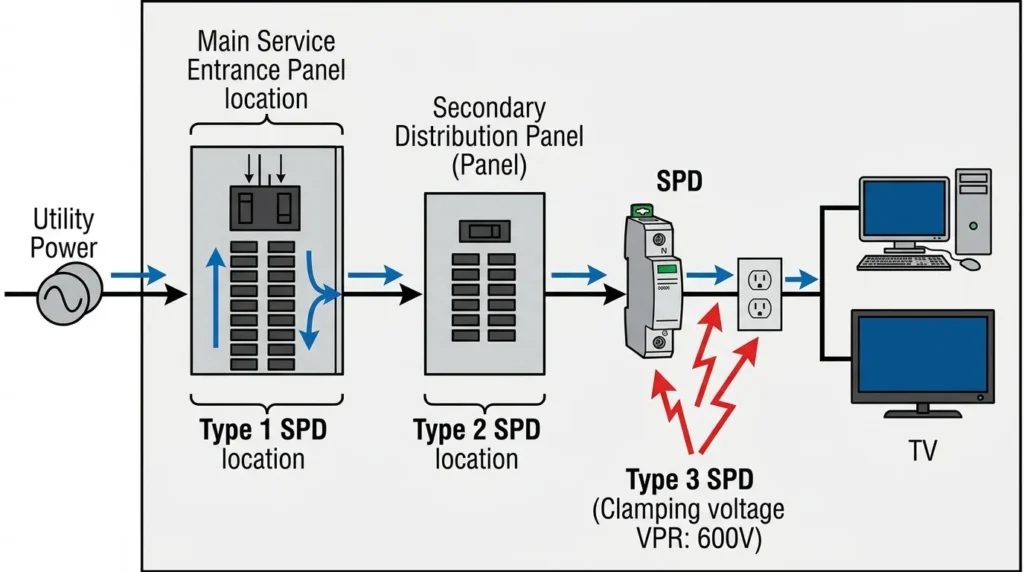
A Type 3 Surge Protection Device (SPD) is designed to provide the final stage of surge protection for individual electrical and electronic equipment. Unlike Type 1 and Type 2 SPDs, which are generally installed at the service entrance or distribution boards, Type 3 SPDs are installed close to sensitive end-use equipment.
They are commonly used in residential, commercial, and office environments to provide additional protection against residual transient overvoltages that may remain after upstream surge protection devices have operated.
Type 3 SPDs are especially useful for sensitive electronic devices such as computers, televisions, printers, networking equipment, and other office electronics.
Where Is a Type 3 SPD Installed?
Type 3 SPDs are normally installed close to the equipment they are intended to protect.
Common examples include:
- Plug-in surge protectors
- Surge-protected power strips
- Socket-outlet surge protectors
- Equipment-level surge protection modules
A simplified protection arrangement is:
Main Supply → Type 1/Type 2 SPD → Distribution Circuit → Type 3 SPD → Sensitive Equipment
The exact arrangement depends on the electrical installation and the applicable protection requirements.
Working Principle of Type 3 SPD
Under normal operating conditions, the Type 3 SPD allows the electrical equipment to operate normally.
When a residual transient voltage reaches the protected circuit, the Type 3 SPD responds rapidly and helps limit the transient voltage at the equipment terminals.
The basic operation is:
- The electrical equipment operates at normal voltage.
- A transient voltage reaches the final circuit.
- The Type 3 SPD responds to the transient.
- Surge current is directed through the protective path.
- The voltage stress on the connected equipment is reduced.
- The SPD returns to its normal state after the transient ends.
Common Examples of Type 3 SPDs
Plug-In Surge Protectors
Plug-in SPDs are connected directly to an electrical socket and provide surge protection for equipment connected through them.
They are commonly used for:
- Computers
- Monitors
- Televisions
- Gaming systems
- Printers
- Routers
- Small office equipment
Surge Protection Power Strips
A surge-protected power strip combines multiple electrical outlets with an internal surge protection device.
This allows several devices to receive power while providing an additional layer of transient protection.
However, not every power strip provides genuine surge protection. Users should check the manufacturer’s specifications and protection ratings rather than assuming that a standard extension strip provides surge protection.
Socket-Outlet Surge Protection
Some electrical installations use surge-protection devices integrated into or installed near socket outlets. These can provide localized protection for equipment connected at that point.
Applications of Type 3 SPD
Type 3 SPDs are commonly used to protect sensitive equipment such as:
- Desktop computers
- Laptops
- Televisions
- Printers
- Wi-Fi routers
- Modems
- Audio systems
- Office electronics
- Security equipment
- Small electronic appliances
They are particularly useful where equipment contains sensitive electronic circuits that may be affected by transient voltage disturbances.
Advantages of Type 3 SPD
Type 3 SPDs offer several practical benefits:
- Provide equipment-level surge protection.
- Can be installed close to sensitive devices.
- Easy to use in plug-in applications.
- Suitable for homes and offices.
- Help reduce residual transient voltage.
- Provide an additional protection layer after upstream SPDs.
- Useful for sensitive electronic equipment.
Limitations of Type 3 SPD
Type 3 SPDs also have some limitations.
Not Designed as the Main Surge Protection
A Type 3 SPD should generally not be treated as a replacement for properly designed upstream surge protection.
It is intended to provide additional protection close to sensitive equipment.
Limited Surge Energy Capability
Because Type 3 SPDs are designed for equipment-level protection, their surge-handling capability is generally lower than that of appropriately selected upstream Type 1 or Type 2 devices.
Requires Proper Upstream Protection
For effective overall protection, Type 3 SPDs are normally used as part of a coordinated surge protection system rather than as the only protective device.
Device Replacement May Be Necessary
Some plug-in surge protectors contain components that can degrade after repeated or severe surge events. Devices with an end-of-life indicator should be replaced when the manufacturer indicates that protection has been exhausted.
Type 3 SPD vs Type 1 and Type 2 SPD
| Feature | Type 1 SPD | Type 2 SPD | Type 3 SPD |
|---|---|---|---|
| Typical location | Service entrance | Distribution board | Near end equipment |
| Main purpose | High-energy surge protection | Distribution-level protection | Equipment-level protection |
| Typical use | Main electrical installation | Internal circuits | Sensitive electronics |
| Example | Service entrance SPD | Panel-mounted SPD | Plug-in surge protector |
| Protection level | Primary | Secondary | Final/local protection |
These categories should be understood as parts of a coordinated protection strategy. The exact requirements and terminology depend on the applicable electrical standards.
Practical Example
Consider an office with a computer, monitor, printer, and Wi-Fi router.
A Type 2 SPD may be installed in the building’s distribution board to protect the internal electrical circuits. A Type 3 SPD can then be placed close to the computer equipment.
If a residual transient reaches the final circuit, the Type 3 SPD provides an additional layer of protection close to the connected electronic devices.
This multi-level approach can improve the overall protection of sensitive equipment.
Important Note
A Type 3 SPD should be selected according to the equipment voltage, installation arrangement, protection requirements, and applicable standards. It should also be used with properly designed upstream electrical protection.
For valuable or critical electronic equipment, relying only on a plug-in surge protector may not provide comprehensive protection against all surge sources.
In Simple Words
A Type 3 Surge Protection Device (SPD) is the final or equipment-level stage of surge protection. It is installed close to sensitive electrical and electronic equipment and helps limit residual transient overvoltages.
Type 1 protects near the service entrance, Type 2 protects distribution circuits, and Type 3 provides additional protection close to sensitive equipment.
Together, these protection stages can form a coordinated approach to reducing the risk of surge-related damage in modern electrical systems.
Combined Surge Protection Device (SPD)
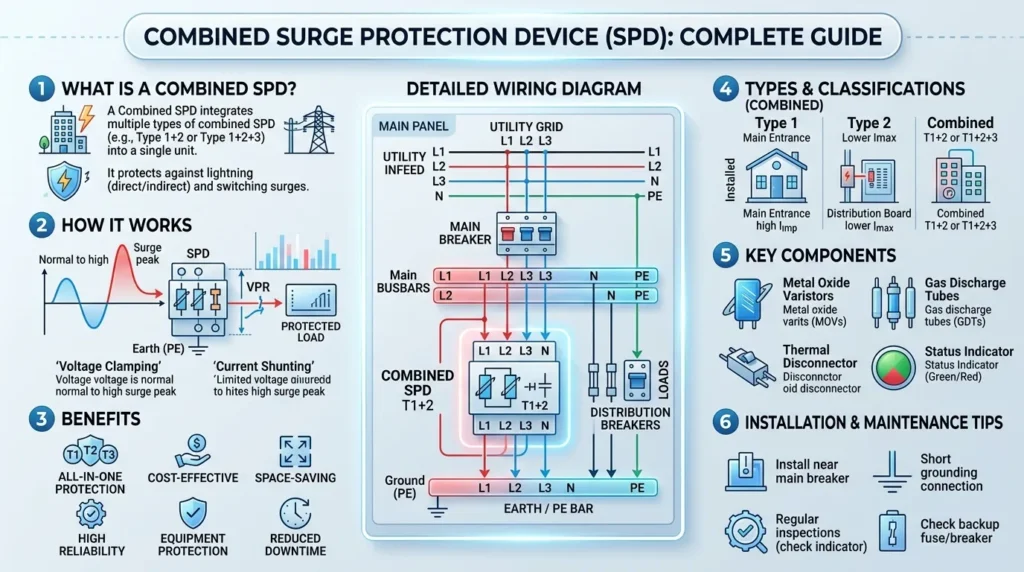
A Combined Surge Protection Device (SPD) is a modern surge protection solution that integrates the functions or protection characteristics of more than one SPD type into a single coordinated device. These SPDs are designed to provide effective protection against different levels of transient overvoltage within an electrical installation.
Instead of using separate protection devices for every stage, a combined SPD can incorporate multiple protection technologies or stages within one assembly. This makes it particularly useful in electrical systems where high reliability, compact installation, and coordinated surge protection are important.
Combined SPDs are commonly considered for critical installations such as data centers, industrial automation systems, communication facilities, renewable energy systems, and other installations containing sensitive electronic equipment.
What Is the Purpose of a Combined SPD?
The main purpose of a combined SPD is to provide multi-level surge protection in a coordinated arrangement.
A conventional surge protection system may use separate devices at different points:
Service Entrance → Distribution Board → Sensitive Equipment
A combined SPD may integrate multiple protective functions into one device or assembly, depending on its design and certification.
This can simplify the protection arrangement while providing suitable protection against both high-energy and residual transient disturbances.
Working Principle of a Combined SPD
The working principle depends on the internal design of the device.
Under normal operating conditions, the SPD remains in its normal standby state and allows the electrical system to operate normally.
When a transient overvoltage occurs, the appropriate internal protection stage responds rapidly. The device then helps divert the surge current through the intended protective path and limits the voltage reaching the protected circuit.
The basic process is:
- Normal operation: The combined SPD remains in standby.
- Transient occurs: A sudden voltage surge appears in the electrical system.
- Protection stage responds: The appropriate internal surge protection components activate.
- Surge current is diverted: Excess surge energy is directed through the protective path.
- Voltage is limited: The transient voltage reaching downstream equipment is reduced.
- Normal operation resumes: After the surge disappears, the device returns to its normal operating condition.
Main Features of Combined SPDs
Combined SPDs can offer several important features:
- Integrated surge protection
- Multiple protection stages or technologies
- Compact installation
- Reduced panel space requirements
- Coordinated surge protection
- Suitable for sensitive electronic systems
- High reliability when correctly selected and installed
- Useful for complex electrical installations
The exact features vary by manufacturer and device design, so the product’s technical specifications should always be checked.
Combined SPD in Data Centers
Data centers contain highly sensitive and expensive equipment, including:
- Servers
- Network switches
- Storage systems
- Communication equipment
- Power distribution equipment
- UPS systems
- Monitoring systems
- Cooling controls
A transient voltage disturbance can cause equipment malfunction, data loss, or service interruption.
For this reason, surge protection is normally designed as part of a broader electrical protection strategy. Combined SPD solutions may be useful where multiple protection requirements need to be addressed within a coordinated system.
Combined SPD in Industrial Automation
Modern industrial facilities use PLCs, sensors, HMIs, variable-frequency drives, industrial computers, and communication networks.
These systems can be sensitive to transient disturbances caused by lightning, switching operations, motors, transformers, and other electrical equipment.
A properly selected combined SPD can help reduce transient voltage stress and improve the resilience of automation equipment.
Combined SPD in Renewable Energy Systems
Solar PV installations and battery energy storage systems contain electronic equipment that can be sensitive to transient overvoltages.
Depending on the system design, surge protection may be required on:
- AC circuits
- DC circuits
- Communication lines
- Control circuits
Combined or coordinated SPD solutions can be considered where multiple protection requirements exist.
Advantages of Combined SPD
1. Integrated Protection
Multiple protective functions can be incorporated into one device or assembly, simplifying the overall protection arrangement.
2. Space Saving
Combining protection stages can reduce the amount of panel space required compared with installing multiple separate devices.
3. Improved Coordination
A properly engineered combined SPD can provide coordinated operation between its internal protection stages.
4. Suitable for Critical Systems
Combined protection solutions can be useful in applications where equipment reliability and continuity are important.
5. Easier Installation
Depending on the design, fewer separate components may be required, which can simplify installation and panel organization.
6. Protection for Sensitive Equipment
Combined SPDs can help reduce transient voltage stress on sensitive electronic and automation equipment.
Limitations of Combined SPD
Despite their advantages, combined SPDs also have some limitations.
Higher Initial Cost
A combined SPD may cost more than a simple single-stage surge protection device.
Requires Correct Selection
The device must be compatible with the electrical system voltage, configuration, grounding arrangement, and expected surge environment.
Replacement Can Be More Complex
If an integrated device reaches its end of service life, the complete unit or a specific module may need to be replaced, depending on its design.
Not a Substitute for Complete Protection
A combined SPD does not eliminate the need for proper grounding, bonding, lightning protection, circuit protection, and appropriate installation practices.
Combined SPD vs Individual SPD Types
| Feature | Individual SPD | Combined SPD |
|---|---|---|
| Protection stages | Usually one primary function | Multiple functions/stages may be integrated |
| Installation | Separate devices may be required | Can reduce the number of separate devices |
| Panel space | May require more space | Often more compact |
| Coordination | Requires coordination between devices | May have integrated coordination |
| Applications | General electrical systems | Complex and critical systems |
| Cost | Often lower initially | May have higher initial cost |
Applications of Combined SPDs
Combined SPDs may be used in:
- Data centers
- Industrial automation systems
- Control panels
- Communication facilities
- Critical infrastructure
- Commercial buildings
- Renewable energy systems
- Manufacturing plants
- Building automation systems
- Sensitive electronic installations
Important Selection Considerations
Before selecting a combined SPD, electrical professionals should consider:
- System voltage
- AC or DC system
- Earthing/grounding arrangement
- Expected surge environment
- Required surge current capability
- Voltage protection level
- Installation location
- Upstream protective devices
- Coordination with other SPDs
- Applicable electrical standards
- Manufacturer’s installation requirements
For critical installations, SPD selection should be part of the overall electrical protection design rather than based only on the device’s physical size or price.
In Simple Words
A Combined Surge Protection Device (SPD) integrates multiple surge protection functions or stages into a single coordinated device or assembly. It is designed to provide effective protection while potentially reducing panel space and simplifying the overall installation.
These devices are particularly useful in data centers, industrial automation systems, communication facilities, and other complex electrical installations where reliable protection of sensitive equipment is important.
However, a combined SPD should always be properly selected, installed, grounded, and coordinated with the rest of the electrical protection system to achieve its intended performance.
5. Main Components of a Surge Protection Device (SPD)
A Surge Protection Device (SPD) contains several important components that work together to detect, limit, and divert transient overvoltages. The exact internal construction depends on the SPD type, application, voltage level, and manufacturer. Some SPDs use a single protection technology, while others combine multiple components to achieve faster response, higher surge-handling capability, and improved safety.
The main components commonly found in surge protection systems include Metal Oxide Varistors (MOVs), Gas Discharge Tubes (GDTs), Transient Voltage Suppression (TVS) diodes, thermal protection mechanisms, disconnect devices, status indicators, and appropriate grounding or bonding connections.
5.1 Metal Oxide Varistor (MOV)
A Metal Oxide Varistor (MOV) is one of the most widely used surge protection components, particularly in low-voltage AC and DC SPDs.
An MOV has a voltage-dependent resistance. Under normal operating voltage, it has relatively high resistance and allows the electrical system to operate normally. When a transient voltage rises above its designed operating region, its resistance decreases significantly, allowing surge current to pass through the protective path.
Function of an MOV
An MOV helps to:
- Respond to excessive transient voltage
- Reduce or clamp the voltage level
- Divert surge current away from protected equipment
- Protect electrical and electronic components
- Handle repeated transient events within its rated capability
Simple Example
Imagine an MOV as an electrical gate that normally remains almost closed. When a dangerous voltage spike appears, the gate opens a path for the surge current, helping prevent excessive voltage from reaching the protected equipment.
MOVs are widely used because they are compact, fast-acting, and suitable for many surge protection applications.
5.2 Gas Discharge Tube (GDT)
A Gas Discharge Tube (GDT) is another technology used in surge protection, particularly where high surge-current handling capability is required.
A GDT contains electrodes separated by a sealed gas-filled space. Under normal voltage conditions, the gas remains non-conductive. When the voltage rises to the device’s specified breakdown level, the gas becomes ionized and the GDT begins conducting.
This creates a low-impedance path for the surge current.
Function of a GDT
A GDT can:
- Handle high surge currents
- Provide strong surge protection
- Isolate the protected circuit under normal conditions
- Divert high-energy transient currents
- Be used in AC, DC, and communication protection applications
GDTs are often used where high-energy surge events are expected.
5.3 Transient Voltage Suppression (TVS) Diode
A Transient Voltage Suppression (TVS) diode is designed to respond extremely quickly to short-duration voltage transients.
TVS devices are commonly used in electronic circuits and low-voltage protection applications where fast response is important.
When the voltage rises above the device’s specified operating range, the TVS diode conducts and limits the transient voltage.
Function of a TVS Diode
TVS diodes help to:
- Protect sensitive electronic circuits
- Respond very quickly to voltage spikes
- Limit transient voltage
- Protect control and communication circuits
- Reduce electrical stress on semiconductor components
TVS diodes are especially useful in electronic equipment because they can respond on a very fast timescale, depending on the device and circuit conditions.
5.4 Thermal Protection Mechanism
Many SPDs, particularly those using MOV technology, include a thermal protection mechanism.
An MOV can generate heat if it experiences excessive energy, repeated surges, or abnormal conditions. If the component becomes overheated, a thermal protection mechanism can disconnect it from the circuit.
Function of Thermal Protection
The thermal protection system helps to:
- Prevent excessive overheating
- Reduce the risk of thermal damage
- Disconnect a failing protective component
- Improve overall SPD safety
- Reduce the risk of damage caused by component failure
This feature is particularly important because an SPD must remain safe even when it reaches the end of its service life.
5.5 Internal Disconnect Device
Many SPDs include an internal or associated disconnect mechanism that separates the surge protection component from the electrical circuit if the device becomes damaged or reaches an unsafe condition.
For example, if an MOV becomes permanently conductive due to severe degradation, the disconnect mechanism can isolate the failed component.
Function
The disconnect mechanism can:
- Isolate a damaged SPD
- Prevent continued overheating
- Improve installation safety
- Help prevent a failed surge protection component from affecting the electrical system
Some SPDs also include a visual indicator that shows whether the protection module is still operational.
5.6 Status Indicator
Modern SPDs often include a status indicator that allows technicians or operators to determine whether the protective device is functioning normally.
A common arrangement uses a simple visual indication such as:
- Green: Protection available
- Red: Protection module requires attention or replacement
However, indicator colors and meanings vary by manufacturer, so the product documentation should always be checked.
Function of a Status Indicator
It helps:
- Identify SPD operating status
- Detect an exhausted protection module
- Simplify maintenance inspections
- Reduce troubleshooting time
- Provide a quick visual indication of device condition
5.7 Grounding and Bonding Connection
The grounding and bonding connection is a critical part of an SPD installation. It provides the intended path through which surge current can be conducted away from the protected circuit.
A simplified protection path can be represented as:
Surge → SPD → Protective Conductor/Bonding Path → Grounding System
The effectiveness of this path depends on proper installation, conductor length, impedance, bonding, and the overall grounding arrangement.
Function of the Grounding Connection
It helps to:
- Provide a controlled path for surge current
- Reduce transient voltage stress
- Improve the effectiveness of the SPD
- Connect the protective system to the building’s grounding/bonding network
An SPD cannot compensate for a poorly designed or improperly installed grounding and bonding system.
5.8 Protective Terminals and Conductors
An SPD requires suitable electrical terminals and conductors to connect it to the electrical system.
These connections may include:
- Line
- Neutral
- Protective earth
- Positive and negative terminals for DC systems
- Communication-line terminals in specialized SPDs
The connection arrangement depends on the electrical system and SPD design.
Why Connection Length Matters
Surge events contain very fast changes in current. Long or poorly routed conductors can introduce additional inductive voltage, reducing the effectiveness of surge protection.
For this reason, SPD installation instructions should be followed carefully, and connection conductors should be routed appropriately.
5.9 Combined Protection Components
Some modern SPDs use more than one protection technology.
For example, an SPD may combine:
GDT + MOV + Thermal Protection
or use other combinations depending on the application.
Combining technologies can provide advantages such as:
- High surge-current capability
- Fast response
- Better voltage limiting
- Improved coordination
- Increased reliability
The exact combination depends on the intended application and the manufacturer’s design.
How These Components Work Together
The components of an SPD do not operate independently. They work together as a coordinated protection system.
A simplified sequence is:
1. Normal voltage → Protective components remain in their normal state
2. Transient voltage occurs → SPD responds
3. MOV, GDT, TVS, or another protective element conducts
4. Surge current is directed through the intended protective path
5. Transient voltage is limited
6. Thermal and disconnect mechanisms provide additional safety if required
7. Status indicator shows the condition of the SPD
8. System returns to normal after the transient
This coordinated operation allows an SPD to respond rapidly while also maintaining safe operation during abnormal or end-of-life conditions.
Important Note for Electrical Technicians
Not every SPD contains all of these components. The internal construction varies according to the SPD type, voltage system, application, surge exposure, protection requirements, and manufacturer.
For example, a simple electronic protection device may use a TVS diode, while a high-energy power SPD may use MOVs, GDTs, thermal protection, disconnect mechanisms, and status indicators.
Therefore, technicians should always check the manufacturer’s technical documentation before testing, installing, or replacing an SPD.
In Simple Words
The main components of a Surge Protection Device work together to provide fast and controlled protection against transient voltage surges. MOVs are widely used for voltage limiting, GDTs can handle high-energy surge currents, and TVS diodes provide very fast protection for sensitive electronic circuits. Thermal protection and disconnect mechanisms improve safety, while status indicators make inspection and maintenance easier.
Most importantly, the SPD must have a properly designed grounding and bonding path. Even a high-quality SPD may not provide its intended protection if it is incorrectly installed or connected to an inadequate protective system.
6. Advantages of Surge Protection Device
There are several Surge Protection Device advantages and disadvantages, but the benefits are significant.
Advantages
- Protects sensitive electronic equipment
- Reduces risk of electrical damage
- Extends lifespan of electrical devices
- Prevents costly downtime in industries
- Improves electrical system reliability
- Protects against lightning-induced surges
Because of these benefits, SPDs are widely recommended in modern electrical systems.
7. Disadvantages / Limitations
Despite their advantages, surge protection devices also have some limitations.
- Limited lifespan due to repeated surges
- Requires proper grounding to work effectively
- May not protect against extremely large lightning strikes
- Needs periodic inspection and replacement
Understanding these limitations helps engineers design better protection systems.
8. Surge Protection Device Applications
Surge Protection Device (SPD) applications can be found in almost every modern electrical installation where electrical and electronic equipment needs protection from transient overvoltages. From residential buildings to large industrial facilities, SPDs help reduce the risk of damage caused by lightning-related surges, switching transients, and other short-duration voltage disturbances.
Modern electrical systems increasingly depend on sensitive electronic components. Computers, PLCs, communication equipment, solar inverters, automation systems, and smart devices can be vulnerable to transient overvoltages. Properly selected and installed SPDs provide an important layer of protection for these systems.
8.1 Residential Buildings
SPDs are commonly used in homes to help protect sensitive electronic equipment from transient voltage disturbances.
Modern houses may contain many electronic devices, including:
- Televisions
- Computers and laptops
- Wi-Fi routers
- Refrigerators
- Washing machines
- Smart-home devices
- Security systems
- Gaming equipment
- Home entertainment systems
- Solar inverters and battery systems
For example, a transient caused by a nearby lightning event or electrical switching operation may enter a building through the electrical supply. A properly installed SPD can help limit the resulting transient voltage and reduce stress on connected equipment.
In residential installations, surge protection may be provided at the main distribution board, with additional equipment-level protection where required.
8.2 Commercial Buildings
Commercial buildings often contain a combination of electrical distribution systems, electronic equipment, communication networks, and building automation systems.
SPDs may be used to protect:
- Office computers
- Printers and scanners
- Networking equipment
- HVAC control systems
- Building management systems
- Security systems
- Access-control equipment
- Lighting control systems
- Electronic appliances
A surge-related failure in a commercial building can cause equipment downtime and interrupt normal business operations. Surge protection therefore forms part of a broader electrical protection strategy.
8.3 Industrial Facilities
Industrial facilities are one of the major Surge Protection Device applications because they contain large amounts of electrical and electronic equipment.
Industrial systems may include:
- Motors
- Motor control centers
- Variable-frequency drives
- PLC systems
- Control panels
- Sensors
- HMIs
- Industrial computers
- Automation systems
- Measurement equipment
Large motors, transformers, contactors, and other inductive equipment can produce switching transients during normal operation. Lightning and external electrical disturbances can also introduce surges into industrial installations.
Properly selected SPDs can help reduce transient voltage stress on sensitive automation and control equipment.
8.4 Control Panels and Automation Systems
Modern control panels rely heavily on electronic components.
SPDs may be used to protect:
- PLCs
- Input/output modules
- Relays
- Sensors
- HMIs
- Controllers
- Communication modules
- Industrial Ethernet equipment
A transient entering a control circuit can cause incorrect signals, equipment malfunction, or unexpected shutdowns.
Surge protection can help improve the reliability of these systems, particularly when combined with proper grounding, bonding, shielding, and wiring practices.
8.5 Data Centers
Data centers require reliable electrical protection because they contain large quantities of sensitive and expensive electronic equipment.
SPDs may be incorporated into the electrical protection strategy for:
- Servers
- Network switches
- Storage systems
- UPS systems
- Power distribution equipment
- Monitoring systems
- Cooling-control systems
- Communication equipment
A surge-related failure in a data center can result in equipment damage, service interruption, and potential data loss. For this reason, surge protection is normally designed as part of a comprehensive power-quality and electrical protection system.
8.6 Telecommunications Systems
Telecommunication installations can be exposed to transient disturbances through both power and communication pathways.
SPDs may be used to protect:
- Communication towers
- Network equipment
- Signal equipment
- Telephone systems
- Radio equipment
- Data communication systems
- Control and monitoring circuits
Protection may be required for both power circuits and communication lines, depending on the installation.
This is especially important for outdoor communication equipment that may be exposed to lightning and other environmental electrical disturbances.
8.7 Solar Power Systems
Solar photovoltaic (PV) systems contain sensitive electronic equipment that can be affected by transient overvoltages.
SPDs may be used on appropriate:
- DC circuits
- AC circuits
- Inverter connections
- Control circuits
- Communication circuits
Solar installations can have long outdoor cable runs, which may increase exposure to induced transient voltages during lightning events.
Proper surge protection, grounding, bonding, and system design are therefore important parts of a reliable solar installation.
8.8 Wind and Renewable Energy Systems
Renewable energy installations such as wind turbines and other distributed-energy systems may contain sensitive control, monitoring, and power-conversion equipment.
SPDs can help protect:
- Control systems
- Monitoring equipment
- Power converters
- Communication systems
- Sensors
- Electrical distribution equipment
The appropriate SPD arrangement depends on the system design and the electrical and environmental conditions at the installation site.
8.9 Hospitals and Critical Facilities
Hospitals and other critical facilities depend on electrical and electronic systems for essential operations.
SPDs may be considered for protecting:
- Medical electronic equipment
- Control systems
- Communication systems
- Building automation
- Emergency power systems
- Data and networking equipment
Because equipment reliability is especially important in critical facilities, surge protection should be integrated into a carefully designed electrical protection system.
8.10 Electrical Substations
Electrical substations contain transformers, switchgear, protection systems, control equipment, and communication systems.
Surge protection may be used to help protect:
- Transformers
- Switchgear
- Control circuits
- Protection relays
- Instrumentation
- Communication equipment
Substation surge protection requires careful engineering because the equipment may be exposed to high-energy transient events.
8.11 Electric Vehicle Charging Systems
Modern EV charging stations contain power electronics, control circuits, communication systems, and sensitive electronic components.
SPDs may be used to help protect:
- EV chargers
- Charging control systems
- Communication interfaces
- Power electronics
- Monitoring equipment
As electric vehicle infrastructure expands, surge protection is becoming an increasingly important consideration in charger installation and electrical system design.
Why Are SPDs Important in These Applications?
Across all these applications, the main purpose of an SPD is to limit transient overvoltages and reduce the electrical stress placed on connected equipment.
However, an SPD should not be viewed as a standalone solution. Effective surge protection depends on several factors, including:
- Correct SPD selection
- Proper installation
- Effective grounding and bonding
- Suitable conductor routing
- Coordination between multiple SPDs
- Appropriate upstream protection
- Compliance with applicable electrical standards
Simple Example
Consider an industrial plant containing a PLC-controlled production line.
If a switching transient occurs on the electrical network, the transient may travel through the distribution system and reach the PLC and other control equipment.
A properly designed surge protection system can help limit the transient before it reaches sensitive components.
This can reduce the likelihood of:
- PLC malfunction
- Control-system failure
- Unexpected machine shutdown
- Electronic component damage
- Production interruptions
Summary of SPD Applications
| Application | Equipment Commonly Protected |
|---|---|
| Residential buildings | TVs, computers, appliances, smart devices |
| Commercial buildings | Office equipment, HVAC, security systems |
| Industrial facilities | Motors, drives, PLCs, control panels |
| Data centers | Servers, networking, UPS systems |
| Telecommunications | Towers, signal and network equipment |
| Solar systems | Inverters, DC/AC circuits, controls |
| Hospitals | Medical electronics, control and communication systems |
| Substations | Transformers, control and protection equipment |
| EV charging | Chargers, control systems, power electronics |
In simple terms, Surge Protection Device applications extend from homes and offices to highly complex industrial and critical infrastructure systems. As electrical installations become more dependent on sensitive electronics, automation, communication, and power electronics, properly designed surge protection becomes increasingly important for improving equipment reliability and reducing the risk of surge-related damage.
9. Comparison: SPD vs Lightning Arrester
Understanding the difference between surge protection device and lightning arrester is important.
| Feature | Surge Protection Device | Lightning Arrester |
|---|---|---|
| Protection Type | Internal electrical surges | Direct lightning strikes |
| Installation | Inside buildings | Outdoor power systems |
| Voltage Level | Low and medium voltage | High voltage transmission lines |
| Response | Protects sensitive electronics | Protects power infrastructure |
Both devices are important but used in different parts of electrical systems.
10. Surge Protection Device Selection Guide
Choosing the right Surge Protection Device (SPD) is important because an incorrectly selected device may not provide adequate protection or may not be compatible with the electrical system. SPD selection should be based on the system voltage, grounding arrangement, installation location, expected surge environment, required protection level, and applicable electrical standards.
For beginners, it is important to understand that there is no single SPD suitable for every electrical installation. A residential distribution board, industrial control panel, solar PV system, and data center may all require different surge protection arrangements.
10.1 Check the System Voltage
The first step is to select an SPD that is compatible with the electrical system voltage.
For example, the SPD must be suitable for the:
- System voltage
- AC or DC supply
- Number of phases
- Frequency, where applicable
- Earthing or grounding arrangement
Installing an SPD with an unsuitable voltage rating can result in poor protection or premature failure.
Always check the manufacturer’s technical specifications before installation.
10.2 Select the Correct SPD Type
The installation location is an important factor in determining the appropriate SPD type.
Type 1 SPD
Generally installed at or near the main service entrance and used where high-energy surge protection is required, particularly in installations exposed to significant lightning risk.
Type 2 SPD
Generally installed in main or sub-distribution boards to protect internal electrical circuits from transient overvoltages.
Type 3 SPD
Installed close to sensitive end-use equipment and provides an additional level of localized protection.
In many installations, different SPD types are coordinated rather than using only one device.
10.3 Check Surge Current Capacity
The SPD should have an appropriate surge-current capability for the expected electrical environment.
Important ratings may include:
- Nominal discharge current (In)
- Maximum discharge current (Imax)
- Impulse current (Iimp) where applicable
These ratings indicate the surge current conditions the device is designed to handle under specified test conditions.
A device installed at a location exposed to higher-energy surges may require a different rating from an SPD installed farther downstream.
10.4 Consider the Voltage Protection Level
The voltage protection level (Up) indicates the level of transient voltage that can remain at the protected side of the SPD under specified test conditions.
Generally, a lower protection level provides greater protection for sensitive equipment, provided the SPD is properly matched to the electrical system.
Sensitive electronic equipment such as:
- Computers
- PLCs
- Communication devices
- Servers
- Control systems
may require careful consideration of the protection level.
However, Up should not be considered in isolation. The complete installation, wiring, grounding, and coordination between SPDs also affect the actual protection achieved.
10.5 Consider the Installation Location
The location where the SPD will be installed strongly influences the selection.
Ask:
- Is it being installed at the service entrance?
- Is it being installed in a distribution board?
- Is it being installed near sensitive equipment?
- Is it part of a solar PV system?
- Is it protecting a communication or control circuit?
The SPD should be selected specifically for its intended installation point.
10.6 Check the Earthing and Grounding Arrangement
The SPD must be compatible with the electrical system’s grounding arrangement.
Different electrical systems may use different configurations, such as:
- TN systems
- TT systems
- IT systems
The correct SPD configuration depends on the system arrangement.
A proper grounding and bonding system is also essential because the SPD requires an effective protective path for surge current.
10.7 Consider the Expected Surge Environment
The expected exposure to surges should also be considered.
Factors may include:
- Lightning activity
- Building location
- External lightning protection system
- Overhead power lines
- Long cable runs
- Industrial switching operations
- Large motors and transformers
- Sensitive electronic equipment
A building in an area with frequent lightning activity may require a more comprehensive surge protection strategy than a low-risk installation.
10.8 Check SPD Standards and Certification
Always select SPDs that comply with the applicable electrical standards and certification requirements for the installation.
Look for appropriate manufacturer documentation showing:
- Tested performance
- Voltage ratings
- Surge-current ratings
- Protection level
- Installation requirements
- Applicable standards
- End-of-life indication, where provided
Avoid selecting an SPD based only on price or appearance.
10.9 Check Backup and Disconnect Protection
Many SPDs require appropriate upstream protection or a backup disconnect arrangement.
Before installation, check the manufacturer’s requirements for:
- Circuit breaker
- Fuse
- Backup protection
- Short-circuit rating
- Maximum permitted backup protection
This helps ensure that the SPD and the electrical installation operate safely during abnormal conditions or SPD failure.
10.10 Consider the Protected Equipment
The type and value of the equipment being protected should also influence the protection strategy.
For example:
Basic household equipment:
A suitable distribution-board SPD may provide an important layer of protection.
Sensitive electronics:
Additional equipment-level protection may be appropriate.
Industrial automation:
Protection may be required for power, control, and communication circuits.
Data centers:
A coordinated and carefully engineered surge protection system is normally required because equipment downtime can be extremely costly.
10.11 Consider Connection Length
The SPD should be installed using the connection arrangement recommended by the manufacturer.
Very long conductors can add impedance and inductive voltage during a fast transient, reducing the effectiveness of the protection.
Therefore:
- Keep SPD connections appropriately short.
- Follow the manufacturer’s wiring instructions.
- Use suitable conductor sizes.
- Maintain proper grounding and bonding.
- Avoid unnecessary conductor loops.
Correct installation is just as important as selecting the correct SPD.
10.12 Consider End-of-Life Indication
Many modern SPDs include a visual or remote indication system that shows whether the protection module is operational.
An end-of-life indicator can help technicians identify when an SPD requires:
- Inspection
- Replacement
- Maintenance
This feature is particularly useful in industrial facilities, commercial buildings, and other installations where regular maintenance is important.
Quick SPD Selection Checklist
Before choosing an SPD, check the following:
| Selection Factor | What to Check |
|---|---|
| System voltage | Match the SPD to the electrical system |
| System type | AC/DC, phase arrangement, grounding system |
| SPD type | Type 1, Type 2, Type 3, or combined |
| Surge capacity | Check Iimp, In, or Imax as applicable |
| Protection level | Check the specified Up |
| Installation location | Service entrance, panel, or equipment level |
| Grounding | Ensure correct grounding and bonding |
| Surge environment | Consider lightning and switching exposure |
| Backup protection | Follow manufacturer’s requirements |
| Standards | Select compliant and properly certified equipment |
| Equipment sensitivity | Consider the value and sensitivity of the load |
| Maintenance | Check status and end-of-life indication |
Tips for Beginners
If you are new to surge protection, do not select an SPD based only on its voltage rating.
A proper selection should consider system configuration, installation location, surge exposure, surge-current capability, voltage protection level, grounding arrangement, and applicable standards.
For residential and commercial installations, following the manufacturer’s installation instructions and consulting a qualified electrician is recommended.
For industrial facilities, data centers, substations, solar installations, and other critical systems, SPD selection should be carried out as part of a complete electrical protection design by a qualified electrical engineer or specialist.
Final Selection Advice
The best Surge Protection Device is not necessarily the most expensive device or the one with the highest surge-current rating. It is the device that is correctly matched to the electrical system, installation location, expected surge environment, and equipment being protected.
Proper coordination between Type 1, Type 2, and Type 3 SPDs can provide a more effective protection strategy than relying on a single device. Equally important are correct grounding, bonding, wiring, backup protection, and regular inspection.
For beginners, the safest approach is to check the electrical system specifications, follow the manufacturer’s instructions, and seek advice from a qualified electrical professional before selecting or installing an SPD.
11. Common Problems and Solutions with Surge Protection Devices
Although a Surge Protection Device (SPD) is designed to protect electrical equipment from transient overvoltages, it can eventually become damaged or lose its protective capability. Repeated surge events, incorrect installation, excessive electrical stress, and poor grounding can all affect SPD performance.
Regular inspection and proper maintenance help identify problems before they affect important electrical equipment. The following are some common SPD problems and practical solutions.
Q1: Why Does a Surge Protection Device Fail?
An SPD can fail when it experiences surge energy beyond its designed capability or when it is exposed to repeated transient events over time.
Possible Causes
- Repeated high-energy surge events
- Direct or nearby lightning activity
- Overvoltage beyond the SPD’s rated operating range
- Incorrect SPD selection
- Poor grounding or bonding
- Improper installation
- Excessive thermal stress
- End-of-life degradation of internal components
For example, an MOV-based SPD may gradually degrade after repeated surge events. Eventually, its protective performance may become insufficient or its internal protection mechanism may disconnect the device.
Solution
If an SPD has reached its end of life:
- Disconnect the circuit safely according to the installation procedure.
- Inspect the SPD and its status indicator.
- Replace the damaged or exhausted SPD with a correctly rated device.
- Check the grounding and bonding system.
- Investigate the possible source and severity of repeated surges.
- Verify that the replacement SPD is suitable for the electrical system.
Simply replacing the SPD without investigating the cause may result in another premature failure.
Q2: Why Is Electrical Equipment Still Damaged Despite Having an SPD?
Installing an SPD does not guarantee complete protection against every possible electrical surge.
Possible Reasons
- Incorrect SPD type was selected.
- SPD was installed in the wrong location.
- Grounding or bonding is inadequate.
- SPD connections are too long or improperly routed.
- Surge entered through another electrical pathway.
- Communication or data cables were not protected.
- Multiple surge entry points were not considered.
- The surge exceeded the protection system’s capability.
- Sensitive equipment requires additional local protection.
For example, a computer may be protected on its power supply but still be exposed to a transient entering through a communication or network cable.
Solution
Consider a coordinated, multi-stage surge protection system.
Depending on the installation, protection may include:
Service entrance protection → Distribution-board protection → Equipment-level protection
Additional protection may also be required for communication, control, or other external conductors.
Proper grounding, bonding, wiring, and SPD coordination should also be checked.
Q3: How Often Should an SPD Be Replaced?
There is no single replacement interval that applies to every SPD.
The service life depends on factors such as:
- Number of surge events
- Surge energy
- Lightning exposure
- Electrical system conditions
- SPD technology
- Installation environment
- Manufacturer’s design and specifications
Some SPDs can operate for many years under suitable conditions, while an SPD exposed to repeated severe surges may require replacement much sooner.
Recommended Approach
Instead of replacing every SPD after a fixed number of years, regularly inspect:
- Status indicators
- Physical condition
- Signs of overheating
- Loose or damaged connections
- End-of-life indication
- Upstream protection
- Grounding and bonding connections
Always follow the manufacturer’s maintenance and replacement recommendations.
Q4: Why Is the SPD Status Indicator Showing a Fault?
Many modern SPDs include a visual status indicator.
If the indicator shows a fault or end-of-life condition, the internal surge protection element may no longer be capable of providing its intended protection.
Possible Causes
- SPD reached the end of its service life
- Repeated surge exposure
- Severe transient event
- Internal component failure
- Thermal protection operated
Solution
Do not ignore the warning indicator. Inspect the device and replace the protection module or complete SPD as specified by the manufacturer.
Q5: Can a Circuit Breaker Replace an SPD?
No.
A circuit breaker and an SPD perform different protective functions.
A circuit breaker primarily protects against conditions such as:
- Overload
- Short circuit
An SPD is designed primarily to limit transient overvoltage and divert surge current through an intended protective path.
Therefore, both devices may be required as part of a complete electrical protection system.
Q6: Can Poor Grounding Reduce SPD Performance?
Yes.
An SPD needs an appropriate protective path for surge current. Poor grounding, bonding problems, or unsuitable connection arrangements can reduce the effectiveness of the protection system.
Possible problems include:
- High grounding impedance
- Loose connections
- Poor bonding
- Long SPD connection conductors
- Incorrect wiring
Solution
Inspect the complete grounding and bonding arrangement and ensure that the SPD is installed according to the manufacturer’s requirements and applicable electrical standards.
Q7: Why Does an SPD Keep Failing After Replacement?
If a replacement SPD fails repeatedly, simply installing another device may not solve the problem.
Possible causes include:
- Frequent high-energy surges
- Incorrect SPD rating
- Incorrect system voltage
- Grounding problems
- Continuous overvoltage
- Wrong SPD type
- Severe lightning exposure
- Electrical system faults
Solution
Investigate the electrical installation rather than repeatedly replacing the SPD.
A qualified electrical professional should check the system voltage, grounding, surge environment, SPD ratings, and overall protection strategy.
12. Future Trends in Surge Protection Technology
The need for surge protection is increasing as electrical systems become more dependent on electronics, automation, renewable energy, communication networks, and smart-grid technologies.
Future SPD technology is expected to focus on faster response, better monitoring, improved reliability, and easier maintenance.
12.1 Smart Surge Protection Devices
Traditional SPDs primarily provide protection without communicating detailed information about their operating condition.
Modern and emerging SPDs can include monitoring features that provide information about:
- Device status
- End-of-life condition
- Surge events
- Fault conditions
- Maintenance requirements
Some systems can provide remote status information to building management or industrial monitoring systems.
This can help maintenance teams identify problems before they result in equipment downtime.
12.2 Remote Monitoring and Predictive Maintenance
Future surge protection systems are expected to make greater use of digital monitoring.
Instead of checking every SPD manually, connected systems may provide alerts when a protection device:
- Has reached its service limit
- Experiences abnormal conditions
- Requires inspection
- Needs replacement
This approach can support predictive maintenance, particularly in data centers, manufacturing plants, and critical infrastructure.
12.3 Integration with Smart Grids
As electrical grids become more intelligent, surge protection will increasingly become part of broader grid-monitoring and protection systems.
Smart-grid technologies can monitor electrical conditions and provide better information about:
- Voltage disturbances
- Switching events
- Power quality
- Equipment conditions
- Protection-system status
Integrating surge protection with these technologies can improve overall system visibility and reliability.
12.4 Advanced Semiconductor Materials
Advances in semiconductor and protective materials may lead to SPD components with improved:
- Response speed
- Energy-handling capability
- Thermal stability
- Durability
- Size and efficiency
New material technologies may allow manufacturers to develop smaller and more efficient surge protection devices for increasingly compact electronic systems.
12.5 Surge Protection for Renewable Energy
The rapid growth of solar PV, wind power, battery storage, and other renewable technologies is creating new surge protection requirements.
Renewable energy systems often contain:
- Power converters
- Inverters
- Controllers
- Communication systems
- Long cable runs
- Outdoor equipment
These components can be sensitive to transient overvoltages.
Future SPD designs will increasingly focus on protection specifically suited to renewable energy systems, including appropriate protection for both AC and DC circuits where required.
12.6 Protection for Electric Vehicle Infrastructure
Electric vehicle charging stations contain power electronics, control systems, communication equipment, and monitoring circuits.
As EV charging infrastructure expands, surge protection will become an increasingly important part of charger design and installation.
Future solutions may provide more advanced protection and monitoring for:
- EV charging stations
- Fast chargers
- Charging control systems
- Power electronics
- Communication interfaces
12.7 Advanced Protection for Data Centers
Data centers require extremely high levels of electrical reliability.
Future surge protection systems will increasingly combine:
- High-performance SPDs
- Real-time monitoring
- Remote status reporting
- Power-quality monitoring
- Coordinated protection
- Predictive maintenance
This can help reduce equipment downtime and improve the reliability of critical digital infrastructure.
12.8 Smaller and More Integrated SPDs
As electrical panels become more compact, manufacturers are developing smaller protection devices with greater functionality.
Future SPDs are likely to offer:
- Compact designs
- Modular construction
- Replaceable protection cartridges
- Remote monitoring
- Better status indication
- Improved coordination
This will make surge protection easier to integrate into modern electrical panels and automated systems.
Future Outlook
The future of surge protection technology is moving toward smart monitoring, faster response, advanced materials, renewable-energy compatibility, and intelligent maintenance.
As modern electrical systems become more connected and dependent on sensitive electronics, surge protection will become more than a simple protective device. It will increasingly form part of an intelligent electrical protection system that can monitor its own condition, communicate maintenance requirements, and help engineers maintain system reliability.
For electrical students, technicians, and engineers, understanding both traditional SPD technology and these emerging developments will be increasingly important as smart buildings, industrial automation, renewable energy, electric vehicles, and digital infrastructure continue to expand.
13. Conclusion
A Surge Protection Device (SPD) is an essential safety component in modern electrical systems. It protects equipment from dangerous voltage spikes caused by lightning, switching operations, and power disturbances. By diverting excess electrical energy to ground, SPDs prevent damage to sensitive electronics and industrial equipment.
Understanding the Surge Protection Device working principle, types, and components helps electrical students and engineers design safer power systems. Although SPDs have some limitations, their ability to reduce electrical damage and improve system reliability makes them highly valuable.
As electrical networks become more advanced and connected, surge protection will become even more important. Learning about SPDs provides a strong foundation for anyone working in electrical engineering, power systems, or industrial automation.