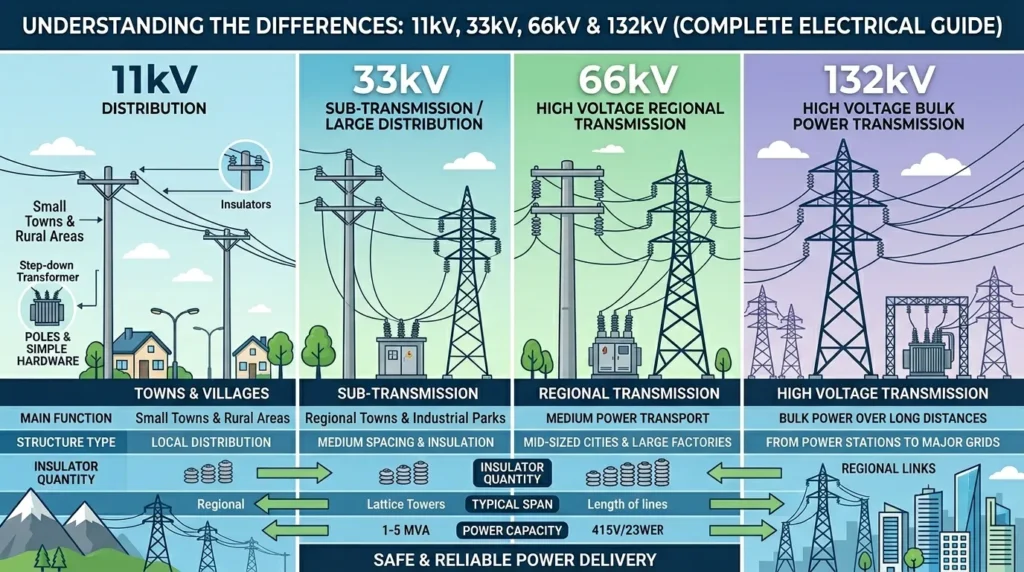

Imagine a large city where electricity is generated far away in a power plant, but it must reach homes, industries, and offices safely and efficiently. This journey of electricity happens through different voltage levels such as 11kV, 33kV, 66kV, and 132kV. Each level has a specific role in transmitting and distributing electrical power.
For example, electricity is generated at a power station and then stepped up to 132kV for long-distance transmission. Later it is reduced step by step to 66kV, 33kV, and finally 11kV before reaching consumers. Without these voltage levels, power losses would be very high, and the system would become inefficient.
In this article, you will learn the difference between 11kV, 33kV, 66kV, and 132kV, their working principle, applications, advantages, disadvantages, and practical uses. This guide is written in simple English for electrical students, technicians, and beginners who want a clear understanding of power systems.
What Are Voltage Levels (11kV, 33kV, 66kV, 132kV)? (2026): Complete Guide, Working Principle, and Applications
Voltage levels such as 11kV, 33kV, 66kV, and 132kV are standardized electrical voltage ratings used at different stages of the power generation, transmission, and distribution system. These voltage levels determine how electrical energy is generated, transmitted over long distances, and finally delivered safely to homes, commercial buildings, and industries.
The primary purpose of using different voltage levels is to minimize transmission losses, improve system efficiency, reduce operating costs, and ensure a reliable power supply. Instead of transmitting electricity at low voltage with high current—which causes significant heat loss—power companies transmit electricity at high voltage and low current. This greatly reduces power loss in transmission lines and allows electricity to travel hundreds of kilometers efficiently.
In modern electrical power systems in 2026, different voltage levels are carefully selected according to transmission distance, power capacity, and consumer requirements.
Simple Explanation
Think of electricity flowing through a power line like water flowing through a pipeline.
- Voltage is similar to water pressure.
- Current is similar to the amount of water flowing.
If the water pressure is increased, the same amount of water can be delivered with less effort. Similarly, increasing the voltage allows the same electrical power to be transmitted with less current.
Because power loss in transmission lines depends mainly on current (I²R losses), reducing the current greatly improves transmission efficiency.
Higher Voltage → Lower Current → Lower Power Loss → Higher Efficiency
This is the fundamental principle behind every modern electrical transmission network.
Why Are Different Voltage Levels Used?
Electricity travels through several stages before reaching consumers. Each stage requires a different voltage level to ensure safe, reliable, and economical operation.
The main reasons for using multiple voltage levels include:
- Reducing transmission losses.
- Improving power transmission efficiency.
- Lowering operating costs.
- Reducing conductor size requirements.
- Improving voltage regulation.
- Ensuring safe power distribution.
- Meeting different industrial and residential power demands.
- Increasing the reliability of the electrical grid.
Practical Examples of Voltage Levels
Each voltage level has a specific purpose within the electrical power system.
132kV – High-Voltage Transmission
The 132kV voltage level is primarily used for transmitting large amounts of electrical power over long distances between generating stations, grid substations, and major cities.
Typical applications include:
- Long-distance power transmission
- Grid substations
- Regional transmission networks
- Large industrial power supply
- Interconnection between transmission systems
66kV – Sub-Transmission Network
The 66kV voltage level is commonly used as a sub-transmission voltage that transfers electricity from major transmission substations to regional substations.
Typical applications include:
- Regional power distribution
- Large industrial areas
- Utility substations
- Medium-distance power transmission
- Urban power supply networks
33kV – Primary Distribution System
The 33kV voltage level serves as the primary distribution voltage in many countries. It supplies electricity to industrial zones, commercial complexes, and local substations.
Typical applications include:
- Industrial plants
- Manufacturing facilities
- Commercial complexes
- Urban distribution networks
- Large shopping centers
- Hospitals and universities
11kV – Secondary Distribution System
The 11kV voltage level is one of the most widely used distribution voltages. It supplies electricity to local distribution transformers, which further reduce the voltage to 400V/230V for residential and commercial consumers.
Typical applications include:
- Residential neighborhoods
- Small industries
- Office buildings
- Schools and colleges
- Hospitals
- Rural electrification
- Commercial buildings
Working Principle of Voltage Levels in an Electrical Power System (2026)
The working principle of different voltage levels is based on the operation of power transformers, which increase (step up) or decrease (step down) voltage according to system requirements.
Transformers make it possible to transmit electricity efficiently over long distances while delivering it safely to consumers at usable voltage levels.
Step-by-Step Power Flow Process
Step 1: Electricity Generation
Electricity is generated in power plants using generators at medium voltage levels, typically between 11kV and 25kV, depending on the plant design and generator capacity.
Step 2: Voltage Is Increased
A step-up transformer raises the generated voltage to high transmission levels such as 132kV, 220kV, 400kV, or even higher.
Increasing the voltage reduces current, which minimizes transmission losses.
Step 3: High-Voltage Transmission
High-voltage transmission lines carry electricity over long distances between power plants and major substations.
High-voltage transmission provides:
- Lower power losses
- Better voltage regulation
- Reduced conductor heating
- Higher transmission efficiency
Step 4: Voltage Is Reduced at Grid Substations
Near cities and industrial regions, step-down transformers reduce the transmission voltage from 132kV to intermediate levels such as 66kV or 33kV.
These substations distribute electricity to regional distribution networks.
Step 5: Local Distribution
Distribution substations further reduce the voltage to 11kV, which is supplied through local distribution feeders.
The 11kV network delivers electricity close to residential, commercial, and industrial consumers.
Step 6: Final Voltage Transformation
Pole-mounted or ground-mounted distribution transformers reduce the voltage from 11kV to:
- 400V (Three-phase supply)
- 230V (Single-phase supply)
This voltage is safe and suitable for homes, offices, schools, hospitals, and small businesses.
Step 7: Electricity Reaches Consumers
Finally, electricity reaches end users through service lines connected to homes, industries, commercial buildings, and public facilities.
Consumers receive a stable and safe power supply for operating electrical appliances and equipment.
Simple Working Principle
The entire electrical power system operates according to one simple rule:
Higher Voltage → Lower Current → Lower Heat Loss → Better Efficiency
By increasing voltage during transmission and reducing it during distribution, utilities can deliver electricity more efficiently, economically, and safely.
Importance of Voltage Levels
Standardized voltage levels are essential for modern electrical networks because they:
- Improve transmission efficiency.
- Reduce I²R (line) losses.
- Lower electricity transmission costs.
- Enhance grid reliability.
- Improve voltage stability.
- Reduce conductor size requirements.
- Support industrial and commercial power systems.
- Ensure safe electricity distribution to consumers.
Voltage levels such as 11kV, 33kV, 66kV, and 132kV form the backbone of modern electrical power systems. Each voltage level has a specific role, from transmitting electricity over long distances to distributing it safely to homes, industries, and commercial buildings.
Using transformers to step voltage up for transmission and step it down for distribution allows utilities to minimize energy losses, improve system efficiency, reduce operating costs, and maintain a reliable power supply. In 2026, these standardized voltage levels continue to play a critical role in supporting growing electricity demand and ensuring the safe, efficient, and economical operation of power systems worldwide.
132kV – High Voltage Transmission Level (2026): Working Principle, Features, Advantages, Applications, and Importance
The 132kV (132,000 Volts) High Voltage Transmission Level is one of the most important voltage levels used in modern electrical power systems. It serves as a major link between power generation stations, grid substations, regional substations, and large urban or industrial load centers. The primary purpose of the 132kV transmission network is to transport large quantities of electrical energy efficiently over long distances while minimizing transmission losses and maintaining a stable power supply.
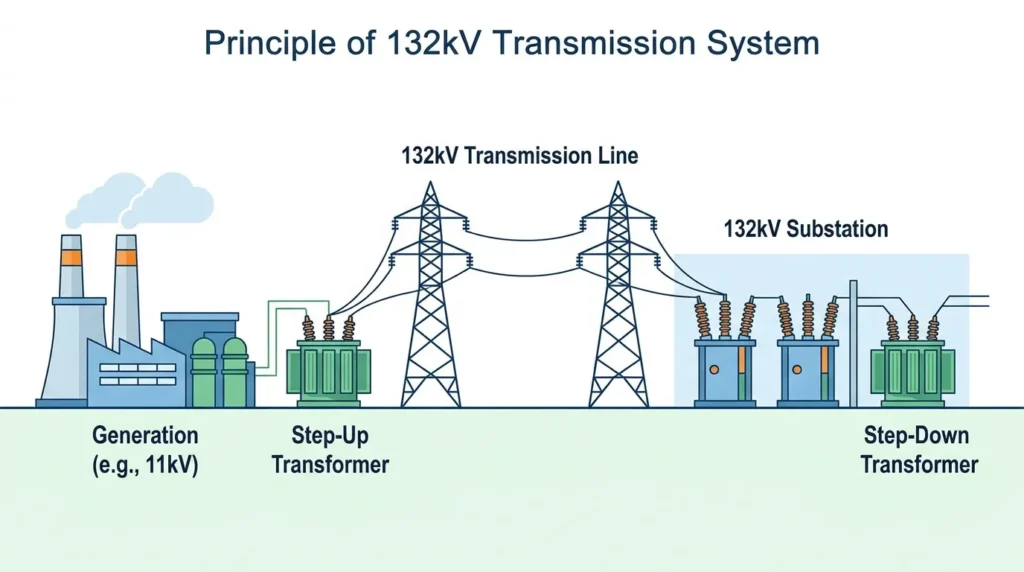
In a typical power system, electricity is generated at power plants at medium voltages, generally between 11kV and 25kV. Before the electricity enters the transmission network, a step-up power transformer increases the voltage to 132kV. This higher voltage significantly reduces the current flowing through the transmission conductors, thereby minimizing I²R (current squared × resistance) losses and improving the overall efficiency of power transmission.
The 132kV transmission system forms an essential part of the high-voltage (HV) or, in some network classifications, extra-high-voltage (EHV) infrastructure. It ensures reliable bulk power transfer between generation plants, regional substations, industrial zones, and metropolitan cities, making it one of the backbone voltage levels of national electrical grids in 2026.
Working Principle of 132kV Transmission
The operation of a 132kV transmission system is based on the principle of high-voltage power transmission.
After electricity is generated at the power station, a step-up transformer raises the generator voltage to 132kV. Increasing the voltage reduces the transmission current while maintaining the same power output.
The high-voltage electricity then travels through overhead transmission lines supported by steel lattice towers. At receiving substations, step-down transformers reduce the voltage to 66kV, 33kV, or 11kV, depending on the requirements of the distribution network.
Finally, local distribution transformers further reduce the voltage to 400V or 230V for residential, commercial, and industrial consumers.
This step-by-step transformation allows electricity to be transmitted efficiently over long distances and delivered safely to end users.
Step-by-Step Power Flow Process
Step 1: Power Generation
Electricity is generated in thermal, hydroelectric, nuclear, solar, or wind power plants at medium voltage levels, typically between 11kV and 25kV.
Step 2: Voltage Step-Up
A power transformer increases the voltage from the generator output to 132kV.
The higher voltage reduces transmission current and significantly lowers energy losses.
Step 3: Long-Distance Transmission
The 132kV transmission lines carry bulk electrical power across long distances using overhead conductors mounted on transmission towers.
This stage connects:
- Power plants
- Grid substations
- Regional substations
- Industrial zones
- Major cities
Step 4: Receiving Substation
At the receiving end, another transformer reduces the voltage from 132kV to 66kV, 33kV, or 11kV, depending on the local distribution requirements.
Step 5: Local Distribution
Distribution substations deliver electricity through lower-voltage feeders to residential areas, commercial buildings, and industrial consumers.
Key Features of 132kV Transmission
The 132kV transmission system offers several important technical characteristics.
- Used for long-distance bulk power transmission.
- Transfers large amounts of electrical energy efficiently.
- Forms an important part of the national transmission grid.
- Reduces transmission losses by lowering current.
- Operates using high-voltage overhead transmission lines.
- Requires steel lattice transmission towers.
- Uses high-quality conductors such as ACSR (Aluminium Conductor Steel Reinforced) or equivalent.
- Equipped with high-performance insulation systems.
- Supports stable and reliable power delivery.
- Suitable for supplying major cities and large industrial regions.
Main Components of a 132kV Transmission System
A typical 132kV transmission network consists of several major components.
- Step-up transformers
- Step-down transformers
- Steel transmission towers
- High-voltage conductors
- Disc-type or composite insulators
- Circuit breakers
- Isolators (Disconnect Switches)
- Current Transformers (CTs)
- Potential/Voltage Transformers (PTs/VTs)
- Lightning arresters
- Protective relays
- Busbars
- Grounding (Earthing) systems
- Communication and control equipment
Each component plays an essential role in ensuring the safe, efficient, and reliable operation of the transmission system.
Advantages of 132kV Transmission
The 132kV transmission network provides numerous benefits to modern electrical power systems.
High Transmission Efficiency
Operating at high voltage significantly reduces transmission current, minimizing energy losses over long distances.
Lower Power Losses
Reduced current results in lower I²R losses, making the transmission system more economical and energy efficient.
Large Power Transfer Capacity
The 132kV network can transmit substantial amounts of electrical power to major cities, industrial zones, and regional substations.
Improved Voltage Regulation
High-voltage transmission helps maintain stable voltage levels across the electrical network, ensuring reliable operation of connected equipment.
Supports National Grid Stability
The 132kV system interconnects multiple substations and generating stations, improving grid reliability and enabling efficient power sharing between regions.
Reduced Operating Costs
Although the initial investment is high, lower transmission losses reduce long-term operating costs.
Disadvantages of 132kV Transmission
Despite its many advantages, the 132kV system also has some limitations.
- High installation and construction costs.
- Requires expensive transmission towers and substations.
- Needs specialized insulation systems.
- Requires skilled engineers for operation and maintenance.
- Strict safety procedures must be followed.
- Faults can interrupt power supply over large areas.
- Requires large right-of-way (ROW) for transmission lines.
Applications of 132kV Transmission
The 132kV voltage level is widely used throughout modern electrical power systems.
Major Applications Include:
- National transmission grids
- Thermal power plants
- Hydroelectric power stations
- Nuclear power plants
- Large solar power plants
- Wind farms
- Regional grid substations
- Metropolitan cities
- Heavy industrial zones
- Mining operations
- Steel manufacturing plants
- Oil and gas facilities
- Large commercial complexes
- Railway electrification networks
Practical Example
Consider a 500 MW thermal power plant located approximately 200 kilometers from a major city.
The generator produces electricity at around 15kV. A step-up transformer increases the voltage to 132kV, allowing the electricity to travel efficiently through transmission lines with minimal power losses.
When the electricity reaches the city’s primary receiving station, another transformer reduces the voltage to 66kV or 33kV. It is then further reduced to 11kV, and finally to 400V/230V before being supplied to homes, offices, schools, hospitals, shopping malls, and industries.
This multi-stage voltage transformation ensures that electricity is delivered safely, efficiently, and economically.
Importance of 132kV Transmission
The 132kV transmission level plays a vital role in ensuring the continuous operation of modern power systems. It enables the efficient transfer of bulk electrical energy over long distances while minimizing energy losses and maintaining voltage stability.
Without the 132kV transmission network, supplying reliable electricity to large cities, industrial regions, and commercial centers would be far less efficient and significantly more expensive.
The 132kV High Voltage Transmission Level is one of the most critical components of modern electrical infrastructure. It provides an efficient, reliable, and economical method for transmitting large amounts of electrical energy between power plants, substations, and major load centers. By reducing transmission losses, improving voltage regulation, and strengthening national grid reliability, the 132kV network supports industrial growth, urban development, and sustainable energy distribution.
In 2026, 132kV transmission systems continue to serve as a cornerstone of electrical power networks worldwide, enabling utilities to deliver safe, stable, and uninterrupted electricity to millions of residential, commercial, and industrial consumers.
66kV – Sub-Transmission Level (2026): Working Principle, Features, Advantages, Applications, and Importance
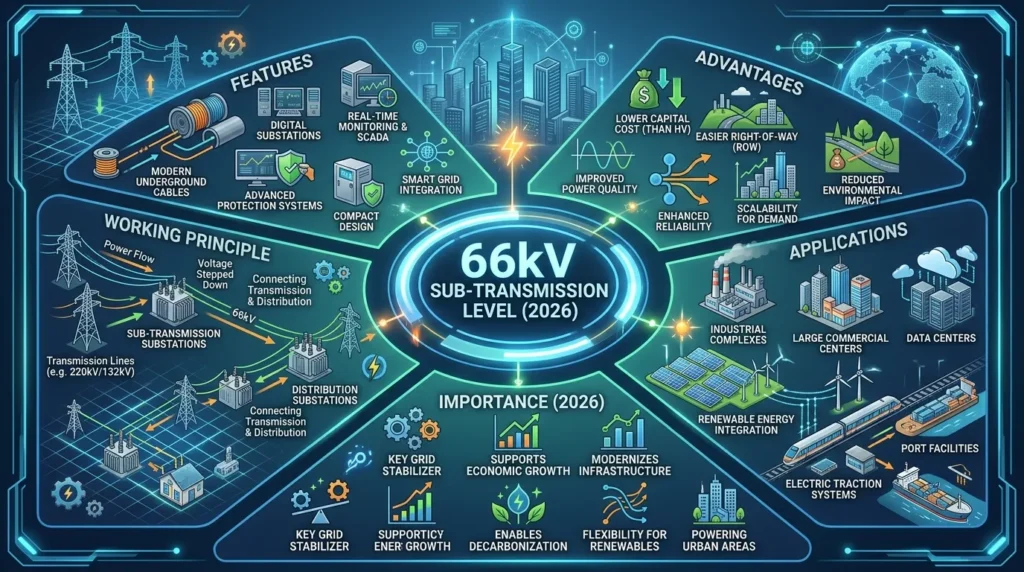
The 66kV (66,000 Volts) Sub-Transmission Level is an important stage in the electrical power system that serves as a bridge between the high-voltage transmission network and the primary distribution system. It is mainly used to transfer electrical energy from 132kV grid substations to regional substations, industrial zones, medium-sized cities, and large commercial areas before the voltage is further reduced to 33kV or 11kV for local distribution.
The primary purpose of the 66kV sub-transmission network is to transport large amounts of electrical power efficiently over medium distances while maintaining good voltage regulation, reducing transmission losses, and ensuring a reliable power supply. It provides an economical solution for supplying electricity to growing urban areas, industrial parks, and regional load centers where the power demand is too high for direct 33kV supply but does not require 132kV transmission.
In modern power systems, the 66kV network plays a vital role in improving grid flexibility, balancing electrical loads, and strengthening the reliability of the distribution infrastructure. It helps utilities distribute power more efficiently while minimizing energy losses and maintaining stable system operation.
Working Principle of the 66kV Sub-Transmission System
The 66kV sub-transmission system operates on the principle of step-down voltage transformation using power transformers.
Electricity generated at power plants is first transmitted over long distances at 132kV or higher. When the power reaches a regional receiving station or grid substation, a step-down transformer reduces the voltage from 132kV to 66kV.
The electricity is then transmitted through 66kV overhead transmission lines or underground cables to regional substations located closer to consumers. At these substations, another transformer further reduces the voltage to 33kV and then 11kV, where it enters the primary and secondary distribution networks.
Finally, distribution transformers reduce the voltage to 400V or 230V for residential, commercial, and small industrial consumers.
This staged voltage reduction ensures safe, efficient, and economical delivery of electricity throughout the power system.
Step-by-Step Power Flow Process
Step 1: Power Generation
Electricity is generated at power stations at medium voltages, typically between 11kV and 25kV.
Step 2: High-Voltage Transmission
A step-up transformer increases the generator voltage to 132kV or higher for efficient long-distance transmission.
Step 3: Voltage Reduction to 66kV
At a major receiving substation, a step-down transformer reduces the transmission voltage from 132kV to 66kV.
Step 4: Regional Sub-Transmission
The 66kV network carries electricity to regional substations, industrial areas, medium-sized cities, and large commercial zones.
Step 5: Distribution Voltage Reduction
Regional substations reduce the voltage from 66kV to 33kV and then to 11kV for local distribution.
Step 6: Consumer Supply
Distribution transformers finally reduce the voltage to 400V (three-phase) or 230V (single-phase) for homes, offices, schools, hospitals, and businesses.
Key Features of the 66kV Sub-Transmission System
The 66kV system offers several technical and operational characteristics that make it ideal for regional power distribution.
- Acts as a bridge between 132kV transmission and 33kV distribution systems.
- Efficiently transfers bulk power over medium distances.
- Supplies electricity to medium-sized cities and industrial areas.
- Improves regional voltage regulation.
- Supports reliable power flow across the electrical grid.
- Reduces transmission losses compared to lower-voltage systems.
- Strengthens the stability of regional distribution networks.
- Provides flexibility for future expansion of the electrical system.
- Supports increasing industrial and commercial electricity demand.
Main Components of a 66kV Sub-Transmission System
A typical 66kV sub-transmission network consists of several essential components.
- Step-down power transformers
- 66kV overhead transmission lines
- Underground power cables (where required)
- Steel lattice towers or reinforced concrete poles
- ACSR (Aluminium Conductor Steel Reinforced) conductors
- High-voltage insulators
- Circuit breakers
- Isolators (Disconnect Switches)
- Current Transformers (CTs)
- Potential/Voltage Transformers (PTs/VTs)
- Lightning arresters
- Protective relays
- Busbars
- Earthing (Grounding) systems
- SCADA and monitoring systems
Each component contributes to the safe, efficient, and reliable operation of the sub-transmission network.
Advantages of the 66kV Sub-Transmission System
The 66kV system provides several important benefits for modern electrical networks.
Efficient Regional Power Transfer
It allows large amounts of electrical power to be transmitted efficiently across medium distances with lower energy losses.
Improved Voltage Regulation
The system maintains stable voltage levels, ensuring reliable electricity supply to industries, businesses, and residential areas.
Reduced Transmission Losses
Operating at 66kV reduces current flow compared to lower-voltage systems, resulting in lower I²R losses and improved energy efficiency.
Supports Growing Demand
The 66kV network can handle increasing electrical loads associated with expanding cities, industrial parks, and commercial developments.
Cost-Effective Solution
Compared with extending 132kV transmission to every location, the 66kV system offers a more economical option for regional power distribution.
Improves Grid Reliability
By acting as an intermediate voltage level, the 66kV network improves the flexibility, stability, and reliability of the overall electrical grid.
Disadvantages of the 66kV Sub-Transmission System
Despite its advantages, the 66kV system also has some limitations.
- Higher installation cost than lower-voltage distribution systems.
- Requires specialized substations and equipment.
- Needs skilled engineers for operation and maintenance.
- Faults can affect a large number of consumers.
- Requires regular inspection and preventive maintenance.
- Strict electrical safety standards must be followed.
- Infrastructure planning can be complex in densely populated areas.
Applications of the 66kV Sub-Transmission System
The 66kV voltage level is widely used in many parts of modern power systems.
Major Applications Include:
- Regional power distribution networks
- Medium-sized cities and towns
- Industrial estates
- Manufacturing plants
- Mining operations
- Oil and gas facilities
- Commercial zones
- Large hospitals
- Universities and educational campuses
- Water treatment plants
- Agricultural pumping stations
- Renewable energy integration
- Regional substations
- Utility distribution networks
Practical Example
Consider a 132kV grid substation supplying electricity to a growing industrial city located approximately 80 kilometers away.
A step-down transformer reduces the voltage from 132kV to 66kV. The electricity is then transmitted through 66kV sub-transmission lines to several regional substations.
At each regional substation, the voltage is further reduced to 33kV and 11kV before being distributed to factories, shopping centers, office buildings, hospitals, schools, and residential neighborhoods.
This multi-stage distribution system ensures reliable power delivery while minimizing energy losses and maintaining voltage stability.
Importance of the 66kV Sub-Transmission Level
The 66kV sub-transmission network plays a crucial role in connecting the high-voltage transmission grid with local distribution systems. It enables efficient regional power transfer, supports expanding industrial and urban areas, and provides the flexibility needed to meet growing electricity demand.
Without the 66kV network, utilities would face greater transmission losses, higher infrastructure costs, and reduced reliability in supplying electricity to medium-distance load centers.
The 66kV Sub-Transmission Level is a vital component of modern electrical power systems, providing an efficient and economical link between 132kV transmission networks and 33kV/11kV distribution systems. By reducing transmission losses, improving voltage regulation, strengthening grid reliability, and supporting regional development, the 66kV network ensures the safe and dependable delivery of electricity to industries, commercial facilities, and growing urban communities.
In 2026, the 66kV sub-transmission system continues to be an essential part of electrical infrastructure, helping utilities deliver stable, efficient, and uninterrupted power while supporting economic growth and the modernization of power networks.
33kV – Primary Distribution Level (2026 Guide)
The 33kV Primary Distribution Level is an important stage in the electrical power distribution system. It is used to deliver electricity from sub-transmission networks (66kV or 132kV) to industrial areas, urban regions, and large commercial consumers. This voltage level acts as a bridge between high-voltage transmission and lower-voltage distribution systems such as 11kV.
The primary purpose of a 33kV distribution network is to transfer electrical energy efficiently while minimizing transmission losses and maintaining a stable voltage supply. It is widely used in cities, industrial estates, manufacturing plants, and commercial zones where electricity demand is relatively high.
Key Features of the 33kV Distribution System
- Supplies electricity to industries and urban areas
- Feeds 11kV distribution substations
- Medium-voltage distribution network
- Suitable for medium and large electrical loads
- Reduces power losses compared to lower voltage systems
- Supports future expansion of electrical networks
- Ensures reliable and stable power delivery
Why is 33kV Used?
The 33kV voltage level provides an excellent balance between transmission efficiency and distribution cost. Instead of distributing electricity directly at 11kV over long distances, utilities use 33kV because higher voltage means lower current for the same amount of power.
Lower current results in:
- Reduced I²R (line) losses
- Smaller voltage drops
- Better system efficiency
- Improved voltage regulation
- Higher power transfer capability
This makes 33kV an economical choice for supplying electricity to towns, industrial zones, and commercial complexes.
How Does the 33kV Primary Distribution System Work?
The working principle of a 33kV distribution system is based on step-by-step voltage reduction.
The process works as follows:
- Electricity is generated at a power plant.
- The voltage is increased to very high levels (132kV, 220kV, or higher) for long-distance transmission.
- At a regional receiving station, transformers reduce the voltage to 66kV or 33kV.
- The 33kV feeders transport electricity to local primary substations.
- Distribution transformers further reduce the voltage to 11kV.
- Finally, local transformers step the voltage down to 415V or 230V for commercial and residential consumers.
This staged voltage reduction improves safety, efficiency, and reliability throughout the electrical network.
Main Components of a 33kV Distribution System
A typical 33kV distribution network consists of several important electrical components.
Power Transformers
Power transformers reduce the incoming transmission voltage to 33kV before electricity enters the primary distribution system.
33kV Feeders
Feeders carry electrical power from substations to different distribution centers with minimal voltage drop.
Overhead Lines or Underground Cables
Electricity is transmitted through:
- ACSR overhead conductors
- XLPE underground cables
- Steel or concrete poles
- Cable trenches in urban installations
Circuit Breakers
33kV circuit breakers automatically disconnect faulty sections during overloads or short circuits.
Protective Relays
Protective relays continuously monitor electrical conditions and send trip signals to circuit breakers whenever abnormal conditions occur.
Isolators
Isolators disconnect equipment during maintenance and provide visible electrical isolation.
Lightning Arresters
Lightning arresters protect equipment from lightning strikes and switching surges.
Earthing System
Proper earthing ensures personnel safety and provides a safe path for fault current.
Applications of 33kV Primary Distribution
The 33kV system is widely used in many sectors of the electrical industry.
Common applications include:
- Industrial manufacturing plants
- Cement factories
- Steel industries
- Chemical plants
- Commercial complexes
- Shopping malls
- Hospitals
- Universities
- Large residential townships
- Urban distribution substations
- Water treatment plants
- Mining operations
Advantages of the 33kV Distribution System
The 33kV primary distribution level offers several important benefits.
- Efficient transmission of medium and large power loads
- Lower power losses compared to 11kV distribution over long distances
- Better voltage regulation
- Reliable electricity supply
- Supports industrial development
- Suitable for expanding cities
- Reduced conductor current
- Improved overall system efficiency
- Easy integration with existing substations
- Long service life with proper maintenance
Disadvantages of the 33kV Distribution System
Despite its advantages, the system also has certain limitations.
- Higher installation cost
- Requires expensive substation equipment
- Needs skilled operators and maintenance staff
- High safety requirements
- Faults can interrupt supply to many consumers
- Maintenance is more complex than low-voltage systems
- Greater insulation requirements
Safety Measures for 33kV Systems
Because 33kV is a high-voltage distribution level, strict safety procedures are essential.
Important safety practices include:
- Use proper personal protective equipment (PPE)
- Follow lockout/tagout (LOTO) procedures
- Maintain safe clearance distances
- Test equipment before maintenance
- Install reliable earthing systems
- Perform regular inspections
- Test protective relays periodically
- Keep vegetation clear of overhead lines
Example of a 33kV Distribution Network
A common example is an electrical utility supplying power from a 66/33kV receiving substation to an industrial estate located 20–80 km away.
The electricity is transmitted through 33kV feeders to several local substations. Each substation then steps the voltage down to 11kV, and finally distribution transformers reduce it to 415V/230V for factories, commercial buildings, and nearby residential consumers.
This arrangement provides efficient power transfer with lower losses and reliable service to areas with significant electricity demand.
The 33kV Primary Distribution Level is a vital part of modern electrical power systems. It serves as the link between sub-transmission and local distribution networks, ensuring electricity reaches industries, commercial facilities, and urban areas efficiently and safely. By reducing transmission losses, improving voltage regulation, and supporting large electrical loads, the 33kV system plays a crucial role in reliable power delivery. Although it requires higher investment and strict safety measures, its efficiency, flexibility, and reliability make it an essential component of today’s electrical distribution infrastructure.
What is 11kV Secondary Distribution Level? Complete Guide (2026)
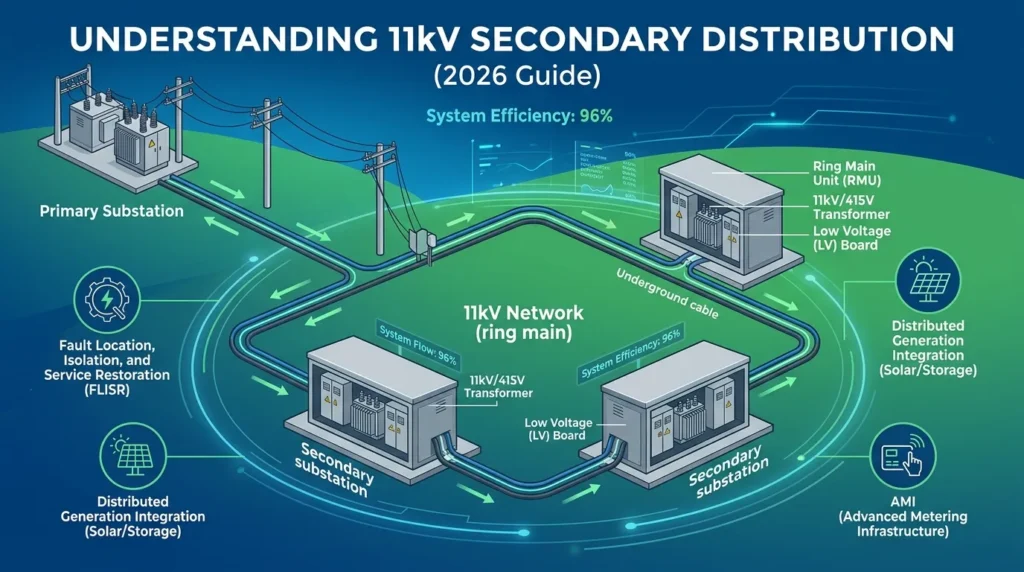
The 11kV Secondary Distribution Level is the final stage of the medium-voltage distribution network in an electrical power system. It delivers electricity from 33kV primary distribution substations to local areas such as residential neighborhoods, commercial buildings, schools, hospitals, rural communities, and small industries. Before electricity reaches consumers, it is stepped down from 11kV to 415V (three-phase) or 230V (single-phase) using distribution transformers.
The 11kV distribution system is widely used because it provides an efficient balance between power transfer capability and economical distribution. It ensures reliable electricity delivery with lower power losses while supplying thousands of homes and businesses safely.
Key Features of the 11kV Distribution System
- Final medium-voltage distribution level
- Receives power from 33kV substations
- Supplies distribution transformers
- Delivers electricity to residential and commercial areas
- Used for small industries and public facilities
- Supports overhead and underground distribution networks
- Provides reliable and efficient local power distribution
Why is 11kV Used?
The 11kV voltage level is ideal for distributing electricity over short to medium distances before supplying end users. It allows utilities to transfer power efficiently without excessive conductor size or significant voltage drop.
Using 11kV offers several benefits:
- Reduces distribution losses
- Improves voltage regulation
- Supplies multiple distribution transformers
- Supports expanding urban and rural networks
- Provides economical local power distribution
Once electricity reaches the local transformer, it is converted into low voltage suitable for homes, offices, and businesses.
How Does the 11kV Secondary Distribution System Work?
The operation of the 11kV distribution system follows a step-by-step voltage reduction process.
The process works as follows:
- Electricity is generated at a power station.
- The voltage is increased to high levels (132kV, 220kV, or higher) for long-distance transmission.
- At receiving substations, the voltage is reduced to 66kV or 33kV.
- Primary distribution substations further reduce the voltage to 11kV.
- The 11kV feeders distribute electricity throughout local service areas.
- Distribution transformers convert 11kV to 415V/230V.
- Low-voltage lines deliver electricity safely to homes, shops, schools, offices, and small industries.
This multi-stage distribution process ensures efficient power delivery while maintaining safe operating voltages.
Main Components of an 11kV Distribution System
An 11kV distribution network consists of several essential components.
Distribution Substation
Distribution substations receive electricity from the 33kV network and reduce it to 11kV for local distribution.
11kV Feeders
Feeders carry electrical power from substations to distribution transformers with minimal voltage loss.
Distribution Transformers
These transformers reduce the voltage from 11kV to 415V/230V, making electricity suitable for residential and commercial consumers.
Overhead Lines and Underground Cables
Power is distributed using:
- ACSR overhead conductors
- XLPE underground cables
- Concrete or steel poles
- Cable ducts and trenches in urban areas
Circuit Breakers
Circuit breakers automatically disconnect faulty sections during overloads, short circuits, or equipment failures.
Protective Relays
Protective relays monitor system conditions and send trip commands to circuit breakers whenever abnormal electrical conditions are detected.
Fuses
Fuses provide additional protection for transformers and distribution lines by disconnecting faulty circuits.
Insulators
Insulators prevent leakage current and safely support overhead conductors.
Earthing System
Proper earthing protects equipment and personnel by providing a safe path for fault currents.
Applications of the 11kV Distribution System
The 11kV network is used extensively for local electricity distribution.
Common applications include:
- Residential housing societies
- Apartment complexes
- Schools and colleges
- Hospitals
- Shopping centers
- Office buildings
- Rural villages
- Agricultural irrigation systems
- Small manufacturing industries
- Warehouses
- Public infrastructure
- Municipal facilities
Advantages of the 11kV Distribution System
The 11kV secondary distribution system offers several important advantages.
- Efficient local electricity distribution
- Lower power losses compared to low-voltage distribution over long distances
- Reliable power supply for consumers
- Better voltage regulation
- Supports both overhead and underground networks
- Easy expansion for developing communities
- Simplified fault isolation
- Lower infrastructure cost than higher-voltage systems
- Suitable for residential, commercial, and light industrial loads
Disadvantages of the 11kV Distribution System
Despite its many advantages, the 11kV system has some limitations.
- Requires strict safety procedures
- Voltage drops may occur over long feeder distances
- Faults can interrupt supply to large local areas
- Regular maintenance is necessary
- Load balancing is essential for stable operation
- Underground cable installation is relatively expensive
- Protection coordination is more complex than low-voltage systems
Safety Measures for 11kV Systems
Although lower than transmission voltages, 11kV is still classified as a medium-voltage system and requires careful safety practices.
Important safety measures include:
- Wear appropriate personal protective equipment (PPE)
- Follow lockout/tagout (LOTO) procedures
- Maintain safe working clearances
- Inspect poles, cables, and transformers regularly
- Test protective relays and circuit breakers periodically
- Ensure proper earthing at all installations
- Keep overhead line corridors free from vegetation
- Use insulated tools during maintenance
Example of an 11kV Distribution Network
A common example of an 11kV distribution system is the supply of electricity from a local 33/11kV distribution substation to residential neighborhoods, commercial markets, schools, hospitals, and nearby villages.
The 11kV feeders transport electricity to distribution transformers installed close to consumers. These transformers reduce the voltage to 415V for three-phase loads and 230V for single-phase domestic users, ensuring a safe and reliable electricity supply.
The 11kV Secondary Distribution Level is one of the most important parts of the electrical power distribution system. It serves as the final medium-voltage stage before electricity is converted into usable low-voltage power for homes, businesses, and small industries. By providing efficient power transfer, reliable voltage regulation, and flexible network expansion, the 11kV system plays a crucial role in delivering safe and continuous electricity to millions of consumers every day. Proper protection, maintenance, and load management ensure that the network operates efficiently and reliably for modern electrical distribution.
Main Components in Voltage Systems
- Power transformers for voltage conversion
- Transmission lines for power flow
- Substations for control and distribution
- Insulators for safety and isolation
- Circuit breakers for protection
- Conductors (copper/aluminum) for current flow
Advantages of Different Voltage Levels
- Reduces power losses
- Improves transmission efficiency
- Enables long-distance power supply
- Supports industrial and residential loads
- Increases grid stability
- Reduces conductor size requirement
Disadvantages / Limitations
- High installation cost
- Requires advanced protection systems
- Needs skilled maintenance
- Risk of electrical hazards
- Complex system design
- Large infrastructure requirement
Applications of Voltage Levels (132kV, 66kV, 33kV, 11kV): Complete Guide
Different voltage levels are used in the power system depending on the distance of transmission and the type of load. Each voltage level plays a specific role in ensuring that electricity is delivered efficiently, safely, and with minimum power loss. From generation to final consumption, voltage is gradually reduced through substations and transformers to meet user requirements.
132kV Applications
The 132kV system is mainly used for long-distance and high-capacity power transmission. At this level, electricity is carried efficiently over large distances between major power stations and substations.
Common applications include:
- Inter-city power transmission networks
- National grid and bulk power transfer systems
- Connection of large generating power stations to the grid
This voltage level helps in reducing transmission losses over very long distances.
66kV Applications
The 66kV system is typically used for regional power distribution. It acts as an intermediate stage between high-voltage transmission and medium-voltage distribution systems.
Common applications include:
- Regional substations
- Power supply to medium-scale industries
- Bulk power transfer within a region or province
It ensures stable and controlled power flow between transmission and distribution networks.
33kV Applications
The 33kV system is widely used in urban and industrial distribution networks. It delivers electricity from substations to large consumers and local distribution points.
Common applications include:
- Industrial zones and manufacturing plants
- Large commercial buildings and complexes
- Distribution feeders in cities and towns
This voltage level is important for managing medium to heavy electrical loads efficiently.
11kV Applications
The 11kV system is the final stage of medium-voltage distribution before stepping down to low voltage for end users. It is the most commonly used distribution level in many regions.
Common applications include:
- Residential electricity supply networks
- Small industries and workshops
- Rural electrification systems
It ensures safe and reliable power delivery to homes and small-scale consumers.
Voltage levels such as 132kV, 66kV, 33kV, and 11kV are essential for organizing the power system into efficient stages. Each level has a specific role, from long-distance transmission to local distribution. This structured system reduces power losses, improves stability, and ensures that electricity reaches consumers safely and reliably across residential, commercial, and industrial sectors.
Comparison Table
| Voltage Level | Category | Usage Area | Distance | Load Capacity |
|---|---|---|---|---|
| 11kV | Distribution | Local areas | Short | Low |
| 33kV | Primary Distribution | Towns/industry | Medium | Medium |
| 66kV | Sub Transmission | Regional supply | Medium-long | High |
| 132kV | Transmission | Inter-city | Long | Very high |
Selection Guide for Voltage Levels (11kV, 33kV, 66kV, 132kV): Practical Understanding
Choosing the correct voltage level in a power system depends mainly on the distance of transmission, load size, and system requirements. Each voltage level is designed for a specific stage in the electrical network, from generation to final distribution. Proper selection ensures efficient power flow, reduced losses, and improved system stability.
- Homes → 11kV (via step-down transformer)
Used for local distribution after multiple voltage reductions, finally supplying safe 230V to households. - Small industries → 33kV
Suitable for industrial zones and medium-load applications requiring stable power supply. - Regional systems → 66kV
Used for transferring power between regional substations and balancing load distribution. - Long-distance transmission → 132kV
Used for inter-city and bulk power transmission over large distances.
Rule of thumb:
👉 Higher distance and higher power demand require higher voltage levels for efficient transmission.
Common Problems in Voltage Transmission Systems and Solutions
Electrical power systems face several challenges during transmission and distribution. Understanding these problems helps in improving system reliability and performance.
Voltage Drop
Voltage drop occurs when electricity travels over long transmission lines, causing a reduction in voltage at the receiving end.
Solution:
Use higher voltage levels (such as 132kV or above) to reduce current and minimize losses.
Power Loss
Power loss is mainly caused by high current flowing through transmission lines, leading to heat generation and energy waste.
Solution:
Increase transmission voltage to reduce current, thereby minimizing I²R losses.
Equipment Damage
Electrical equipment may get damaged due to voltage fluctuations, surges, or unstable supply conditions.
Solution:
Install protection devices such as relays, circuit breakers, and surge protectors to safeguard equipment.
Fault Detection Issues
In large and complex networks, identifying faults can be difficult and time-consuming.
Solution:
Use smart monitoring systems, automated fault detection, and digital grid technology for quick diagnosis.
Future Trends in Power Systems
The electrical power industry is rapidly evolving toward smarter, more efficient, and more sustainable systems. Modern technologies are improving reliability and reducing energy waste.
- Smart grid systems for real-time monitoring and control
- AI-based fault detection and predictive maintenance
- Ultra-high voltage (UHV) transmission for long-distance efficiency
- Underground cable systems in urban areas for safety and space saving
- Integration of renewable energy sources like solar and wind
- Development of more efficient and low-loss transformers
Voltage level selection and system design play a crucial role in efficient power transmission and distribution. By using appropriate voltage levels such as 11kV, 33kV, 66kV, and 132kV, electrical networks can minimize losses, improve stability, and ensure safe power delivery. With modern advancements like smart grids and AI-based monitoring, future power systems are becoming more intelligent, reliable, and energy-efficient, supporting the growing global demand for electricity.
Conclusion
The voltage levels 11kV, 33kV, 66kV, and 132kV are essential parts of electrical power systems. Each level has a specific role in transmitting electricity efficiently from power stations to consumers. High voltage is used for long-distance transmission, while lower voltage is used for safe local distribution.
Understanding these voltage levels helps electrical students, engineers, and technicians design and maintain efficient power systems. From generation to final consumption, every level ensures safe, stable, and reliable electricity supply. As technology advances, these systems will become even more efficient, smart, and reliable for future energy needs.