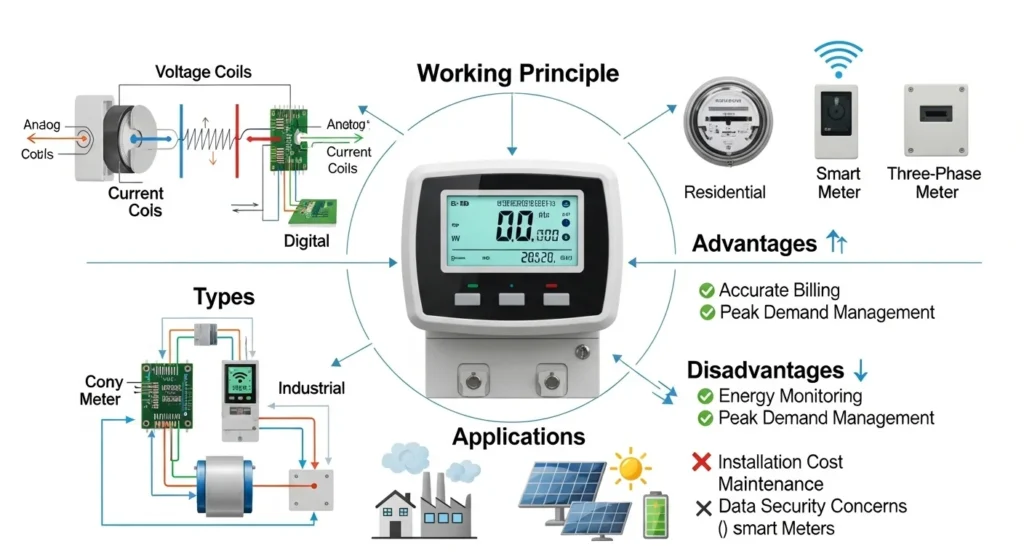

A smart meter is a digital electricity meter that records how much energy a home uses and sends that data to the utility automatically. It replaces manual meter reading, supports time-of-use tariffs, and lets you see your usage in near real time. Most new meters use AMI, two-way communication, while older AMR meters only send data one way.
How Does a Smart Meter Work?
A smart meter is a digital electricity meter that measures energy use in kilowatt-hours, stores the readings in short intervals, and communicates them to the utility over a secure network without a person visiting the property. Current and voltage sensors inside the meter sample the supply many times per second, a processor adds up the energy, and a radio or power-line module sends the totals to the utility.
The meter stores energy in 15-minute or 60-minute intervals and sends a daily summary to the utility, so a bill is based on real use rather than an estimate. The display on the meter cycles through total kilowatt-hours, current demand in kilowatts and the tariff in use. Many meters also talk to a home display or an app over a home area network, so you can see what you are using right now and which appliances are running.
What Is the Difference Between AMI and AMR?
| Feature | AMI | AMR |
| Communication | Two-way | One-way |
| Reading interval | Every 15 to 60 minutes | Monthly, drive-by |
| Remote connect / disconnect | Yes | No |
| Outage alerts | Automatic | No, customer reports |
| Time-of-use billing | Yes | No |
AMI is now the standard in most new rollouts: the US Energy Information Administration reported more than 100 million smart meters installed in the United States by 2022, about 78 percent of all electricity meters, with most of them AMI meters. AMR is the older step between a dial meter and a smart meter, and utilities are replacing it as networks are upgraded.
How Do You Read a Smart Meter?
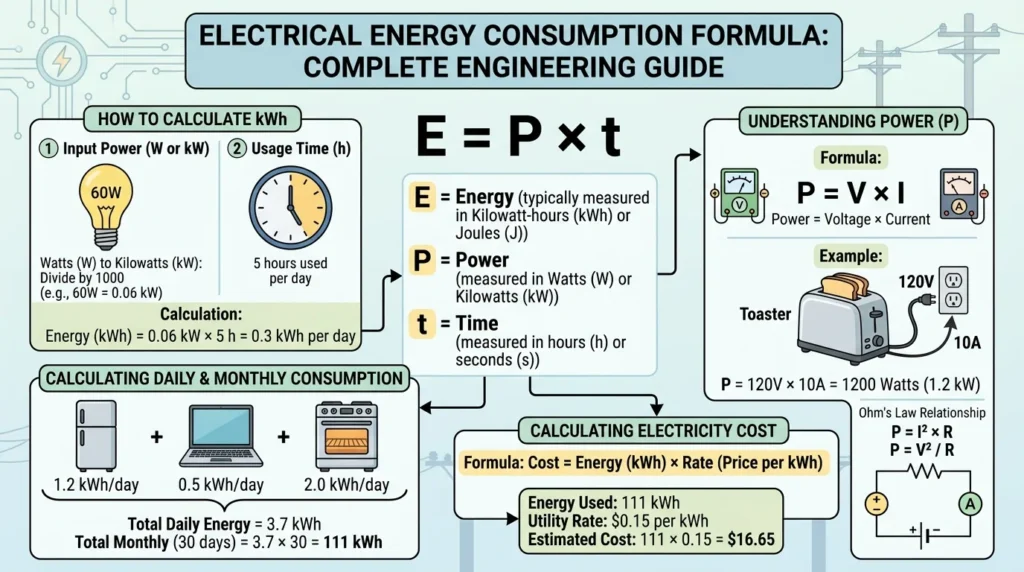
Press the display button on the meter to cycle through the registers. The first number is usually total energy in kilowatt-hours, shown as kWh, and it is the number your bill uses. The next screens show current demand in kilowatts, the voltage, and sometimes the time-of-use register, such as peak and off-peak kWh. To work out usage in a week, subtract last week’s kWh reading from this week’s reading. An average US home uses about 900 kWh per month, or about 30 kWh per day, according to the US Energy Information Administration.
What Are the Benefits and Concerns of Smart Meters?
Smart meters give accurate bills with no estimated readings, faster outage detection, and the choice to shift washing and EV charging to cheaper off-peak hours, which can cut a bill by 5 to 10 percent in time-of-use trials. Concerns are mostly about privacy and radio signals: the meter records energy in intervals, not which appliance you use, the data is encrypted, and a smart meter transmits for only a few seconds per day at a power far below a mobile phone. Utilities must keep the data secure under local rules.
Most utilities now offer an online portal or app where you can see your hourly, daily and monthly usage, set alerts when usage spikes, and compare your home with similar homes nearby. Use the portal to find the biggest loads, such as water heating and air conditioning, and to check that a bill matches your own readings. This data is the main benefit of a smart meter, and it costs nothing extra to use.
Frequently Asked Questions
Do Smart Meters Use a Lot of Electricity Themselves?
No. A smart meter itself uses only about 1 to 2 watts, or roughly 10 to 20 kilowatt-hours per year, which costs less than 3 US dollars a year at typical prices. That is tiny next to an average home using about 900 kilowatt-hours per month. The display and radio are the main loads, and they draw very little power.
Can I Opt Out of a Smart Meter?
It depends on your state and utility. Some utilities let you keep an old meter or ask for the radio to be turned off, usually with a monthly manual-reading fee of about 10 to 25 US dollars. Others do not offer an opt-out. Ask your utility directly what the rules and fees are in your area.
Are Smart Meters Accurate?
Yes. Smart meters are tested to the ANSI C12.20 standard and are typically accurate within plus or minus 0.5 to 1 percent, which is better than older mechanical meters that slow down with age. If a bill jumps suddenly, check for a new appliance, a change in weather, or a faulty heater before blaming the meter, and ask the utility to test it if the readings still look wrong.
Do Smart Meters Emit Harmful Radiation?
A smart meter uses a low-power radio that sends a short burst of data only a few times a day, so total transmission time is seconds per day. Studies by utilities and regulators find its radio-frequency exposure is far below FCC safety limits and much lower than a mobile phone or Wi-Fi router used close to the body. If you are still concerned, ask your utility about a wired or radio-off option.
What Should I Do If My Smart Meter Display Is Blank?
First check whether the power is out: look at your main breaker and ask a neighbour. If the house has power but the meter screen is blank, press the display button once, in case the screen has timed out. Do not open the meter yourself. Call your utility and report a blank display; it usually means a faulty display or a supply problem that only the utility can fix.
Conclusion
A smart meter is more than a billing device: it gives you accurate readings, faster outage response and the data to cut waste. Start by reading your own meter once a month, then use the time-of-use data to shift heavy loads to cheaper hours. For the circuits behind the meter, see our guide to electrical panel design, and to understand the supply feeding it, read 120V vs 240V: Why American Homes Have Both. For more technical background, see the smart meter overview on Wikipedia.