
Imagine a large power plant producing electricity for thousands of homes. Inside the plant, massive boilers burn fuel to generate steam, which drives turbines to produce electrical power. During this process, a large amount of heat leaves the system through hot exhaust gases. If this heat is wasted, the system becomes less efficient and consumes more fuel.
This is where an economizer becomes extremely important. An economizer is a device designed to recover waste heat from exhaust gases and use it to preheat water before it enters the boiler. By doing this, the system saves fuel, improves efficiency, and reduces operating costs.
In modern industries, energy efficiency is a top priority. Power plants, factories, and heating systems use economizers to make better use of energy resources and reduce environmental impact.
In this article, you will learn the economizer working principle, different types of economizers, their main components, and their applications in industry. We will also discuss the economizer advantages and disadvantages, common problems, and tips for selecting the right economizer system. This guide is written in simple language so electrical students, technicians, and beginners can clearly understand the concept.
2. What Is an Economizer? (2026): Definition, Purpose, and How It Improves Boiler Efficiency
An economizer is a heat recovery device installed in boilers, thermal power plants, and industrial heating systems to improve energy efficiency. It works by recovering waste heat from hot exhaust (flue) gases and using that heat to preheat the boiler feedwater before it enters the boiler.
Instead of allowing valuable heat to escape through the chimney, the economizer captures and reuses it. As a result, the boiler requires less fuel to heat the water and produce steam, leading to lower operating costs, improved thermal efficiency, and reduced environmental impact.
Economizers are widely used in power generation, manufacturing industries, HVAC systems, marine boilers, and process plants because they increase energy efficiency without requiring additional fuel.
2.1 Simple Explanation of an Economizer
Imagine you are heating water for tea. If the water is already warm before placing it on the stove, it reaches its boiling point much faster and requires less gas or electricity.
An economizer works in exactly the same way.
Instead of sending hot exhaust gases directly into the atmosphere, it transfers their heat to the incoming boiler feedwater. Since the water enters the boiler at a higher temperature, the boiler consumes less fuel to produce steam.
This simple heat recovery process saves energy, reduces fuel costs, and improves the overall performance of the boiler system.
2.2 Practical Example of an Economizer
Consider a thermal power plant where coal, natural gas, or another fuel is burned to generate steam for electricity production.
Without an Economizer
- Fuel burns inside the boiler.
- Water is heated to produce steam.
- Hot flue gases leave the boiler.
- Most of the waste heat escapes through the chimney.
- More fuel is required to maintain steam production.
With an Economizer
- Hot flue gases leave the boiler furnace.
- Instead of going directly to the chimney, they pass through the economizer.
- Boiler feedwater flows through tubes inside the economizer.
- Heat from the exhaust gases is transferred to the feedwater.
- The preheated water enters the boiler.
- The boiler uses less fuel to convert water into steam.
This simple improvement significantly increases the overall efficiency of the power plant while reducing fuel consumption and emissions.
2.3 Why Is an Economizer Important?
An economizer plays a vital role in modern boiler systems because it recovers energy that would otherwise be wasted. By utilizing exhaust heat, it improves boiler performance and supports sustainable industrial operations.
Major Benefits
- Improves boiler efficiency.
- Reduces fuel consumption.
- Lowers operating costs.
- Increases steam production efficiency.
- Reduces greenhouse gas emissions.
- Minimizes waste heat losses.
- Extends boiler service life.
- Supports energy conservation.
3. Economizer Working Principle (2026): How an Economizer Works Step by Step
The working principle of an economizer is based on heat exchange. It transfers thermal energy from hot exhaust gases leaving the boiler to the colder feedwater entering the boiler.
This process recovers waste heat that would otherwise be lost through the chimney, allowing the boiler to operate more efficiently with lower fuel consumption.
The economizer itself does not generate heat—it simply recovers and reuses heat that has already been produced during combustion.
3.1 Step-by-Step Working Process of an Economizer
The operation of an economizer follows a simple and efficient sequence.
Step 1: Fuel Combustion in the Boiler
The economizer process begins when fuel such as coal, natural gas, diesel, biomass, or fuel oil burns inside the boiler furnace. During combustion, the chemical energy stored in the fuel is converted into heat energy. This intense heat raises the temperature of the water inside the boiler, producing steam for industrial processes or power generation. At the same time, very hot combustion gases, known as flue gases, are generated as a by-product of the burning process.
Step 2: Generation of High-Temperature Flue Gases
After combustion, the hot flue gases travel through the boiler while transferring a portion of their heat to the water and steam system. Even after leaving the main heating section, these gases still contain a significant amount of unused thermal energy. Instead of allowing this valuable heat to escape directly through the chimney, the economizer captures it and puts it to productive use, improving the overall efficiency of the boiler.
Step 3: Hot Flue Gases Pass Through the Economizer
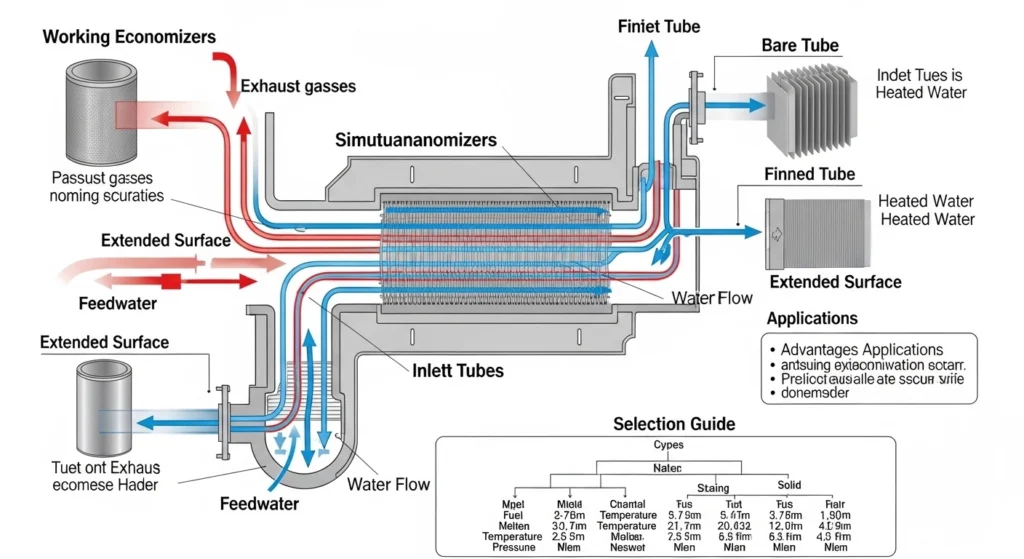
Before exiting through the stack or chimney, the hot flue gases are directed through the economizer. Inside the economizer, the gases flow around specially designed heat exchange tubes. These tubes provide a large surface area that allows efficient transfer of heat from the exhaust gases to the feedwater without mixing the two fluids. This process recovers energy that would otherwise be wasted.
Step 4: Cold Boiler Feedwater Flows Through the Heat Exchange Tubes
At the same time, relatively cold boiler feedwater enters the economizer through the inlet header and flows inside the heat exchange tubes. As the water travels through these tubes, it is continuously exposed to the heat from the surrounding flue gases. This gradual heating process increases the water temperature before it enters the boiler, reducing the amount of additional heating required.
Step 5: Efficient Heat Transfer Occurs
The economizer operates on the principle of indirect heat exchange. Heat naturally flows from the hotter flue gases to the colder feedwater through the metal walls of the tubes. Since there is no direct contact between the gases and the water, the process remains safe and efficient.
As a result:
- The flue gases lose a large portion of their remaining heat.
- The feedwater temperature increases significantly.
- Boiler heat losses are minimized.
- More energy is recovered from the combustion process.
- Overall thermal efficiency is improved.
Step 6: Preheated Feedwater Enters the Boiler
After passing through the economizer, the preheated feedwater leaves through the outlet header and enters the boiler or steam drum. Because the water is already at a higher temperature, the boiler requires less fuel and less time to convert it into steam. This not only improves steam production but also reduces thermal stress on the boiler components, contributing to longer equipment life and lower maintenance costs.
Step 7: Improved Boiler Performance and Energy Efficiency
The continuous recovery of waste heat significantly improves the overall performance of the boiler system. By utilizing energy that would otherwise be lost through the chimney, the economizer helps maximize fuel efficiency and reduce operating expenses.
Results of the Economizer Working Process
- Improves overall boiler thermal efficiency.
- Reduces fuel consumption and operating costs.
- Increases steam generation efficiency.
- Minimizes waste heat losses.
- Lowers greenhouse gas and carbon emissions.
- Reduces boiler workload.
- Extends boiler service life.
- Enhances overall plant productivity and reliability.
- Supports energy conservation and sustainable industrial operations.
By following these seven steps, an economizer transforms wasted exhaust heat into useful energy, making it one of the most effective and economical heat recovery devices used in modern boilers, thermal power plants, and industrial steam systems in 2026.
3.2 Easy Analogy to Understand the Working Principle
Imagine boiling water for tea.
If you start with cold water, it takes more time and energy to reach boiling point.
If the water is already warm, it boils much faster while consuming less fuel or electricity.
An economizer works in the same way by preheating the boiler feedwater before it enters the boiler, reducing the energy required for steam generation.
3.3 Heat Transfer Process Inside an Economizer
The economizer operates using the principle of indirect heat exchange.
During operation:
- Hot exhaust gases flow outside the tubes.
- Feedwater flows inside the tubes.
- Heat passes through the tube walls.
- No direct mixing occurs between water and flue gases.
This indirect heat transfer ensures safe, efficient, and continuous operation while maximizing energy recovery.
3.4 Key Benefits of the Economizer Working Process
The heat recovery process provides several important advantages for industrial and commercial boiler systems.
Major Benefits
- Reduces fuel consumption.
- Improves boiler thermal efficiency.
- Recovers waste heat.
- Lowers operating costs.
- Reduces greenhouse gas emissions.
- Increases steam generation efficiency.
- Minimizes energy losses.
- Extends boiler equipment life.
- Improves overall plant performance.
3.5 Why Understanding the Working Principle Is Important
Understanding how an economizer works helps engineers, technicians, and students appreciate the importance of heat recovery in modern energy systems. By capturing waste heat from exhaust gases and transferring it to boiler feedwater, an economizer improves efficiency, reduces fuel costs, lowers emissions, and supports sustainable industrial operations.
As industries continue to focus on energy conservation and environmental responsibility in 2026, economizers remain one of the most effective technologies for improving boiler performance and maximizing the efficient use of fuel.
4. Types of Economizers (2026): Complete Classification, Features, and Applications
Economizers are classified based on their working principle, operating temperature, heat recovery method, construction, and application. Each type is designed to recover waste heat efficiently while meeting specific industrial and commercial requirements. Selecting the appropriate economizer depends on factors such as boiler type, fuel used, flue gas temperature, and desired energy savings.
Below are the most common types of economizers used in 2026.
Non-Condensing Economizer (2026): Working Principle, Features, Advantages, and Industrial Applications
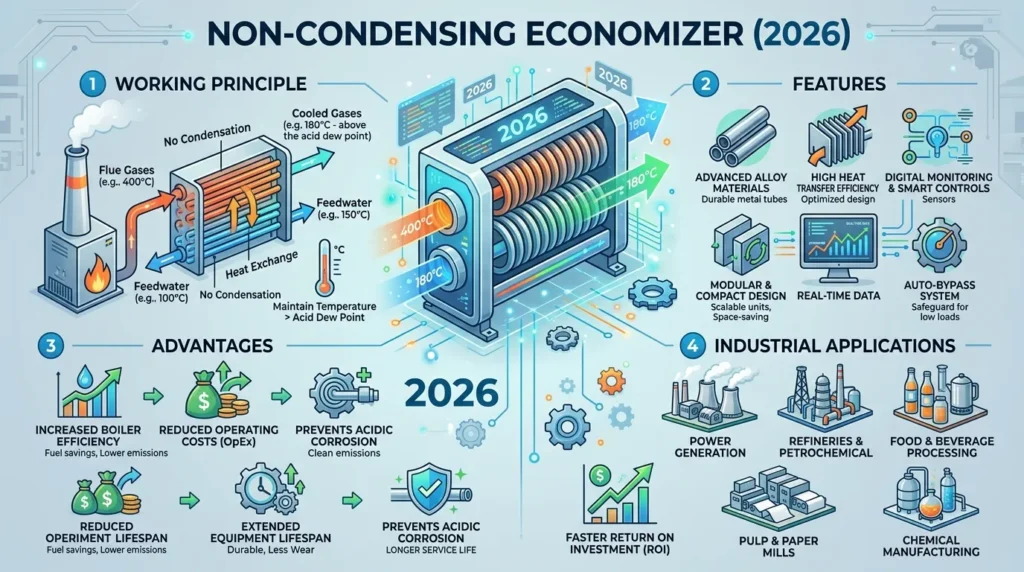
The Non-Condensing Economizer is the most commonly used type of economizer in industrial boiler systems, thermal power plants, and steam-generating facilities. It is specifically designed to recover sensible heat from hot flue gases without allowing the exhaust gases to cool below their acid dew point. By maintaining the flue gas temperature above the condensation point, this economizer prevents the formation of acidic moisture, which can cause severe corrosion of boiler components and exhaust systems.
Unlike condensing economizers, a non-condensing economizer only utilizes the sensible heat contained in the exhaust gases and does not recover the latent heat released during water vapor condensation. Although its heat recovery is slightly lower than that of a condensing economizer, it offers greater durability, lower maintenance requirements, and excellent reliability in high-temperature industrial applications.
Because of its simple design, long operating life, and cost-effective performance, the non-condensing economizer remains the preferred choice for many industries in 2026.
Working Principle of a Non-Condensing Economizer
The non-condensing economizer operates using the principle of indirect heat exchange.
As hot flue gases leave the boiler furnace, they pass through the economizer before reaching the chimney. At the same time, relatively cold boiler feedwater flows through heat exchange tubes inside the economizer. Heat is transferred from the hot gases to the colder feedwater through the tube walls without allowing the two fluids to mix.
The flue gases are cooled only to a safe temperature that remains above the dew point, preventing moisture condensation and protecting the equipment from corrosion. The preheated feedwater then enters the boiler, where less fuel is required to convert it into steam.
Key Features
- Operates above the flue gas condensation (dew point) temperature.
- Recovers sensible heat from hot exhaust gases.
- Prevents acidic condensation inside the economizer.
- Minimizes corrosion and material deterioration.
- Improves boiler thermal efficiency.
- Reduces overall fuel consumption.
- Simple and reliable heat exchanger design.
- Suitable for continuous industrial operation.
- Requires relatively low maintenance.
- Compatible with medium- and high-temperature boiler systems.
Advantages of a Non-Condensing Economizer
The non-condensing economizer offers several practical and economic benefits that make it one of the most widely installed heat recovery systems in industrial applications.
Improves Boiler Efficiency
By recovering waste heat from the exhaust gases, the economizer increases the temperature of the incoming feedwater. This reduces the amount of fuel needed to produce steam and improves the boiler’s overall thermal efficiency.
Lower Risk of Corrosion
Since the flue gases never cool below the acid dew point, harmful acidic condensation does not form inside the economizer. This greatly reduces corrosion and extends the service life of both the economizer and the boiler.
Reduced Fuel Consumption
Preheated feedwater requires less additional heating inside the boiler, resulting in lower fuel usage and significant energy savings over time.
Long Equipment Life
Operating above the condensation temperature protects internal components from moisture-related damage, allowing the economizer to operate reliably for many years with minimal deterioration.
Simple Construction and Easy Maintenance
The design of a non-condensing economizer is relatively straightforward, making installation, inspection, cleaning, and maintenance easier compared to more complex heat recovery systems.
Reliable Industrial Performance
These economizers are capable of operating continuously under demanding industrial conditions, providing stable and dependable performance in power plants and manufacturing facilities.
Industrial Applications
The non-condensing economizer is widely used in industries where high-temperature boilers operate continuously and where corrosion prevention is an important consideration.
Common applications include:
- Thermal power plants
- Industrial steam boilers
- Manufacturing industries
- Chemical processing plants
- Food and beverage processing industries
- Paper and pulp mills
- Textile manufacturing plants
- Oil and gas refineries
- Petrochemical industries
- Sugar mills
- Cement plants
- Pharmaceutical manufacturing facilities
- District heating systems
Why Industries Prefer Non-Condensing Economizers
Many industrial facilities continue to choose non-condensing economizers because they provide an excellent balance between efficiency, durability, reliability, and operating cost. While they do not recover latent heat like condensing economizers, they offer outstanding long-term performance with a much lower risk of corrosion and maintenance issues.
For industries operating conventional boiler systems, the non-condensing economizer remains one of the most practical and cost-effective heat recovery solutions available in 2026, helping reduce fuel consumption, improve boiler efficiency, extend equipment life, and support sustainable industrial operations.
4.2 Condensing Economizer (2026): Working Principle, Features, Advantages, and Industrial Applications
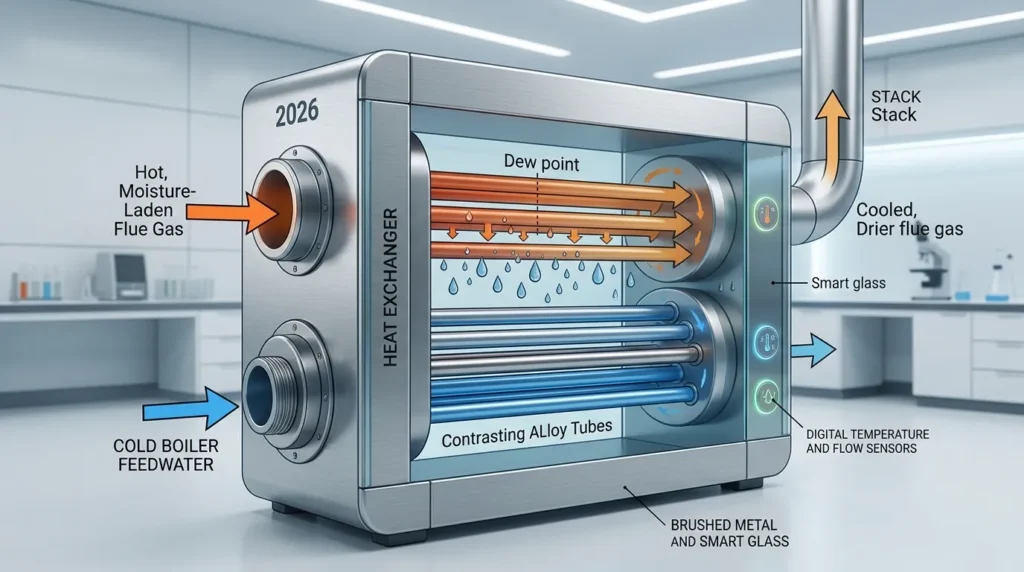
A Condensing Economizer is an advanced heat recovery device designed to maximize boiler efficiency by recovering both sensible heat and latent heat from hot exhaust (flue) gases. Unlike a non-condensing economizer, which only recovers sensible heat, a condensing economizer cools the flue gases below their dew point, causing the water vapor present in the exhaust gases to condense into liquid water.
During this condensation process, a large amount of latent heat is released. The economizer captures this additional heat and transfers it to the boiler feedwater or heating water, significantly increasing the overall thermal efficiency of the system. Because it extracts more energy from the exhaust gases, a condensing economizer can achieve much higher energy savings than conventional heat recovery systems.
This type of economizer is widely used in modern high-efficiency boiler systems, commercial heating plants, district heating networks, and industrial facilities where maximum fuel savings and reduced carbon emissions are priorities.
Working Principle of a Condensing Economizer
The condensing economizer operates using the principle of advanced heat exchange and condensation.
After combustion, the hot flue gases leave the boiler and enter the condensing economizer. Inside the economizer, relatively cold feedwater or return water flows through specially designed heat exchange tubes.
As heat is transferred from the hot gases to the water, the temperature of the flue gases gradually decreases. When the gas temperature falls below the dew point, the water vapor contained in the exhaust begins to condense. During condensation, additional latent heat is released and transferred to the circulating water.
The cooled exhaust gases then leave the economizer at a much lower temperature, while the heated water enters the boiler or heating system, reducing the amount of fuel needed for further heating.
Key Features
- Recovers both sensible heat and latent heat.
- Operates below the flue gas dew point.
- Extracts heat from condensed water vapor.
- Provides significantly higher thermal efficiency.
- Maximizes waste heat recovery.
- Reduces exhaust gas temperature.
- Improves overall boiler performance.
- Supports energy-efficient heating systems.
- Designed using corrosion-resistant materials to withstand acidic condensate.
- Ideal for low-temperature return water systems.
Advantages of a Condensing Economizer
The condensing economizer offers several important benefits, making it one of the most efficient heat recovery technologies available in modern boiler systems.
Maximum Energy Recovery
By recovering both sensible and latent heat, the condensing economizer extracts more usable energy from exhaust gases than conventional economizers.
Lower Fuel Consumption
Because more waste heat is recovered, the boiler requires significantly less fuel to heat the feedwater or return water, resulting in substantial energy savings.
Higher Boiler Efficiency
Condensing economizers can greatly improve the overall thermal efficiency of boiler systems, helping facilities reduce operating costs while maintaining high steam or hot water output.
Reduced Carbon Emissions
Lower fuel consumption directly reduces carbon dioxide (CO₂) emissions and other greenhouse gases, making the system more environmentally friendly.
Lower Operating Costs
Reduced fuel usage translates into lower energy bills and improved long-term operating economy, especially in facilities with continuous boiler operation.
Supports Sustainable Energy Goals
Condensing economizers help industries meet modern energy-efficiency regulations and environmental standards by minimizing wasted heat and improving resource utilization.
Applications
Condensing economizers are commonly installed in systems where maximum heat recovery and high energy efficiency are required.
Typical applications include:
- High-efficiency boiler systems
- Commercial heating systems
- District heating plants
- Condensing gas boilers
- Hospitals and healthcare facilities
- Hotels and large commercial buildings
- Universities and educational campuses
- Food processing industries
- Pharmaceutical manufacturing plants
- Chemical processing industries
- Energy-efficient industrial facilities
- Combined Heat and Power (CHP) plants
- Biomass and renewable energy systems
Why Industries Choose Condensing Economizers
Many industries are replacing conventional heat recovery systems with condensing economizers because of their superior efficiency and lower environmental impact. Although the initial installation cost is generally higher and corrosion-resistant materials are required to handle acidic condensate, the long-term savings in fuel costs and energy consumption often provide an excellent return on investment.
For facilities aiming to maximize boiler performance, reduce emissions, and comply with modern energy-efficiency standards, the condensing economizer has become one of the most effective heat recovery solutions available in 2026. By recovering nearly all available waste heat from exhaust gases, it helps industries achieve lower operating costs, improved sustainability, and higher overall system efficiency.
4.3 Feedwater Economizer (2026): Working Principle, Features, Advantages, and Industrial Applications
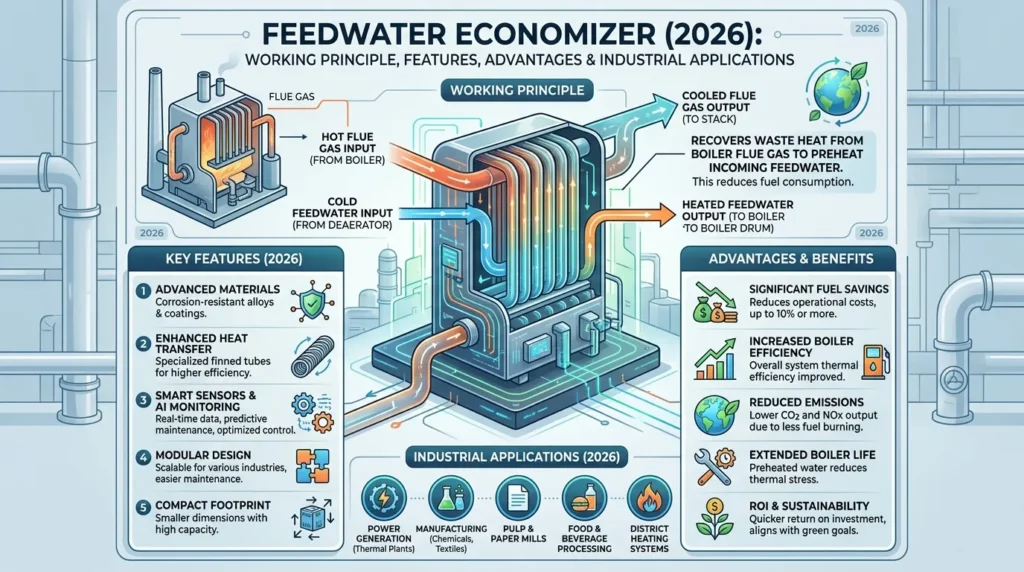
A Feedwater Economizer is a heat recovery device specifically designed to preheat boiler feedwater before it enters the steam drum or boiler shell. It utilizes the waste heat available in the boiler’s hot exhaust (flue) gases to increase the temperature of the incoming feedwater. Since the water enters the boiler at a higher temperature, the boiler requires less fuel to convert it into steam, resulting in improved thermal efficiency and lower operating costs.
Among all economizer types, the feedwater economizer is one of the most widely used in steam-generating boilers, thermal power plants, and industrial steam systems. It is considered an essential component for improving boiler performance, conserving energy, and reducing fuel consumption.
Working Principle of a Feedwater Economizer
The feedwater economizer operates on the principle of indirect heat exchange.
After combustion takes place inside the boiler furnace, hot flue gases flow toward the chimney. Before leaving the boiler, these gases pass through the economizer. At the same time, relatively cold feedwater from the feedwater pump enters the economizer through the inlet header and flows inside the heat exchange tubes.
As the hot flue gases pass around the tubes, heat is transferred through the tube walls into the feedwater. The water temperature rises without mixing with the exhaust gases. The preheated feedwater then exits the economizer through the outlet header and enters the boiler or steam drum, where much less energy is required to produce steam.
This simple yet highly effective heat recovery process significantly improves the overall efficiency of the boiler system.
Key Features
- Installed in the boiler exhaust gas path.
- Preheats boiler feedwater before it enters the steam drum.
- Utilizes waste heat from flue gases.
- Improves steam generation efficiency.
- Reduces boiler fuel consumption.
- Enhances overall thermal performance.
- Operates continuously during boiler operation.
- Simple and reliable heat exchanger design.
- Suitable for medium- and large-capacity boiler systems.
- Helps maximize waste heat recovery.
Advantages of a Feedwater Economizer
The feedwater economizer offers numerous benefits that improve both boiler performance and overall plant efficiency.
Faster Steam Production
Since the feedwater is already heated before entering the boiler, it reaches the boiling point more quickly, allowing steam to be generated in less time.
Lower Fuel Consumption
The boiler requires less fuel to raise the temperature of the preheated water, resulting in substantial fuel savings during continuous operation.
Higher Boiler Efficiency
Recovering waste heat from exhaust gases increases the overall thermal efficiency of the boiler and reduces energy losses.
Reduced Operating Costs
Lower fuel consumption directly decreases operating expenses, making boiler operation more economical over the long term.
Reduced Thermal Stress
Introducing warm feedwater instead of cold water minimizes sudden temperature changes inside the boiler. This reduces thermal stress on boiler components and helps extend equipment life.
Improved Heat Recovery
The feedwater economizer captures energy that would otherwise escape through the chimney, maximizing the utilization of available heat.
Lower Environmental Impact
By reducing fuel consumption, the economizer also lowers carbon dioxide (CO₂) emissions and supports environmentally sustainable industrial operations.
Applications
Feedwater economizers are widely used wherever steam generation is required and improving boiler efficiency is a priority.
Common applications include:
- Thermal and steam power plants
- Industrial steam boilers
- Sugar mills
- Paper and pulp industries
- Textile manufacturing plants
- Food and beverage processing industries
- Chemical processing plants
- Oil and gas refineries
- Pharmaceutical manufacturing facilities
- Fertilizer industries
- Petrochemical plants
- Cement manufacturing plants
- District heating systems
- Biomass and waste-to-energy plants
Why Feedwater Economizers Are Important
The feedwater economizer is one of the most valuable components in modern steam-generating systems because it recovers waste heat that would otherwise be lost. By preheating the boiler feedwater, it reduces fuel consumption, improves steam production, increases boiler efficiency, and lowers operating costs without requiring additional energy input.
As industries continue to focus on energy conservation, cost reduction, and environmental sustainability, feedwater economizers remain an essential part of modern boiler technology in 2026. Their ability to enhance heat recovery, extend boiler life, and improve overall plant performance makes them one of the most cost-effective investments for industrial and commercial steam systems.
4.4 Air-Side Economizer (2026): Working Principle, Features, Advantages, and Applications
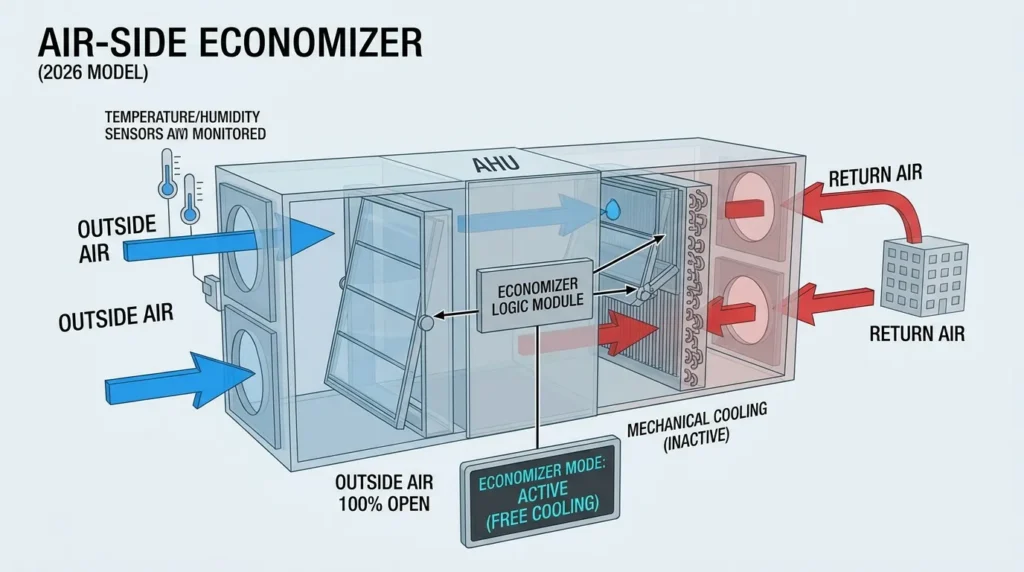
An Air-Side Economizer is an energy-saving ventilation system that uses cool outdoor air instead of relying entirely on mechanical air conditioning to cool a building. When the outdoor temperature and humidity are suitable, the economizer automatically brings fresh outside air into the building while exhausting warm indoor air. This reduces the workload on air-conditioning equipment, lowers electricity consumption, and improves indoor comfort.
Unlike boiler economizers, which recover heat from exhaust gases, an air-side economizer focuses on reducing cooling energy by making use of favorable outdoor weather conditions. It is widely used in modern HVAC (Heating, Ventilation, and Air Conditioning) systems and is considered one of the most effective methods for improving building energy efficiency.
With the growing emphasis on sustainable construction and green building standards, air-side economizers have become an important feature in commercial and industrial buildings in 2026.
Working Principle of an Air-Side Economizer
The air-side economizer operates by continuously monitoring outdoor air conditions using sensors.
When the outside air is cooler than the indoor air and the humidity level is within the acceptable range, the HVAC control system automatically opens dampers to allow fresh outdoor air into the building.
The cool outdoor air helps reduce the indoor temperature naturally, minimizing or eliminating the need for mechanical cooling from air conditioners or chillers.
When outdoor conditions become too hot, humid, or unsuitable, the economizer closes the outdoor air dampers and the HVAC system returns to normal mechanical cooling operation.
This automatic switching ensures maximum energy savings while maintaining indoor comfort.
Key Features
- Uses fresh outdoor air for cooling.
- Automatically operates based on outdoor temperature and humidity.
- Reduces the load on air-conditioning systems.
- Lowers electricity consumption.
- Improves indoor air quality through increased ventilation.
- Integrates with modern HVAC automation systems.
- Reduces compressor operating time.
- Supports green building and energy-efficiency standards.
- Provides automatic control through sensors and dampers.
- Improves overall HVAC system performance.
Advantages of an Air-Side Economizer
The air-side economizer offers numerous benefits for commercial and institutional buildings.
Significant Energy Savings
By using naturally cool outdoor air, the HVAC system consumes much less electrical energy, resulting in lower operating costs.
Reduced Air Conditioner Workload
Mechanical cooling equipment operates less frequently, reducing wear and extending the lifespan of compressors and other HVAC components.
Improved Indoor Air Quality
Fresh outdoor air replaces stale indoor air, reducing the concentration of indoor pollutants, odors, and carbon dioxide while creating a healthier environment.
Lower Operating Costs
Reduced electricity consumption leads to substantial long-term savings on energy bills.
Supports Sustainable Buildings
Air-side economizers help buildings meet modern energy-efficiency regulations and green building certification requirements.
Enhanced Occupant Comfort
Continuous ventilation with fresh air helps maintain a comfortable indoor environment while improving air circulation.
Applications
Air-side economizers are commonly installed in buildings where cooling systems operate for long hours and energy efficiency is a priority.
Common applications include:
- Commercial office buildings
- Shopping malls
- Data centers
- Hospitals and healthcare facilities
- Schools, colleges, and universities
- Hotels and resorts
- Airports
- Government buildings
- Libraries
- Museums
- Manufacturing facilities
- Warehouses
- Large retail stores
- Convention and exhibition centers
Why Air-Side Economizers Are Important
As energy costs continue to rise and environmental regulations become stricter, air-side economizers provide an effective solution for reducing HVAC energy consumption without compromising indoor comfort. By intelligently utilizing cool outdoor air whenever weather conditions permit, these systems improve energy efficiency, reduce electricity usage, enhance indoor air quality, and extend the life of HVAC equipment.
In 2026, air-side economizers remain one of the most practical and cost-effective technologies for achieving sustainable building operations, making them an essential component of modern HVAC systems in commercial, institutional, and industrial facilities.
4.5 Water-Side Economizer (2026): Working Principle, Features, Advantages, and Applications
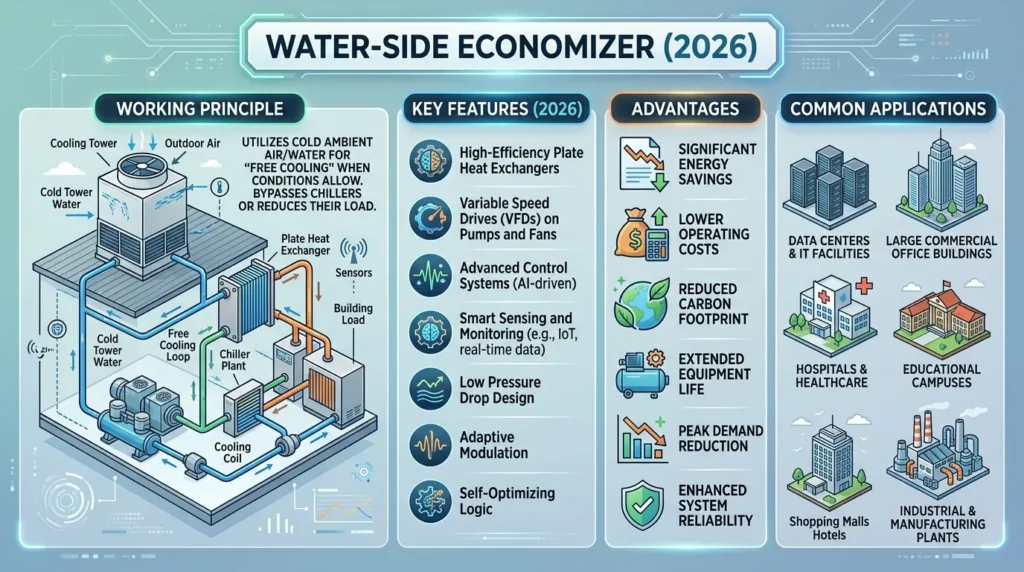
A Water-Side Economizer is an energy-efficient cooling system that uses naturally cool water instead of relying entirely on mechanical refrigeration to cool buildings and industrial facilities. Rather than using outdoor air like an air-side economizer, it utilizes chilled water, cooling towers, lakes, rivers, groundwater, or other natural cooling sources to remove heat from the building’s cooling system.
When outdoor water temperatures are sufficiently low, the water-side economizer transfers heat from the building’s chilled water system to the cooling source without requiring the chiller compressor to operate continuously. This significantly reduces electricity consumption, lowers operating costs, and improves the overall efficiency of HVAC systems.
Water-side economizers are especially valuable in facilities that require cooling throughout the year, such as data centers, hospitals, office buildings, and industrial plants. In 2026, they are widely recognized as one of the most effective technologies for improving energy efficiency and supporting sustainable building operations.
Working Principle of a Water-Side Economizer
The water-side economizer operates on the principle of indirect heat exchange using cool water instead of mechanical refrigeration.
During operation, warm water returning from the building’s cooling system flows through a heat exchanger. At the same time, naturally cool water supplied by a cooling tower or another cooling source flows through the opposite side of the heat exchanger.
Heat transfers from the warmer building water to the cooler water source without the two water streams mixing. As a result, the building’s chilled water is cooled before returning to the HVAC system.
When outdoor temperatures are low enough, the economizer can provide partial or even complete cooling without operating the mechanical chiller. If the cooling demand increases or outdoor conditions become warmer, the chiller automatically starts to provide additional cooling.
This automatic operation helps maximize energy savings while maintaining a stable indoor temperature.
Key Features
- Uses chilled water or cooling towers for free cooling.
- Utilizes naturally cool outdoor water sources.
- Reduces dependence on mechanical refrigeration.
- Improves overall HVAC system efficiency.
- Significantly lowers electricity consumption.
- Reduces compressor operating time.
- Integrates with building automation systems (BAS).
- Operates automatically based on water temperature.
- Provides reliable cooling for year-round operations.
- Supports sustainable and energy-efficient building design.
Advantages of a Water-Side Economizer
Water-side economizers offer numerous operational and economic benefits for commercial and industrial cooling systems.
Significant Energy Savings
By using naturally cool water instead of mechanical refrigeration, water-side economizers greatly reduce electrical power consumption.
Reduced Chiller Operation
The chiller compressor operates less frequently, reducing equipment wear and extending the service life of the cooling system.
Lower Operating Costs
Reduced electricity usage leads to substantial long-term savings in building operating expenses.
Improved HVAC Efficiency
The cooling system operates more efficiently because part or all of the cooling load is handled by the economizer.
Lower Carbon Emissions
Using less electrical energy reduces greenhouse gas emissions and supports environmentally sustainable building operations.
Higher Equipment Reliability
Reduced operating hours for compressors and chillers lower maintenance requirements and improve system reliability.
Applications
Water-side economizers are widely used in facilities where continuous cooling is required and energy efficiency is a major priority.
Common applications include:
- Large commercial office buildings
- Data centers
- Industrial cooling systems
- Corporate office complexes
- Hospitals and healthcare facilities
- Universities and educational campuses
- Hotels and convention centers
- Manufacturing plants
- Pharmaceutical industries
- Research laboratories
- Financial institutions
- Government buildings
- Airports
- Shopping malls
- High-rise commercial buildings
Why Water-Side Economizers Are Important
As cooling systems account for a significant portion of electricity consumption in modern buildings, water-side economizers provide an effective solution for reducing energy use while maintaining reliable cooling performance. By utilizing naturally cool water sources and minimizing chiller operation, they help lower operating costs, improve HVAC efficiency, reduce environmental impact, and extend equipment life.
In 2026, water-side economizers have become an essential component of high-performance HVAC systems, particularly in facilities that require continuous cooling, such as data centers, hospitals, industrial plants, and large commercial buildings. Their ability to deliver “free cooling” makes them one of the most valuable technologies for achieving long-term energy savings and sustainable building operations.
5. Main Components of an Economizer (2026): Parts, Functions, and Construction
An economizer consists of several carefully designed components that work together to transfer heat efficiently from hot exhaust gases to boiler feedwater. Each component plays an important role in maximizing heat recovery, maintaining safe operation, and ensuring long-term durability.
Understanding these components helps engineers, technicians, and students better understand how economizers function in industrial boiler systems.
5.1 Heat Exchange Tubes (2026): Construction, Working Principle, Functions, and Importance
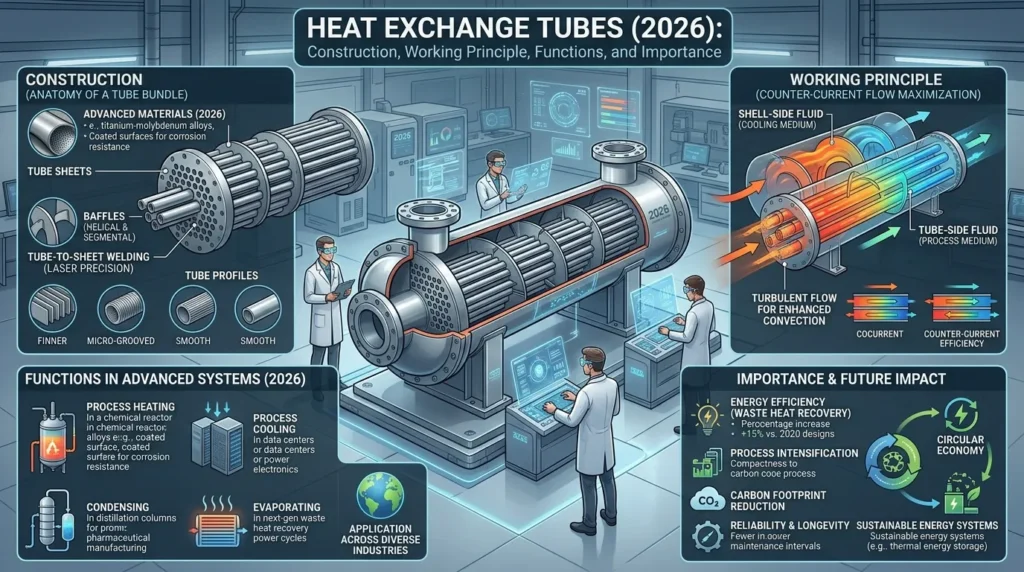
Heat exchange tubes are the most important component of an economizer because they are responsible for transferring heat from the hot flue gases to the boiler feedwater. These tubes serve as the primary heat transfer surface, allowing the economizer to recover waste heat that would otherwise escape through the chimney.
During operation, feedwater flows inside the tubes, while hot exhaust (flue) gases flow around the outside of the tubes. Since the two fluids remain separated by the tube walls, heat is transferred safely and efficiently without any direct mixing. This indirect heat exchange increases the temperature of the feedwater before it enters the boiler, reducing the fuel required for steam generation.
Heat exchange tubes are manufactured from high-strength carbon steel, alloy steel, stainless steel, or other corrosion-resistant materials capable of withstanding high temperatures, pressure, thermal expansion, and corrosive flue gases. In modern economizers, finned tubes are often used to increase the heat transfer surface area, resulting in even greater thermal efficiency.
Working Principle of Heat Exchange Tubes
The heat exchange tubes operate on the principle of conduction and convection.
As hot flue gases pass over the outer surface of the tubes, thermal energy is transferred through the metal tube walls to the colder feedwater flowing inside. Because heat naturally moves from a higher temperature to a lower temperature, the water absorbs the heat while the exhaust gases gradually cool down.
This continuous heat transfer process improves boiler efficiency without consuming any additional fuel.
Main Functions of Heat Exchange Tubes
Heat exchange tubes perform several critical functions within the economizer system.
- Transfer waste heat from hot exhaust gases to boiler feedwater.
- Increase the temperature of incoming feedwater before it enters the boiler.
- Improve overall boiler thermal efficiency.
- Reduce fuel consumption and operating costs.
- Recover energy that would otherwise be lost through the chimney.
- Support faster and more efficient steam generation.
- Maintain continuous and reliable heat transfer during boiler operation.
- Withstand high operating temperatures and pressure.
- Resist corrosion, thermal stress, and mechanical wear.
- Improve the overall performance and reliability of the economizer.
Advantages of High-Quality Heat Exchange Tubes
Using high-quality heat exchange tubes provides several operational benefits.
- Higher heat transfer efficiency.
- Improved boiler performance.
- Longer service life.
- Lower maintenance requirements.
- Reduced risk of tube leakage.
- Better corrosion resistance.
- Increased energy savings.
- Enhanced operational safety.
- Greater reliability under continuous industrial operation.
Common Materials Used for Heat Exchange Tubes
The material selection depends on the boiler operating conditions, temperature, pressure, and fuel type.
Common materials include:
- Carbon steel
- Alloy steel
- Stainless steel
- Low-alloy steel
- Nickel-based alloys
- Corrosion-resistant specialty alloys
Each material is selected to provide the required strength, thermal conductivity, and resistance to corrosion for long-term, reliable operation.
Why Heat Exchange Tubes Are Important
Heat exchange tubes are considered the heart of an economizer because they directly determine how efficiently waste heat is recovered from the flue gases. Well-designed and properly maintained tubes maximize heat transfer, reduce fuel consumption, improve steam production, and extend the life of the boiler system.
As economizer technology continues to advance in 2026, modern heat exchange tubes are being developed with improved materials, enhanced corrosion protection, and optimized designs to deliver higher efficiency, greater durability, and better overall performance in industrial and commercial boiler systems.
5.2 Inlet Header (2026): Construction, Working Principle, Functions, and Importance
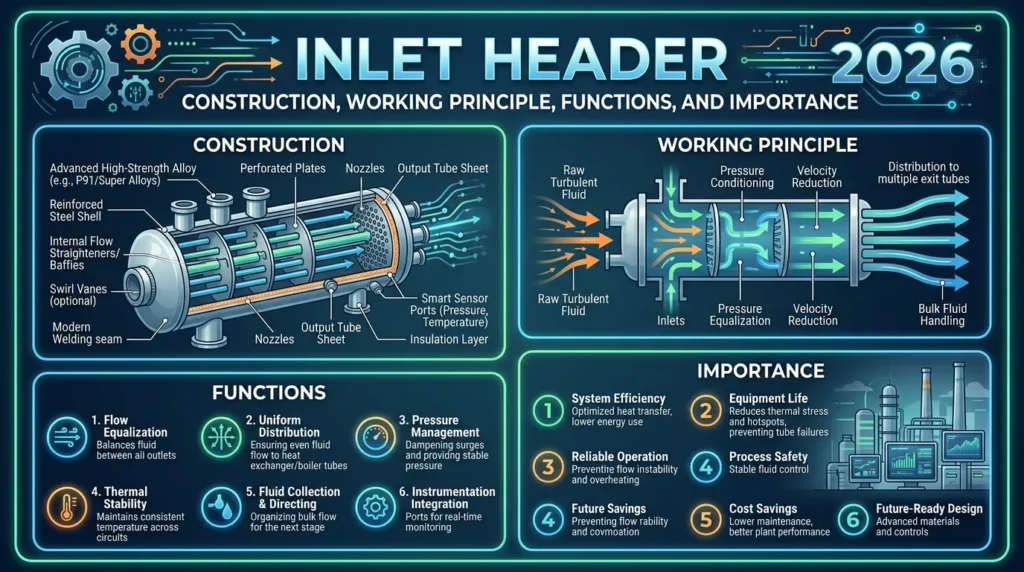
The Inlet Header is one of the most important components of an economizer because it serves as the entry point for the boiler feedwater. Its primary function is to receive feedwater from the feedwater pump or feedwater line and distribute it evenly to all the heat exchange tubes inside the economizer.
A properly designed inlet header ensures that each heat exchange tube receives an equal amount of water. This balanced distribution allows uniform heat absorption, improves heat transfer efficiency, prevents overheating of individual tubes, and enhances the overall performance of the economizer.
The inlet header is typically manufactured from high-strength carbon steel, alloy steel, or stainless steel to withstand high operating pressure, elevated temperatures, and continuous industrial service. It is designed according to boiler pressure standards to ensure safe and reliable operation.
Working Principle of the Inlet Header
The inlet header works as a feedwater distribution chamber.
When the feedwater pump supplies water to the economizer, the water first enters the inlet header. Inside the header, the water is evenly divided and directed into each heat exchange tube. As the water flows through the tubes, it absorbs heat from the surrounding hot flue gases.
Uniform water distribution is essential because it ensures that all tubes participate equally in the heat transfer process. This prevents uneven heating, minimizes thermal stress, and improves the efficiency of the economizer.
Main Functions of the Inlet Header
The inlet header performs several important functions within the economizer system.
- Receives feedwater from the feedwater system.
- Distributes water evenly to all heat exchange tubes.
- Maintains balanced water flow throughout the economizer.
- Ensures uniform heating of all tubes.
- Prevents localized overheating and hot spots.
- Supports efficient heat transfer.
- Maintains stable pressure distribution.
- Improves overall boiler efficiency.
- Contributes to smooth and continuous economizer operation.
Advantages of a Properly Designed Inlet Header
A high-quality inlet header provides several operational benefits.
- Uniform feedwater distribution.
- Improved heat transfer efficiency.
- Better boiler performance.
- Reduced thermal stress on economizer tubes.
- Lower risk of tube failure.
- Increased equipment reliability.
- Enhanced operational safety.
- Longer service life of the economizer.
- Reduced maintenance requirements.
Common Materials Used for Inlet Headers
The inlet header must withstand high pressure, temperature, and continuous water flow. Therefore, durable materials are used in its construction.
Common materials include:
- Carbon steel
- Alloy steel
- Stainless steel
- High-pressure boiler-grade steel
- Corrosion-resistant alloy materials
The material selection depends on the boiler operating pressure, temperature, feedwater quality, and industrial application.
Importance of Uniform Water Distribution
Even distribution of feedwater is essential for efficient economizer operation. If some tubes receive more water than others, heat transfer becomes uneven, which can lead to poor performance, thermal stress, and premature tube damage.
A properly functioning inlet header helps:
- Maximize heat recovery.
- Improve steam generation efficiency.
- Reduce fuel consumption.
- Protect economizer tubes from overheating.
- Extend the life of the boiler system.
- Ensure stable and reliable operation.
Why the Inlet Header Is Important
The inlet header acts as the starting point of the feedwater flow inside the economizer. Although it appears to be a simple component, it plays a crucial role in maintaining balanced water circulation and maximizing heat transfer efficiency. Without proper feedwater distribution, the economizer cannot recover waste heat effectively, resulting in reduced boiler performance and higher fuel consumption.
In 2026, modern economizer systems feature optimized inlet header designs with improved flow distribution, high-strength materials, and advanced engineering to ensure maximum efficiency, reliability, and long-term performance in industrial boiler and power plant applications.
5.3 Outlet Header (2026): Construction, Working Principle, Functions, and Importance
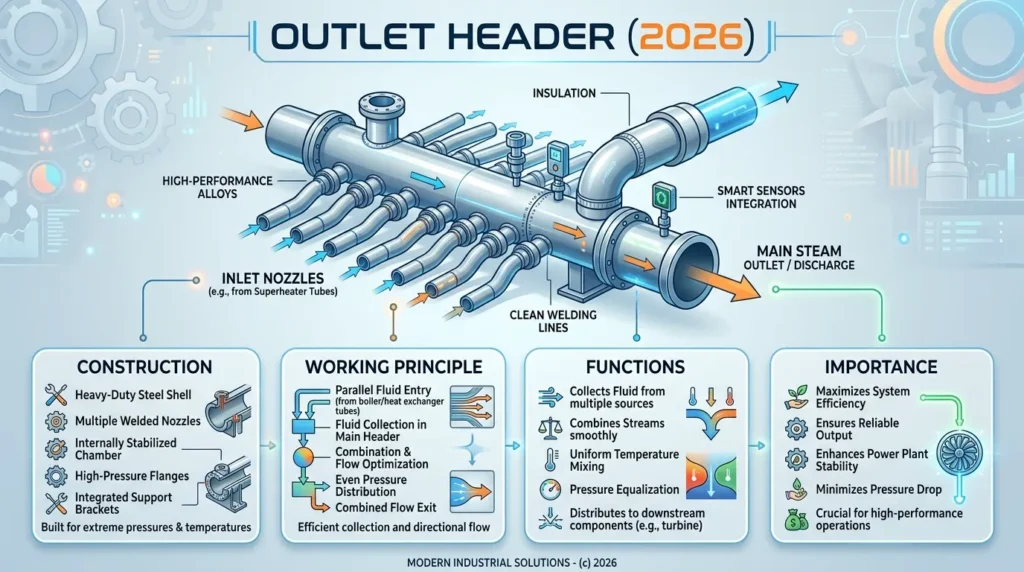
The Outlet Header is a vital component of an economizer that collects the preheated feedwater after it has passed through the heat exchange tubes. Once the feedwater absorbs heat from the hot flue gases, it flows into the outlet header, which then directs the heated water toward the boiler, steam drum, or boiler shell for steam generation.
The outlet header acts as a collection and distribution chamber, ensuring that the heated feedwater leaves the economizer smoothly and reaches the boiler at a uniform temperature and pressure. Proper operation of the outlet header helps maintain continuous water circulation, improves boiler efficiency, and supports stable steam production.
Like the inlet header, the outlet header is manufactured from high-strength carbon steel, alloy steel, or stainless steel to withstand high pressure, elevated temperatures, and continuous industrial operation.
Working Principle of the Outlet Header
The outlet header works by collecting the heated feedwater from all the economizer tubes.
As the feedwater flows through the heat exchange tubes, it absorbs thermal energy from the surrounding flue gases. The heated water then exits each tube and enters the outlet header, where it is combined into a single flow.
From the outlet header, the preheated feedwater is directed to the boiler or steam drum. Since the water has already gained a significant amount of heat, the boiler requires less fuel to convert it into steam, improving overall system efficiency and reducing energy consumption.
Main Functions of the Outlet Header
The outlet header performs several essential functions within the economizer system.
- Collects heated feedwater from all heat exchange tubes.
- Directs the preheated water toward the boiler or steam drum.
- Maintains smooth and continuous water flow.
- Ensures balanced pressure throughout the economizer.
- Supports efficient steam generation.
- Reduces flow disturbances and pressure losses.
- Improves overall heat recovery performance.
- Contributes to stable boiler operation.
- Enhances the efficiency of the entire steam generation system.
Advantages of a Properly Designed Outlet Header
A well-designed outlet header provides numerous operational benefits that improve both economizer and boiler performance.
- Ensures uniform collection of heated feedwater.
- Improves boiler thermal efficiency.
- Supports continuous and stable water circulation.
- Reduces hydraulic pressure losses.
- Helps maximize waste heat recovery.
- Lowers fuel consumption.
- Increases steam production efficiency.
- Improves system reliability.
- Reduces maintenance requirements.
- Extends the service life of the economizer and boiler.
Common Materials Used for Outlet Headers
Since the outlet header operates under high temperature and pressure conditions, it is constructed using durable materials that provide excellent strength and corrosion resistance.
Common materials include:
- Carbon steel
- Alloy steel
- Stainless steel
- High-pressure boiler-grade steel
- Corrosion-resistant alloy materials
The material selection depends on factors such as operating pressure, feedwater temperature, boiler capacity, and industrial application.
Importance of the Outlet Header
The outlet header plays a critical role in maintaining the efficient operation of an economizer. It ensures that all the heated feedwater collected from the heat exchange tubes is delivered uniformly to the boiler, preventing pressure imbalances and ensuring consistent steam production.
Without a properly functioning outlet header, water flow could become uneven, reducing heat transfer efficiency, increasing fuel consumption, and affecting overall boiler performance.
Why the Outlet Header Is Important
The outlet header serves as the final stage of the feedwater heating process inside the economizer. It connects the economizer to the boiler by safely collecting and transferring preheated feedwater for steam generation. Its efficient operation helps maximize waste heat recovery, improve boiler efficiency, reduce fuel costs, and ensure reliable performance.
In 2026, modern economizer outlet headers are designed using advanced engineering techniques, optimized flow paths, and high-strength materials to deliver superior durability, balanced water flow, and long-term operational reliability in power plants, industrial boilers, and large-scale steam generation systems.
5.4 Heat-Resistant Casing (2026): Construction, Functions, and Importance
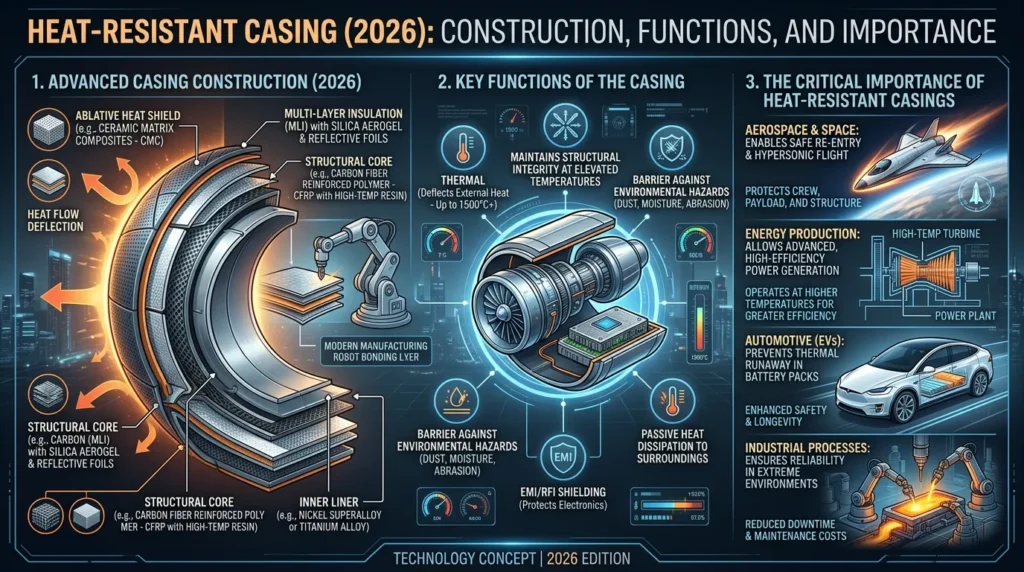
The Heat-Resistant Casing is the outer protective enclosure of an economizer that surrounds and supports the internal heat exchange components. It plays a crucial role in ensuring efficient heat recovery by directing the flow of hot flue gases over the heat exchange tubes while protecting the internal parts from external damage.
The casing is designed to withstand high temperatures, pressure variations, thermal expansion, dust, moisture, and harsh industrial environments. It also helps reduce heat loss to the surroundings by keeping the heat concentrated within the economizer, thereby improving the overall efficiency of the boiler system.
Modern economizer casings are typically manufactured from carbon steel, alloy steel, stainless steel, or other heat-resistant materials and are often insulated with thermal insulation to further minimize energy losses and improve operator safety.
Working Principle of the Heat-Resistant Casing
The heat-resistant casing acts as a protective and guiding structure for the economizer.
As hot flue gases leave the boiler, they enter the economizer through the casing. The casing directs these gases to flow uniformly across the heat exchange tubes, ensuring maximum contact between the hot gases and the tube surfaces. This controlled flow allows efficient heat transfer to the feedwater flowing inside the tubes.
At the same time, the casing prevents heat from escaping into the surrounding environment and shields the internal components from dust, moisture, corrosion, and mechanical damage.
Main Functions of the Heat-Resistant Casing
The heat-resistant casing performs several important functions within the economizer system.
- Encloses and supports the entire economizer assembly.
- Guides hot flue gases uniformly across the heat exchange tubes.
- Reduces heat loss to improve thermal efficiency.
- Protects internal components from environmental damage.
- Provides structural strength and mechanical support.
- Prevents leakage of exhaust gases.
- Helps maintain proper airflow through the economizer.
- Supports thermal insulation materials.
- Improves operational safety for maintenance personnel.
- Enhances the overall performance and durability of the economizer.
Advantages of a High-Quality Heat-Resistant Casing
A properly designed casing offers several operational and maintenance benefits.
- Improves heat recovery efficiency.
- Minimizes unnecessary heat losses.
- Protects internal parts from corrosion and physical damage.
- Extends the service life of the economizer.
- Improves overall boiler efficiency.
- Enhances workplace safety by reducing hot surface exposure.
- Supports stable and efficient flue gas flow.
- Reduces maintenance and repair costs.
- Increases equipment reliability during continuous operation.
Common Materials Used for Heat-Resistant Casings
The casing must withstand harsh operating conditions while maintaining its structural integrity. Common construction materials include:
- Carbon steel
- Stainless steel
- Alloy steel
- Heat-resistant steel plates
- Corrosion-resistant coated metals
In many industrial installations, the outer casing is covered with thermal insulation materials such as mineral wool, ceramic fiber, or fiberglass to reduce heat loss and improve energy efficiency.
Importance of the Heat-Resistant Casing
Without a properly designed casing, hot flue gases could escape before transferring sufficient heat to the feedwater, reducing the efficiency of the economizer. Excessive heat loss would increase fuel consumption, while inadequate protection could expose internal components to damage from dust, moisture, corrosion, and harsh operating conditions.
A well-engineered casing ensures efficient heat transfer, protects valuable equipment, and maintains safe and reliable operation throughout the economizer’s service life.
Why the Heat-Resistant Casing Is Important
The heat-resistant casing is much more than an outer cover—it is a critical component that supports efficient heat recovery, safe operation, and long-term durability. By directing exhaust gases through the heat exchange section, minimizing heat loss, and protecting internal components, it helps maximize boiler efficiency and reduce operating costs.
In 2026, modern economizer casings feature advanced heat-resistant materials, improved thermal insulation, corrosion-resistant coatings, and optimized airflow designs, enabling higher energy efficiency, longer equipment life, and more reliable performance in power plants, industrial boilers, and commercial heating systems.
5.5 Support Structure (2026): Construction, Functions, and Importance

The Support Structure is a critical structural component of an economizer that securely holds the entire economizer assembly in its proper position. It is designed to support the weight of the economizer while withstanding high temperatures, thermal expansion, vibrations, wind loads, and mechanical stresses generated during boiler operation.
A properly designed support structure ensures that all economizer components, including the heat exchange tubes, headers, and casing, remain correctly aligned. This alignment is essential for efficient heat transfer, safe operation, and long-term equipment reliability.
Support structures are typically fabricated from high-strength structural steel or alloy steel capable of handling heavy loads and harsh industrial environments. They are engineered according to industry standards to provide maximum strength, durability, and safety throughout the service life of the economizer.
Working Principle of the Support Structure
The support structure works by providing a stable foundation for the economizer while allowing controlled movement caused by thermal expansion.
As the economizer heats up during operation, its components naturally expand due to high temperatures. The support structure is designed to accommodate this expansion without causing excessive stress or distortion. It also absorbs vibrations generated by the boiler system and external forces, helping maintain proper alignment and preventing damage to the economizer.
By supporting the equipment securely, the structure ensures continuous, safe, and efficient operation under varying load and temperature conditions.
Main Functions of the Support Structure
The support structure performs several important functions within the economizer system.
- Supports the total weight of the economizer assembly.
- Maintains the correct position and alignment of all components.
- Resists thermal expansion during high-temperature operation.
- Absorbs vibrations and mechanical shocks.
- Provides structural stability under heavy loads.
- Supports the casing, headers, and heat exchange tubes.
- Prevents excessive movement and deformation.
- Ensures safe installation and long-term operation.
- Improves the reliability of the boiler system.
- Enhances overall equipment safety.
Advantages of a Strong Support Structure
A well-designed support structure provides numerous operational and safety benefits.
- Improves structural stability.
- Extends the service life of the economizer.
- Reduces vibration-related damage.
- Minimizes stress caused by thermal expansion.
- Enhances operational safety.
- Maintains proper equipment alignment.
- Reduces maintenance requirements.
- Supports reliable and continuous boiler operation.
- Increases overall system durability.
Common Materials Used
Support structures are manufactured using strong materials capable of handling heavy industrial loads.
Common materials include:
- Structural carbon steel
- High-strength alloy steel
- Stainless steel (for corrosive environments)
- Galvanized steel components
- Heat-resistant structural steel
Protective coatings and anti-corrosion treatments are often applied to improve durability and resist rust, moisture, and harsh environmental conditions.
Importance of the Support Structure
Without a properly engineered support structure, the economizer could experience misalignment, excessive vibration, thermal stress, or even structural failure. These issues can reduce heat transfer efficiency, increase maintenance costs, and create serious safety risks.
A robust support structure ensures that the economizer remains stable throughout its operating life, even under continuous high-temperature and high-pressure conditions.
Why the Support Structure Is Important
The support structure is the foundation of the economizer system, providing the strength and stability required for safe and efficient operation. By supporting heavy equipment, accommodating thermal expansion, minimizing vibration, and maintaining structural integrity, it helps maximize boiler efficiency, reduce downtime, and extend equipment life.
In 2026, modern economizer support structures are designed using advanced engineering techniques, high-strength materials, and computer-aided structural analysis to provide greater durability, improved safety, and reliable performance in power plants, industrial boilers, and large-scale steam generation facilities.
5.6 Fins (Extended Heat Transfer Surfaces)
Many modern economizers use finned tubes to increase the surface area available for heat transfer. The additional surface improves thermal efficiency without significantly increasing equipment size.
Functions
- Increase heat transfer area.
- Improve thermal efficiency.
- Enhance heat recovery.
- Reduce exhaust gas temperature.
5.7 Inspection and Cleaning Openings
Modern economizers include inspection doors or access panels that allow maintenance personnel to inspect, clean, and service internal components.
Functions
- Simplify maintenance.
- Enable tube inspection.
- Facilitate soot removal.
- Reduce maintenance time.
5.8 Insulation System
Thermal insulation surrounds the economizer casing to reduce heat loss and protect workers from high surface temperatures.
Functions
- Minimizes heat loss.
- Improves energy efficiency.
- Protects personnel.
- Maintains stable operating temperatures.
Why These Components Are Important
Every component of an economizer contributes to efficient heat recovery, safe operation, and reliable boiler performance. From the heat exchange tubes that recover waste heat to the headers that distribute feedwater and the casing that directs exhaust gases, each part is essential for maximizing energy efficiency.
As industrial boiler technology continues to advance in 2026, modern economizers incorporate improved materials, optimized tube designs, intelligent monitoring systems, and enhanced corrosion protection, making them more efficient, durable, and environmentally friendly than ever before.
6. Advantages of an Economizer (2026): Benefits for Boiler Efficiency and Energy Savings
An economizer is one of the most effective heat recovery devices used in modern boiler systems. By capturing waste heat from flue gases and using it to preheat boiler feedwater, an economizer improves thermal efficiency, reduces fuel consumption, and lowers operating costs. As industries continue to focus on energy conservation and environmental sustainability, economizers have become essential components in power plants, manufacturing facilities, and commercial heating systems.
Below are the major advantages of using an economizer in 2026.
6.1 Improves Boiler Efficiency
The primary advantage of an economizer is its ability to increase boiler efficiency by recovering heat that would otherwise escape through the chimney. This recovered heat raises the temperature of the feedwater before it enters the boiler, reducing the amount of fuel needed to produce steam.
Benefits
- Higher thermal efficiency
- Better heat utilization
- Improved boiler performance
- Reduced energy losses
6.2 Reduces Fuel Consumption
Since the feedwater enters the boiler at a higher temperature, less fuel is required to reach the desired steam temperature. This significantly lowers fuel consumption over time.
Benefits
- Lower fuel usage
- Reduced operating expenses
- Improved energy management
- Better return on investment
6.3 Lowers Energy Costs
By improving heat recovery and reducing fuel consumption, economizers help industries save substantial amounts on energy bills.
Benefits
- Lower electricity and fuel costs
- Reduced production expenses
- Increased plant profitability
- Faster payback period
6.4 Reduces Greenhouse Gas Emissions
Burning less fuel results in lower carbon dioxide (CO₂) and other harmful emissions. Economizers therefore support cleaner industrial operations and help organizations meet environmental regulations.
Environmental Benefits
- Lower CO₂ emissions
- Reduced air pollution
- Improved environmental compliance
- Supports sustainable energy practices
6.5 Extends Boiler Life
Preheated feedwater reduces thermal shock inside the boiler, decreasing stress on boiler components. This helps extend the lifespan of the boiler and reduces repair costs.
Benefits
- Reduced thermal stress
- Longer equipment life
- Lower maintenance costs
- Improved system reliability
6.6 Improves Steam Production Efficiency
Because the boiler requires less energy to heat preheated feedwater, steam can be generated more efficiently and consistently.
Benefits
- Faster steam generation
- Stable boiler operation
- Higher productivity
- Improved process efficiency
6.7 Enhances Overall Plant Performance
An efficiently operating economizer improves the performance of the entire steam generation system by reducing energy waste and optimizing heat recovery.
Benefits
- Increased plant efficiency
- Better resource utilization
- Lower operating costs
- Improved industrial productivity
Real-World Benefits of Economizers
Industries that install properly designed economizers often achieve significant fuel savings while maintaining the same steam output. This makes economizers a cost-effective investment for power plants, manufacturing facilities, refineries, food processing industries, and other steam-dependent operations.
7. Disadvantages and Limitations of an Economizer (2026): Challenges and Practical Considerations
Although economizers provide numerous benefits, they also have certain limitations. Understanding these disadvantages helps engineers design better systems and implement proper maintenance practices to maximize equipment performance.
7.1 High Initial Installation Cost
Installing an economizer requires additional equipment, piping, and engineering work, making the initial investment relatively high.
Impact
- Higher capital cost
- Longer installation time
- Increased project budget
However, the long-term fuel savings often offset the initial investment.
7.2 Requires Regular Maintenance
Economizers operate under harsh conditions involving high temperatures, flue gases, soot, and moisture. Routine inspection and maintenance are essential for maintaining efficiency.
Maintenance Requirements
- Tube cleaning
- Leak inspection
- Corrosion monitoring
- Soot removal
- Performance testing
7.3 Risk of Corrosion
If exhaust gas temperatures fall below the acid dew point, acidic condensation may occur, leading to corrosion of economizer tubes.
Prevention
- Maintain proper flue gas temperatures.
- Use corrosion-resistant materials.
- Perform regular inspections.
- Follow recommended operating conditions.
7.4 Fouling and Soot Buildup
Dust, ash, soot, and other combustion residues may accumulate on heat transfer surfaces over time, reducing heat recovery efficiency.
Solutions
- Schedule routine cleaning.
- Optimize combustion.
- Use high-quality fuel.
- Monitor pressure drop across the economizer.
7.5 Space Requirements
Economizers require sufficient installation space, especially in existing boiler systems where retrofitting may be necessary.
Considerations
- Boiler room layout
- Maintenance clearance
- Pipe routing
- Structural support
How to Minimize These Limitations
Most economizer problems can be reduced through proper system design, quality materials, routine maintenance, and regular performance monitoring. When maintained correctly, the long-term benefits generally outweigh the disadvantages.
8. Economizer Applications (2026): Where Economizers Are Used in Modern Industries
Economizers are widely used wherever waste heat recovery can improve energy efficiency and reduce operating costs. Their ability to recover heat from exhaust gases makes them valuable across many industrial and commercial sectors.
8.1 Thermal Power Plants
Thermal power plants are among the largest users of economizers. They recover waste heat from boiler exhaust gases to preheat feedwater before it enters the boiler.
Benefits
- Higher boiler efficiency
- Reduced coal or fuel consumption
- Increased steam production
- Lower operating costs
8.2 Industrial Boiler Systems
Factories and manufacturing plants that operate steam boilers use economizers to improve fuel efficiency and reduce production costs.
Industries Include
- Food processing
- Chemical manufacturing
- Textile production
- Paper mills
- Pharmaceutical plants
- Sugar factories
8.3 HVAC (Heating, Ventilation, and Air Conditioning) Systems
Modern HVAC systems use economizer technology to improve building energy efficiency. Air-side and water-side economizers utilize cool outdoor conditions to reduce the workload on mechanical cooling systems.
Applications
- Commercial buildings
- Shopping malls
- Hospitals
- Schools
- Office complexes
- Hotels
8.4 Data Centers
Data centers generate large amounts of heat and consume significant electrical power for cooling. Economizer systems reduce cooling energy by utilizing favorable outdoor air or water temperatures whenever conditions allow.
Benefits
- Lower electricity consumption
- Reduced cooling costs
- Improved energy efficiency
- Extended cooling equipment life
8.5 Oil and Gas Industry
Refineries and petrochemical plants use economizers to recover waste heat from industrial furnaces and boilers, improving process efficiency and reducing fuel usage.
8.6 Renewable Energy and Biomass Plants
Biomass boilers and waste-to-energy plants use economizers to maximize heat recovery and improve the efficiency of renewable energy generation.
8.7 Marine and Ship Boilers
Large marine vessels use economizers to recover heat from engine exhaust gases, improving fuel economy and reducing emissions during long-distance operations.
Why Economizer Applications Are Expanding
As industries continue to focus on energy efficiency, cost reduction, and environmental sustainability, economizers are becoming increasingly important across power generation, manufacturing, commercial buildings, HVAC systems, renewable energy facilities, marine applications, and data centers. Their ability to recover waste heat, reduce fuel consumption, and improve overall system efficiency makes them an essential technology for modern industrial operations in 2026 and beyond.
9. Comparison Section
Many students ask about the difference between economizer and air preheater. Both devices recover heat but operate differently.
| Feature | Economizer | Air Preheater |
|---|---|---|
| Function | Preheats boiler feedwater | Preheats combustion air |
| Heat Source | Flue gas heat | Flue gas heat |
| Position in Boiler | Before the boiler inlet | Before furnace air intake |
| Purpose | Improve boiler efficiency | Improve combustion efficiency |
Understanding the difference between economizer and air preheater helps engineers design efficient thermal systems.
10. Economizer Selection Guide (2026): How to Choose the Right Economizer for Maximum Efficiency
Selecting the right economizer is essential for achieving maximum heat recovery, improving boiler efficiency, reducing fuel consumption, and ensuring long-term system reliability. An economizer that is not properly matched to the boiler or operating conditions can result in poor performance, higher maintenance costs, increased pressure losses, and reduced equipment lifespan.
Whether you are installing a new boiler system or upgrading an existing one, understanding the key selection factors will help you choose the most suitable economizer for your application.
10.1 Determine the Boiler Capacity
The first and most important factor is the boiler’s capacity. The economizer should be sized according to the boiler’s steam or hot water output to ensure efficient heat recovery without restricting the flow of flue gases or feedwater.
An undersized economizer will recover less heat, while an oversized unit may increase installation costs without providing significant efficiency improvements.
Why It Matters
- Maximizes heat recovery
- Improves boiler efficiency
- Prevents excessive pressure drop
- Ensures balanced system performance
10.2 Evaluate Flue Gas Temperature
The temperature of the exhaust gases determines how much waste heat can be recovered. Higher flue gas temperatures generally provide greater opportunities for energy savings.
However, the outlet gas temperature should remain above the acid dew point to prevent condensation and corrosion inside the economizer.
Considerations
- Maximum flue gas temperature
- Minimum outlet temperature
- Heat recovery potential
- Corrosion prevention
10.3 Consider the Fuel Type
Different fuels produce different combustion gases and operating conditions. Fuel type directly affects economizer design, material selection, and maintenance requirements.
Common Fuel Types
- Natural gas
- Diesel
- Heavy fuel oil
- Coal
- Biomass
- Waste-derived fuels
Each fuel produces different levels of soot, ash, sulfur compounds, and moisture, which influence heat transfer efficiency and corrosion resistance.
10.4 Check Feedwater Flow Rate
The economizer must be capable of handling the required feedwater flow without causing excessive resistance or reducing heat transfer efficiency.
Proper water flow ensures uniform heating and prevents overheating of economizer tubes.
Benefits of Correct Water Flow
- Better heat absorption
- Stable boiler operation
- Improved energy efficiency
- Reduced thermal stress
10.5 Evaluate Available Installation Space
Before selecting an economizer, assess the available installation space within the boiler room or plant. Adequate space is necessary for installation, inspection, maintenance, and future repairs.
Factors to Consider
- Equipment dimensions
- Maintenance clearance
- Access for cleaning
- Existing piping layout
- Structural support requirements
Proper planning helps simplify installation and reduces maintenance difficulties later.
10.6 Select the Right Construction Material
Economizers operate in high-temperature environments where corrosion and thermal stress are common. Choosing high-quality, corrosion-resistant materials significantly improves durability and reliability.
Common Materials
- Carbon steel
- Stainless steel
- Alloy steel
- Cast iron (for specific applications)
- Corrosion-resistant nickel alloys
The choice of material should match the operating temperature, fuel type, and environmental conditions.
10.7 Consider Heat Recovery Efficiency
Modern economizers are designed to maximize heat recovery while minimizing energy losses. Higher-efficiency models reduce boiler fuel consumption and lower operating costs over time.
Benefits
- Reduced fuel usage
- Lower operating expenses
- Improved boiler efficiency
- Reduced carbon emissions
- Faster return on investment
10.8 Ensure Easy Maintenance and Inspection
An economizer should be easy to inspect, clean, and maintain. Accessible designs reduce maintenance time and improve long-term reliability.
Look For
- Easy tube access
- Inspection openings
- Simple cleaning procedures
- Replaceable components
- Built-in monitoring systems
Regular maintenance keeps the economizer operating at peak efficiency.
10.9 Safety and Compliance
Always ensure that the selected economizer complies with applicable engineering standards, safety regulations, and manufacturer specifications.
Safety Considerations
- Pressure rating
- Temperature rating
- Material certification
- Boiler compatibility
- Environmental compliance
Using certified equipment improves safety and ensures reliable long-term operation.
10.10 Tips for Beginners
If you are selecting an economizer for the first time, following a few practical guidelines can help you make the right decision.
Best Practices
- Match the economizer with the boiler capacity.
- Check compatibility with the existing boiler system.
- Select corrosion-resistant materials for longer service life.
- Evaluate flue gas temperature before choosing a model.
- Ensure adequate installation space and maintenance access.
- Choose energy-efficient designs with high heat recovery.
- Follow the manufacturer’s installation and maintenance recommendations.
- Consult qualified engineers for large industrial applications.
Why Proper Economizer Selection Matters
Choosing the right economizer improves fuel efficiency, increases heat recovery, reduces operating costs, and extends boiler life. A properly selected economizer also minimizes maintenance requirements, enhances system reliability, and supports compliance with modern energy-efficiency standards.
As industrial heating systems continue to evolve in 2026, selecting the correct economizer remains a key factor in achieving efficient, reliable, and environmentally sustainable boiler operations.
11. Common Economizer Problems and Troubleshooting Guide (2026): Causes, Solutions, and Maintenance Tips
Although economizers are designed to improve boiler efficiency and recover waste heat, they can experience operational problems due to continuous exposure to high temperatures, flue gases, dust, moisture, and pressure variations. If these issues are not identified and resolved promptly, they can reduce heat recovery efficiency, increase fuel consumption, and shorten equipment lifespan.
Regular inspection, preventive maintenance, and proper operation help ensure reliable economizer performance and minimize unexpected downtime.
Below are the most common economizer problems encountered in 2026, along with their causes and recommended solutions.
11.1 Tube Leakage
Tube leakage is one of the most common economizer failures. Leaking tubes reduce heat transfer efficiency, waste energy, and may cause boiler shutdowns if left untreated.
Possible Causes
- Corrosion caused by acidic flue gases
- Mechanical damage during maintenance
- Thermal stress due to repeated heating and cooling
- High-pressure operation
- Material aging and fatigue
- Poor water quality causing internal corrosion
Solutions
- Inspect economizer tubes regularly.
- Replace damaged or leaking tubes immediately.
- Use corrosion-resistant materials where possible.
- Maintain proper boiler water treatment.
- Monitor operating pressure and temperature.
- Perform routine preventive maintenance.
11.2 Reduced Heat Transfer Efficiency
When heat transfer decreases, the economizer cannot recover enough waste heat from exhaust gases. This leads to higher fuel consumption and lower overall boiler efficiency.
Possible Causes
- Soot accumulation on tube surfaces
- Dust and ash deposits
- Scale formation inside tubes
- Dirty flue gas passages
- Inadequate cleaning schedule
Solutions
- Clean economizer tubes at regular intervals.
- Remove soot and ash using appropriate cleaning equipment.
- Maintain proper combustion to reduce soot formation.
- Use effective water treatment to prevent scaling.
- Inspect heat transfer surfaces during maintenance shutdowns.
11.3 Excessive Pressure Drop
A high pressure drop across the economizer reduces airflow and affects boiler performance. It also increases the workload on fans and other system components.
Possible Causes
- Blocked flue gas passages
- Heavy soot or ash buildup
- Poor economizer design
- Damaged or deformed tubes
- Restricted airflow
Solutions
- Clean gas passages regularly.
- Remove accumulated debris and deposits.
- Ensure proper airflow throughout the system.
- Repair or replace damaged tubes.
- Verify that the economizer is correctly designed for the boiler capacity.
11.4 Corrosion of Economizer Tubes
Corrosion gradually weakens economizer tubes, leading to leaks, reduced efficiency, and costly repairs.
Possible Causes
- Acidic condensation
- Moisture in flue gases
- Poor water chemistry
- High sulfur fuel combustion
- Long-term exposure to corrosive gases
Solutions
- Maintain proper flue gas temperatures.
- Improve boiler water treatment.
- Install corrosion-resistant tubes.
- Monitor condensate formation.
- Perform regular corrosion inspections.
11.5 Fouling and Ash Deposits
Over time, ash, soot, and other combustion by-products accumulate on heat transfer surfaces, reducing heat recovery efficiency.
Possible Causes
- Poor fuel quality
- Incomplete combustion
- Lack of routine cleaning
- High ash content in fuel
Solutions
- Use high-quality fuel whenever possible.
- Optimize combustion settings.
- Schedule periodic soot blowing.
- Perform routine cleaning of heat exchange surfaces.
11.6 Thermal Stress and Tube Cracking
Rapid temperature changes can create thermal stress, causing cracks or deformation in economizer tubes.
Possible Causes
- Frequent boiler start-stop cycles
- Sudden temperature fluctuations
- Improper operating procedures
- Uneven heat distribution
Solutions
- Avoid rapid heating and cooling.
- Follow proper startup and shutdown procedures.
- Monitor operating temperatures continuously.
- Replace cracked or weakened tubes promptly.
11.7 Water Flow Problems
Insufficient or uneven water flow reduces the economizer’s ability to absorb heat effectively.
Possible Causes
- Blocked pipes
- Pump failure
- Air trapped in the system
- Faulty control valves
Solutions
- Inspect pumps and valves regularly.
- Remove air from the water circuit.
- Ensure proper water circulation.
- Repair or replace faulty components.
11.8 Preventive Maintenance Tips
Regular maintenance is the most effective way to prevent economizer problems and maintain peak efficiency.
Best Practices
- Inspect tubes for leaks and corrosion.
- Clean soot, ash, and dust deposits regularly.
- Monitor flue gas temperature and pressure.
- Check water quality and treatment systems.
- Inspect insulation and support structures.
- Calibrate monitoring instruments periodically.
- Replace worn or damaged components before failure occurs.
- Follow the manufacturer’s maintenance schedule.
Why Troubleshooting Is Important
Early detection and correction of economizer problems improve heat recovery, reduce fuel consumption, lower maintenance costs, and extend equipment life. Proper troubleshooting also enhances boiler safety, minimizes unexpected downtime, and ensures compliance with modern industrial efficiency standards.
As boiler systems continue to evolve in 2026, effective economizer maintenance and troubleshooting remain essential for achieving maximum energy efficiency, reliable operation, and sustainable industrial performance..
12. Future Trends in Economizer Technology (2026): Smart Heat Recovery and Energy-Efficient Innovations
As industries continue to prioritize energy efficiency, sustainability, and reduced operating costs, economizer technology is evolving rapidly. Modern economizers are becoming smarter, more durable, and highly efficient through the use of advanced materials, automation, and intelligent monitoring systems. These innovations help maximize heat recovery, improve boiler performance, and support environmentally friendly industrial operations.
Below are the key trends shaping the future of economizer technology in 2026 and beyond.
12.1 Advanced Corrosion-Resistant Materials
Manufacturers are developing economizers using high-performance materials such as stainless steel, nickel alloys, and other corrosion-resistant metals. These materials can withstand high temperatures, pressure, and corrosive flue gases, significantly increasing equipment lifespan and reducing maintenance requirements.
Benefits include:
- Improved corrosion resistance
- Longer service life
- Better heat transfer efficiency
- Lower maintenance costs
- Increased operational reliability
12.2 Smart Monitoring and Automation Systems
Modern economizers are increasingly equipped with intelligent sensors and automation technologies that continuously monitor system performance. These smart systems collect real-time data on temperature, pressure, flow rate, and heat recovery efficiency.
Using advanced control systems, operators can quickly detect abnormalities, optimize boiler performance, and schedule preventive maintenance before major failures occur.
Key Features:
- Real-time performance monitoring
- Automatic fault detection
- Remote monitoring capabilities
- Predictive maintenance alerts
- Improved operational efficiency
12.3 AI-Based Performance Optimization
Artificial Intelligence (AI) is transforming industrial boiler systems by analyzing operational data and automatically optimizing economizer performance. AI-powered systems can identify energy losses, recommend efficiency improvements, and adjust operating parameters without manual intervention.
Advantages include:
- Higher fuel efficiency
- Reduced energy waste
- Lower operating costs
- Improved equipment reliability
- Enhanced plant productivity
12.4 Stricter Energy Efficiency and Environmental Regulations
Governments worldwide continue to introduce stricter energy-efficiency standards and environmental regulations aimed at reducing fuel consumption and greenhouse gas emissions. Economizers play an essential role in meeting these requirements by recovering waste heat that would otherwise be lost through exhaust gases.
Industries adopting advanced economizer systems can improve regulatory compliance while lowering their environmental impact.
Benefits include:
- Reduced carbon emissions
- Improved compliance with environmental standards
- Lower fuel consumption
- Increased sustainability
- Better energy management
12.5 Integration with Smart Industrial Systems
With the growth of Industry 4.0 and smart manufacturing, economizers are increasingly integrated into centralized energy management systems. These systems communicate with boilers, pumps, turbines, and other plant equipment to optimize overall energy usage.
This integration enables automatic adjustments that maximize efficiency while minimizing fuel costs and downtime.
Applications include:
- Smart power plants
- Industrial automation
- Manufacturing facilities
- District heating systems
- Large commercial buildings
12.6 Renewable Energy and Sustainable Power Generation
Economizers are becoming an important part of renewable and sustainable energy systems. They improve the efficiency of biomass boilers, waste-to-energy plants, combined heat and power (CHP) systems, and other clean energy technologies by recovering valuable waste heat.
As industries transition toward greener energy solutions, economizers will continue to play a critical role in reducing energy losses and supporting sustainable power generation.
12.7 Digital Twins and Predictive Maintenance
Emerging technologies such as digital twins allow engineers to create virtual models of economizer systems. These digital models simulate real operating conditions, helping identify potential issues before they affect equipment performance.
Combined with predictive maintenance software, digital twins improve reliability, reduce unexpected shutdowns, and extend equipment life.
Future Outlook
The future of economizer technology is centered on higher efficiency, intelligent automation, advanced materials, and sustainable energy management. As industrial facilities continue to focus on reducing fuel consumption, lowering emissions, and improving operational reliability, economizers will remain one of the most valuable heat recovery technologies in modern power plants and industrial processes.
With continued advancements in AI, smart monitoring, corrosion-resistant materials, and renewable energy integration, economizers are expected to play an even greater role in building cleaner, more efficient, and environmentally responsible energy systems throughout 2026 and the years ahead.
13. Conclusion
An economizer is an essential heat recovery device used in boilers and power plants to improve energy efficiency. By capturing waste heat from exhaust gases and using it to preheat feedwater, the economizer significantly reduces fuel consumption and improves system performance.
Understanding the economizer working principle, types, components, and economizer applications helps engineers and technicians design more efficient thermal systems. While there are some limitations such as maintenance requirements and installation costs, the long-term benefits usually outweigh these challenges.
For electrical students and beginners, learning about economizers is important because they are widely used in modern power generation and industrial systems. As energy efficiency becomes increasingly important worldwide, economizers will continue to play a vital role in improving boiler performance and reducing energy waste.