
Imagine you plug in your phone charger at home. Within seconds, your phone starts charging. But have you ever wondered what actually flows inside the wire to make this happen? That invisible flow is called electric current, and understanding its formula is one of the most important concepts in electrical engineering.
Whether you are designing a circuit, repairing electrical equipment, or studying basic electronics, knowing the current formula helps you calculate how electricity behaves in real situations. It allows you to predict performance, avoid overloads, and ensure safety.
In this article, you will learn everything about the current formula, including its definition, working principle, types, applications, advantages, and limitations. The explanation is simple and practical, so even beginners can easily understand it while still being useful for professionals.
Current formula
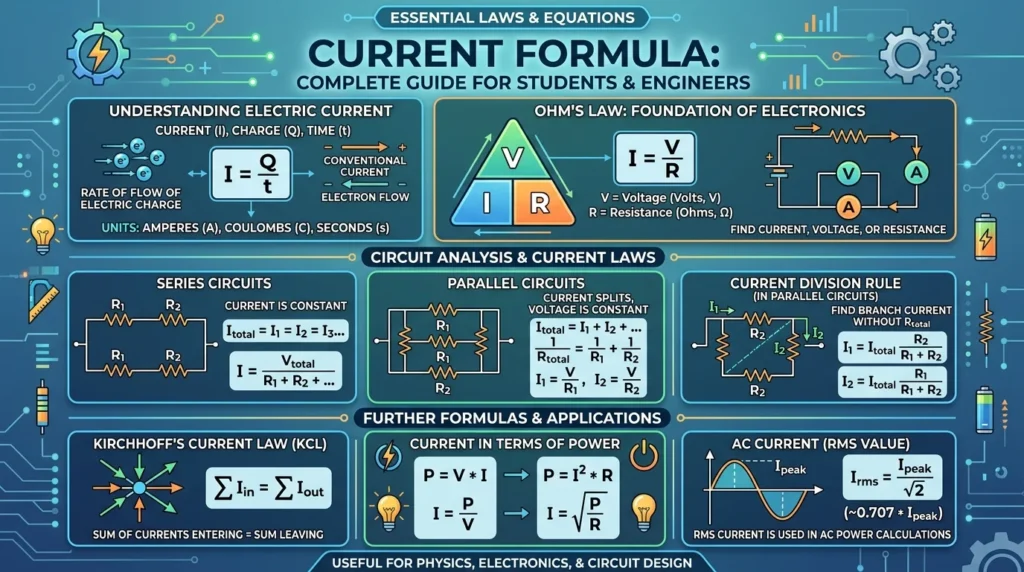
The current formula is used to calculate the flow of electric current in an electrical circuit. It tells us how much electric charge is moving through a conductor at any given time.
1. Ohm’s Law Current Formula
I=RV
Vs
V
R
Ω
I=RVs=6.0Ω12.0V=2.00AVs = 12.0 V+-R = 6.0 ΩI = 2.00 A
Details:
- I (Current):
Measured in Amperes (A). It represents the flow of electrons in a circuit. - V (Voltage):
Measured in Volts (V). It is the electrical pressure that pushes electrons. - R (Resistance):
Measured in Ohms (Ω). It opposes the flow of current.
Key Understanding:
- Current is directly proportional to voltage
- Current is inversely proportional to resistance
Example:
If V = 20V and R = 5Ω
Then I = 20 ÷ 5 = 4A
2. Current Formula Using Charge
I=tQ
Details:
- I (Current): Flow of charge (Amperes)
- Q (Charge): Measured in Coulombs (C)
- t (Time): Measured in seconds (s)
Meaning:
This formula shows how much charge passes through a conductor in a given time.
Example:
If Q = 8C and t = 2s
Then I = 8 ÷ 2 = 4A
3. AC Circuit Current Formula
I=ZV
Details:
- Z (Impedance): Total opposition in AC circuits
(includes resistance + reactance)
Use:
- Used in AC circuits
- Important for motors, transformers, and power systems
Final Key Points
- Unit of current = Ampere (A)
- Current flows only in a closed circuit
- These formulas are the foundation of electrical engineering
- Used in design, analysis, and troubleshooting
2. What is Current Formula?
The current formula is used to calculate the flow of electric charge in a circuit. It is one of the most basic and important formulas in electrical engineering.
The most commonly used current formula is derived from Ohm’s Law:
genui{“math_block_widget_always_prefetch_v2”:{“content”:”I = \frac{V}{R}”}}
Where:
- I = Current (Amperes)
- V = Voltage (Volts)
- R = Resistance (Ohms)
Simple Explanation
Electric current is the flow of electrons through a conductor. The formula shows that:
- Current increases when voltage increases
- Current decreases when resistance increases
Practical Example
If you have:
- Voltage = 10V
- Resistance = 5Ω
Then:
- Current = 10 ÷ 5 = 2 Amperes
This means 2 amperes of current are flowing in the circuit.
3. Working Principle of Current Formula
The current formula working principle is based on how electrical energy moves through a conductor.
How Does Electric Current Work? (Step-by-Step Explanation)
- Voltage Source Creates Electrical Pressure
- A battery, generator, or power supply creates an electrical potential difference (voltage).
- This voltage acts as the force that pushes electrons through a conductor.
- Without voltage, electric current cannot flow.
- A Closed Circuit Allows Electrons to Move
- When the electrical circuit is complete, electrons begin moving from the negative terminal toward the positive terminal (electron flow).
- This continuous movement of electrons forms an electric current.
- Resistance Controls the Flow of Current
- Every conductor offers some resistance to the movement of electrons.
- Higher resistance reduces the amount of current flowing through the circuit.
- Lower resistance allows current to flow more easily.
- Electric Current Flows Through the Circuit
- As electrons move through the conductor, electric current is produced.
- The current carries electrical energy to devices such as bulbs, fans, motors, and electronic equipment.
- The circuit continues to operate as long as the power source and complete path are available.
This version is more informative, beginner-friendly, and optimized for SEO while naturally including keywords like electric current, voltage, electrons, resistance, and electrical circuit.
Simple Analogy (Water Flow)
Think of electricity like water in a pipe:
- Voltage = Water pressure
- Current = Water flow
- Resistance = Pipe blockage
More pressure → more flow
More blockage → less flow
4. Types / Classification of Current Formula
The current formula can be expressed in different ways depending on the situation.
4.1 Ohm’s Law Current Formula
This is the most basic form:
- Used in simple circuits
- Works for DC and AC (with resistance only)
4.2 Current from Charge Formula
Another formula is:
- I = Q / t
Where:
- Q = Charge (Coulombs)
- t = Time (seconds)
Used in:
- Physics calculations
- Charge flow analysis
4.3 AC Current Formula
For alternating current:
- I = V / Z
Where:
- Z = Impedance (includes resistance + reactance)
Used in:
- AC circuits
- Power systems
5. Main Components Required for Electric Current Flow
To understand electric current and current flow, it is important to know the main components of an electrical circuit. Each component plays a vital role in allowing electricity to flow safely and efficiently.
5.1 Voltage Source
A voltage source provides the electrical energy needed to move electrons through a circuit. It creates the potential difference (voltage) that drives electric current.
Examples:
- Battery
- Generator
- Power supply
- Solar panel
5.2 Conductor
A conductor is the path through which electric current flows. Conductors have low electrical resistance, allowing electrons to move easily.
Common Conductors:
- Copper wire
- Aluminum wire
- Silver conductor
5.3 Resistance
Resistance is the property of a material that opposes the flow of electric current. It controls the amount of current flowing in the circuit and helps protect electrical components.
Key Points:
- Measured in ohms (Ω)
- Higher resistance reduces current flow.
- Lower resistance allows more current to pass.
5.4 Electrical Load
An electrical load is any device that consumes electrical energy and converts it into another form of energy, such as light, heat, or motion.
Common Examples:
- Electric bulb
- Ceiling fan
- Electric motor
- Heater
- Television
- Computer
This updated version is more informative, beginner-friendly, and optimized for SEO by naturally incorporating keywords such as electric current, electrical circuit, voltage source, conductor, resistance, and electrical load.
6. Advantages of Current Formula
The current formula advantages and disadvantages are important for practical understanding.
Advantages
- Simple and easy to use
- Helps design safe electrical circuits
- Useful in troubleshooting
- Works for both small and large systems
- Essential for all electrical calculations
- Saves time in engineering analysis
7. Disadvantages / Limitations
Limitations
- Not accurate for complex AC circuits without modification
- Does not include power factor directly
- Assumes ideal conditions
- Cannot handle non-linear components easily
- Requires correct values of voltage and resistance
8. Applications of the Electric Current Formula
The electric current formula is widely used in electrical engineering, electronics, and everyday life. It helps engineers, technicians, and electricians calculate the amount of current flowing through a circuit, ensuring safe and efficient operation of electrical systems.
8.1 Home Applications
The current formula is commonly used in residential electrical systems for safe and reliable power distribution.
Common Home Applications:
- Designing household electrical wiring
- Operating electrical appliances safely
- Selecting the correct fuse and circuit breaker
- Calculating current for lighting circuits
- Installing switches and power outlets
- Preventing circuit overloads
8.2 Industrial Applications
Industries rely on the electric current formula to design, operate, and maintain electrical equipment and power systems.
Common Industrial Applications:
- Electric motor control systems
- Industrial machine design
- Power generation and distribution
- Electrical panel design
- Transformer and generator calculations
- Factory automation systems
8.3 Applications in Modern Technology
The current formula is essential in today’s advanced electrical and electronic technologies.
Common Applications:
- Electronic circuit design
- Battery Management Systems (BMS)
- Electric vehicles (EVs)
- Solar power systems
- Wind energy systems
- UPS and inverter systems
- Charging circuits for mobile devices and laptops
- Smart home and IoT devices
8.4 Educational and Engineering Applications
Students, engineers, and technicians use the electric current formula to solve electrical problems and design efficient circuits.
Examples:
- Solving circuit calculations
- Learning Ohm’s Law
- Designing electrical projects
- Troubleshooting electrical faults
- Performing laboratory experiments
- Preparing for electrical engineering examinations
electric current formula, electrical circuit, industrial applications, electronic circuits, battery management systems, and renewable energy systems.
9. Comparison Section
Difference Between Current Formula and Power Formula
| Feature | Current Formula | Power Formula |
|---|---|---|
| Formula | I = V / R | P = V × I |
| Purpose | Calculate current | Calculate power |
| Unit | Ampere | Watt |
| Use | Circuit analysis | Energy consumption |
| Dependency | Voltage & resistance | Voltage & current |
Choosing the right formula depends on your situation.
10. Selection Guide Tips for Using the Electric Current Formula
The electric current formula is easy to apply when you use the correct equation and accurate values. These practical tips will help beginners, students, and technicians perform current calculations correctly.
9.1 Tips for Beginners
Choose the appropriate current formula based on the type of electrical problem.
- Use Ohm’s Law (I = V/R) for simple DC electrical circuits where voltage and resistance are known.
- Use Current Formula (I = Q/t) when calculating current from electric charge and time.
- Use AC Current Formula (I = V/Z) for alternating current (AC) circuits where impedance is known.
- Always identify the known values before selecting the formula.
- Write all given values with their correct SI units before starting the calculation.
9.2 Practical Tips for Accurate Current Calculations
Following good electrical practices improves the accuracy and safety of current calculations.
- Always verify the units of voltage, resistance, charge, and time.
- Measure resistance accurately using a digital multimeter.
- Never estimate or guess electrical values.
- Double-check all calculations before using the results.
- Ensure the circuit is powered off before taking resistance measurements.
- Use quality measuring instruments for reliable readings.
- Follow electrical safety precautions while working on live circuits.
9.3 Common Mistakes to Avoid
Many calculation errors can be prevented by avoiding these common mistakes.
- Using the wrong current formula for the given problem.
- Mixing different units during calculations.
- Ignoring circuit resistance or impedance.
- Recording incorrect measurement values.
- Forgetting to verify the final answer with practical measurements.
By following these tips, you can calculate electric current accurately and improve your understanding of electrical circuits, Ohm’s Law, and current calculations in both academic and practical applications.
11. Common Problems & Solutions
Q1: Why is my current too high?
Cause:
- Low resistance
- High voltage
Solution:
- Add resistor
- Reduce voltage
Q2: Why is there no current flow?
Cause:
- Open circuit
- Broken wire
Solution:
- Check connections
- Repair wiring
Q3: Why does current fluctuate?
Cause:
- Unstable voltage
- Faulty components
Solution:
- Use stabilizer
- Replace damaged parts
Q4: Why does equipment overheat?
Cause:
- Excess current
Solution:
- Use proper rating devices
- Install protection systems
12. Future Trends in Electric Current Measurement and Calculation
As electrical technology continues to evolve, the electric current formula plays an increasingly important role in modern power systems, smart devices, and renewable energy applications. Accurate current calculations are essential for improving efficiency, safety, and energy management.
12.1 Smart Electrical Systems
Modern smart electrical systems use advanced sensors and automation to monitor and control current in real time.
Key Developments:
- Automated current monitoring
- AI-based circuit protection
- Smart circuit breakers
- Real-time fault detection
- Intelligent energy management systems
These technologies improve system reliability while reducing energy losses and maintenance costs.
12.2 Renewable Energy Systems
Renewable energy technologies depend on precise current calculations for efficient power generation and distribution.
Applications Include:
- Solar photovoltaic (PV) systems
- Wind power generation
- Hybrid energy systems
- Battery energy storage systems (BESS)
- Grid-connected renewable power plants
Accurate current measurement helps maximize energy output, improve system efficiency, and ensure safe operation.
12.3 Electric Vehicles (EVs)
The rapid growth of electric vehicles has increased the importance of electric current calculations in battery and charging technologies.
Current Formula Applications in EVs:
- Battery current management
- EV charging stations
- Battery Management Systems (BMS)
- Motor controller design
- Fast-charging technology
- Power distribution within electric vehicles
Proper current management extends battery life, improves performance, and enhances vehicle safety.
12.4 Digital Measurement and Smart Devices
Digital technologies are transforming how electrical current is measured, monitored, and analyzed.
Modern Measurement Tools:
- Smart energy meters
- Digital multimeters
- Clamp meters
- IoT-enabled monitoring devices
- Wireless current sensors
- Cloud-based energy management systems
These tools provide real-time data, improve measurement accuracy, and enable remote monitoring of electrical systems.
12.5 Artificial Intelligence and Automation
Artificial Intelligence (AI) is becoming an essential part of modern electrical engineering by optimizing current flow and predicting system faults.
Future AI Applications:
- Predictive maintenance of electrical equipment
- Automatic fault detection
- Intelligent load balancing
- Energy consumption optimization
- Smart grid management
As AI technology advances, electric current calculations will become even more accurate, helping create safer, more efficient, and sustainable electrical systems.
13. Conclusion
The current formula is one of the most fundamental tools in electrical engineering. It helps you understand how electricity flows and how circuits behave under different conditions. From simple home wiring to complex industrial systems, this formula plays a vital role in safe and efficient operation.
By learning its working principle, types, and applications, you can confidently analyze and design electrical systems. While it has some limitations, it remains essential for both beginners and professionals.
Keep practicing calculations and applying them in real situations. The more you use the current formula, the more confident and skilled you will become in electrical engineering.