
Imagine you are using a ceiling fan, charging your mobile phone, or running an air conditioner at home. All these devices work on AC power (Alternating Current power). Without understanding how electrical power is calculated, it becomes difficult for electricians, engineers, and technicians to design safe and efficient electrical systems.
The AC Power Formula is one of the most important concepts in electrical engineering. It helps us calculate how much electrical power is being consumed or delivered in an AC circuit. Whether you are working in residential wiring, industrial systems, or power plants, this formula is used everywhere.
In this article, you will learn what AC power is, how the formula works, types of AC power, real-world applications, advantages, limitations, and practical examples. This guide is designed in simple English so that beginners can easily understand even complex electrical concepts.
2. What is AC Power Formula?
The AC Power Formula is a mathematical expression used to calculate electrical power in alternating current circuits.
Definition
AC power is the rate at which electrical energy is transferred in an AC circuit.
Basic Formula
For single-phase AC power:
P = V × I × cos φ
Where:
- P = Real Power (Watts)
- V = Voltage (Volts)
- I = Current (Amperes)
- cos φ = Power factor
Simple Explanation
In AC systems, voltage and current do not always move in perfect sync. The power factor adjusts this difference.
Example
If a fan uses 230V, draws 2A current, and power factor is 0.8:
P = 230 × 2 × 0.8 = 368 Watts
This means the fan consumes 368 watts of real electrical power.
3. Working Principle of AC Power Formula
The AC power formula working principle is based on the interaction between voltage, current, and phase difference.
Step-by-Step Explanation
- AC voltage changes direction continuously.
- Current also changes direction with voltage.
- Sometimes, voltage and current do not peak at the same time.
- This time difference is called phase difference.
Key Idea
Only a portion of electrical power is useful (real power), while some is stored and returned (reactive power).
Simple Analogy
Think of pushing a swing:
- Some energy moves the swing forward (useful work)
- Some energy is lost in resistance (wasted energy)
Important Points
- Power depends on phase angle
- Power factor shows efficiency
- Higher power factor = better efficiency
4. Types / Classification of AC Power
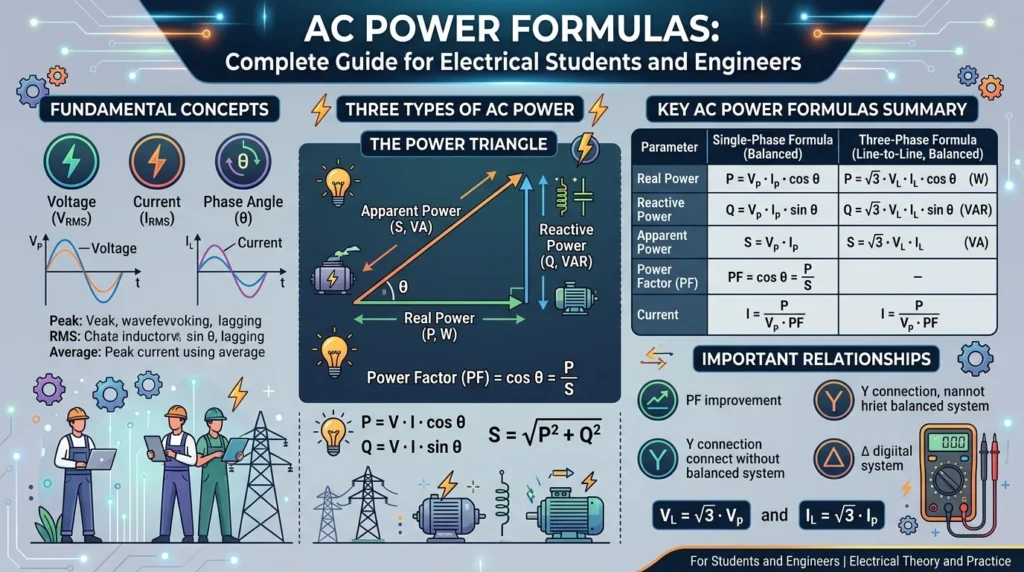
4.1 Real Power (Active Power)
Real power is the actual usable power in a circuit.
Formula:
P = V × I × cos φ
- Unit: Watt (W)
- Used for doing real work like lighting, heating
4.2 Reactive Power
Reactive power does not do useful work but supports voltage.
Formula:
Q = V × I × sin φ
- Unit: VAR (Volt-Amp Reactive)
- Important for motors and transformers
4.3 Apparent Power
Total power supplied in the circuit.
Formula:
S = V × I
- Unit: VA (Volt-Ampere)
4.4 Single Phase vs Three Phase Power
- Single phase: Used in homes
- Three phase: Used in industries
Three-phase power formula:
P = √3 × V × I × cos φ
5. Main Components of AC Power System
5.1 Voltage Source
Provides electrical energy to the circuit.
5.2 Current Flow
Movement of electrons in the circuit.
5.3 Load
Devices that consume electricity like motors and appliances.
5.4 Power Factor
Indicates efficiency of power usage.
5.5 Conductors
Wires that carry electrical current.
Each component plays an important role in determining total AC power.
6. Advantages of AC Power Formula
- Easy to calculate power in systems
- Helps design safe electrical networks
- Useful in both home and industry
- Works for single and three-phase systems
- Helps improve energy efficiency
- Supports large-scale power transmission
7. Disadvantages / Limitations
- Power factor makes calculations complex
- Reactive power reduces efficiency
- Losses occur in long-distance transmission
- Requires correction equipment like capacitors
- Not all power is usable (some is wasted in reactive form)
8. Applications of AC Power Formula
8.1 Home Applications
- Fans
- Lights
- Air conditioners
- Refrigerators
8.2 Industrial Applications
- Motors
- Pumps
- Heavy machines
- Manufacturing units
8.3 Power Systems
- Power generation stations
- Transmission lines
- Electrical grids
8.4 Modern Technology
- Smart grids
- Renewable energy systems
- Electric vehicles charging systems
9. Comparison: AC vs DC Power
| Feature | AC Power | DC Power |
|---|---|---|
| Direction | Changes continuously | Flows in one direction |
| Formula | P = V × I × cos φ | P = V × I |
| Transmission | Efficient over long distance | Limited range |
| Losses | Lower with high voltage | Higher over distance |
| Usage | Homes & industries | Electronics, batteries |
Difference between AC Power Formula and DC Power Formula
AC includes power factor due to phase difference, while DC does not.
10. Selection Guide for AC Power Calculation
Tips for Beginners
- Always check voltage rating
- Identify single or three-phase system
- Measure current correctly
- Consider power factor
- Use proper safety equipment
Engineering Advice
- Use meters for accurate readings
- Consider load type (resistive or inductive)
- Apply correction for reactive power if needed
11. Common Problems & Solutions
Problem 1: Low Power Factor
Solution: Use capacitor banks for correction
Problem 2: Voltage Drop
Solution: Use thicker cables or reduce distance
Problem 3: Overheating of Equipment
Solution: Check load and improve ventilation
Problem 4: Incorrect Power Reading
Solution: Calibrate measuring instruments
Problem 5: High Energy Loss
Solution: Improve wiring quality and reduce reactive load
12. Future Trends in AC Power Systems
Smart Grids
Modern systems use AI-based monitoring for power efficiency.
Renewable Energy Integration
Solar and wind systems use advanced AC conversion technology.
Energy-Efficient Systems
New designs focus on reducing power loss and improving power factor.
Digital Monitoring
Smart meters provide real-time AC power data.
The future of AC power systems is focused on efficiency, automation, and sustainability.
13. Conclusion
The AC Power Formula is a fundamental concept in electrical engineering that helps us understand how electrical energy is calculated and used in AC systems. From simple home appliances to large industrial machines, this formula plays a vital role in designing safe and efficient electrical networks.
By understanding real power, reactive power, and apparent power, students and engineers can improve system performance and reduce energy losses. Whether you are a beginner or a professional, mastering this concept is essential for working in the electrical field.
In short, the AC power formula is not just a mathematical equation—it is the backbone of modern electrical power systems.