
Adjectives make language clearer. Compare “I bought a car” with “I bought a new red car.” The second sentence gives more information because new and red describe the car.
But not every adjective works in the same way. Some adjectives describe quality, while others show number, ownership, location, or comparison. This is why students often search for Types of Adjectives when learning English grammar.
Understanding the different types helps you identify adjectives and use them correctly. It also makes it easier to understand sentence structure, comparisons, descriptions, and everyday English.
For example, beautiful describes quality, three tells us how many, my shows possession, and this points to a particular noun. These words can all provide information about nouns, but they have different grammatical functions.
In this guide, you will learn the main Types of Adjectives, their definitions, examples, common mistakes, British and American English differences, and practical usage. You will also learn how to compare adjective types and identify them quickly in sentences.
Types of Adjectives – Quick Answer
Types of Adjectives are different groups of adjectives classified by the kind of information they provide about a noun or pronoun.
Common types include:
- Descriptive adjectives
- Quantitative adjectives
- Numeral adjectives
- Demonstrative adjectives
- Possessive adjectives
- Interrogative adjectives
- Comparative adjectives
- Superlative adjectives
- Proper adjectives
- Distributive adjectives
Examples
She lives in a beautiful house.
Beautiful is a descriptive adjective.
I have three books.
Three is a numeral adjective.
This car is new.
This is a demonstrative adjective.
That is my phone.
My is a possessive adjective.
Which book do you want?
Which is an interrogative adjective.
The easiest way to remember the concept is:
Different types of adjectives give different kinds of information about nouns.
The Origin of Types of Adjectives
The word adjective comes from the Latin adiectivum, meaning something that is “added” or “joined.” It comes from adiicere, meaning “to add.”
An adjective adds information to a noun.
For example:
a house
becomes:
a large house
The word large adds information about the house.
The classification of adjectives developed through traditional grammar systems. Grammarians grouped adjectives according to their meaning and function. These categories help students understand how words work in sentences.
Why Are There Different Types?
Different adjectives answer different questions.
| Question | Example | Adjective |
|---|---|---|
| What is it like? | a beautiful flower | beautiful |
| How many? | five books | five |
| Which one? | this book | this |
| Whose? | my book | my |
| What kind? | a wooden table | wooden |
| How does it compare? | a bigger house | bigger |
These categories make English grammar easier to study and teach.
British English vs American English Spelling
The phrase Types of Adjectives is spelled the same in British and American English.
There is no spelling difference in the terms:
- adjective
- adjectives
- types of adjectives
However, individual adjectives can have different spellings in British and American English.
Common British and American Differences
| American English | British English |
|---|---|
| color | colour |
| favorite | favourite |
| honor | honour |
| behavior | behaviour |
| center | centre |
| gray | grey |
| traveled | travelled |
| canceled | cancelled |
For example:
American English:
My favorite color is blue.
British English:
My favourite colour is blue.
Both forms are correct in their respective varieties.
-or and -our
American English often uses -or, while British English often uses -our.
color → colour
favorite → favourite
humor → humour
-er and -re
Some words use -er in American English and -re in British English.
center → centre
theater → theatre
meter → metre
These spelling differences do not change the basic types or functions of adjectives.
Which Spelling Should You Use?
There is no alternative spelling for Types of Adjectives itself. The phrase is standard in both British and American English.
The main choice is which spelling system to use for individual words.
For US Audiences
Use American English spelling.
favorite
color
center
For UK Audiences
Use British English spelling.
favourite
colour
centre
For Commonwealth Countries
Many Commonwealth countries use British-style spelling, although local preferences can differ.
For example, favourite and colour are common in British, Australian, and New Zealand English.
For Global Audiences
Choose one style and use it consistently.
If your website targets American readers, use American English. If it targets British readers, use British English.
Consistency is more important than mixing both systems.
Common Mistakes With Types of Adjectives
Students often understand individual adjectives but become confused when classifying them.
Mistake 1: Thinking Every Describing Word Is the Same Type
❌ Three is a descriptive adjective.
✅ Three is a numeral adjective because it tells us the number.
Compare:
a beautiful house
three houses
Beautiful describes quality, while three gives a number.
Mistake 2: Confusing Possessive Adjectives With Possessive Pronouns
Possessive adjectives come before nouns.
This is my book.
Possessive pronouns can stand alone.
This book is mine.
So:
- my = possessive adjective
- mine = possessive pronoun
Mistake 3: Confusing Demonstrative Adjectives With Pronouns
Compare:
This book is interesting.
Here, this modifies the noun book.
This is interesting.
Here, this stands alone as a pronoun.
Mistake 4: Incorrect Comparative Forms
❌ This car is more faster than that one.
✅ This car is faster than that one.
Do not normally use more with an adjective that already has the -er comparative form.
Mistake 5: Incorrect Superlative Forms
❌ He is the most tallest player.
✅ He is the tallest player.
Use most with adjectives that normally require most, rather than adding it to an existing -est form.
Mistake 6: Confusing Adjectives With Adverbs
❌ She sings beautiful.
✅ She sings beautifully.
Beautiful is an adjective, while beautifully is an adverb.
Types of Adjectives in Everyday Examples
Different adjective types appear in emails, news, social media, and formal writing.
In Emails
Thank you for your quick response.
Please review the attached document.
We need three copies.
I have attached my report.
These examples use descriptive, numeral, and possessive adjectives.
In News Articles
The company launched a new product.
Several workers attended the meeting.
The government announced new rules.
This decision could affect businesses.
News writing uses adjectives to give readers important details.
On Social Media
What a beautiful day!
I bought a new phone.
This place is amazing!
My first trip was unforgettable.
Adjectives make social media posts more descriptive and expressive.
In Formal Writing
The study provides important information.
The system requires regular maintenance.
Several factors affect the results.
The new method improves efficiency.
Clear adjective use makes professional writing more precise.
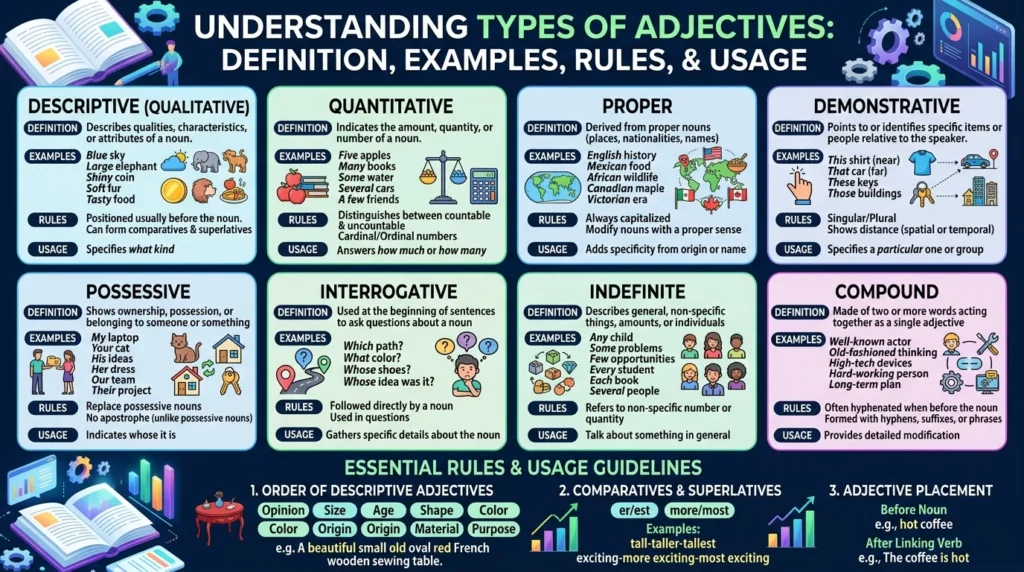
Main Types of Adjectives
Descriptive Adjectives
Descriptive adjectives tell us what a person, place, animal, object, or idea is like.
Examples:
- beautiful
- large
- small
- intelligent
- strong
- expensive
- clean
Example:
The technician used a modern tool.
Modern describes the tool.
Quantitative Adjectives
Quantitative adjectives show the amount of something.
Examples:
- much
- little
- enough
- some
- sufficient
Example:
We have enough time.
There is little water left.
Numeral Adjectives
Numeral adjectives tell us the number or order of nouns.
They include:
- one
- two
- five
- first
- second
- tenth
Examples:
I bought five books.
She won the first prize.
Numeral adjectives can show exact numbers or order.
Demonstrative Adjectives
Demonstrative adjectives point to specific nouns.
Common examples are:
- this
- that
- these
- those
Examples:
This car is expensive.
Those buildings are new.
Remember that these words function as adjectives when they come directly before a noun.
Possessive Adjectives
Possessive adjectives show ownership or relationship.
Common examples include:
- my
- your
- his
- her
- its
- our
- their
Examples:
This is my computer.
They sold their house.
She forgot her keys.
Interrogative Adjectives
Interrogative adjectives are used with nouns to form questions.
Common examples include:
- what
- which
- whose
Examples:
Which book do you want?
What color do you prefer?
Whose bag is this?
These words are followed by nouns.
Distributive Adjectives
Distributive adjectives refer to members of a group separately.
Common examples include:
- each
- every
- either
- neither
Examples:
Each student received a book.
Every worker must follow the rules.
Either option is acceptable.
Proper Adjectives
A proper adjective comes from a proper noun and describes a person, place, culture, or country.
Examples:
- American
- British
- Indian
- Chinese
- Canadian
- Shakespearean
Examples:
She enjoys Indian food.
He studies American history.
Proper adjectives are normally capitalized.
Comparative Adjectives
Comparative adjectives compare two people or things.
Examples:
This car is faster than that car.
My bag is heavier than yours.
Short adjectives often use -er.
tall → taller
fast → faster
Longer adjectives often use more.
useful → more useful
expensive → more expensive
Superlative Adjectives
Superlative adjectives compare three or more people or things.
Examples:
He is the tallest student.
This is the most expensive phone.
Short adjectives commonly use -est.
small → smallest
fast → fastest
Longer adjectives often use most.
beautiful → most beautiful
expensive → most expensive
Types of Adjectives Comparison Table
| Type | Main Purpose | Example |
|---|---|---|
| Descriptive | Describes quality | a beautiful house |
| Quantitative | Shows amount | enough water |
| Numeral | Shows number/order | five books |
| Demonstrative | Points to a noun | this car |
| Possessive | Shows ownership | my phone |
| Interrogative | Asks about a noun | which book? |
| Distributive | Refers to members separately | each student |
| Proper | Comes from a proper noun | Indian food |
| Comparative | Compares two | taller building |
| Superlative | Compares three or more | tallest building |
Adjective Forms Comparison
Some adjectives change form when they compare people or things.
| Base Form | Comparative | Superlative |
|---|---|---|
| tall | taller | tallest |
| small | smaller | smallest |
| fast | faster | fastest |
| large | larger | largest |
| happy | happier | happiest |
| easy | easier | easiest |
| beautiful | more beautiful | most beautiful |
| expensive | more expensive | most expensive |
| good | better | best |
| bad | worse | worst |
The last two examples are irregular and must be learned separately.
How to Identify the Type of Adjective
You can use a simple process to identify an adjective.
Step 1: Find the Noun
Look for the person, place, thing, or idea being discussed.
She bought a new car.
The noun is car.
Step 2: Find the Word Giving More Information
New gives information about the car.
Step 3: Ask What Information It Gives
Ask:
- What kind?
- How many?
- Which one?
- Whose?
- How does it compare?
For example:
Five students attended.
“How many?” → five
Therefore, five is a numeral adjective.
My students attended.
“Whose?” → my
Therefore, my is a possessive adjective.
Types of Adjectives – Google Trends and Usage Data
The keyword Types of Adjectives has strong educational value because it is commonly used by students, teachers, and English learners.
Related searches often include:
- types of adjectives
- types of adjectives with examples
- 10 types of adjectives
- types of adjectives in English
- adjective types and examples
- kinds of adjectives
- adjective examples
- types of adjectives for students
Who Searches for Types of Adjectives?
The topic is especially useful for:
- School students
- English learners
- ESL students
- Teachers
- Grammar students
- Exam candidates
- Parents helping children
- Writers
Why Is This Topic Popular?
Students often learn the basic definition of an adjective first. They then need to understand how adjectives are grouped.
Learning the different types helps with:
- Sentence analysis
- Grammar exams
- Writing
- Reading comprehension
- Comparisons
- English vocabulary
- Sentence construction
Search interest can vary by country and time of year. It may increase around school terms, examinations, and language-learning periods. Exact country-level search data should be checked using a current Google Trends report for the desired date range.
FAQs About Types of Adjectives
1. What are the types of adjectives?
Common types include descriptive, quantitative, numeral, demonstrative, possessive, interrogative, distributive, proper, comparative, and superlative adjectives.
2. What is a descriptive adjective?
A descriptive adjective tells us what a noun is like.
Example:
She has a beautiful voice.
3. What is a quantitative adjective?
A quantitative adjective tells us about the amount of something.
Example:
We have enough food.
4. What is a demonstrative adjective?
A demonstrative adjective points to a specific noun.
Examples include this, that, these, and those.
This book is mine.
5. What is a possessive adjective?
A possessive adjective shows ownership or relationship.
Examples include my, your, his, her, our, and their.
This is my phone.
6. What is a comparative adjective?
A comparative adjective compares two people or things.
John is taller than Mark.
7. What is a superlative adjective?
A superlative adjective compares three or more people or things.
John is the tallest student in the class.
8. What is a numeral adjective?
A numeral adjective shows a number or order.
She bought three books.
He won the first prize.
9. What is a proper adjective?
A proper adjective comes from a proper noun and normally begins with a capital letter.
Examples:
American culture
Indian food
Shakespearean drama
10. What is the difference between an adjective and an adverb?
An adjective usually describes a noun or pronoun, while an adverb can modify a verb, adjective, or another adverb.
She is a careful driver.
She drives carefully.
11. How many types of adjectives are there?
There is no single universal list. Different grammar books classify adjectives in slightly different ways. The most common categories include descriptive, quantitative, numeral, demonstrative, possessive, interrogative, distributive, proper, comparative, and superlative adjectives.
Conclusion
Understanding the Types of Adjectives makes English grammar much easier. Adjectives add information to nouns and help us describe people, places, objects, ideas, numbers, ownership, and comparisons.
The main categories include descriptive, quantitative, numeral, demonstrative, possessive, interrogative, distributive, proper, comparative, and superlative adjectives. Each type has a different purpose. For example, beautiful describes quality, three shows number, my shows possession, and this points to a specific noun.
It is also important to remember that grammar books may classify adjectives in slightly different ways. Some categories overlap, and modern grammar may describe certain words differently based on their function in a sentence.
There is no British or American spelling difference in the phrase Types of Adjectives. However, individual adjectives can have different regional spellings, such as color/colour and favorite/favourite.
The best way to master adjectives is to study them in real sentences. Identify the noun, find the word that gives more information, and then ask what kind of information it provides. With regular practice, identifying and using different adjective types becomes simple and natural.