
Imagine waking up early on a cold winter morning and turning on the shower expecting warm water. Within seconds, hot water flows from the tap, making your day comfortable. Behind this simple convenience is an important appliance called a water heater.
Water heaters are used in almost every home, hotel, hospital, and industrial facility. They provide hot water for bathing, cleaning, cooking, and many industrial processes. Without a water heater, daily tasks would become difficult, especially in cold weather.
For electrical students, engineers, and technicians, understanding the water heater working mechanism is very important. It helps in installation, troubleshooting, maintenance, and safe operation. Water heaters involve electrical heating elements, thermostats, insulation, and safety devices that must work together correctly.
In this article, you will learn the water heater working principle, its types, components, advantages and disadvantages, practical applications, and troubleshooting methods. The goal is to explain the concept in simple language so beginners and professionals can clearly understand how water heaters operate.
2. What Is a Water Heater? Complete Definition, Working, and Practical Example (2026)
A water heater is an electrical, gas-powered, solar, or heat pump appliance designed to heat water for residential, commercial, and industrial applications. It raises the temperature of cold water and supplies hot water for everyday activities such as bathing, cooking, cleaning, washing clothes, dishwashing, and industrial processes. Depending on its design, a water heater either stores hot water in an insulated tank or heats water instantly as it flows through the unit.
In simple terms, a water heater converts electrical energy, natural gas, LPG, solar energy, or heat pump energy into thermal energy, which is then transferred to the water. Modern water heaters are equipped with thermostats, safety valves, insulation, and temperature controls to ensure efficient operation, consistent water temperature, and user safety.
Simple Explanation
A water heater works by using a heating element, gas burner, or heat exchanger to transfer heat to cold water. In storage-type water heaters, the heated water is stored inside an insulated tank until it is needed. In contrast, tankless (instant) water heaters heat water only when a hot water tap is opened, providing a continuous supply without storing it.
Once the water reaches the desired temperature, the thermostat maintains the set temperature by automatically switching the heating system on or off. The hot water is then delivered through plumbing pipes to showers, faucets, kitchen sinks, washing machines, and other appliances.
Practical Example
A common example is an electric storage water heater (electric geyser) installed in residential bathrooms. When the unit is switched on, an electric heating element inside the insulated tank heats the stored water. The thermostat continuously monitors the temperature and automatically turns the heating element off once the preset temperature is reached. When a user opens the hot water tap, the heated water flows from the tank to the shower or faucet, while fresh cold water enters the tank to be heated again.
Similarly, in many homes and commercial buildings, tankless water heaters provide instant hot water without storing it, making them more energy-efficient for households with lower hot water demand.
This straightforward process demonstrates the basic water heater working principle, which is widely used in homes, hotels, hospitals, offices, factories, and other facilities around the world to provide a safe, reliable, and efficient supply of hot water.
3. Water Heater Working Principle: How a Water Heater Works Step by Step (2026)
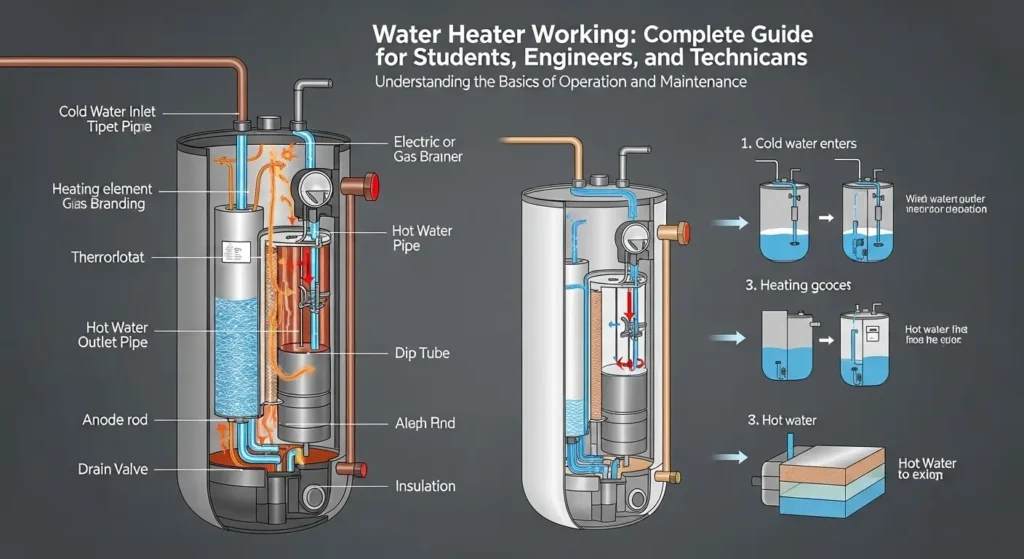
The water heater working principle is based on the concepts of energy conversion and heat transfer. A water heater converts electrical energy, natural gas, LPG, or solar energy into thermal energy, which is then transferred to cold water to increase its temperature. Once the water reaches the desired temperature, it is stored in an insulated tank or supplied instantly to the user, depending on the type of water heater.
Modern water heaters are equipped with heating elements or gas burners, thermostats, safety valves, and insulated tanks to ensure efficient heating, maintain a consistent water temperature, and provide safe operation. The thermostat automatically controls the heating process, helping to reduce energy consumption while delivering a continuous supply of hot water.
Step-by-Step Water Heater Working Process
1. Cold Water Enters the Heater
The process begins when cold water enters the water heater through the inlet pipe, which is usually located at the bottom of the storage tank. This ensures that the incoming cold water is heated evenly before being supplied for use.
2. Heating Element or Burner Activates
When the water heater is switched on, the electric heating element (in electric water heaters) or the gas burner (in gas water heaters) begins producing heat. This is the primary source of thermal energy that raises the water temperature.
3. Heat Is Transferred to the Water
The heating element or burner transfers heat directly to the surrounding water through thermal conduction and convection. As the heating continues, the water temperature gradually rises until it reaches the desired level.
4. Thermostat Monitors the Temperature
A built-in thermostat continuously measures the water temperature inside the tank. Once the preset temperature is reached, the thermostat automatically switches off the heating element or burner to prevent overheating and save energy. When the temperature drops after hot water is used, the thermostat turns the heating system back on.
5. Hot Water Rises to the Top of the Tank
As water becomes hotter, its density decreases, causing it to rise naturally to the top of the storage tank, while the cooler water remains near the bottom. This natural circulation helps maintain a steady supply of hot water.
6. Hot Water Is Delivered to the User
When a hot water tap, shower, or appliance is turned on, the heated water exits through the outlet pipe located near the top of the tank. The hot water is then delivered through the plumbing system to the required outlet.
7. Cold Water Refills the Tank
As hot water leaves the tank, fresh cold water automatically enters through the inlet pipe to replace it. The heating cycle then repeats, ensuring that hot water is always available when needed.
Simple Analogy
Think of a water heater like boiling water in a kettle. Heat is applied at the bottom of the container, causing the water to warm up. As the water heats, the hotter and lighter water rises to the top while the cooler water moves downward to be heated. This natural movement continues until all the water reaches the desired temperature.
The same principle is used in electric, gas, and storage water heaters, although modern units use thermostats and insulation to improve efficiency and maintain a constant water temperature.
Summary
The water heater working principle involves converting electrical or fuel energy into heat energy, transferring that heat to cold water, and automatically maintaining the required temperature using a thermostat. Through a continuous cycle of cold water entering, heating, hot water rising, distribution, and automatic refilling, water heaters provide a reliable, safe, and energy-efficient supply of hot water for homes, commercial buildings, and industrial facilities worldwide.
4. Types of Water Heaters
Water heaters are available in different designs depending on heating method and storage system.
Storage Water Heater: Complete Guide to Working, Components, Benefits, and Applications (2026)
A storage water heater, also known as a tank water heater or storage-type water heater, is one of the most widely used water heating systems in homes, apartments, hotels, hospitals, offices, and commercial buildings. It stores a fixed quantity of hot water inside an insulated tank, ensuring that hot water is readily available whenever it is needed. Storage water heaters are available in various capacities, typically ranging from 10 liters to over 300 liters, making them suitable for both residential and industrial applications.
Unlike tankless (instant) water heaters, which heat water only when a tap is opened, a storage water heater continuously maintains a supply of hot water inside the tank. This makes it ideal for households and businesses where multiple people need hot water simultaneously for bathing, washing, cleaning, or other daily tasks.
How Does a Storage Water Heater Work?
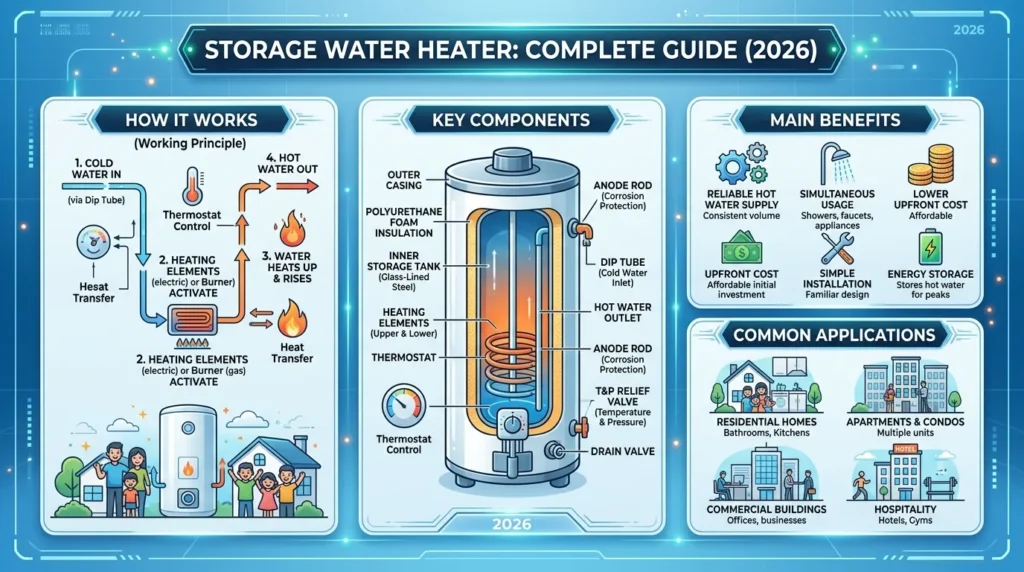
The working principle of a storage water heater is simple and efficient. Cold water enters the insulated storage tank through the inlet pipe located near the bottom of the tank. When the unit is switched on, an electric heating element or gas burner heats the water until it reaches the temperature selected on the thermostat.
As the water becomes hot, it naturally rises to the top of the tank because hot water is less dense than cold water. When a hot water tap or shower is opened, the heated water flows out through the outlet pipe at the top of the tank. At the same time, fresh cold water enters the tank to replace the used hot water, where it is reheated automatically. The built-in thermostat continuously monitors the water temperature and switches the heating system on or off as required, maintaining a constant supply of hot water while minimizing energy consumption.
Main Components of a Storage Water Heater
A typical storage water heater consists of several important components that ensure efficient and safe operation:
- Storage Tank – Stores heated water and is insulated to minimize heat loss.
- Heating Element or Gas Burner – Generates heat to warm the water.
- Thermostat – Monitors and controls the water temperature automatically.
- Temperature and Pressure (T&P) Relief Valve – Protects the tank from excessive pressure and overheating.
- Cold Water Inlet Pipe – Allows fresh cold water to enter the tank.
- Hot Water Outlet Pipe – Supplies heated water to taps and appliances.
- Magnesium Anode Rod – Prevents internal corrosion and extends the tank’s lifespan.
- Insulation Layer – Reduces standby heat loss and improves energy efficiency.
- Drain Valve – Used for flushing sediment and performing maintenance.
Advantages of a Storage Water Heater
Storage water heaters offer several benefits that make them a popular choice for residential and commercial users:
- Provides a continuous supply of stored hot water.
- Can supply multiple bathrooms or outlets simultaneously.
- Simple installation and operation.
- Available in a wide range of tank capacities.
- Reliable and long-lasting performance.
- Lower initial purchase cost compared to some advanced systems.
- Suitable for homes with high hot water demand.
- Compatible with electric, gas, and solar heating systems.
Limitations of a Storage Water Heater
Despite their advantages, storage water heaters also have a few limitations:
- Consumes more energy due to standby heat loss.
- Requires more installation space because of the storage tank.
- Limited hot water supply until the tank is reheated.
- Heating recovery time may be slower than instant water heaters.
- Requires periodic maintenance to remove sediment buildup.
Common Applications of Storage Water Heaters
Storage water heaters are widely used in various sectors, including:
- Residential homes and apartments
- Hotels and resorts
- Hospitals and healthcare facilities
- Schools and universities
- Office buildings
- Restaurants and commercial kitchens
- Factories and industrial plants
- Gyms, spas, and sports facilities
These applications benefit from the ability to store and deliver a consistent supply of hot water throughout the day.
A storage water heater is a dependable and efficient solution for providing hot water in residential, commercial, and industrial settings. By storing heated water inside an insulated tank and automatically maintaining the desired temperature, it ensures a reliable supply of hot water whenever required. Its simple design, ease of operation, and ability to serve multiple outlets simultaneously make it one of the most commonly installed water heating systems worldwide. Although it requires more space and may experience some standby heat loss, a properly maintained storage water heater delivers excellent performance, durability, and convenience, making it a practical choice for users with regular and high hot water demands.
This is the most common type used in homes.
Features
- Contains an insulated storage tank
- Stores hot water for later use
- Usually electric or gas-powered
Advantages
- Simple design
- Reliable hot water supply
Tankless Water Heater: Complete Guide to Working, Benefits, and Applications (2026)
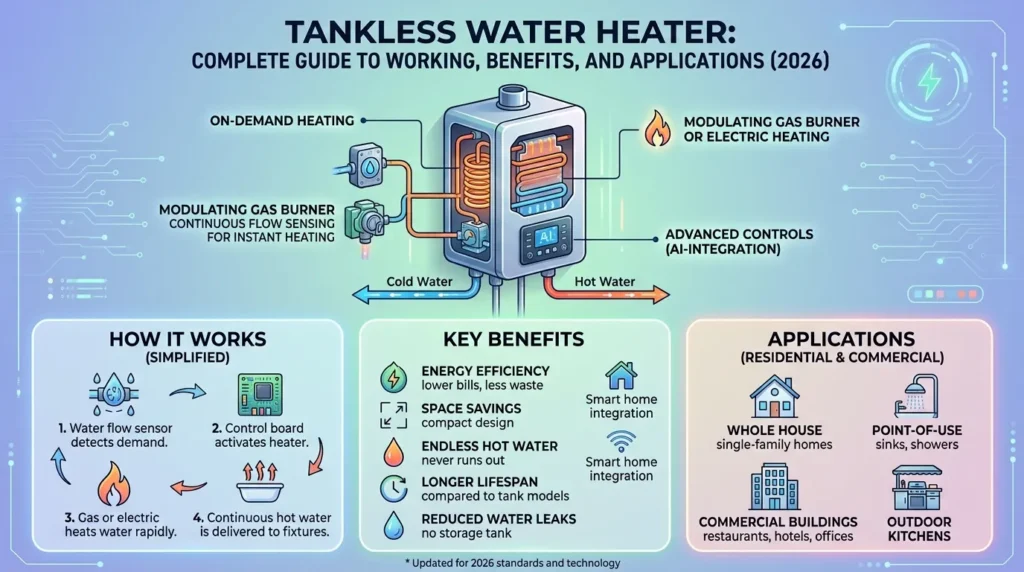
A tankless water heater, also known as an instant water heater or on-demand water heater, is a modern water heating system that heats water only when it is needed. Unlike a storage water heater, which stores hot water in a tank, a tankless water heater produces hot water instantly as cold water flows through the unit. This eliminates the need for a storage tank, reduces standby heat loss, and improves overall energy efficiency.
Tankless water heaters are becoming increasingly popular in homes, apartments, hotels, offices, restaurants, and commercial buildings because they provide an endless supply of hot water while occupying much less space. They are available in electric and gas models and are ideal for users who want lower energy consumption and continuous hot water without waiting for a storage tank to refill.
How Does a Tankless Water Heater Work?
The working principle of a tankless water heater is simple and highly efficient. When a hot water tap, shower, or appliance is turned on, cold water enters the unit through the inlet pipe. A flow sensor detects the movement of water and immediately activates the electric heating elements or gas burner.
As the water passes through the heat exchanger, it is rapidly heated to the preset temperature. The heated water then flows directly to the outlet without being stored in a tank. When the hot water tap is closed, the heating system automatically switches off, preventing unnecessary energy consumption.
Since water is heated only when required, there is no standby heat loss, making tankless water heaters significantly more energy-efficient than traditional storage models.
Main Components of a Tankless Water Heater
A typical tankless water heater consists of several essential components that ensure efficient and safe operation:
- Water Inlet Pipe – Allows cold water to enter the unit.
- Flow Sensor – Detects water flow and activates the heating system.
- Heating Element or Gas Burner – Generates heat to warm the water instantly.
- Heat Exchanger – Transfers heat efficiently from the heating source to the flowing water.
- Temperature Sensor – Monitors water temperature continuously.
- Thermostat and Electronic Control Board – Regulates heating and maintains the selected temperature.
- Safety Devices – Protect against overheating, excessive pressure, and dry operation.
- Water Outlet Pipe – Delivers heated water directly to taps and appliances.
Advantages of a Tankless Water Heater
Tankless water heaters provide numerous benefits compared to conventional storage water heaters:
- Supplies hot water on demand without storing it.
- Highly energy-efficient due to the absence of standby heat loss.
- Provides a continuous supply of hot water for extended use.
- Compact and wall-mounted design saves installation space.
- Longer service life than many storage water heaters.
- Lower operating costs over time due to reduced energy consumption.
- Heats water quickly with minimal waiting time.
- Suitable for modern smart homes and energy-efficient buildings.
Limitations of a Tankless Water Heater
Despite their many advantages, tankless water heaters also have some limitations:
- Higher initial purchase and installation cost.
- Limited flow rate may not support multiple high-demand outlets simultaneously.
- May require electrical or gas system upgrades in older buildings.
- Performance can decrease if the unit is undersized for household demand.
- Regular maintenance is necessary in areas with hard water to prevent scale buildup.
Common Applications of Tankless Water Heaters
Tankless water heaters are widely used in various residential and commercial environments, including:
- Houses and apartments
- Hotels and guest houses
- Office buildings
- Restaurants and cafés
- Hospitals and healthcare facilities
- Schools and universities
- Commercial kitchens
- Small industrial facilities
- Remote cabins and vacation homes
These systems are especially suitable where continuous hot water, energy efficiency, and space-saving installation are priorities.
A tankless water heater is an advanced and energy-efficient water heating solution that provides instant hot water whenever it is needed. By heating water only as it flows through the unit, it eliminates the need for a storage tank, reduces energy waste, and delivers a continuous supply of hot water. With its compact design, fast heating capability, long service life, and lower operating costs, a tankless water heater is an excellent choice for modern homes, commercial buildings, and businesses seeking reliable, space-saving, and environmentally friendly hot water systems.
Also known as an instant water heater.
Features
- Heats water instantly
- No storage tank
- Compact design
Advantages
- Energy efficient
- Unlimited hot water
Solar Water Heater: Complete Guide to Working, Components, Benefits, and Applications (2026)
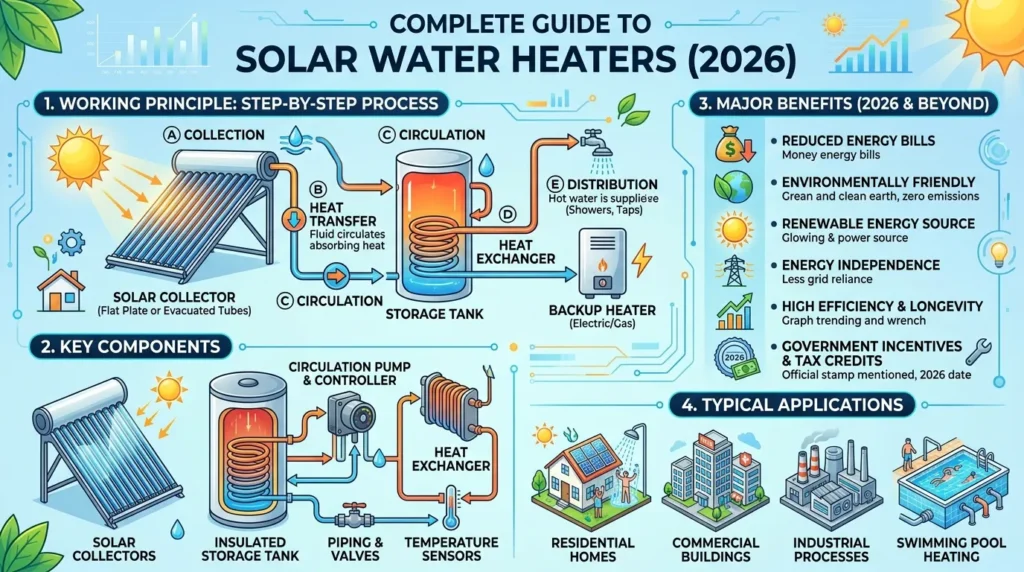
A solar water heater is an environmentally friendly water heating system that uses solar energy to heat water for residential, commercial, and industrial applications. Instead of relying entirely on electricity or gas, it captures heat from the sun through specially designed solar collectors and transfers that heat to water. This significantly reduces energy consumption, lowers electricity bills, and decreases carbon emissions.
Solar water heaters are widely installed in homes, hotels, hospitals, schools, factories, apartment buildings, and commercial facilities, especially in regions that receive abundant sunlight throughout the year. Most systems include an insulated storage tank that keeps the heated water warm for several hours, ensuring a reliable supply even after sunset. Some models also include an electric or gas backup heater to provide hot water during cloudy weather or periods of low solar radiation.
How Does a Solar Water Heater Work?
The working principle of a solar water heater is based on absorbing solar radiation and transferring the heat to water. During daylight hours, sunlight strikes the solar collector, which absorbs the sun’s energy and converts it into heat.
The collected heat is transferred to the water flowing through the collector tubes. As the water heats up, it naturally rises into the insulated storage tank through the thermosiphon effect or is circulated by a pump in active solar water heating systems. The insulated tank stores the heated water and maintains its temperature until it is needed.
When a hot water tap is opened, the stored hot water flows through the plumbing system to showers, faucets, or appliances. Fresh cold water enters the system and is heated again, creating a continuous cycle during sunny conditions.
Main Components of a Solar Water Heater
A complete solar water heating system consists of several important components:
- Solar Collector – Absorbs sunlight and converts it into thermal energy.
- Insulated Storage Tank – Stores heated water while minimizing heat loss.
- Heat Exchanger – Transfers heat between the solar collector and water in indirect systems.
- Circulation Pump – Moves water or heat-transfer fluid in active solar systems.
- Controller Unit – Monitors system temperature and controls pump operation.
- Temperature Sensors – Measure collector and tank temperatures.
- Pipes and Insulated Tubing – Carry water or heat-transfer fluid throughout the system.
- Expansion Tank – Compensates for thermal expansion of water.
- Pressure Relief Valve – Protects the system from excessive pressure.
- Backup Electric or Gas Heater – Provides hot water when solar energy is insufficient.
Types of Solar Water Heaters
Several types of solar water heaters are available depending on climate and application:
Active Solar Water Heater
Uses electric pumps and controllers to circulate water or heat-transfer fluid between the collector and storage tank. It provides higher efficiency and is suitable for larger installations.
Passive Solar Water Heater
Relies on natural water circulation (thermosiphon effect) without pumps or electronic controls. It has a simple design, lower maintenance, and reduced installation costs.
Flat Plate Collector System
Uses flat solar panels with absorber plates to capture sunlight. These systems are durable and commonly used for residential water heating.
Evacuated Tube Collector System
Uses vacuum-insulated glass tubes that provide excellent heat retention and higher efficiency, especially in colder climates or during winter.
Advantages of a Solar Water Heater
Solar water heaters offer many benefits for both homeowners and businesses:
- Uses free and renewable solar energy.
- Significantly reduces electricity and gas bills.
- Environmentally friendly with low carbon emissions.
- High energy efficiency in sunny regions.
- Low operating and maintenance costs.
- Long service life, often exceeding 20 years.
- Reduces dependence on fossil fuels.
- Suitable for residential, commercial, and industrial applications.
- May qualify for government incentives or energy-efficiency programs in some regions.
Limitations of a Solar Water Heater
Despite their advantages, solar water heaters also have some limitations:
- Higher initial installation cost than conventional water heaters.
- Performance depends on the availability of sunlight.
- Requires adequate roof space for solar collectors.
- May need a backup heating system during cloudy or rainy weather.
- Installation is more complex than electric storage heaters.
- Periodic maintenance is required to keep collectors clean and efficient.
Common Applications of Solar Water Heaters
Solar water heaters are widely used in many sectors, including:
- Residential homes and apartments
- Hotels and resorts
- Hospitals and healthcare facilities
- Schools and universities
- Office buildings
- Restaurants and commercial kitchens
- Factories and industrial processing plants
- Swimming pools
- Dairy farms and agricultural facilities
- Remote locations with limited electricity access
A solar water heater is one of the most energy-efficient and environmentally friendly methods of producing hot water. By using solar collectors, insulated storage tanks, and heat transfer systems, it converts sunlight into usable thermal energy without relying heavily on electricity or gas. Although the initial installation cost is higher, the long-term savings on energy bills, low maintenance requirements, and reduced environmental impact make solar water heaters an excellent investment for homes, businesses, and industries. As the demand for renewable energy continues to grow, solar water heaters are expected to play an increasingly important role in sustainable and energy-efficient water heating solutions worldwide.
This system uses solar energy to heat water.
Features
- Solar collectors absorb sunlight
- Water is heated naturally
Advantages
- Eco-friendly
- Very low operating cost
Heat Pump Water Heater: Complete Guide to Working, Components, Benefits, and Applications (2026)
A heat pump water heater (HPWH) is an energy-efficient water heating system that uses heat from the surrounding air to warm water instead of generating heat directly through electric resistance elements or gas burners. Rather than producing heat, it transfers existing heat from the air into the water using a refrigeration cycle, making it one of the most efficient water heating technologies available today.
Heat pump water heaters typically consume 60–70% less electricity than conventional electric storage water heaters, making them an excellent choice for homeowners and businesses looking to reduce energy costs and environmental impact. They are commonly installed in homes, apartments, hotels, hospitals, offices, commercial buildings, and industrial facilities, especially in regions with moderate to warm climates.
Many modern heat pump water heaters also include a backup electric heating element, ensuring a continuous supply of hot water during periods of high demand or when the surrounding air temperature is too low for efficient heat pump operation.
How Does a Heat Pump Water Heater Work?
The working principle of a heat pump water heater is based on the refrigeration cycle, which transfers heat from the surrounding air to the water stored inside an insulated tank.
First, a fan draws warm air from the surrounding environment and passes it over the evaporator coil containing a refrigerant. The refrigerant absorbs heat from the air and evaporates into a low-pressure gas.
Next, the compressor compresses the refrigerant gas, increasing both its pressure and temperature. The hot refrigerant then flows through the condenser coil, where it transfers its heat to the water inside the storage tank.
As the refrigerant releases its heat, it cools down and passes through the expansion valve, where its pressure decreases before returning to the evaporator to repeat the cycle.
The thermostat continuously monitors the water temperature and automatically starts or stops the heat pump to maintain the desired water temperature while minimizing energy consumption.
Main Components of a Heat Pump Water Heater
A heat pump water heater consists of several essential components that work together efficiently:
- Evaporator Coil – Absorbs heat from the surrounding air.
- Compressor – Compresses the refrigerant to increase its temperature.
- Condenser Coil – Transfers heat from the refrigerant to the water.
- Expansion Valve – Reduces refrigerant pressure before it returns to the evaporator.
- Refrigerant – Transfers heat throughout the refrigeration cycle.
- Storage Tank – Stores heated water for later use.
- Fan – Draws ambient air across the evaporator coil.
- Thermostat – Monitors and controls the water temperature automatically.
- Electric Backup Heating Element – Provides additional heating during high-demand periods or cold weather.
- Temperature and Pressure Relief Valve (T&P Valve) – Protects the system from excessive pressure and overheating.
Advantages of a Heat Pump Water Heater
Heat pump water heaters provide numerous benefits compared to traditional electric and gas water heaters:
- Uses up to 70% less electricity than conventional electric water heaters.
- Highly energy-efficient and environmentally friendly.
- Significantly reduces monthly electricity bills.
- Produces lower carbon emissions.
- Provides a reliable supply of hot water.
- Long operating life with proper maintenance.
- Automatic temperature control for consistent performance.
- Eligible for energy-efficiency incentives or rebates in some regions.
- Suitable for integration with solar energy systems.
Limitations of a Heat Pump Water Heater
Although highly efficient, heat pump water heaters have a few limitations:
- Higher initial purchase and installation cost.
- Operates best in warm or moderate climates.
- Requires adequate installation space with good airflow.
- Slightly slower water heating compared to electric resistance heaters.
- Fan and compressor may produce some operating noise.
- Performance decreases in very cold environments without backup heating.
Common Applications of Heat Pump Water Heaters
Heat pump water heaters are widely used in various residential and commercial applications, including:
- Residential homes
- Apartments and condominiums
- Hotels and resorts
- Hospitals and healthcare facilities
- Office buildings
- Restaurants and commercial kitchens
- Educational institutions
- Sports complexes and gyms
- Industrial facilities
- Eco-friendly and green buildings
These applications benefit from the system’s high efficiency, low operating costs, and environmentally sustainable performance.
A heat pump water heater is one of the most advanced and energy-efficient water heating technologies available today. Instead of generating heat directly, it captures heat from the surrounding air and transfers it to water through a refrigeration cycle, resulting in substantial energy savings and reduced environmental impact. Equipped with components such as an evaporator, compressor, condenser, expansion valve, thermostat, and insulated storage tank, it delivers a dependable supply of hot water while using significantly less electricity than conventional systems. Although the initial investment is higher, its long-term energy savings, low operating costs, and eco-friendly performance make the heat pump water heater an excellent choice for modern homes, commercial buildings, and sustainable construction projects.
This advanced type transfers heat from surrounding air to water.
Features
- Uses heat pump technology
- Highly energy efficient
Applications
- Modern energy-efficient buildings
5. Main Components of a Water Heater
Understanding the components helps technicians diagnose faults easily.
Tank
The tank stores hot water and is usually made from steel with corrosion protection.
Heating Element
The heating element converts electrical energy into heat.
Most electric heaters use immersed resistance heaters.
Thermostat
The thermostat controls the water temperature by switching the heater ON and OFF automatically.
Anode Rod
This rod protects the tank from rust and corrosion.
Inlet and Outlet Pipes
- Cold inlet pipe brings cold water into the tank
- Hot outlet pipe supplies hot water to the system
Insulation Layer
Insulation reduces heat loss and improves efficiency.
Safety Valve
A pressure relief valve prevents excessive pressure buildup inside the tank.
6. Water Heater Advantages and Disadvantages
Understanding water heater advantages and disadvantages helps users choose the right system.
Advantages
- Provides instant hot water
- Improves comfort in daily life
- Simple operation
- Widely available technology
- Suitable for homes and industries
- Improves hygiene and cleaning efficiency
Real-World Benefits
- Comfortable bathing in winter
- Hot water for washing dishes
- Industrial cleaning processes
- Hospital sanitation systems
7. Disadvantages / Limitations
Although useful, water heaters have some limitations.
Limitations
- Consumes electricity or fuel
- Risk of overheating if safety fails
- Requires regular maintenance
- Storage heaters may run out of hot water
- Initial installation cost
Understanding these limitations helps technicians maintain the system properly.
8. Water Heater Applications
The water heater applications extend beyond household use.
Residential Applications
- Bathrooms and showers
- Kitchen washing
- Laundry systems
Commercial Applications
- Hotels and restaurants
- Hospitals
- Apartment buildings
Industrial Applications
- Food processing plants
- Chemical industries
- Textile factories
Modern Technology Uses
- Smart homes
- Solar energy systems
- Energy-efficient buildings
9. Difference Between Storage and Tankless Water Heater
Understanding the difference between storage water heater and tankless water heater helps in selecting the correct system.
| Feature | Storage Water Heater | Tankless Water Heater |
|---|---|---|
| Water Storage | Stores hot water in tank | No storage tank |
| Size | Larger | Compact |
| Hot Water Supply | Limited to tank capacity | Continuous |
| Energy Efficiency | Moderate | Higher |
| Installation Cost | Lower | Higher |
Both systems have their own advantages depending on user requirements.
10. Selection Guide: How to Choose the Right Water Heater
Selecting the correct water heater depends on several factors.
1. Capacity
Choose tank size based on the number of users.
Example:
- 10–15 liters → small use
- 25–50 liters → family use
2. Power Rating
Higher power heaters heat water faster.
Common ratings:
- 1500 W
- 2000 W
- 3000 W
3. Energy Efficiency
Look for energy-efficient models to reduce electricity consumption.
4. Installation Space
Tankless heaters are better for small spaces.
5. Safety Features
Choose heaters with:
- thermostat protection
- pressure relief valve
- automatic cutoff
11. Common Problems & Solutions
Technicians frequently encounter these issues.
Why is the water heater not heating?
Possible causes:
- Faulty heating element
- Broken thermostat
- Power supply problem
Why is hot water running out quickly?
Reasons:
- Small tank size
- Sediment buildup
- Thermostat setting too low
Why is the heater making noise?
Possible issue:
- Mineral deposits inside tank
Solution:
- Flush the tank and clean sediment.
Why is water leaking?
Possible causes:
- Loose pipe connections
- Damaged tank
- Faulty pressure valve
Always inspect connections and replace faulty parts.
12. Future Trends in Water Heater Technology
Water heater technology is continuously improving.
Smart Water Heaters
Modern heaters can be controlled using mobile apps.
Solar Integration
Solar water heaters are becoming popular due to energy savings.
Energy Efficient Heat Pumps
Heat pump water heaters reduce electricity consumption significantly.
IoT-Based Monitoring
Smart sensors can detect faults and monitor energy usage.
These technologies are shaping the future of heating systems.
13. Conclusion
Water heaters play a crucial role in modern homes and industries by providing reliable hot water for daily activities. Understanding the water heater working principle helps electrical students, technicians, and engineers install, maintain, and troubleshoot these systems effectively.
In this guide, we discussed what a water heater is, how it works, its major types, components, advantages and disadvantages, and practical applications. We also explored the difference between storage water heater and tankless water heater, along with useful tips for selecting the right system.
As technology advances, modern water heaters are becoming more energy-efficient, safer, and environmentally friendly. Engineers and technicians who understand these systems will be better prepared to work with future heating technologies.
Learning the fundamentals of water heater systems is an essential step for anyone involved in electrical installation, maintenance, or energy management.