
Imagine an electrical technician inspecting a large manufacturing plant. The machines appear to be running normally, yet the electricity bill is unusually high. After testing the electrical system, the technician discovers that the power factor is very low. By correcting it, the factory reduces energy losses, improves equipment performance, and lowers electricity costs.
This real-life example shows why power factor measurement is an essential part of electrical engineering. Whether you work in a home, commercial building, or industrial facility, measuring power factor helps improve electrical efficiency, reduce power losses, and protect electrical equipment.
Power factor measurement is widely used by electricians, engineers, technicians, and maintenance professionals to monitor the performance of electrical systems. Understanding how it works can help you troubleshoot electrical problems, improve energy efficiency, and reduce operating expenses.
In this complete guide, you will learn the power factor measurement working principle, different types of power factor meters, their components, advantages, disadvantages, applications, selection tips, troubleshooting methods, and future developments. The explanations are simple and practical, making this guide suitable for beginners as well as experienced professionals.
What is Power Factor Measurement?
Power factor measurement is the process of determining how efficiently electrical power is being used in an AC electrical system. It measures the relationship between real power (kW) and apparent power (kVA).
Power factor is expressed as a value between 0 and 1, or sometimes as a percentage.
The formula is:
Power Factor = Real Power ÷ Apparent Power
A power factor close to 1.0 means the electrical system is operating efficiently.
A lower power factor means more current is required to deliver the same amount of useful power, resulting in higher energy losses.
Simple Explanation
Think of pushing a shopping cart.
- If you push straight ahead, all your effort moves the cart forward.
- If you push at an angle, part of your effort is wasted.
Power factor works in the same way. A higher power factor means more electrical energy performs useful work.
Practical Example
Suppose two factories use identical motors.
- Factory A has a power factor of 0.98
- Factory B has a power factor of 0.70
Factory B draws more current, experiences higher cable losses, and pays higher electricity charges even though both factories produce the same output.
Power Factor Measurement Working Principle
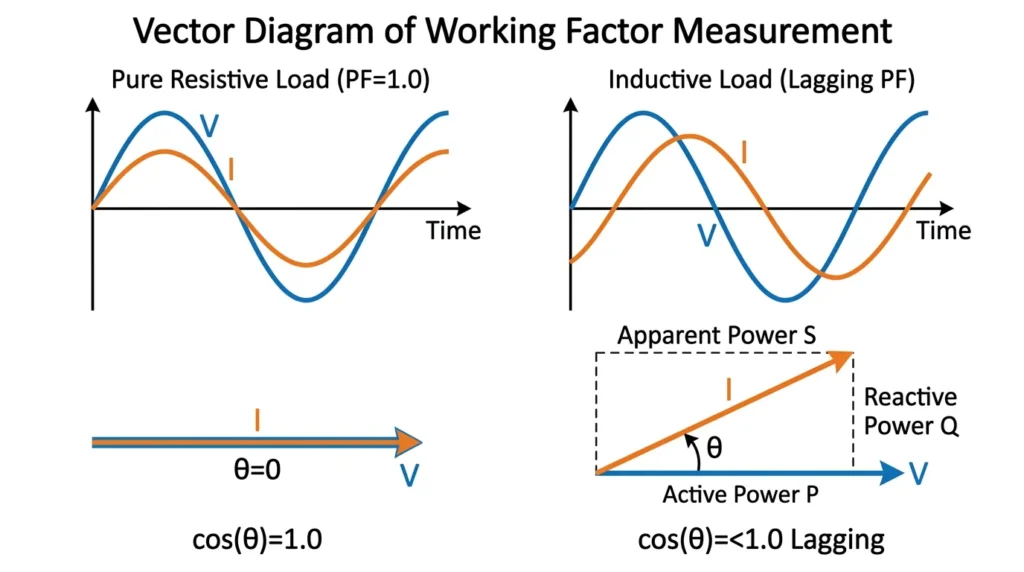
The power factor measurement working principle is based on measuring the phase angle between voltage and current in an AC circuit.
In resistive loads, voltage and current remain in phase.
In inductive loads like motors and transformers, current lags behind voltage.
Power factor meters determine this phase difference and calculate the power factor.
Step-by-Step Working Process
- AC voltage is applied to the meter.
- AC current is sensed using a current coil or current transformer.
- The meter compares the phase angle between voltage and current.
- Internal circuits calculate the cosine of the phase angle.
- The measured value is displayed as the power factor.
Easy Analogy
Imagine two runners.
- If both run together, they stay aligned.
- If one runner falls behind, they become out of sync.
Voltage and current behave similarly. Power factor measurement shows how synchronized they are.
Basic Working Steps
- Measure supply voltage.
- Measure load current.
- Detect phase difference.
- Calculate cosine of the angle.
- Display the power factor.
Types of Power Factor Measurement
Different methods are used depending on the application and required accuracy.
Analog Power Factor Meter
An analog meter uses moving coils and magnetic fields to indicate power factor directly on a dial.
Features
- Simple construction
- No external programming
- Easy to read
- Common in older installations
Best Applications
- Educational laboratories
- Small industries
- Traditional electrical panels
Digital Power Factor Meter
Digital meters use electronic circuits and microprocessors to calculate power factor.
Features
- High accuracy
- LCD or LED display
- Fast response
- Additional electrical measurements
Best Applications
- Modern industries
- Commercial buildings
- Energy audits
Portable Power Factor Meter
Portable instruments are designed for field testing.
Features
- Battery operated
- Lightweight
- Easy to carry
- Quick measurements
Best Applications
- Maintenance work
- Electrical inspections
- Troubleshooting
Panel Mounted Power Factor Meter
These meters are permanently installed inside electrical control panels.
Features
- Continuous monitoring
- Industrial design
- Reliable operation
- Suitable for automation
Best Applications
- Factories
- Power distribution systems
- Industrial plants
Smart Power Factor Meter
Smart meters communicate with automation systems using industrial communication protocols.
Features
- Remote monitoring
- Data logging
- Real-time analysis
- Cloud connectivity
Best Applications
- Smart factories
- Smart grids
- Building management systems
Main Components of a Power Factor Meter
Understanding the main parts helps explain how power factor measurement works.
Voltage Coil
Measures supply voltage and provides the voltage reference.
Function
- Detects AC voltage
- Creates reference signal
Current Coil
Measures the load current.
Function
- Detects current flow
- Compares current with voltage
Measuring Circuit
Processes voltage and current signals.
Function
- Calculates phase difference
- Determines power factor
Display Unit
Shows the measured value.
Types
- Analog pointer
- LCD display
- LED display
Microprocessor (Digital Meters)
Modern digital meters contain a microprocessor.
Function
- Performs calculations
- Stores data
- Improves accuracy
Communication Interface
Available in smart meters.
Function
- Sends data to monitoring systems
- Supports remote diagnostics
Advantages of Power Factor Measurement
Power factor measurement provides many operational and financial benefits.
- Improves electrical efficiency
- Reduces energy losses
- Helps lower electricity bills
- Prevents overload conditions
- Detects inefficient equipment
- Supports preventive maintenance
- Improves transformer performance
- Reduces cable heating
- Helps comply with utility regulations
- Extends equipment lifespan
- Supports energy management programs
- Enables better system planning
- Improves industrial productivity
Disadvantages / Limitations
Although very useful, power factor measurement has some limitations.
- Requires proper installation
- Incorrect wiring causes inaccurate readings
- Analog meters have lower accuracy
- Digital meters cost more
- Harmonics can affect measurements
- Periodic calibration may be required
- Some systems need current transformers
- Advanced smart meters require communication infrastructure
Power Factor Measurement Applications
Power factor measurement has numerous applications across different sectors.
Residential Applications
- Home energy monitoring
- Solar inverter systems
- Backup power systems
- Smart home energy management
Commercial Applications
- Shopping malls
- Hospitals
- Hotels
- Office buildings
- Educational institutions
Industrial Applications
Industries depend heavily on power factor monitoring.
Common applications include:
- Motor control centers
- Manufacturing plants
- Steel industries
- Cement factories
- Chemical plants
- Paper mills
- Food processing plants
- Textile industries
Utility Applications
Power utilities use power factor measurement to:
- Monitor distribution systems
- Improve grid efficiency
- Reduce transmission losses
- Maintain voltage stability
Renewable Energy Systems
Used in:
- Solar power plants
- Wind farms
- Battery storage systems
- Hybrid renewable systems
Difference Between Power Factor Measurement and Energy Measurement
Many beginners confuse these two concepts.
| Feature | Power Factor Measurement | Energy Measurement |
|---|---|---|
| Purpose | Measures electrical efficiency | Measures energy consumption |
| Unit | Power Factor (0–1) | kWh |
| Main Function | Detects phase relationship | Records energy usage |
| Used For | Efficiency improvement | Billing |
| Helps Reduce Bills | Indirectly | Directly measures usage |
| Continuous Monitoring | Yes | Yes |
This comparison highlights the difference between power factor measurement and energy measurement. While both are important, they serve different purposes in electrical systems.
Selection Guide
Choosing the correct power factor meter depends on your application.
Accuracy
Higher accuracy is essential for industrial testing and energy management.
Display Type
Choose:
- Digital for better precision
- Analog for simple applications
Measurement Range
Ensure the meter covers your expected operating conditions.
Installation Type
Options include:
- Portable
- Panel mounted
- DIN rail mounted
- Handheld
Communication Features
Modern systems benefit from:
- RS-485
- Modbus
- Ethernet
- Wi-Fi
- Cloud connectivity
Budget
Select a meter that balances performance and cost.
Tips for Beginners
- Prefer digital meters.
- Buy from trusted manufacturers.
- Check calibration certificates.
- Ensure compatibility with your electrical system.
- Choose a model with a clear display and safety certifications.
Common Problems & Solutions
Why does the power factor reading fluctuate?
Cause:
Changing electrical loads.
Solution:
Measure during stable operating conditions.
Why is the measured power factor very low?
Cause:
Large inductive loads such as motors or transformers.
Solution:
Install power factor correction capacitors.
Why is the meter reading incorrect?
Cause:
Improper wiring or incorrect CT polarity.
Solution:
Inspect wiring and follow the manufacturer’s connection diagram.
Why is the digital display blank?
Cause:
No auxiliary power or blown fuse.
Solution:
Check the power supply and replace the fuse if necessary.
Why does the reading change after maintenance?
Cause:
Incorrect reconnection of voltage or current inputs.
Solution:
Verify all electrical connections before energizing the system.
How often should power factor meters be calibrated?
Industrial installations typically benefit from periodic calibration according to maintenance schedules and manufacturer recommendations to maintain reliable accuracy.
Future Trends in Power Factor Measurement
Power factor measurement technology continues to evolve alongside smart electrical systems.
Smart Energy Monitoring
Modern meters continuously monitor electrical performance and provide real-time data.
Benefits
- Faster fault detection
- Improved efficiency
- Better maintenance planning
Internet of Things (IoT)
IoT-enabled power factor meters can send data to cloud platforms for remote monitoring and analysis.
Artificial Intelligence-Based Analytics
AI-assisted software can analyze historical power factor trends to predict equipment issues and recommend corrective actions.
Integration with Smart Grids
Future electrical grids will use intelligent meters to optimize energy distribution, improve power quality, and reduce transmission losses.
Renewable Energy Integration
As solar and wind installations continue to grow, advanced power factor measurement systems will help maintain stable and efficient electrical networks.
Conclusion
Power factor measurement is one of the most important techniques for improving the efficiency and reliability of AC electrical systems. By measuring the relationship between voltage and current, it helps engineers identify energy losses, reduce unnecessary power consumption, and optimize the performance of motors, transformers, and other electrical equipment. Understanding the power factor measurement working principle, different meter types, components, power factor measurement applications, and the advantages and disadvantages of these instruments enables students, technicians, and engineers to make informed decisions in both maintenance and system design. As industries adopt smart grids, IoT, and advanced energy management systems, modern power factor measurement will become even more accurate, automated, and essential for achieving energy-efficient and sustainable electrical operations.