
Imagine a large factory running heavy motors, welding machines, and air compressors at the same time. The electricity company must supply enough electrical power not only for useful work but also for magnetic and reactive loads inside the system. This total supplied power is known as apparent power.
The Apparent Power Formula is one of the most important concepts in AC electrical systems. It helps engineers, technicians, and electricians understand the total power flowing in a circuit. Without understanding apparent power, it becomes difficult to properly size transformers, generators, cables, and circuit breakers.
In real-world electrical systems, voltage and current are often out of phase because of inductive and capacitive loads. Due to this phase difference, electrical power is divided into different parts such as real power, reactive power, and apparent power. Understanding their relationship is essential for designing efficient and safe electrical systems.
In this article, you will learn the apparent power formula, working principle, types, components, advantages, disadvantages, applications, comparisons, troubleshooting, and future trends. This guide is written in simple English for beginners as well as electrical professionals.
What is Apparent Power Formula?
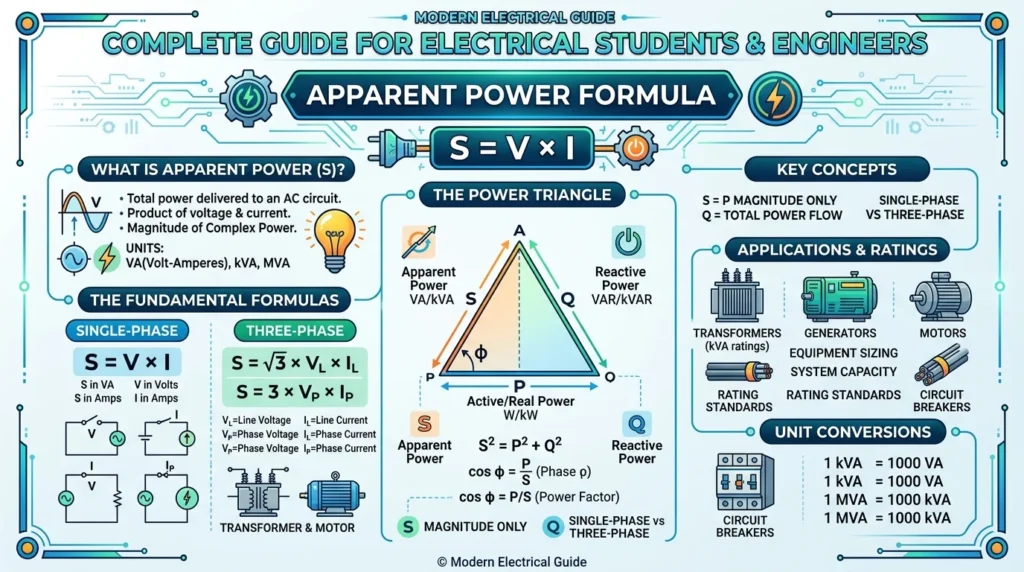
The Apparent Power Formula is used to calculate the total electrical power supplied in an AC circuit.
Definition
Apparent power is the combination of:
- Real power (useful power)
- Reactive power (non-working power)
It represents the total power delivered by the source.
The apparent power formula is:
[
S = V \times I
]
Where:
- (S) = Apparent Power (Volt-Ampere or VA)
- (V) = Voltage (Volts)
- (I) = Current (Amperes)
For three-phase systems:
[
S = \sqrt{3} \times V \times I
]
Simple Explanation
In AC circuits, not all supplied power performs useful work. Some power is used to create magnetic fields in motors and transformers. Apparent power includes both useful and non-useful power.
Practical Example
Suppose an AC motor operates at:
- Voltage = 230V
- Current = 10A
Using the formula:
[
S = 230 \times 10 = 2300VA
]
So the apparent power is 2300 Volt-Amperes.
Apparent Power Formula Working Principle
The apparent power formula working principle is based on the relationship between voltage, current, and phase angle in AC circuits.
Step-by-Step Working
Step 1: AC Supply Provides Voltage
The power source sends alternating voltage to the load.
Step 2: Current Flows in Circuit
Current flows through electrical devices connected to the supply.
Step 3: Phase Difference Occurs
In inductive or capacitive loads, voltage and current become out of phase.
Step 4: Total Power is Formed
The total supplied power becomes apparent power.
Simple Analogy
Imagine filling a water tank using a pump:
- Useful water reaching the tank = Real power
- Water circulating unnecessarily = Reactive power
- Total water pumped = Apparent power
Power Triangle
The relationship between powers is shown by:
[
S^2 = P^2 + Q^2
]
Where:
- (S) = Apparent Power
- (P) = Real Power
- (Q) = Reactive Power
This is called the power triangle.
Types / Classification of Apparent Power
Single-Phase Apparent Power
Used in homes and small electrical systems.
Formula:
[
S = V \times I
]
Applications
- Fans
- Lights
- Home appliances
Three-Phase Apparent Power
Used in industries and large power systems.
Formula:
[
S = \sqrt{3} \times V \times I
]
Applications
- Motors
- Industrial machines
- Factories
Balanced Apparent Power
Occurs when all phases carry equal load.
Features
- Better efficiency
- Stable operation
- Lower losses
Unbalanced Apparent Power
Occurs when phase loads are unequal.
Features
- Voltage imbalance
- Heating problems
- Reduced efficiency
Main Components of Apparent Power System
Voltage Source
Provides electrical energy to the system.
Function
Creates electrical pressure for current flow.
Current Flow
Represents movement of electric charge.
Function
Transfers electrical energy to the load.
Load
Any device consuming electrical energy.
Examples
- Motors
- Heaters
- Air conditioners
Power Factor
Represents efficiency of power usage.
Formula
[
Power\ Factor = \frac{Real\ Power}{Apparent\ Power}
]
Measuring Instruments
Used to measure electrical quantities.
Examples
- Voltmeter
- Ammeter
- Power analyzer
Advantages of Apparent Power Formula
The apparent power advantages and disadvantages are important for electrical system design.
Advantages
- Helps size transformers correctly
- Useful for generator selection
- Essential for power system calculations
- Supports efficient cable sizing
- Improves electrical safety
- Helps understand total load demand
- Useful in industrial energy management
Disadvantages / Limitations
Limitations of Apparent Power
- Does not show useful power separately
- Reactive power reduces efficiency
- Requires understanding of phase angle
- Complex in large industrial systems
- Poor power factor increases apparent power
Apparent Power Applications
The apparent power applications are found in almost every AC electrical system.
Home Applications
- Air conditioners
- Refrigerators
- Washing machines
- Ceiling fans
Industrial Applications
- Heavy motors
- Welding systems
- Manufacturing plants
- Compressor systems
Power Distribution Systems
- Transformers
- Substations
- Transmission systems
Renewable Energy Systems
- Solar inverters
- Wind power systems
- Battery backup systems
Modern Technology Applications
- Smart grids
- EV charging systems
- Data centers
- Automation systems
Comparison Section
Difference Between Apparent Power and Real Power
| Feature | Apparent Power | Real Power |
|---|---|---|
| Definition | Total supplied power | Useful working power |
| Unit | VA | Watt |
| Includes Reactive Power | Yes | No |
| Formula | S = V × I | P = V × I × cosφ |
| Use | Equipment sizing | Actual work |
Difference Between Apparent Power and Reactive Power
| Feature | Apparent Power | Reactive Power |
|---|---|---|
| Function | Total power | Magnetic support power |
| Unit | VA | VAR |
| Useful Work | Partial | No |
| Role | System sizing | Voltage support |
Selection Guide
How to Choose Correct Apparent Power Rating
For Beginners
- Check system voltage
- Measure current accurately
- Identify single or three-phase supply
- Consider future load expansion
Engineering Tips
Choose Proper Transformer Rating
Transformer VA rating should be greater than load apparent power.
Consider Power Factor
Low power factor increases apparent power demand.
Avoid Overloading
Always maintain safety margin.
Common Problems & Solutions
Problem 1: High Apparent Power
Cause
Poor power factor.
Solution
Use capacitor banks for correction.
Problem 2: Transformer Overheating
Cause
Overloaded apparent power demand.
Solution
Use higher-rated transformer.
Problem 3: Voltage Drop
Cause
Excessive current flow.
Solution
Use larger cable size.
Problem 4: Low Efficiency
Cause
High reactive power.
Solution
Improve power factor.
Problem 5: Incorrect Measurements
Cause
Faulty instruments.
Solution
Calibrate measuring devices regularly.
Future Trends
Smart Power Monitoring
Modern systems use digital sensors to monitor apparent power in real time.
AI-Based Energy Management
Industries are using intelligent systems to reduce unnecessary apparent power demand.
Smart Grids
Future power systems automatically balance loads and improve power efficiency.
Renewable Energy Integration
Solar and wind systems require advanced apparent power management for stable operation.
Advanced Power Electronics
New inverters and converters help reduce reactive losses and improve overall system performance.
Conclusion
The Apparent Power Formula is a fundamental concept in AC electrical engineering. It represents the total electrical power supplied to a circuit, including both useful and reactive power. Understanding apparent power is extremely important for selecting transformers, generators, cables, and protection equipment.
For students, technicians, and engineers, learning the relationship between apparent power, real power, and reactive power helps improve system efficiency and safety. Whether working in homes, industries, or renewable energy systems, apparent power calculations are essential in every AC power network.
As electrical systems become smarter and more energy-efficient, understanding apparent power will remain a critical skill for modern electrical professionals.