
Imagine a hospital during a power outage. Within seconds, backup generators start running to support life-saving equipment. Now imagine if that generator fails due to poor maintenance. The result can be dangerous and costly. This is why generator maintenance is not optional—it is critical.
Generators are widely used in homes, industries, construction sites, and emergency systems. They provide backup power when the main supply fails. However, like any machine, generators need regular care to perform efficiently and safely.
Proper maintenance increases reliability, reduces breakdowns, and extends the life of the generator. Ignoring maintenance can lead to sudden failure, higher repair costs, and even safety hazards.
In this article, you will learn everything about generator maintenance, including its meaning, working principle, types, components, advantages and disadvantages, applications, and troubleshooting. The explanation is simple and practical—just like guidance from a senior engineer to a junior technician.
What is Generator Maintenance?
Generator maintenance is the process of regularly inspecting, servicing, testing, and repairing a generator to ensure it works properly and safely.
Simple Explanation
- Maintenance = keeping the generator in good condition
- Includes cleaning, checking, and replacing parts
Practical Example
If a diesel generator is not used for months without maintenance, its battery may discharge, fuel may degrade, and the engine may fail to start during an emergency. Regular maintenance prevents such problems.
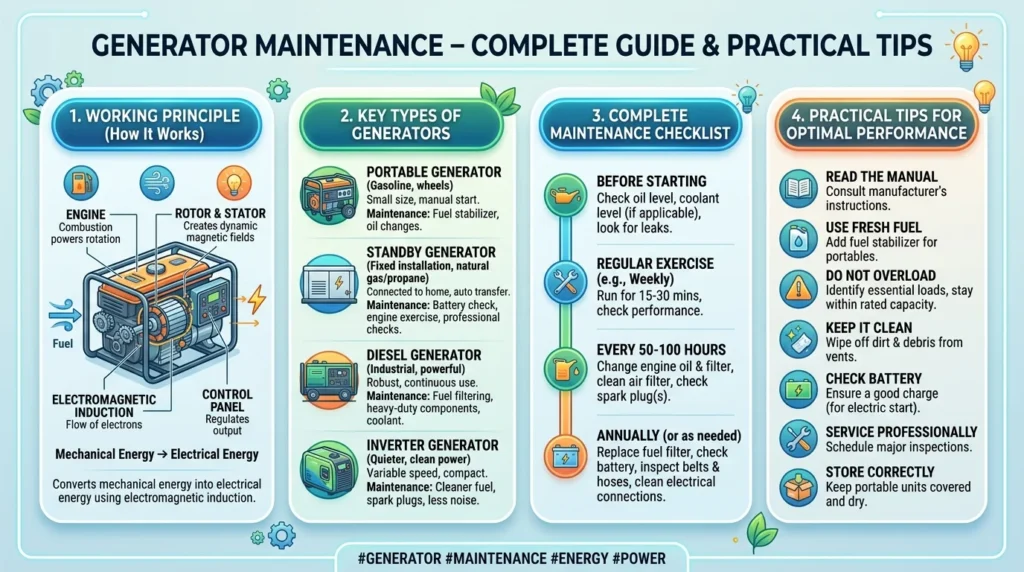
Generator Maintenance Working Principle
The generator maintenance working principle is based on preventive care and timely inspection to avoid failure.
Step-by-Step Explanation
- Inspect generator condition
- Check fuel, oil, and coolant levels
- Test electrical output
- Identify wear or damage
- Repair or replace faulty parts
Simple Analogy
Think of generator maintenance like vehicle servicing:
- Regular service = smooth operation
- No service = sudden breakdown
Key Points
- Prevents unexpected failure
- Improves efficiency
- Ensures safety
Types / Classification of Generator Maintenance
Generator maintenance can be divided into different types based on approach.
1. Preventive Maintenance
This is the most common type.
Features
- Regular inspections
- Scheduled servicing
- Replacement before failure
Example
Changing oil after fixed running hours
2. Predictive Maintenance
Uses advanced techniques to predict faults.
Features
- Condition monitoring
- Use of sensors and data analysis
Example
Detecting bearing wear using vibration analysis
3. Corrective Maintenance
Performed after a fault occurs.
Features
- Repairs damaged parts
- Restores generator operation
Example
Fixing a faulty alternator
4. Routine Maintenance
Basic daily or weekly checks.
Features
- Cleaning
- Checking fuel and oil levels
Example
Visual inspection before operation
Main Components of a Generator (Maintenance Focus)
Understanding components helps in effective maintenance.
1. Engine
- Converts fuel into mechanical energy
- Requires oil, fuel, and cooling system checks
2. Alternator
- Converts mechanical energy into electrical energy
- Needs insulation and winding inspection
3. Fuel System
- Stores and supplies fuel
- Requires cleaning and leak checks
4. Cooling System
- Prevents overheating
- Needs coolant level and radiator checks
5. Battery
- Starts the generator
- Needs regular charging and inspection
6. Control Panel
- Controls generator operation
- Requires proper wiring and display checks
Advantages of Generator Maintenance
Key Benefits
- Increases generator life
- Reduces breakdowns
- Improves efficiency
- Ensures safety
- Saves repair costs
Real-World Benefits
- Reliable power during outages
- Smooth industrial operations
- Reduced downtime
Disadvantages / Limitations
Practical Limitations
- Requires time and effort
- Maintenance cost involved
- Needs skilled technicians
Technical Challenges
- Incorrect maintenance can cause damage
- Requires proper scheduling
Generator Maintenance Applications
The generator maintenance applications are important in many areas.
1. Homes
- Backup power systems
- Inverter generators
2. Hospitals
- Critical life-support systems
- Emergency power supply
3. Industries
- Continuous production
- Heavy machinery operation
4. Construction Sites
- Temporary power supply
- Portable generators
5. Data Centers
- Prevent data loss
- Ensure uninterrupted power
Comparison Section
Preventive vs Corrective Maintenance
| Feature | Preventive Maintenance | Corrective Maintenance |
|---|---|---|
| Timing | Before failure | After failure |
| Cost | Lower | Higher |
| Reliability | High | Low |
| Risk | Minimal | High |
Selection Guide
Choosing the right maintenance approach is important.
Key Factors
- Type of generator
- Usage frequency
- Operating environment
- Budget
Tips for Beginners
- Follow manufacturer guidelines
- Schedule regular inspections
- Keep maintenance records
- Use quality spare parts
Common Problems & Solutions (FAQs)
1. Generator not starting
Cause: Weak battery or fuel issue
Solution: Check battery charge and fuel supply
2. Overheating
Cause: Low coolant or blocked radiator
Solution: Refill coolant and clean radiator
3. Low output voltage
Cause: Alternator fault
Solution: Inspect and repair alternator
4. Excessive noise
Cause: Loose parts or worn components
Solution: Tighten and replace parts
5. Fuel leakage
Cause: Damaged fuel lines
Solution: Repair or replace pipes
Future Trends in Generator Maintenance
Technology is improving maintenance methods.
Modern Developments
- Smart monitoring systems
- IoT-based maintenance
- Remote diagnostics
- Automated alerts
Industry Direction
- Predictive maintenance growth
- Increased automation
- Better efficiency tools
Conclusion
Generator maintenance is essential for ensuring reliable and efficient power generation. It helps prevent unexpected failures, reduces repair costs, and extends the life of the generator.
By understanding the generator maintenance working principle, types, components, and practical methods, engineers and technicians can maintain systems effectively. Regular inspection, timely servicing, and proper handling are key to success.
Although maintenance requires time and effort, its benefits far outweigh the costs. With modern technologies like smart monitoring and predictive systems, generator maintenance is becoming more advanced and efficient.
For beginners, learning proper maintenance practices is a valuable step toward becoming a skilled electrical professional.