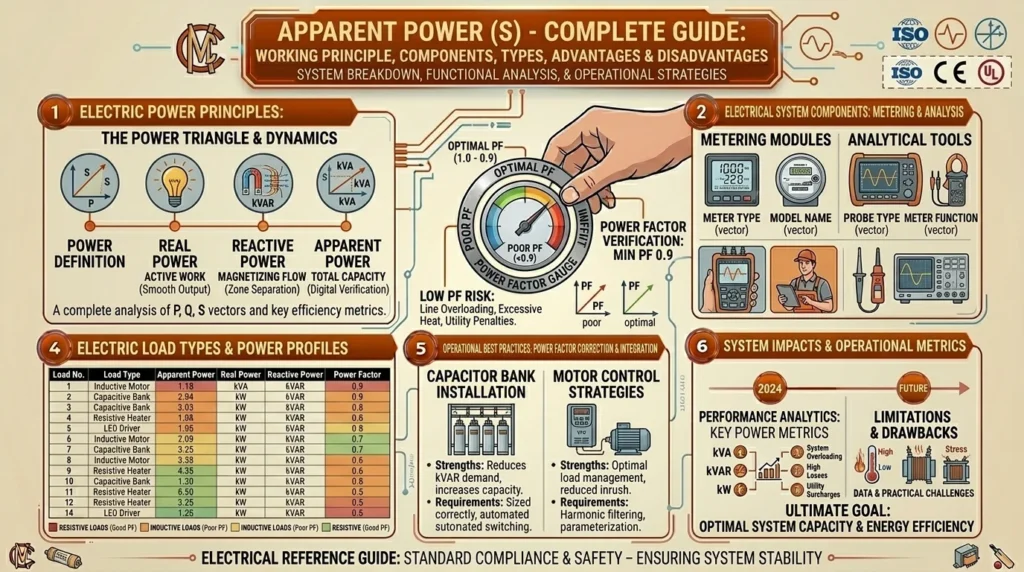

In everyday life, electricity powers almost everything around us—fans, lights, air conditioners, industrial machines, and office equipment. But not all electrical power is the same. For example, when you switch on an air conditioner, the electricity drawn from the supply is not fully converted into useful cooling. Some of it is used for actual work, while some is stored and returned back to the system.
This is where the concept of apparent power becomes important. Many electrical students and beginners often get confused between real power, reactive power, and apparent power. Understanding this concept is essential for designing efficient electrical systems, selecting correct equipment, and improving power quality in industries.
In this article, you will learn what apparent power is, how it works, its types, applications, advantages, disadvantages, and how it compares with real and reactive power. The explanation is simple, practical, and written for students, technicians, and engineers.
2. What is Apparent Power?
Definition
Apparent power is the total power supplied to an electrical circuit. It is the combination of real power and reactive power in an AC system.
It is represented by the symbol S and measured in Volt-Amps (VA).
Simple Explanation
In simple words:
- Real power does useful work (like running a motor)
- Reactive power supports magnetic fields
- Apparent power is the total power drawn from the source
Practical Example
If a motor consumes electricity:
- Some power runs the motor shaft (real power)
- Some power creates magnetic fields (reactive power)
- Total power from supply is apparent power
3. Apparent Power Working Principle
The apparent power working principle is based on the relationship between voltage and current in an AC circuit.
Step-by-Step Explanation
- AC voltage is supplied to the circuit
- Current flows depending on load type
- Some energy performs useful work (real power)
- Some energy is stored and returned (reactive power)
- Total combination is apparent power
Simple Analogy
Think of a glass of juice:
- Juice = real power (useful energy)
- Foam = reactive power (non-useful but necessary)
- Whole glass = apparent power
Formula
S = V \times I
Where:
- S = Apparent Power (VA)
- V = Voltage (Volts)
- I = Current (Amps)
4. Types / Classification of Power in AC Circuit
To understand apparent power, we must know its components.
4.1 Real Power (Active Power)
Real power is the actual usable power.
- Symbol: P
- Unit: Watt (W)
- Used for doing work like lighting, heating
4.2 Reactive Power
Reactive power does not perform useful work but supports magnetic fields.
- Symbol: Q
- Unit: VAR (Volt-Amp Reactive)
- Used in motors and transformers
4.3 Apparent Power
Apparent power is the combination of both real and reactive power.
- Symbol: S
- Unit: VA
- Total power supplied by source
5. Main Components Related to Apparent Power
Voltage Source
- Provides electrical energy
- Determines system strength
Current Flow
- Flow of electrons in circuit
- Depends on load type
Load (Device)
- Can be resistive, inductive, or capacitive
- Determines power behavior
Power Factor
- Indicates efficiency of power usage
- Ratio between real and apparent power
6. Advantages of Understanding Apparent Power
Advantages
- Helps in proper electrical system design
- Improves energy efficiency
- Reduces electricity losses
- Essential for industrial load management
- Helps in selecting correct transformers and generators
- Improves power factor correction
7. Disadvantages / Limitations
Limitations
- Cannot be used directly for useful work measurement
- Confusing for beginners
- Requires understanding of AC theory
- Increases system complexity in analysis
- Poor power factor increases apparent power demand
8. Applications of Apparent Power
The apparent power applications are very important in real-world electrical systems.
Residential Applications
- Home appliances
- Air conditioners
- Refrigerators
Industrial Applications
- Motors and pumps
- Manufacturing machines
- Large electrical systems
Commercial Applications
- Offices
- Shopping malls
- Data centers
Modern Technology
- Renewable energy systems (solar and wind)
- Smart grids
- Electric vehicles charging systems
9. Comparison Section
Difference Between Real, Reactive, and Apparent Power
| Type | Symbol | Unit | Purpose | Nature |
|---|---|---|---|---|
| Real Power | P | Watt (W) | Useful work | Active |
| Reactive Power | Q | VAR | Magnetic field support | Non-useful |
| Apparent Power | S | VA | Total power supplied | Combination |
This shows the difference between real power and apparent power clearly.
10. Selection Guide (Power System Design Tips)
How to Handle Apparent Power in Systems
- Always check load type before design
- Maintain good power factor (>0.9)
- Use capacitors for correction
- Select transformers based on VA rating
- Avoid overloading systems
- Balance inductive loads
For Beginners
- Start by understanding voltage and current
- Learn power triangle concept
- Practice simple circuit examples
11. Common Problems & Solutions
Problem: High Apparent Power Consumption
Solution: Improve power factor using capacitor banks
Problem: Low System Efficiency
Solution: Reduce reactive load usage
Problem: Transformer Overloading
Solution: Check VA rating and redistribute load
Problem: Poor Power Factor Penalty
Solution: Install automatic power factor correction system
12. Future Trends in Power Systems
The electrical industry is evolving rapidly, and apparent power management is becoming more advanced.
- Smart energy monitoring systems
- AI-based load optimization
- Advanced power factor correction devices
- Renewable energy integration
- Smart grid technology
These innovations help reduce energy waste and improve system efficiency.
13. Conclusion
Apparent power is a fundamental concept in electrical engineering that helps us understand how electrical energy is distributed in AC systems. It represents the total power supplied, combining both useful and non-useful components. By learning about real, reactive, and apparent power, students and engineers can design better and more efficient electrical systems.
Understanding the apparent power working principle, its applications, and limitations is essential for improving energy efficiency and reducing losses. Whether in homes, industries, or modern power grids, apparent power plays a crucial role in electrical system performance. Mastering this concept is a strong foundation for anyone studying or working in electrical engineering.