
Imagine a situation where suddenly the lights go off in your home, or a machine in a factory stops working without warning. In many cases, the reason behind this problem is an electrical fault. Faults can cause serious damage to equipment, lead to power outages, and even create dangerous conditions like fire or electric shock. That is why understanding types of faults is very important for electrical students, engineers, and technicians.
In electrical systems, faults are unavoidable due to aging equipment, environmental conditions, or human errors. Knowing how faults occur and how to handle them can save time, money, and improve safety.
In this article, you will learn what faults are, how they work, their different types, advantages and disadvantages of fault detection, practical applications, and how to solve common problems. This guide is written in simple English so that beginners can easily understand complex electrical concepts.
2. What is Types of Faults?
A fault in an electrical system is any abnormal condition that disrupts the normal flow of current. It usually happens when there is an unintended path for current, such as a short circuit or broken conductor.
In simple words, a fault means something has gone wrong in the circuit.
Practical Example
If two wires touch each other accidentally, a large current flows suddenly. This is called a short circuit fault and can damage appliances or wiring.
3. Types of Faults Working Principle
The types of faults working principle is based on how current behaves during abnormal conditions.
Step-by-Step Explanation
- Under normal conditions, current flows through a fixed path
- When a fault occurs, the path of current changes
- This causes:
- Increase in current (overcurrent)
- Decrease in voltage
- Heat generation
- Protective devices like circuit breakers detect this change
- The system disconnects faulty parts to prevent damage
Simple Analogy
Think of water flowing in a pipe. If the pipe breaks, water leaks or flows in the wrong direction. Similarly, electrical faults disturb current flow.
4. Types / Classification
Open Circuit Fault
An open circuit fault is a common electrical fault that occurs when the normal path of current flow is broken, resulting in no current flowing through the circuit. This can happen due to a broken wire, loose connection, blown fuse, or faulty switch. In simple terms, an open circuit means the circuit is incomplete, so electricity cannot travel from the source to the load. This type of fault is less dangerous compared to short circuit faults, but it can still cause equipment to stop working and interrupt power supply.
The working principle of an open circuit fault is easy to understand. In a healthy circuit, current flows in a closed loop from the power source through conductors and returns back. However, when a break occurs anywhere in the circuit, the loop is opened. As a result, the current becomes zero, even though voltage may still be present across the open points. This condition can be compared to a water pipe system: if the pipe is broken, water cannot reach its destination even though pressure exists at the source.
Open circuit faults can occur in both single-phase and three-phase systems. In power transmission lines, this fault may happen due to conductor snapping caused by strong winds, corrosion, or mechanical damage. In household wiring, it may occur due to loose terminals or damaged cables. Electrical devices connected to such circuits will stop functioning immediately because they are not receiving current.
One of the main disadvantages of an open circuit fault is interruption of operation, which can affect productivity in industries or cause inconvenience in homes. However, it is easier to detect and repair compared to other faults. Tools like multimeters and continuity testers are commonly used to identify the location of the break.
Overall, an open circuit fault is a simple but important concept in electrical systems. Understanding its causes and effects helps engineers and technicians maintain reliable and safe operation of electrical networks.
This occurs when a wire breaks or a connection is lost.
Example: Broken wire in a circuit
Effect: No current flows
Short Circuit Fault
A short circuit fault is one of the most common and dangerous types of electrical faults. It occurs when two conductors with different potentials, such as phase and neutral or two phases, come into direct contact with each other. This creates a path with very low resistance, allowing a large amount of current to flow suddenly. Because of this excessive current, short circuit faults can damage equipment, cause overheating, and even lead to fire hazards if not properly controlled.
The working principle of a short circuit fault is based on the relationship between current, voltage, and resistance, explained by Ohm’s Law. According to this law, current increases when resistance decreases. In a normal circuit, resistance limits the current flow. However, during a short circuit, resistance becomes very low, so the current rises to a very high level in a short time. This sudden surge can damage wires, insulation, and connected devices.
Short circuit faults can occur due to several reasons, such as damaged insulation, loose wiring, moisture, or faulty equipment. In industrial systems, they may also occur due to mechanical failure or accidental contact between conductors. In homes, common causes include worn-out wires or improper connections.
The effects of a short circuit fault are serious. It can cause overheating of wires, melting of insulation, and damage to electrical appliances. In severe cases, it can lead to sparks or fire. To prevent these dangers, protective devices like circuit breakers and fuses are used. These devices detect the high current and quickly disconnect the circuit to protect the system.
Overall, a short circuit fault is a critical condition in electrical systems. Understanding its causes, effects, and protection methods is essential for ensuring safety and maintaining reliable operation in both residential and industrial environments.
This happens when two conductors come in contact with each other.
Example: Phase-to-phase contact
Effect: Very high current flow
Earth Fault (Ground Fault)
An earth fault, also known as a ground fault, is a type of electrical fault that occurs when a live conductor (phase wire) comes into contact with the earth or any grounded part of the system. This creates an unintended path for current to flow directly to the ground. Earth faults are very common in electrical systems and can be dangerous if not properly detected and controlled. They may cause electric shocks, equipment damage, and even fire hazards.
The working principle of an earth fault is based on the behavior of current when it finds a low-resistance path to the ground. Under normal conditions, current flows through the intended circuit path. However, when insulation fails or a conductor touches a grounded surface, current diverts and flows into the earth. This condition is explained by Ohm’s Law, where current increases if resistance decreases. Since the earth path usually has low resistance, a significant amount of current can flow through it.
Earth faults can occur due to damaged insulation, moisture in cables, worn-out wiring, or mechanical damage. In industrial systems, heavy machinery and harsh environments increase the chances of such faults. In homes, faulty appliances or exposed wires are common causes. When an earth fault occurs, it can create leakage current that may pass through a person touching the equipment, leading to electric shock.
To protect against earth faults, devices like earthing systems, residual current devices (RCDs), and earth fault relays are used. These devices quickly detect leakage current and disconnect the supply, preventing accidents. Proper grounding ensures that fault current safely flows into the earth without harming people or equipment.
Overall, an earth fault is a serious condition that must be handled carefully. Understanding its causes, effects, and protection methods helps in maintaining safe and reliable electrical systems in homes, industries, and power networks.
This fault occurs when a live wire touches the earth or grounded surface.
Example: Damaged insulation
Effect: Current flows to ground
Symmetrical Fault
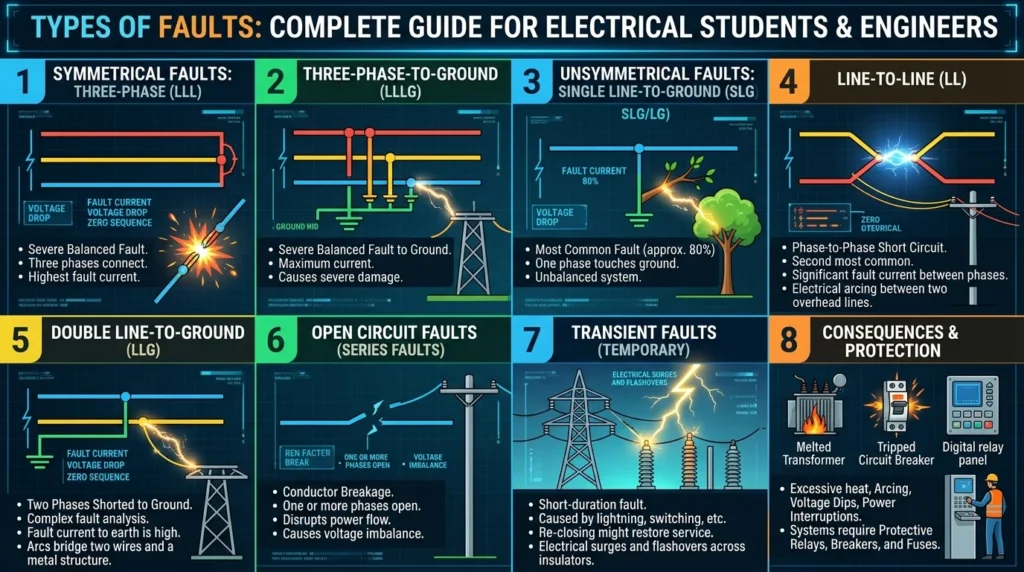
A symmetrical fault is a type of electrical fault in which all three phases of a power system are affected equally. It usually occurs when all three phase conductors come into contact with each other, or when they are simultaneously short-circuited to ground. This type of fault is also known as a three-phase fault or balanced fault. Although symmetrical faults are less common compared to other faults, they are the most severe because they produce very high fault currents that can damage equipment quickly.
The working principle of a symmetrical fault is based on the sudden reduction in resistance between all three phases. Under normal conditions, current flows in a balanced manner through each phase. However, when a symmetrical fault occurs, the impedance of the system drops sharply, and a large amount of current flows through all three phases equally. This condition follows Ohm’s Law, where current increases as resistance decreases. Because all phases are equally affected, the system remains electrically balanced, but the fault current becomes extremely high.
Symmetrical faults can occur due to equipment failure, insulation breakdown, or external factors such as lightning or severe weather conditions. In power systems, they are more likely to happen in high-voltage transmission lines and substations. Even though they are rare, their impact is very serious and requires immediate action.
The effects of a symmetrical fault include overheating, mechanical stress on equipment, and possible failure of generators, transformers, and transmission lines. To protect the system, high-speed circuit breakers and protective relays are used. These devices quickly detect the fault and isolate the affected section to prevent further damage.
Overall, a symmetrical fault is a critical condition in electrical systems. Understanding its behavior and protection methods is essential for ensuring the safety and reliability of power networks.
All three phases are equally affected.
Example: Three-phase short circuit
Effect: Balanced fault but very severe
Unsymmetrical Fault
An unsymmetrical fault is a type of electrical fault in which one or two phases of a three-phase system are affected, while the remaining phase or phases continue to operate normally. This results in an unbalanced system where voltages and currents are not equal in all phases. Unsymmetrical faults are the most common type of faults in power systems and include conditions such as single line-to-ground fault, line-to-line fault, and double line-to-ground fault.
The working principle of an unsymmetrical fault is based on the disturbance of the normal balanced condition of a three-phase system. Under normal operation, all three phases carry equal current and voltage. However, when a fault occurs in one or two phases, the balance is disturbed. This leads to unequal current distribution and voltage drops across the system. This behavior follows Ohm’s Law, where current flow changes according to the resistance and path of the circuit. Because the fault does not involve all three phases equally, the system becomes unbalanced, which can affect the performance of connected equipment.
There are three main types of unsymmetrical faults. A single line-to-ground fault occurs when one phase touches the earth. A line-to-line fault happens when two phases come into contact with each other. A double line-to-ground fault occurs when two phases touch each other and also connect to the ground. Among these, the single line-to-ground fault is the most common.
The effects of unsymmetrical faults include voltage imbalance, overheating, and vibration in electrical machines. Sensitive equipment may malfunction due to uneven voltage supply. To protect the system, relays and circuit breakers are used to detect and isolate the faulty section quickly.
Overall, unsymmetrical faults are common but manageable with proper protection systems. Understanding their types and effects helps engineers maintain stable and reliable electrical power systems.
Only one or two phases are affected.
Types include:
- Single line-to-ground fault
- Line-to-line fault
- Double line-to-ground fault
These are more common in real systems.
5. Main Components
Important parts involved in fault detection and protection include:
- Circuit Breaker – Disconnects faulty circuit
- Relay – Detects abnormal conditions
- Fuse – Melts and stops current flow
- Earthing System – Provides safe path to ground
- Conductors – Carry current
Each component plays a key role in protecting the system.
6. Advantages
- Improves safety of electrical systems
- Prevents damage to equipment
- Reduces fire hazards
- Helps quick fault detection
- Ensures reliable power supply
7. Disadvantages / Limitations
- Fault detection systems can be costly
- Requires regular maintenance
- Complex systems need skilled operators
- False tripping can interrupt supply
8. Applications
The types of faults applications are seen in many areas:
Home
- Protecting appliances
- Preventing short circuits
Industry
- Machine protection
- Continuous operation
Modern Technology
- Power grids
- Renewable energy systems
- Smart electrical networks
9. Comparison Section
Difference Between Symmetrical and Unsymmetrical Faults
| Feature | Symmetrical Fault | Unsymmetrical Fault |
|---|---|---|
| Phases Affected | All three | One or two |
| Occurrence | Rare | Common |
| Severity | Very high | Moderate |
| Balance | Balanced | Unbalanced |
10. Selection Guide
Choosing the right fault protection system depends on:
- Type of electrical system
- Voltage level
- Load requirement
- Environment conditions
Tips for Beginners
- Always use proper earthing
- Select correct circuit breakers
- Maintain wiring regularly
- Avoid overloading circuits
11. Common Problems & Solutions
Q1: Why do faults occur frequently?
Answer: Poor maintenance, aging wires, or overload.
Q2: How to detect faults?
Answer: Use relays, meters, and protection devices.
Q3: What is the most dangerous fault?
Answer: Short circuit fault due to high current.
Q4: How to prevent faults?
Answer: Proper installation and regular inspection.
12. Future Trends
Electrical systems are becoming smarter with advanced fault detection technologies:
- Smart grids with automatic fault detection
- AI-based monitoring systems
- IoT-enabled protection devices
- Faster and more accurate relays
These technologies improve safety and efficiency.
13. Conclusion
Understanding types of faults is essential for anyone working with electrical systems. Faults can cause serious damage, but with proper knowledge and protection, they can be managed effectively. From open circuit to short circuit and earth faults, each type has its own behavior and impact. By using the right protective devices and following good practices, engineers and technicians can ensure safe and reliable operation of electrical systems. Keep learning and practicing to build strong technical skills in this important area.