
Imagine entering a kitchen and suddenly smelling gas, but you are not sure where it is coming from. This situation can quickly become dangerous if the leak is not detected in time. Gas leaks can lead to fire hazards, explosions, and serious health issues. That is why a gas leak detector is one of the most important safety devices used in homes and industries today.
For electrical students, engineers, and technicians, understanding how a gas leak detector works is essential. It is not just about safety; it is also about designing reliable systems and preventing accidents in real-world environments.
In this article, you will learn everything about gas leak detectors, including their working principle, types, components, advantages, limitations, and practical applications. By the end, you will have a clear and professional understanding of how these devices operate and how to select the right one.
2. What is a Gas Leak Detector?
A gas leak detector is an electronic device used to identify the presence of harmful or combustible gases in the air. It alerts users when gas concentration exceeds a safe level.
Simple Explanation
Think of it like a smoke detector, but instead of detecting smoke, it detects gases such as LPG, methane, carbon monoxide, or propane.
Practical Example
In a home kitchen, if LPG gas leaks from a cylinder, the gas leak detector senses it and triggers an alarm, warning people before the situation becomes dangerous.
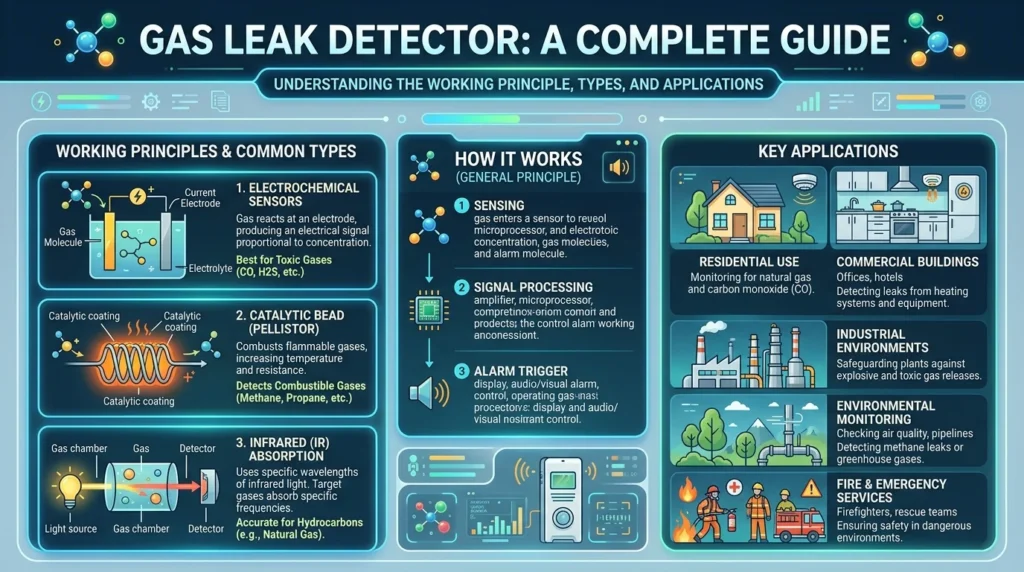
3. Gas Leak Detector Working Principle
The gas leak detector working principle is based on sensing gas concentration in the air and converting it into an electrical signal.
Step-by-Step Working
- Gas enters the detector through air vents
- Sensor detects the presence of gas molecules
- Sensor changes its electrical properties
- Signal is sent to the processing circuit
- Alarm is triggered if gas level exceeds limit
Easy Analogy
It works like a human nose. When you smell gas, your brain alerts you. Similarly, the sensor “smells” gas and sends a signal to the alarm system.
Key Points
- Continuous monitoring of air
- Instant response to gas presence
- Automatic alarm system
4. Types / Classification of Gas Leak Detectors
4.1 Semiconductor Gas Sensors
These are the most common and affordable detectors.
- Use metal oxide sensors
- Detect gases like LPG and methane
- Suitable for home use
4.2 Infrared (IR) Gas Detectors
These use infrared light to detect gas.
- High accuracy
- Used in industries
- Detect hydrocarbon gases
4.3 Electrochemical Gas Sensors
Used for toxic gases.
- Detect carbon monoxide and hydrogen sulfide
- Highly sensitive
- Used in safety-critical environments
4.4 Catalytic Gas Sensors
Used for combustible gases.
- Detect flammable gases
- Require oxygen to operate
- Common in industrial plants
5. Main Components of Gas Leak Detector
5.1 Gas Sensor
- Core part of the device
- Detects gas presence
5.2 Control Circuit
- Processes signals from sensor
- Decides alarm conditions
5.3 Alarm System
- Produces sound or light
- Alerts users instantly
5.4 Power Supply
- Provides energy to device
- Can be battery or mains powered
5.5 Display (Optional)
- Shows gas concentration
- Useful in advanced systems
6. Gas Leak Detector Advantages
- Prevents fire and explosion risks
- Protects human life
- Easy to install and use
- Provides early warning
- Works automatically
- Suitable for both homes and industries
7. Gas Leak Detector Advantages and Disadvantages
Advantages
- Reliable safety device
- Low maintenance
- Cost-effective
Disadvantages
- Requires regular calibration
- Sensor life is limited
- False alarms may occur
- Power dependency
8. Gas Leak Detector Applications
The gas leak detector applications are wide and essential in many fields.
Home Applications
- Kitchen gas monitoring
- LPG cylinder safety
- Apartment safety systems
Industrial Applications
- Oil and gas plants
- Chemical factories
- Refineries
Commercial Applications
- Hotels and restaurants
- Hospitals
- Shopping malls
Modern Technology Uses
- Smart home systems
- IoT-based safety devices
- Automated shutdown systems
9. Comparison Section
Difference Between Gas Leak Detector and Smoke Detector
| Feature | Gas Leak Detector | Smoke Detector |
|---|---|---|
| Detects | Gas | Smoke |
| Purpose | Prevent gas leaks | Detect fire |
| Sensor Type | Gas sensor | Optical/ionization |
| Use Area | Kitchen, industry | Rooms, offices |
| Response | Gas concentration | Smoke particles |
10. Selection Guide
Choosing the right gas leak detector is important for safety.
Tips for Beginners
- Identify gas type (LPG, CO, methane)
- Choose certified products
- Check sensitivity level
- Prefer battery backup models
- Look for alarm loudness
Professional Tips
- Use industrial-grade detectors for factories
- Consider calibration requirements
- Choose multi-gas detectors if needed
11. Common Problems & Solutions
Problem 1: False Alarm
Cause: Dust or humidity
Solution: Clean sensor regularly
Problem 2: No Alarm
Cause: Dead battery or faulty sensor
Solution: Replace battery or device
Problem 3: Slow Detection
Cause: Aging sensor
Solution: Replace sensor
Problem 4: Continuous Beeping
Cause: Gas presence or system fault
Solution: Check environment and reset device
12. Future Trends
The future of gas leak detectors is evolving with technology.
Smart Detectors
- Connected to mobile apps
- Real-time alerts
AI-Based Detection
- Improved accuracy
- Reduced false alarms
IoT Integration
- Connected with smart homes
- Automatic gas shutoff
Advanced Sensors
- Longer life
- Higher sensitivity
13. Conclusion
A gas leak detector is a critical safety device that protects lives and property from dangerous gas leaks. It works by sensing gas concentration and alerting users before the situation becomes harmful. From homes to large industries, its applications are vast and essential.
Understanding the gas leak detector working principle, types, and components helps engineers and technicians design safer systems. While it has some limitations, its advantages far outweigh them. With modern technology like IoT and AI, gas detection systems are becoming smarter and more reliable.
For students and beginners, learning about gas leak detectors is a step toward building safer electrical and industrial systems. Always choose the right detector and maintain it properly for maximum safety.