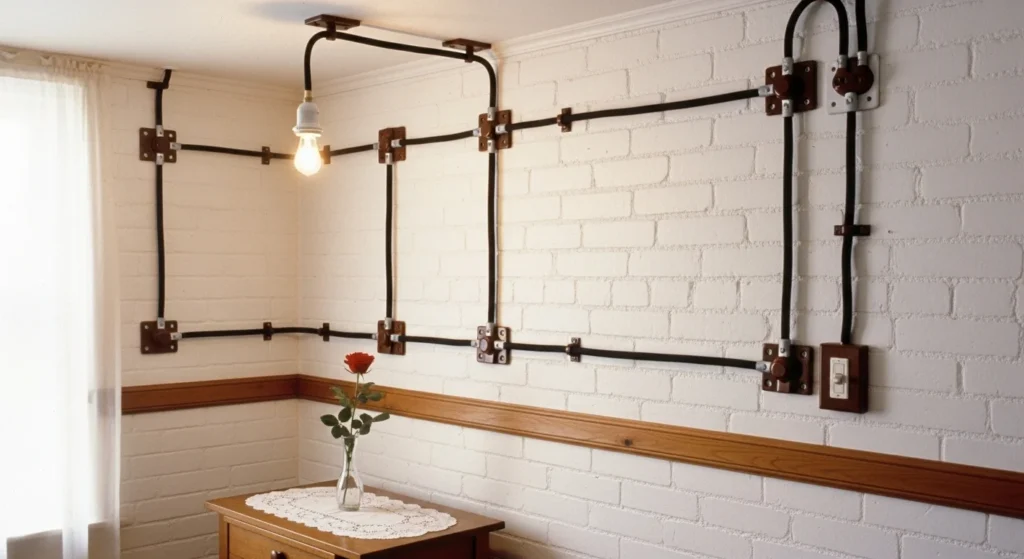

Imagine a newly constructed house where electricians need to install a temporary electrical connection for lighting and tools during construction. Instead of installing expensive concealed wiring immediately, electricians often use a simple and quick wiring method to supply electricity safely. One of the most commonly used methods for temporary electrical installations is the Cleat Wiring System in Houses.
Cleat wiring is one of the oldest and simplest electrical wiring methods. It is still used in certain situations where quick installation, low cost, and easy removal are required. Although modern buildings mainly use concealed wiring systems, understanding cleat wiring is still very important for electrical students, engineers, and technicians.
This topic is especially important for beginners learning electrical wiring systems. It helps them understand how early electrical installations were designed and how temporary wiring systems work.
In this detailed guide, you will learn:
- What a Cleat Wiring System in Houses is
- Cleat wiring working principle
- Types of cleat wiring systems
- Main components used in the system
- Cleat wiring advantages and disadvantages
- Practical applications of cleat wiring
- Differences between cleat wiring and other wiring systems
- Common problems and troubleshooting methods
This article explains the topic in simple and clear language so that beginners can easily understand
What Is Cleat Wiring? Complete Guide (2026)

Cleat wiring is one of the simplest and oldest methods of electrical wiring used for distributing electrical power in temporary installations. It is an open wiring system in which insulated electrical wires are installed openly on walls, ceilings, or other supporting surfaces with the help of special supporting devices known as cleats.
In this wiring method, the conductors are not placed inside pipes, conduits, or hidden channels. Instead, they are supported at regular distances using cleats made from materials such as porcelain, PVC, or wood. The cleats hold the wires firmly and maintain proper spacing between different conductors to ensure safe operation.
Cleat wiring was widely used in older electrical installations because it was simple, inexpensive, and required fewer materials compared to other wiring methods. Even today, it is used for temporary electrical systems where quick installation and easy removal are required.
This wiring system is commonly found in construction sites, temporary buildings, workshops, exhibitions, laboratories, event lighting systems, and testing areas. The main reason for its popularity in these applications is that electricians can install, modify, inspect, and remove the wiring quickly without damaging the building structure.
However, cleat wiring has limited protection because the wires remain exposed. Due to safety concerns, it is not recommended for permanent residential or commercial electrical installations. Modern buildings usually use safer wiring methods such as conduit wiring, concealed wiring, and cable tray systems.
Understanding cleat wiring is important for electrical students, technicians, and beginners because it explains the basic principles of wire support, electrical installation planning, and temporary power distribution.
History of Cleat Wiring
Cleat wiring was introduced during the early development of electrical systems when simple and affordable wiring solutions were required. Before modern conduit and concealed wiring systems became common, open wiring methods were widely used in homes, factories, and commercial buildings.
The main purpose of cleat wiring was to provide a quick way to install electrical conductors while keeping them separated from surfaces. Porcelain cleats were commonly used because porcelain provides excellent insulation and can withstand heat.
With advancements in electrical technology, cleat wiring became less common for permanent installations. However, it continued to be useful in temporary electrical applications because of its simplicity and low cost.
Definition of Cleat Wiring
Cleat wiring is an open electrical wiring system in which insulated wires are supported on walls or ceilings using porcelain, plastic, or wooden cleats fixed at regular intervals.
In simple words, electrical wires are installed openly and held in position by small supporting devices called cleats.
Construction of Cleat Wiring System (2026)
The construction of a cleat wiring system is simple, economical, and easy to understand, making it one of the most basic electrical wiring methods. In this system, insulated electrical wires are installed openly on walls or ceilings and are supported by specially designed cleats fixed at regular intervals. Unlike concealed or conduit wiring, the conductors remain visible, making installation, inspection, maintenance, and fault detection much easier.
A properly constructed cleat wiring system consists of several components that work together to provide mechanical support, maintain conductor spacing, and ensure safe temporary electrical distribution.
1. Cleats
Cleats are the primary supporting components of the cleat wiring system. Their main function is to hold insulated electrical conductors securely while maintaining the correct distance between adjacent wires. By keeping the conductors properly aligned, cleats prevent wires from sagging, crossing each other, or coming into direct contact with the wall or ceiling.
A standard cleat consists of two parts:
- Base Part – Fixed to the wall or ceiling using screws.
- Cap Part – Placed over the conductors and tightened to secure the wires firmly.
The grooves provided in the cleats allow the conductors to fit securely while maintaining proper spacing, which improves both safety and the overall appearance of the wiring.
Depending on the installation requirements, cleats are manufactured from different materials.
A. Porcelain Cleats
Porcelain cleats are the traditional type of cleats used in older electrical installations. They are manufactured from high-quality ceramic material that provides excellent electrical insulation and can withstand high operating temperatures.
Because porcelain is non-conductive and resistant to moisture and heat, these cleats were widely used before PVC products became common. Although they are less popular today due to their weight and brittleness, they are still used in certain temporary installations and electrical training laboratories.
Advantages of Porcelain Cleats
- Excellent electrical insulation
- High resistance to heat and fire
- Long service life
- Good mechanical strength
- Resistant to moisture and corrosion
- Suitable for electrical training and laboratory work
- Provides secure support for insulated conductors
B. PVC Plastic Cleats
PVC (Polyvinyl Chloride) cleats are the most commonly used cleats in modern temporary electrical installations. They are lightweight, inexpensive, corrosion-resistant, and easy to install, making them the preferred choice for electricians.
PVC provides good electrical insulation and does not rust or absorb moisture. These cleats are widely used in construction sites, temporary offices, exhibitions, maintenance projects, and event lighting systems where wiring needs to be installed and removed quickly.
Advantages of PVC Cleats
- Low manufacturing and installation cost
- Lightweight and easy to transport
- Quick and simple installation
- Good electrical insulation
- Resistant to corrosion, moisture, and many chemicals
- Requires very little maintenance
- Suitable for most temporary electrical installations
C. Wooden Cleats
Wooden cleats were commonly used in the early days of electrical wiring before porcelain and PVC became widely available. They were manufactured from hardwood and provided a simple and economical method of supporting electrical conductors.
Although wooden cleats are rarely used today, they remain important from a historical and educational perspective. Modern electrical standards generally prefer porcelain or PVC because they provide better insulation, durability, and fire resistance.
Advantages of Wooden Cleats
- Low initial cost
- Easy to manufacture
- Simple installation
- Readily available materials
- Suitable for basic temporary wiring in older installations
Limitations of Wooden Cleats
- Absorb moisture over time
- Lower durability than porcelain and PVC
- Vulnerable to insect attack and decay
- Higher fire risk because wood is combustible
- Not recommended for modern electrical installations
Importance of Cleats in the Wiring System
Regardless of the material used, cleats perform several essential functions in a cleat wiring system:
- Support insulated electrical conductors securely.
- Maintain proper spacing between phase, neutral, and earth wires.
- Prevent wires from sagging or shifting.
- Reduce the risk of conductor contact and short circuits.
- Allow easy inspection, maintenance, and replacement of wires.
- Keep the wiring layout neat, organized, and safe.
The choice of cleat material depends on the application, budget, and environmental conditions. PVC cleats are the most widely used today due to their affordability and ease of installation, while porcelain cleats are preferred where higher heat resistance is required. Wooden cleats are now mainly studied as part of the history and evolution of electrical wiring systems.
Parts of a Cleat (2026)
A standard cleat is a two-piece supporting device used in cleat wiring systems to hold insulated electrical conductors securely on walls or ceilings. It is designed to provide strong mechanical support while maintaining proper spacing between wires. The two-part construction makes installation, inspection, maintenance, and wire replacement quick and convenient.
A typical cleat consists of the following two main sections:
1. Base Part
The base part is the lower section of the cleat and acts as the foundation of the entire support system. It is permanently fixed to the wall, ceiling, or other mounting surface using screws. The base contains specially designed grooves where the insulated electrical wires are placed before the cap is installed.
The strength and stability of the wiring system largely depend on the proper installation of the base part. Once securely fixed, it provides reliable support for the electrical conductors throughout the installation.
Functions of the Base Part
- Provides strong mechanical support for electrical conductors.
- Holds the insulated wires securely in the grooves.
- Maintains the correct position of the wires during operation.
- Keeps proper spacing between phase, neutral, and earth conductors.
- Prevents wires from sagging due to their weight.
- Forms a stable foundation for attaching the cap part.
- Ensures a neat, organized, and safe wiring arrangement.
2. Cap Part
The cap part is the upper section of the cleat that is placed over the conductors after they have been positioned in the grooves of the base. It is then tightened using screws, locking the wires firmly in place.
The cap protects the conductors from unnecessary movement caused by vibration, handling, or minor mechanical stress. Since it can be easily removed, electricians can quickly access the wiring for inspection, maintenance, or modifications without dismantling the complete installation.
Functions of the Cap Part
- Locks the electrical wires securely inside the cleat.
- Prevents conductors from slipping or moving out of position.
- Maintains proper spacing between adjacent wires.
- Reduces the risk of wires touching each other and causing short circuits.
- Helps keep the wiring layout neat and properly aligned.
- Allows quick removal for repairs, inspections, or wiring modifications.
- Improves the overall stability and safety of the wiring system.
Benefits of the Two-Part Cleat Design
The combination of the base part and cap part makes cleat wiring one of the simplest and most practical temporary wiring systems. This two-piece design offers several advantages:
- Quick and easy installation.
- Simple removal and replacement of wires.
- Easy inspection and fault detection.
- Convenient maintenance and repairs.
- Secure support for electrical conductors.
- Proper conductor spacing for improved electrical safety.
- Reduced installation time and labor costs.
- Suitable for temporary electrical installations where wiring changes are frequently required.
The two-part construction is one of the key reasons why cleat wiring remains a popular choice for temporary electrical installations, construction sites, workshops, laboratories, and training centers, where flexibility and easy maintenance are essential.
Working Principle of Cleat Wiring
The working principle of cleat wiring is based on mechanical support and electrical insulation.
The electrical wires carry current from the supply source to connected loads. The cleats do not carry electrical current; their main function is to support and protect the conductors mechanically.
When installed correctly:
- Wires remain separated from each other
- Conductors do not touch walls directly
- Heat can escape easily
- Inspection becomes simple
- Fault detection becomes faster
Because the wires are exposed, electricians can easily identify overheating, insulation damage, or loose connections.
Types of Cleat Wiring
Cleat wiring can be classified according to the type of cleat material used.
1. Porcelain Cleats: An Essential Component of Cleat Wiring (2026)
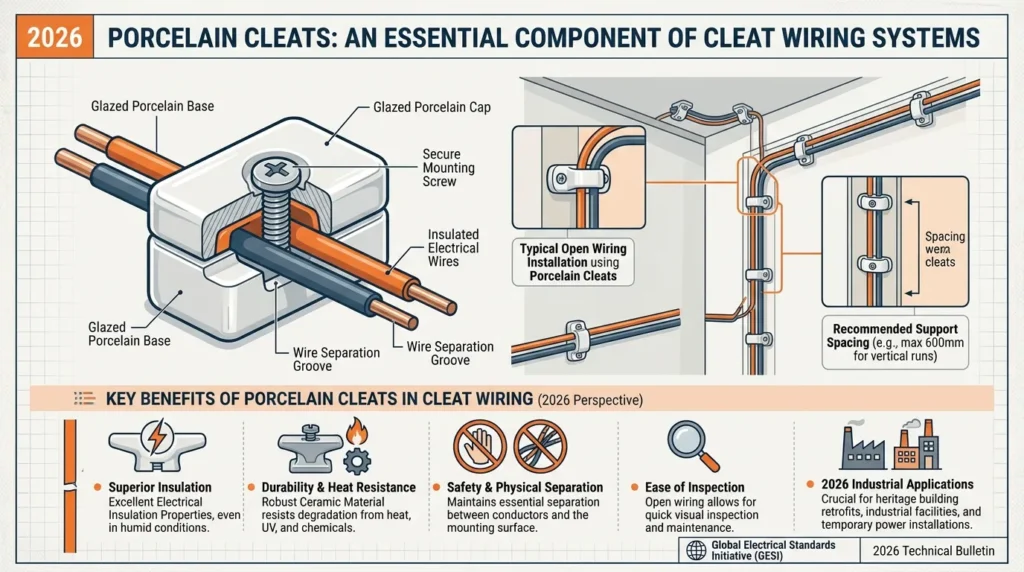
Porcelain cleats are the traditional and most widely recognized type of cleats used in cleat wiring systems. They have been used for many decades because porcelain is an excellent electrical insulating material with high mechanical strength and outstanding resistance to heat. Before PVC and other plastic materials became popular, porcelain cleats were the standard choice for supporting electrical conductors in temporary wiring installations.
A porcelain cleat is designed to securely hold insulated electrical wires while maintaining proper spacing between conductors. Each cleat consists of two parts: a base, which is fixed to the wall or ceiling with screws, and a cap, which is placed over the wires and tightened to lock them firmly in place. This design prevents the wires from sagging, moving, or coming into contact with each other, ensuring a neat and organized wiring layout.
One of the biggest advantages of porcelain cleats is their excellent insulation properties. Since porcelain is a non-conductive material, it helps reduce the risk of electrical leakage and accidental short circuits. It also has a high resistance to heat, making it suitable for environments where wires may operate at higher temperatures. Unlike wooden cleats, porcelain does not absorb moisture, rot, or become damaged by insects, which contributes to its long service life.
Porcelain cleats are mainly used in temporary electrical installations, such as construction sites, testing laboratories, training workshops, exhibitions, and temporary lighting systems. They are also commonly used in educational institutions where electrical students learn the fundamentals of wiring installation because the exposed wires make it easier to observe conductor placement, wire spacing, and installation techniques.
Although porcelain cleats provide excellent insulation and durability, they are less commonly used in modern installations because they are heavier, more fragile, and more expensive than PVC cleats. If dropped or subjected to strong impact, porcelain can crack or break. For this reason, many temporary installations now use lightweight plastic cleats, while porcelain cleats remain popular in electrical training and applications requiring high heat resistance.
Key Features of Porcelain Cleats
- Made from high-quality porcelain ceramic material
- Excellent electrical insulation properties
- High resistance to heat and fire
- Strong mechanical strength under normal conditions
- Resistant to moisture, corrosion, and weathering
- Long service life with minimal maintenance
- Maintains proper spacing between electrical conductors
- Suitable for temporary wiring installations
- Easy to install, inspect, and remove
- Commonly used in electrical training laboratories and educational institutions
Advantages of Porcelain Cleats
- Provides superior electrical insulation
- Can withstand high operating temperatures
- Durable and reliable for temporary installations
- Does not rust, corrode, or absorb moisture
- Helps keep wiring neat and properly supported
- Reduces the risk of conductor contact and short circuits
- Requires very little maintenance
Limitations of Porcelain Cleats
- More expensive than PVC cleats
- Brittle and may crack if subjected to impact
- Heavier than plastic alternatives
- Not recommended for permanent modern building wiring
- Gradually being replaced by lightweight PVC cleats in many temporary applications
2. PVC Cleats: A Lightweight and Cost-Effective Solution for Cleat Wiring (2026)
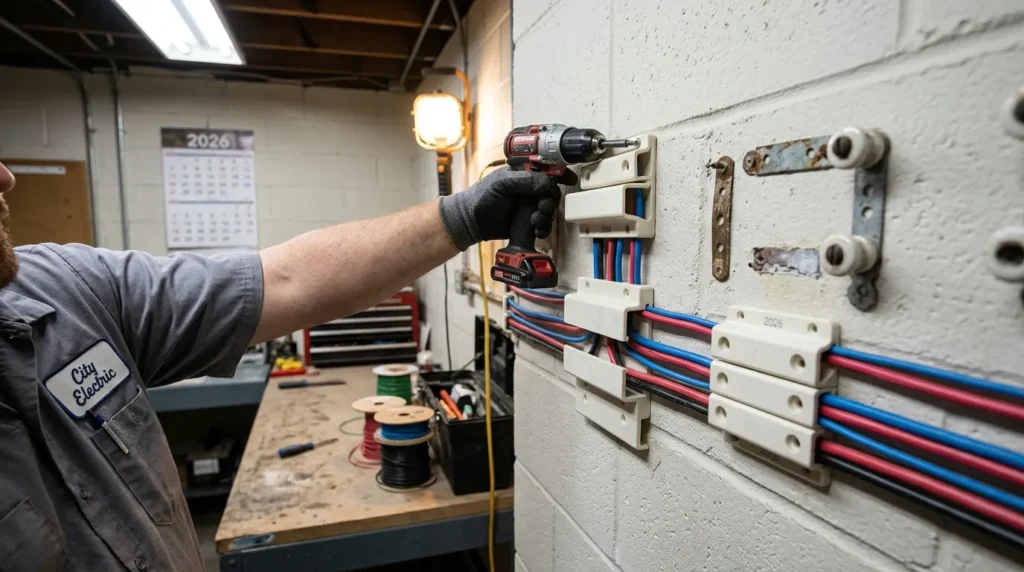
PVC (Polyvinyl Chloride) cleats are the most commonly used type of cleats in modern cleat wiring systems. They have become a popular alternative to traditional porcelain cleats because they are lightweight, economical, durable, and easy to install. PVC is a strong insulating material that offers good electrical safety while reducing the overall cost of temporary wiring installations.
PVC cleats are designed to support insulated electrical conductors on walls or ceilings while maintaining the correct spacing between wires. Like porcelain cleats, they consist of two parts: a base, which is fixed to the surface using screws, and a cap, which is secured over the wires to hold them firmly in place. This two-piece design prevents the wires from sagging or shifting during operation and helps maintain a neat and organized wiring layout.
One of the biggest advantages of PVC cleats is their lightweight construction. They are much easier to handle and install than porcelain cleats, allowing electricians to complete wiring projects more quickly. PVC is also resistant to corrosion, moisture, chemicals, and rust, making it suitable for both indoor and certain outdoor temporary installations where environmental conditions may vary.
Because PVC is a good electrical insulator, it helps reduce the risk of electrical leakage and accidental contact between conductors. In addition, PVC cleats require very little maintenance and have a long service life when used under normal operating conditions. Their affordability and ease of installation make them the preferred choice for many temporary electrical projects.
PVC cleats are widely used in construction sites, temporary offices, workshops, warehouses, exhibitions, event lighting, testing laboratories, maintenance work, and industrial installations. They are especially useful where electrical wiring needs to be installed, modified, or removed frequently.
Although PVC cleats provide many advantages, they are mainly intended for temporary wiring systems. They should not be used for permanent electrical installations in residential or commercial buildings, where conduit or concealed wiring systems provide better protection and comply with modern electrical safety standards.
Key Features of PVC Cleats
- Manufactured from high-quality PVC (Polyvinyl Chloride)
- Lightweight and easy to transport
- Excellent electrical insulation properties
- Quick and simple installation
- Resistant to corrosion, rust, and moisture
- Durable under normal working conditions
- Holds electrical conductors securely in place
- Requires minimal maintenance
- Cost-effective compared to porcelain cleats
- Ideal for temporary electrical wiring systems
Advantages of PVC Cleats
- Low installation and material cost
- Faster installation than porcelain cleats
- Lightweight and easy to handle
- Good resistance to moisture and chemicals
- Does not rust or corrode
- Easy to replace or reposition during maintenance
- Suitable for a wide range of temporary electrical applications
- Provides good insulation and wire support
Limitations of PVC Cleats
- Not suitable for permanent electrical wiring
- Lower heat resistance than porcelain cleats
- Can become brittle after prolonged exposure to direct sunlight
- May deform under excessive heat or heavy mechanical load
- Offers limited protection because the conductors remain exposed
Common Applications of PVC Cleats
PVC cleats are commonly used in:
- Construction sites
- Temporary residential and commercial buildings
- Exhibition halls
- Event and festival lighting
- Workshops and maintenance areas
- Electrical training laboratories
- Temporary industrial installations
- Emergency power distribution systems
- Testing and demonstration setups
- Short-term electrical projects
PVC cleats continue to be the preferred choice for temporary electrical wiring because they combine low cost, lightweight construction, reliable insulation, and easy installation, making them highly practical for modern electrical work in 2026.
3. Wooden Cleats: Traditional Support Components in Early Cleat Wiring Systems (2026)

Wooden cleats are one of the oldest types of cleats used in traditional electrical wiring systems. Before modern materials such as porcelain and PVC became widely available, wooden cleats were commonly used to support insulated electrical wires on walls and ceilings. They provided a simple and low-cost method for holding conductors in position during the early development of electrical installations.
Wooden cleats are generally made from treated hardwood and are designed with grooves where electrical wires are placed. Similar to other cleat types, they usually consist of a base part and a cover or cap part. The base is fixed to the supporting surface, while the cap holds the wires securely inside the grooves.
In older electrical installations, wooden cleats were preferred because wood was easily available, inexpensive, and simple to shape according to wiring requirements. They were mainly used in temporary wiring systems and early open wiring installations where quick installation was needed.
However, with improvements in electrical safety standards and the development of better insulating materials, wooden cleats have become less common. Materials such as porcelain and PVC provide better resistance against moisture, heat, fire, and environmental damage, making them more suitable for modern electrical applications.
Construction of Wooden Cleats (2026)
Wooden cleats are constructed from well-seasoned hardwood such as teak, oak, or other durable timber to provide mechanical support for electrical conductors in open wiring systems. In early electrical installations, these cleats were carefully shaped into small rectangular or circular blocks with specially designed grooves that securely hold insulated wires. The primary purpose of wooden cleats is to support the conductors, maintain proper spacing between wires, and prevent them from sagging or coming into contact with walls or each other.
A typical wooden cleat consists of two main parts: the wooden base and the wooden cap. These two parts work together to keep the electrical conductors firmly in position while allowing easy installation and removal whenever maintenance or modifications are required.
1. Wooden Base
The wooden base is the lower section of the cleat and serves as the main supporting component. It is securely fixed to the wall, ceiling, or any other mounting surface using screws or nails. The base contains one or more grooves that are designed to accommodate insulated electrical wires.
Its primary functions include:
- Providing strong mechanical support for electrical conductors.
- Holding the wires in the correct position during installation.
- Maintaining proper spacing between phase, neutral, and earth conductors.
- Preventing wires from sagging or shifting due to their weight.
- Forming a stable foundation for the wooden cap.
Properly installed wooden bases ensure that the wiring remains neat, organized, and safely supported throughout the temporary installation.
2. Wooden Cap
The wooden cap is the upper section of the cleat that is placed over the conductors after they have been positioned in the grooves of the base. It is tightened using screws to lock the wires securely in place.
The main functions of the wooden cap are:
- Holding the electrical wires firmly inside the grooves.
- Preventing conductors from slipping or becoming loose.
- Protecting the wires from minor mechanical movement.
- Keeping the conductors properly aligned throughout the wiring route.
- Allowing easy removal when repairs, inspections, or wiring modifications are required.
The removable cap design makes maintenance simple because electricians can access the conductors without dismantling the entire wiring system.
Grooved Design of Wooden Cleats
One of the most important features of wooden cleats is their grooved construction. The grooves are carefully designed to accommodate insulated wires of different sizes while maintaining a safe distance between adjacent conductors.
The grooved design offers several benefits:
- Ensures proper spacing between electrical conductors.
- Prevents wires from touching each other, reducing the risk of short circuits.
- Minimizes mechanical stress on the insulation.
- Keeps the wiring layout neat and organized.
- Makes inspection and fault detection easier because the wires remain clearly visible.
Although wooden cleats were effective for early electrical installations, they have largely been replaced by porcelain and PVC cleats, which provide better insulation, greater durability, improved moisture resistance, and enhanced fire safety in modern temporary wiring systems.
Features of Wooden Cleats
- Made from hardwood materials
- Simple and traditional design
- Easy to manufacture and install
- Low initial cost
- Provides basic mechanical support for wires
- Suitable for old temporary wiring systems
- Easy to replace and modify
Advantages of Wooden Cleats
Although wooden cleats are rarely used in modern electrical installations, they offered several practical advantages in the early days of electrical wiring. Their low cost, easy availability, and simple construction made them a preferred choice for temporary and basic wiring systems before porcelain and PVC cleats became widely available.
1. Low Cost
One of the biggest advantages of wooden cleats was their affordability. Wood was inexpensive, readily available, and easy to process, making wooden cleats much cheaper to manufacture than porcelain or other specialized materials. This made them an economical option for small electrical projects, temporary installations, and areas where keeping installation costs low was important.
2. Easy Installation
Wooden cleats were lightweight and simple to install. Electricians could easily drill, cut, or shape them to fit different wiring layouts. The base of the cleat was fixed to the wall or ceiling with screws or nails, and the cap securely held the insulated wires in place. This straightforward installation process reduced labor time and allowed wiring to be completed quickly.
3. Simple Design
The design of wooden cleats was uncomplicated, consisting of only a base and a cap with grooves for supporting electrical conductors. Their simple construction made them easy to manufacture, repair, and replace. Because of this simplicity, they were widely used in basic electrical installations and were also useful for teaching beginners the fundamentals of open wiring systems.
4. Easy Modification
Another important advantage was the ease of modifying the wiring system. Since the conductors were openly installed and held by removable caps, electricians could quickly add new wires, replace damaged conductors, or change the wiring layout without removing large sections of the installation. This flexibility made wooden cleats suitable for temporary electrical setups where wiring changes were frequently required.
5. Easily Available Material
Wood was one of the most commonly available construction materials, making wooden cleats easy to produce locally. This ensured that replacement cleats could be obtained quickly without requiring specialized manufacturing, especially in remote areas where modern electrical accessories were not readily available.
6. Suitable for Temporary and Educational Installations
Before modern wiring materials became common, wooden cleats were widely used for temporary electrical installations and practical training. Their open design allowed electrical students and trainees to clearly observe wire routing, conductor spacing, and installation techniques, making them useful for educational demonstrations and basic electrical workshops.
Limitations of Wooden Cleats
Despite their historical importance, wooden cleats have several disadvantages that limit their use in modern electrical systems.
1. Absorb Moisture
Wood is a natural material that can absorb moisture from the surrounding environment. When exposed to humidity or water, wooden cleats may become weaker and lose their insulating properties.
Moisture absorption can increase the risk of:
- Insulation failure
- Leakage current
- Short circuits
- Damage to electrical conductors
2. Lower Durability
Compared with porcelain and PVC cleats, wooden cleats have a shorter service life.
They may be affected by:
- Rotting
- Cracking
- Insect damage
- Environmental conditions
Because of these issues, they require more maintenance and replacement.
3. Fire Risk Compared to Modern Materials
Wood is a combustible material, which means it can catch fire when exposed to excessive heat or electrical faults.
Compared with:
- Porcelain cleats (fire-resistant)
- PVC cleats (better electrical safety properties)
wooden cleats provide less protection against fire hazards.
Applications of Wooden Cleats
Wooden cleats were mainly used in:
- Old residential electrical installations
- Early temporary wiring systems
- Historical electrical projects
- Basic training demonstrations
- Low-cost wiring setups
Today, they are rarely used in practical electrical installations because modern materials provide better safety and reliability.
Wooden Cleats vs Modern Cleats
| Wooden Cleats | Porcelain/PVC Cleats |
|---|---|
| Traditional material | Modern materials |
| Absorb moisture | Better moisture resistance |
| Lower durability | Longer service life |
| Higher fire risk | Better fire resistance |
| Used in old installations | Used in modern temporary wiring |
| Requires more maintenance | Requires less maintenance |
Wooden cleats represent an important stage in the history of electrical wiring systems. They provided a simple and affordable solution for supporting electrical conductors before advanced materials became available. However, due to their ability to absorb moisture, lower durability, and higher fire risk, wooden cleats have largely been replaced by safer alternatives such as porcelain and PVC cleats.
In modern electrical engineering, wooden cleats are mainly studied for educational and historical purposes, while PVC and porcelain cleats are preferred for practical temporary wiring applications.
Installation Process of Cleat Wiring (2026)
The installation of cleat wiring is straightforward and requires only basic electrical tools and materials. Since it is an open wiring system, the conductors are mounted directly on walls or ceilings using cleats. Proper installation is essential to ensure electrical safety, mechanical stability, and reliable performance. Before beginning the installation, electricians should prepare the required materials, inspect the wiring route, and follow all applicable electrical safety standards.
Below is the step-by-step installation process of a cleat wiring system.
Step 1: Planning the Wiring Layout
The first and most important step is planning the entire wiring layout. A well-planned layout ensures efficient power distribution, minimizes material waste, and makes future maintenance easier.
Before starting the installation, electricians determine:
- The route through which the electrical wires will run.
- The location of switches, sockets, lighting fixtures, and distribution boards.
- The total electrical load of the circuit.
- The number and size of conductors required.
- The spacing between cleats according to the wire size.
- The safest path that avoids excessive bends or obstacles.
Proper planning reduces installation time, improves safety, and ensures a neat and organized wiring system.
Step 2: Marking Cleat Positions
After finalizing the wiring layout, the positions for the cleats are marked on the wall or ceiling. Accurate marking is important because it determines how well the wires will be supported throughout the installation.
Cleats should be installed at equal intervals, generally between 40 cm and 60 cm, depending on the size and weight of the conductors. Additional cleats should be installed near bends, junctions, switches, sockets, and terminals to provide extra support.
Correct spacing between cleats helps to:
- Prevent wire sagging.
- Maintain proper conductor alignment.
- Reduce mechanical stress on the wires.
- Improve the overall appearance of the installation.
Step 3: Fixing the Cleats
Once the marking is complete, the base parts of the cleats are fixed securely to the wall or ceiling using screws and wall plugs where required.
Each cleat should be firmly tightened to prevent movement during operation. Loose cleats can cause the conductors to shift, resulting in poor wire support and possible damage to the insulation.
During this stage, electricians should ensure that:
- All cleats are properly aligned.
- Screws are tightened securely.
- The spacing between cleats is consistent.
- The cleats are capable of supporting the weight of the conductors.
A strong and stable foundation is essential for a reliable wiring installation.
Step 4: Installing the Electrical Wires
After the base cleats have been installed, the insulated electrical wires are carefully placed inside the grooves provided in the cleats.
The conductors should be laid neatly without excessive bending, twisting, or tension. Adequate spacing must be maintained between the different conductors to improve safety and simplify maintenance.
The following conductors are commonly installed:
- Phase (Live) Wire – Carries electrical power from the supply source.
- Neutral Wire – Provides the return path for current.
- Earth (Ground) Wire – Protects users and equipment by safely carrying fault current to the ground.
The wires should be arranged in an organized manner to ensure proper identification and easy troubleshooting.
Step 5: Fixing the Cap Part
After positioning the conductors correctly, the cap part of each cleat is placed over the wires and secured using screws.
The cap holds the wires firmly inside the grooves and prevents them from moving due to vibration or accidental pulling. Care should be taken not to overtighten the screws, as excessive pressure may damage the wire insulation.
A properly installed cap provides several benefits:
- Holds the conductors securely in position.
- Maintains proper spacing between adjacent wires.
- Prevents wire movement and sagging.
- Improves the overall stability of the wiring system.
- Allows easy removal for future inspection or maintenance.
Step 6: Connecting Electrical Accessories
Once all the wires have been secured, the conductors are connected to electrical accessories such as switches, sockets, lighting fixtures, junction boxes, and the distribution board according to the approved wiring diagram.
All connections should be made using proper terminals and tightened securely to ensure good electrical contact. Loose connections can generate heat, reduce efficiency, and increase the risk of electrical faults.
Step 7: Testing and Inspection
The final step is to inspect and test the complete wiring system before switching on the electrical supply. Testing ensures that the installation is safe, correctly connected, and free from faults.
Electricians typically perform the following tests:
- Continuity Test – Confirms that all conductors are continuous without any breaks.
- Insulation Resistance Test – Verifies that the insulation is in good condition and prevents leakage current.
- Polarity Test – Ensures that phase, neutral, and earth connections are correctly identified.
- Earth Continuity Test – Checks that the earthing conductor is properly connected.
- Visual Inspection – Ensures all cleats, wires, screws, and electrical accessories are securely installed.
After all tests are completed successfully, the electrical supply can be switched on, and the wiring system is ready for safe operation.
Safety Precautions During Installation
To ensure a safe and reliable installation, electricians should follow these precautions:
- Disconnect the power supply before starting any wiring work.
- Use properly insulated electrical wires.
- Wear appropriate personal protective equipment (PPE).
- Install cleats at recommended intervals.
- Avoid damaging the insulation while tightening the caps.
- Ensure all electrical connections are secure.
- Follow local electrical codes and safety regulations.
- Perform all required electrical tests before energizing the circuit.
Following these installation steps ensures that the cleat wiring system is safe, well-organized, and capable of providing reliable temporary electrical power for construction sites, workshops, laboratories, exhibitions, and other short-term electrical installations.
Advantages of Cleat Wiring (2026)
Cleat wiring is one of the simplest and most economical wiring systems used for temporary electrical installations. Although it is not suitable for permanent buildings, it offers several practical advantages that make it ideal for construction sites, workshops, exhibitions, testing laboratories, and other short-term electrical projects.
1. Low Installation Cost
One of the biggest advantages of cleat wiring is its low installation cost. The system requires only a few basic materials, such as insulated wires, cleats, screws, and electrical accessories. Unlike conduit wiring, it does not require expensive pipes, fittings, or wall cutting, which significantly reduces both material and labor costs. This makes cleat wiring an economical solution for temporary electrical installations.
2. Quick and Simple Installation
Cleat wiring is very easy and fast to install. Since the conductors are mounted directly on walls or ceilings using cleats, electricians can complete the installation in a short period without using specialized tools or complex construction work. This makes it highly suitable for projects where electrical power is required immediately.
3. Easy Inspection and Maintenance
Because the electrical wires remain completely visible, inspection and maintenance become much easier. Electricians can quickly identify loose connections, damaged insulation, overheating, or other electrical faults without removing walls or conduits. This reduces maintenance time and improves the overall reliability of the wiring system.
4. Easy Modification and Expansion
Another major advantage is its flexibility. If additional electrical points, switches, sockets, or lighting fixtures are required, new conductors can be added easily without dismantling the existing installation. This makes cleat wiring ideal for temporary projects where electrical requirements frequently change.
5. Good Heat Dissipation
Since the conductors are installed openly, air circulates freely around the wires. This natural ventilation helps dissipate heat more effectively than enclosed wiring systems, reducing the chances of overheating and improving the safe operation of the conductors under normal load conditions.
6. Easy Fault Detection
Electrical faults such as broken wires, damaged insulation, loose connections, or short circuits can be located quickly because every conductor is visible. This simplifies troubleshooting and reduces repair time, allowing the electrical system to be restored to service more efficiently.
7. Easy Removal and Reusability
Cleat wiring can be dismantled quickly without causing damage to walls or ceilings. Most of the components, including cleats and insulated wires, can often be reused in another temporary installation. This makes the system both economical and environmentally friendly for repeated short-term use.
8. Suitable for Temporary Installations
Cleat wiring is specifically designed for temporary electrical applications. It is widely used at construction sites, exhibition halls, workshops, festivals, laboratories, maintenance projects, and emergency power installations where the wiring is required only for a limited period.
9. Requires Minimal Tools and Materials
The installation process requires only basic electrical tools and a small number of components. This reduces installation complexity and allows electricians to complete the work efficiently with minimal equipment.
10. Ideal for Electrical Training
Because all conductors remain visible, cleat wiring is commonly used in electrical laboratories, vocational institutes, and training centers. Students can easily observe conductor placement, wire spacing, electrical connections, and installation techniques, making it an excellent learning method for beginners.
Disadvantages of Cleat Wiring (2026)
Although cleat wiring offers several advantages for temporary electrical installations, it also has certain limitations. Due to these disadvantages, it is generally not recommended for permanent residential, commercial, or industrial buildings.
1. Poor Protection Against Mechanical Damage
The electrical conductors remain fully exposed, making them vulnerable to accidental impacts, cuts, abrasion, and physical damage. Objects striking the wires can damage the insulation and create electrical hazards.
2. Not Suitable for Permanent Installations
Cleat wiring is intended only for temporary use. It does not provide the durability, protection, or long-term reliability required for permanent electrical systems in homes, offices, or industrial facilities.
3. Exposure to Weather and Environmental Conditions
Because the wires are exposed, they can be affected by moisture, rain, dust, direct sunlight, chemicals, and extreme temperatures. Continuous exposure to these environmental factors may deteriorate the wire insulation and reduce the lifespan of the installation.
4. Poor Aesthetic Appearance
The visible conductors and supporting cleats give the wiring a less attractive appearance compared to concealed or conduit wiring systems. For this reason, cleat wiring is generally avoided in modern residential and commercial buildings where appearance is an important consideration.
5. Higher Risk of Accidental Contact
Since the conductors are openly installed, there is a greater chance that people may accidentally touch or damage the wiring. Although insulated wires reduce this risk, exposed wiring still provides less protection than enclosed wiring systems.
6. Requires Frequent Inspection
The exposed conductors should be inspected regularly to check for loose cleats, damaged insulation, dust accumulation, and signs of wear. Without routine maintenance, the safety and reliability of the system may decrease over time.
7. Limited Protection Against Fire Hazards
Open wiring is more susceptible to fire risks if the conductors become overloaded, damaged, or improperly installed. Unlike conduit wiring, cleat wiring provides very little physical protection against electrical faults that may lead to overheating.
8. Shorter Service Life
Compared with concealed or conduit wiring systems, cleat wiring generally has a shorter operational life because the conductors are continuously exposed to environmental and mechanical stresses.
9. Unsuitable for Damp or Hazardous Locations
Cleat wiring should not be used in areas with excessive moisture, corrosive chemicals, explosive gases, or highly dusty environments. Such conditions can damage the insulation and increase the risk of electrical accidents.
10. Lower Overall Safety Compared to Modern Wiring Systems
Modern wiring methods, such as conduit wiring and concealed wiring, provide much better protection against electrical shocks, mechanical damage, moisture, and fire. Therefore, cleat wiring is considered less safe and is mainly reserved for temporary electrical installations where quick installation and low cost are the primary requirements.
Safety Precautions for Cleat Wiring
To ensure safe operation:
- Use properly insulated wires
- Install cleats at correct spacing
- Avoid installing near water sources
- Regularly inspect wire insulation
- Tighten loose cleat screws
- Do not overload circuits
- Use proper earthing protection
- Replace damaged wires immediately
Maintenance of Cleat Wiring
Regular maintenance improves safety and reliability.
Maintenance tasks include:
- Checking damaged insulation
- Inspecting loose connections
- Cleaning dust from wires
- Replacing broken cleats
- Testing insulation resistance
- Checking overheating signs
Applications of Cleat Wiring
Cleat wiring is mainly used for temporary purposes.
Common applications include:
- Construction sites
- Temporary offices
- Workshops
- Exhibition halls
- Laboratories
- Festival lighting
- Stage lighting systems
- Emergency power supply
- Testing areas
- Temporary industrial setups
Cleat Wiring vs Conduit Wiring
| Cleat Wiring | Conduit Wiring |
|---|---|
| Temporary wiring system | Permanent wiring system |
| Low installation cost | Higher installation cost |
| Wires remain visible | Wires are protected inside pipes |
| Easy modification | Difficult modification |
| Less protection | High protection |
| Used for short-term applications | Used in homes and industries |
Is Cleat Wiring Suitable for Modern Houses?
Cleat wiring is generally not suitable for modern houses because safety standards require better protection for electrical conductors.
Modern homes prefer:
- Concealed conduit wiring
- Surface conduit wiring
- Cable tray systems
These systems provide:
- Better safety
- Longer life
- Improved appearance
- Protection from damage
Cleat wiring is a basic and economical electrical wiring method that has played an important role in the development of electrical installations. Although it is no longer preferred for permanent buildings, it remains useful for temporary electrical applications where quick installation, low cost, and easy maintenance are required.
For electrical students, technicians, and beginners, learning cleat wiring provides a strong understanding of fundamental wiring concepts, conductor support methods, and electrical safety practices. Even in 2026, cleat wiring remains an important topic in electrical engineering education and temporary power distribution systems.
3. Cleat Wiring Working Principle (2026): How It Works Step by Step
The working principle of cleat wiring is based on supporting insulated electrical conductors with non-conductive cleats that are securely fixed to walls or ceilings. These cleats hold the wires firmly in position, maintain proper spacing between conductors, and prevent them from sagging, touching each other, or coming into contact with the mounting surface.
Unlike conduit or concealed wiring systems, cleat wiring is an open wiring system, meaning the conductors remain visible throughout the installation. This allows electricians to easily inspect the wiring, identify faults, and carry out maintenance whenever required. The cleats themselves do not carry electrical current; they only provide mechanical support and electrical insulation for the conductors.
When electrical power is supplied, current flows through the insulated wires to the connected electrical devices, while the cleats ensure that the wiring remains secure, organized, and safe throughout the installation.
Step-by-Step Working Process
1. Power Supply Connection
The working process begins when electrical power is supplied from the main distribution board (DB) or another power source. The phase (live), neutral, and earth conductors are connected to the appropriate terminals before being routed through the cleat wiring system.
The distribution board protects the circuit using protective devices such as circuit breakers or fuses and distributes electricity safely to different electrical loads.
2. Wiring Layout Preparation
Before installing the wires, electricians carefully plan the wiring route. The positions of switches, sockets, lighting fixtures, and other electrical accessories are marked to ensure an organized installation.
Proper planning helps to:
- Reduce material wastage.
- Maintain safe conductor spacing.
- Simplify future maintenance.
- Improve the overall appearance of the wiring.
3. Cleat Installation
The base parts of the cleats are fixed securely to the wall or ceiling using screws. The cleats are installed at regular intervals, generally 40–60 cm (16–24 inches) apart, depending on the size and weight of the electrical conductors.
Proper spacing between cleats prevents the wires from sagging and provides adequate mechanical support throughout the wiring route.
4. Wire Placement
After the cleats have been installed, insulated electrical conductors are carefully placed into the grooves of the base cleats.
The conductors are arranged neatly so that:
- Phase, neutral, and earth wires remain properly separated.
- The wires do not cross each other unnecessarily.
- Mechanical stress on the conductors is minimized.
- The wiring remains organized and easy to inspect.
5. Securing the Wires with the Cap
Once the conductors are correctly positioned, the cap part of each cleat is placed over the wires and tightened using screws.
The cap performs several important functions:
- Holds the conductors firmly in place.
- Prevents wire movement caused by vibration or accidental pulling.
- Maintains safe spacing between adjacent conductors.
- Reduces the possibility of short circuits caused by conductor contact.
6. Current Flow Through the Conductors
After all electrical connections have been completed and the circuit has been tested, the power supply is switched on.
Electrical current flows from the distribution board through the phase (live) conductor to the connected electrical equipment. The neutral conductor provides the return path for the current, while the earth conductor offers protection by safely carrying fault current to the ground if an electrical fault occurs.
Throughout this process, the cleats continue to provide mechanical support, ensuring that the conductors remain securely positioned without carrying any electrical current themselves.
7. Inspection and Maintenance
Because the conductors remain fully visible, electricians can easily inspect the wiring system during operation.
Routine inspection allows quick identification of:
- Loose cleats
- Damaged insulation
- Overheated conductors
- Loose electrical connections
- Mechanical damage
This makes maintenance faster and reduces system downtime.
Simple Analogy
Think of cleat wiring like securing a garden hose to a wall using a series of clips. The clips do not carry water—they simply hold the hose in place, keep it straight, and prevent it from falling or bending.
In the same way, cleats do not carry electricity. They simply support the insulated electrical wires, maintain proper spacing between conductors, and keep the wiring secure while electrical current flows safely through the wires.
Important Design Features
Several design features make cleat wiring effective for temporary electrical installations:
- Cleats are typically installed 40–60 cm (16–24 inches) apart for proper wire support.
- Conductors remain fully visible for easy inspection and maintenance.
- Cleats are made from insulating materials such as porcelain or PVC.
- Proper spacing between wires helps prevent short circuits and overheating.
- The open wiring design provides excellent heat dissipation.
- The two-part cleat design allows quick installation, easy wire replacement, and convenient maintenance.
- The system is best suited for temporary electrical installations, including construction sites, workshops, laboratories, exhibitions, and event lighting.
Summary of the Working Principle
The cleat wiring system works by supporting insulated electrical conductors on walls or ceilings using non-conductive cleats. The cleats keep the wires properly spaced, prevent unnecessary movement, and provide mechanical support while electricity flows safely through the conductors. This simple yet effective design makes cleat wiring an economical, easy-to-install, and reliable solution for temporary electrical installations.
4. Types / Classification of Cleat Wiring
There are mainly two types of cleat wiring systems based on the number of conductors supported.
4.1 Single Cleat Wiring: Construction, Working, Advantages, and Applications in Electrical Systems complete guide
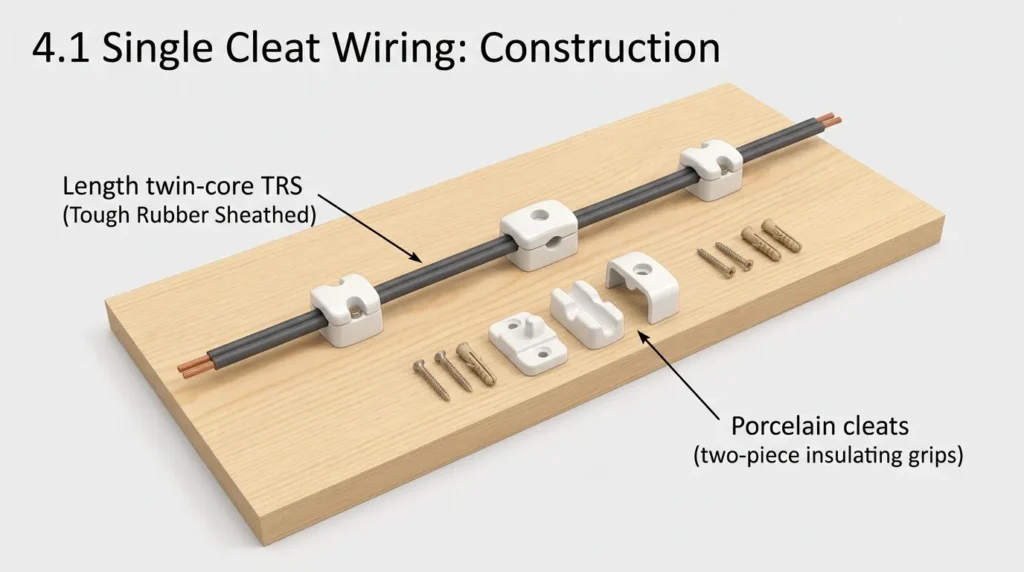
Single cleat wiring is a temporary wiring system in which a single insulated conductor is supported using cleats fixed on walls or wooden battens. It is one of the simplest and most economical wiring methods, mainly used for temporary electrical installations.
Construction
In single cleat wiring, a single insulated wire is held between two half cleats made of porcelain, wood, or plastic. These cleats are fixed on walls or wooden surfaces at regular intervals using screws or nails. The wire is placed inside the groove of the cleats, and the two halves are tightened together to hold it firmly. Proper spacing is maintained to ensure safety and support.
Working Principle
The working of single cleat wiring is based on open surface installation. Electrical current flows through the insulated conductor, which is supported externally by cleats. Since the wiring is not enclosed in conduits or pipes, it allows easy installation, inspection, and removal. This makes it suitable for short-term electrical setups.
Advantages
- Very low installation cost
- Easy to install and remove
- Simple design and maintenance
- Requires less material
- Quick fault detection and repair
Applications
- Temporary lighting systems
- Construction sites
- Testing laboratories
- Short-term events and exhibitions
- Emergency electrical setups
Single cleat wiring is a simple and cost-effective wiring method used mainly for temporary purposes. Although it is not suitable for permanent installations due to safety and durability concerns, it is still widely used where quick and flexible wiring is required.
Features
- One conductor per cleat
- Used for simple circuits
- Suitable for low power loads
Typical Use
- Small lighting circuits
- Temporary installations
Double Cleat Wiring: Construction, Working Principle, Advantages, and Applications in Electrical Systems (Complete Guide)
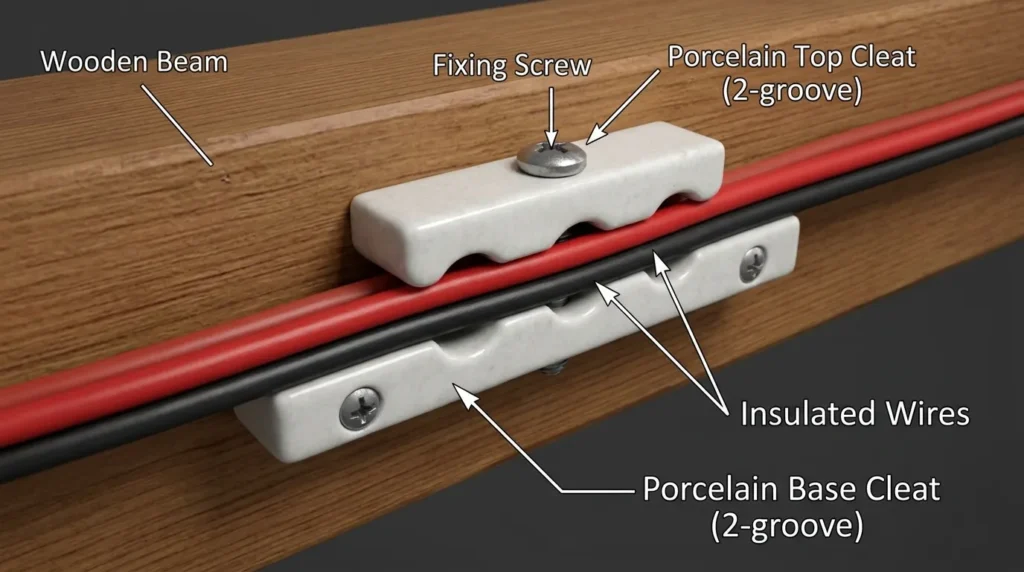
Double cleat wiring is a temporary electrical wiring system in which a single insulated conductor is supported using a pair of cleats. These cleats are fixed on walls or wooden surfaces to hold the wire safely in place. It is commonly used where quick installation and easy removal are required.
Construction
In double cleat wiring, each wire is supported by two-part cleats made of porcelain, wood, or plastic. The cleats are fixed at regular intervals on walls or wooden battens using screws or nails. The insulated conductor is placed between the two halves of the cleat, and then tightened to provide proper grip and support. This ensures that the wire remains stable and properly aligned.
Working Principle
The working of double cleat wiring is based on open surface installation, where electrical conductors are exposed but safely supported by cleats. The current flows through insulated wires, while the cleats provide mechanical support and prevent sagging or damage. This system allows easy inspection, maintenance, and replacement of wiring.
Advantages
- Very low installation cost
- Quick and easy installation
- Simple maintenance and repair
- Easy fault detection
- Requires minimal materials
Applications
- Temporary electrical installations
- Construction sites
- Testing laboratories
- Short-term lighting arrangements
- Exhibition and event setups
Double cleat wiring is a simple and economical temporary wiring method widely used for short-term electrical needs. Although it is not suitable for permanent installations due to safety limitations and exposure to environmental damage, it remains useful for quick and flexible electrical setups.
Features
- Supports both phase and neutral wires
- Provides better wire alignment
- Most common type of cleat wiring
Typical Use
- Domestic temporary wiring
- Construction site power supply
Multi-Wire Cleat Wiring: Construction, Working Principle, Advantages, and Applications in Electrical Systems (Complete Guide)
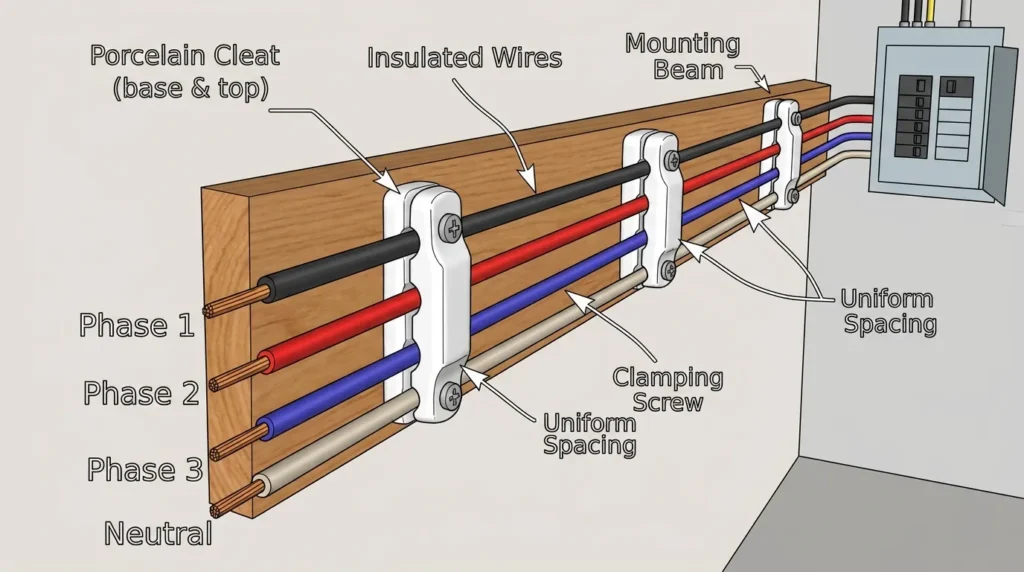
Multi-wire cleat wiring is a temporary wiring system in which multiple insulated conductors are supported together using cleats fixed on walls or wooden surfaces. It is an extension of single and double cleat wiring, designed to carry more circuits in a simple and cost-effective arrangement.
Construction
In multi-wire cleat wiring, several insulated wires are placed in grooves of cleats made from porcelain, wood, or plastic. These cleats are fixed at regular intervals on walls or wooden battens using screws or nails. The wires are properly separated within the cleat to avoid contact and short circuits, ensuring safe operation even when multiple conductors are used.
Working Principle
The working of multi-wire cleat wiring is based on open surface electrical installation. Each conductor carries current independently while being mechanically supported by cleats. The cleats maintain spacing between wires, prevent sagging, and allow easy inspection. Since the system is exposed, fault detection and maintenance become simple and quick.
Advantages
- Very low installation cost
- Easy and fast installation
- Simple maintenance and inspection
- Flexible for multiple circuits
- Quick fault detection and repair
Applications
- Temporary construction site wiring
- Testing and laboratory setups
- Short-term industrial installations
- Event and exhibition lighting systems
- Emergency electrical arrangements
Multi-wire cleat wiring is a simple, economical, and flexible wiring method used for temporary electrical systems requiring multiple circuits. Although it is not suitable for permanent installations due to safety and environmental exposure, it is highly useful where quick setup and easy maintenance are required.
Features
- Supports more than two wires
- Used in larger temporary systems
Typical Use
- Workshops
- Temporary distribution networks
5. Main Components of Cleat Wiring System
The cleat wiring system uses several basic components.
1. Cleats in Electrical Wiring Systems: Structure, Functions, and Practical Applications
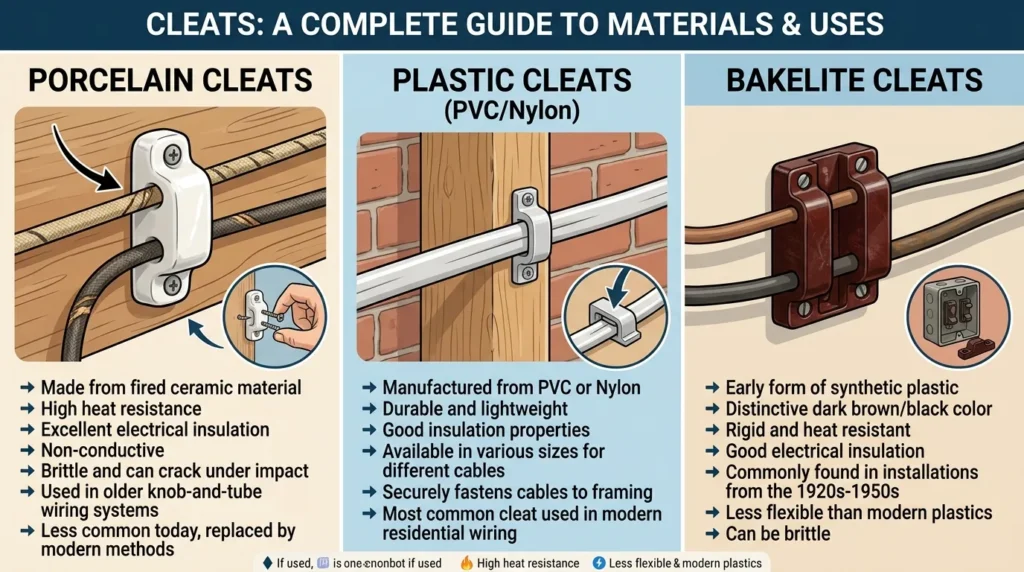
In electrical wiring, cleats are small but important hardware fittings used to support, guide, and secure electrical wires or cables along walls, ceilings, or wooden surfaces. They are generally made from durable materials such as porcelain, plastic, wood, or metal, and are fixed in position using screws or nails.
The main function of cleats is to prevent wires from sagging or moving, especially in temporary wiring systems. They help maintain proper alignment and spacing between conductors, which improves safety and reduces the risk of mechanical damage. Cleats are available in different sizes and designs to accommodate wires of various diameters and numbers of conductors.
Cleats are commonly used in both industrial and temporary electrical installations where quick setup and easy removal are required. They are especially useful for long wiring runs or installations around corners, as they keep the wiring neatly arranged and firmly supported. This also makes inspection, maintenance, and fault detection much easier.
Overall, cleats play a vital role in ensuring safe, organized, and efficient wiring by providing reliable mechanical support to electrical conductors.
Types of Cleats
- Porcelain cleats
- Plastic cleats
- Bakelite cleats
Function
- Hold wires in position
- Maintain spacing between conductors
- Provide electrical insulation
2What Are Insulated Wires? Working, Materials, and Uses Explained
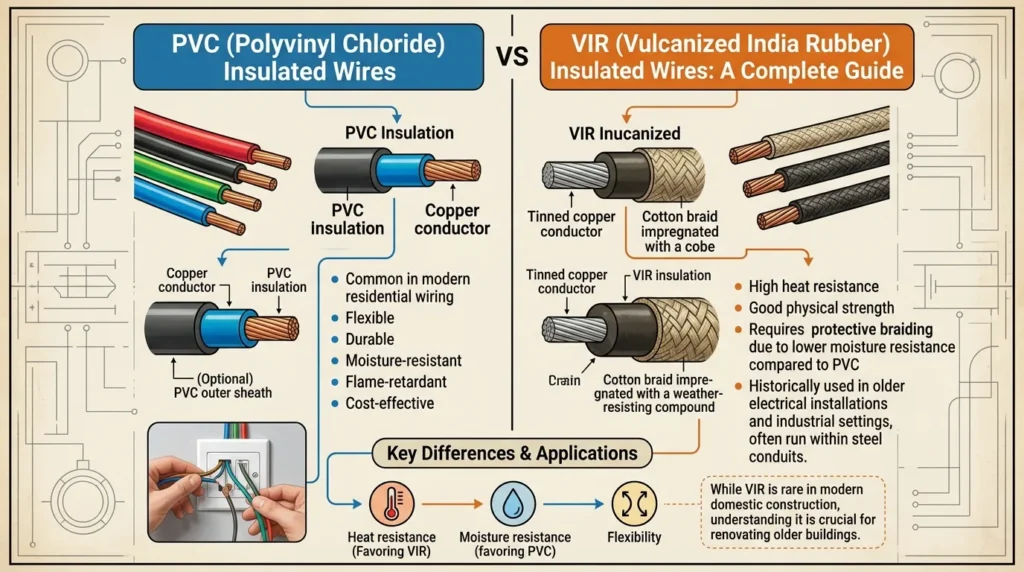
Insulated wires are electrical conductors that are covered with a protective layer of insulating material such as PVC, rubber, or polyethylene. This insulation prevents direct contact between the conductor and surrounding objects or other wires, reducing the risk of electric shock, short circuits, and fire hazards. These wires are widely used in residential, commercial, and industrial electrical installations due to their safety and reliability.
The main purpose of insulation is to ensure that electrical current flows only through the conductor and does not leak into the environment. Copper and aluminum are commonly used as conductor materials because of their excellent conductivity, while the insulation layer provides mechanical protection and electrical safety. Insulated wires are available in different colors, which help in identifying phases, neutral, and ground connections in electrical systems.
These wires are designed to withstand different voltage levels and environmental conditions such as heat, moisture, and chemical exposure. Depending on the application, insulation thickness and material may vary to provide better protection. For example, high-voltage systems require thicker insulation compared to low-voltage domestic wiring.
Overall, insulated wires are a fundamental component of modern electrical systems. They ensure safe and efficient transmission of electricity, protect users from electrical hazards, and improve the overall durability and performance of wiring systems in various applications.
Wires carry electrical current.
Common types include:
- PVC insulated wires
- VIR (Vulcanized India Rubber) wires
Function
- Conduct electricity from source to load
3. Screws and Wall Plugs: Construction, Working Principle, and Applications in Electrical Fittings
Screws and wall plugs are essential fixing accessories used in electrical installations and general construction work to securely attach electrical fittings, cleats, switches, and other hardware to walls or solid surfaces. A screw is a threaded fastener made of metal that provides strong gripping power when driven into a wall plug or directly into wood or metal surfaces.
A wall plug, also known as an anchor or rawl plug, is usually made of plastic or nylon and is inserted into a drilled hole in masonry walls such as brick or concrete. When a screw is driven into the wall plug, it expands and creates a tight grip inside the wall, ensuring a strong and stable hold. This combination prevents loosening over time and supports heavier loads safely.
Screws and wall plugs are widely used in electrical wiring systems to mount cleats, conduit clips, switch boxes, and other fixtures. They provide durability, stability, and safety in both temporary and permanent installations. Different sizes of screws and plugs are selected based on the weight of the object and the type of wall material.
Overall, screws and wall plugs play a crucial role in ensuring secure, reliable, and long-lasting electrical and mechanical installations.
These are used to fix cleats onto walls or ceilings.
Function
- Secure cleats firmly to the structure
4. Distribution Board: Structure, Working, Types, and Role in Power Distribution Systems
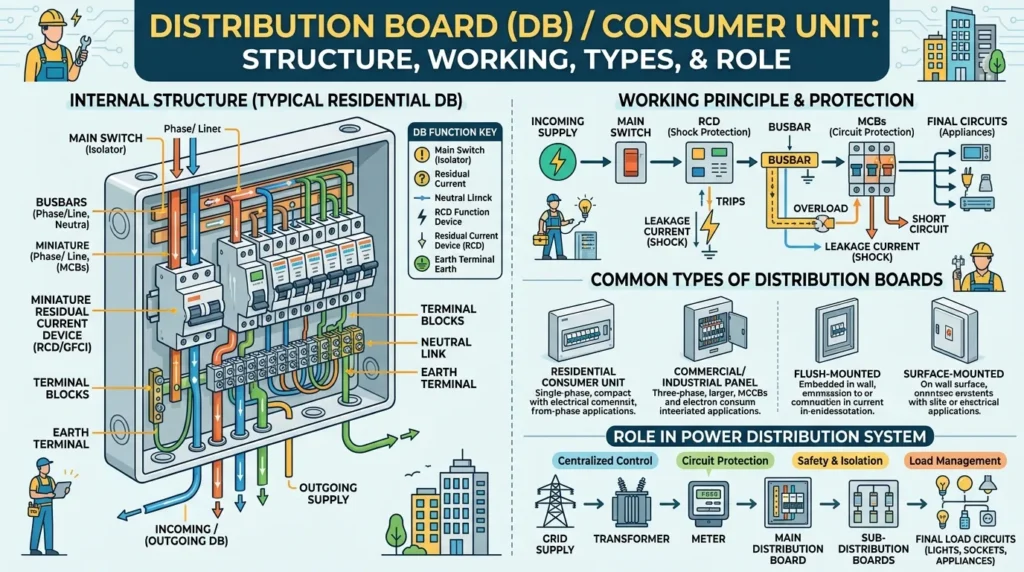
The distribution board controls power distribution.
A Distribution Board (DB) is an important electrical component used in residential, commercial, and industrial installations to distribute electrical power safely and efficiently to different circuits. It acts as a central point where the main power supply is divided into multiple sub-circuits for lighting, sockets, and appliances.
The distribution board contains essential protective devices such as circuit breakers, fuses, and sometimes residual current devices (RCDs). These components help protect electrical circuits from overload, short circuits, and leakage currents, ensuring safety for both equipment and users. The incoming main supply is connected to the DB, and then it is distributed through separate outgoing circuits.
Each circuit in the distribution board can be controlled independently, which makes maintenance and fault detection easier. If a fault occurs in one circuit, only that specific breaker trips, while the rest of the system continues to operate normally. This improves system reliability and reduces downtime.
Distribution boards are available in different types and sizes depending on the load requirements and application. They are commonly used in homes, offices, factories, and commercial buildings to ensure organized and safe power distribution.
Overall, the distribution board is a key part of modern electrical systems, providing protection, control, and efficient power management.
Function
- Contains switches and protective devices
Switches and Sockets: Construction, Working Principle, and Applications in Electrical Systems
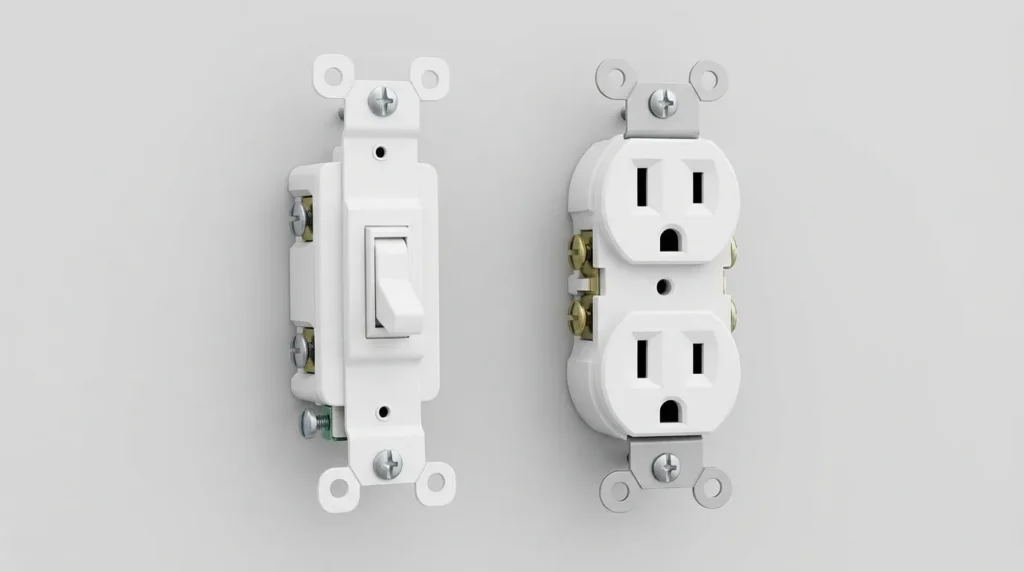
Switches and sockets are essential electrical devices used in residential, commercial, and industrial wiring systems to control and access electrical power safely. A switch is a device that is used to open or close an electrical circuit, allowing or stopping the flow of current to a connected load such as a light, fan, or appliance. A socket, on the other hand, is a fixed outlet that provides a safe point where electrical devices can be plugged in to receive power.
Switches work on a simple mechanical principle. When the switch is turned ON, the internal contacts connect and complete the circuit, allowing current to flow. When it is turned OFF, the contacts separate and break the circuit, stopping the flow of electricity. Sockets are designed with insulated terminals to ensure safe connection between the plug and power supply.
These devices are commonly made from durable insulating materials such as plastic or bakelite to ensure safety and long life. Modern switches and sockets also include safety features like child protection shutters and surge protection in advanced models.
Switches and sockets are widely used in homes, offices, industries, and commercial buildings. They provide convenient control of electrical appliances and ensure safe power distribution. Overall, they are fundamental components of any electrical installation system.
These control electrical appliances.
Function
- Turn power on or off
- Provide connection points for devices
6. Cleat Wiring Advantages
Cleat wiring is one of the oldest and simplest methods of electrical wiring used mainly for temporary electrical installations. In this system, insulated cables are supported on walls or ceilings using porcelain or plastic cleats. Although modern wiring methods are more commonly used today, cleat wiring still has importance in temporary setups such as construction sites, workshops, testing laboratories, exhibitions, and outdoor events. One of the main reasons for its continued use is the large number of practical advantages it offers.
Simple Installation
One of the biggest advantages of cleat wiring is its simple and quick installation process. The wires are fixed openly on walls or wooden boards using cleats, making the setup easy to understand and install. Electricians can complete the wiring work in less time compared to concealed or conduit wiring systems.
This simplicity also makes cleat wiring suitable for beginners and temporary projects where fast electrical connections are required.
Low Cost
Cleat wiring is very economical because it requires fewer materials and less labor. The main components include insulated wires and cleats, which are inexpensive compared to conduit pipes, casing systems, or concealed wiring materials.
Because of its low installation cost, cleat wiring is commonly used for short-term electrical needs where spending a large amount of money is unnecessary.
Easy Maintenance
Another important advantage of cleat wiring is easy inspection and maintenance. Since the wires are openly visible, faults such as damaged insulation, loose connections, or broken wires can be identified quickly.
Electricians can repair or replace damaged wires without breaking walls or removing complex structures. This reduces maintenance time and improves convenience.
Good Heat Dissipation
In cleat wiring, wires are exposed to open air, which allows better cooling and heat dissipation. This reduces the chances of overheating during operation.
Proper cooling improves wire performance and lowers the risk of insulation damage caused by excessive heat.
Flexible for Temporary Use
Cleat wiring is highly suitable for temporary electrical installations because it can be installed and removed easily. It is widely used in:
- Construction sites
- Temporary workshops
- Festival lighting
- Outdoor functions
- Laboratories
- Testing environments
Once the work is completed, the wiring can be removed without major difficulty.
Easy Fault Detection
Fault finding in cleat wiring is simple because all wires remain visible. Problems like short circuits, leakage currents, or damaged insulation can be located quickly.
This advantage reduces downtime and helps maintain safe electrical operation.
Better Ventilation Around Wires
Since the wires are not enclosed inside conduits or walls, air circulates freely around them. This ventilation helps reduce moisture buildup and improves the life of the insulation in dry environments.
Simple Modifications
Changes or extensions in the wiring system can be made easily. Additional wires or circuits can be added without complicated procedures.
This flexibility makes cleat wiring useful for experimental electrical setups and temporary load arrangements.
Lightweight Wiring System
Cleat wiring uses fewer supporting materials, making the overall system lightweight. It does not require heavy pipes, metal conduits, or complex mounting structures.
This reduces installation effort and material handling requirements.
Suitable for Educational Purposes
Cleat wiring is commonly used in electrical training centers and laboratories because students can easily observe wire arrangements, connections, and circuit layouts.
Its open structure helps beginners understand basic electrical wiring concepts clearly.
Cleat wiring offers many advantages such as low cost, easy installation, quick maintenance, simple fault detection, and flexibility for temporary electrical setups. Although it is not commonly used for permanent residential installations today, it remains highly useful for short-term applications, educational purposes, and testing environments. Its simplicity and affordability make it an important traditional wiring method in electrical engineering.
Understanding cleat wiring advantages and disadvantages helps technicians decide when to use it.
Advantages
- Very low installation cost
- Simple and quick installation
- Easy to inspect and repair
- Ideal for temporary wiring
- Minimal materials required
- No wall cutting required
- Flexible system for quick modifications
Because of these benefits, cleat wiring is widely used in temporary electrical setups.
7. Cleat Wiring Disadvantages / Limitations
Cleat wiring is a temporary wiring system in which insulated electrical wires are supported on walls or ceilings using porcelain or plastic cleats. Although this wiring method is simple and economical, it also has several disadvantages and limitations that make it unsuitable for permanent electrical installations. Due to these drawbacks, cleat wiring is mostly used only for temporary purposes such as construction sites, testing labs, exhibitions, and short-term electrical connections.
Poor Appearance
One of the major disadvantages of cleat wiring is its poor appearance. Since the wires are installed openly on walls and ceilings, the system does not look neat or attractive.
For homes, offices, and commercial buildings where appearance matters, cleat wiring is generally not preferred because modern wiring systems provide a cleaner and more professional finish.
Not Suitable for Permanent Installations
Cleat wiring is mainly designed for temporary use and is not suitable for long-term electrical installations. The exposed wires can easily become damaged over time due to environmental conditions, mechanical stress, or accidental contact.
For permanent buildings, safer and more durable wiring methods like conduit wiring are preferred.
Higher Risk of Mechanical Damage
Because the wires remain exposed, they can be damaged easily by:
- Physical impact
- Sharp objects
- Animals or rodents
- Human contact
This increases the chances of wire breakage, insulation damage, and electrical faults.
Unsafe in Moist or Wet Areas
Cleat wiring performs poorly in damp, humid, or wet environments. Moisture can damage the insulation and increase the risk of electric shock or short circuits.
Therefore, it should not be used in bathrooms, outdoor wet locations, or industrial areas with high humidity.
Risk of Electric Shock
Since the wires are openly visible and accessible, there is a higher chance of accidental human contact. Damaged insulation or loose wiring can expose live conductors and create serious electrical shock hazards.
This makes cleat wiring less safe compared to concealed or conduit wiring systems.
Shorter Lifespan
Cleat wiring generally has a shorter service life because the wires are continuously exposed to dust, sunlight, heat, moisture, and environmental effects.
Over time, the insulation may crack, fade, or weaken, reducing the reliability of the wiring system.
Requires Frequent Maintenance
Due to open exposure, cleat wiring needs regular inspection and maintenance. Wires and cleats may loosen or become damaged, especially in busy work areas.
Frequent maintenance increases labor requirements and operating costs over time.
Limited Load Capacity
Cleat wiring is not suitable for carrying heavy electrical loads. It is mainly used for light-duty temporary applications.
For large industrial equipment or high-power installations, stronger wiring systems are necessary.
Fire Hazard Risk
Exposed wires can become dangerous if overloaded or damaged. Poor insulation or loose connections may produce sparks, overheating, or short circuits, increasing the possibility of electrical fires.
This limitation makes cleat wiring unsafe for critical or sensitive installations.
Easily Affected by Environmental Conditions
Dust, smoke, chemicals, rain, sunlight, and temperature changes can affect the condition of the wires and cleats. Outdoor use becomes difficult unless proper protection is provided.
Environmental exposure reduces system reliability and safety.
Low Security and Protection
Unlike conduit wiring, cleat wiring provides very little physical protection to cables. The wires remain open and accessible, making them vulnerable to tampering or accidental damage.
This is another reason why it is rarely used in modern permanent buildings.
Cleat wiring has several disadvantages such as poor appearance, low durability, safety risks, frequent maintenance, and limited protection against environmental conditions. Although it is simple and low-cost, these limitations make it unsuitable for permanent residential, commercial, and industrial installations. Today, cleat wiring is mainly used for temporary electrical work where quick installation and easy removal are required.
Although cleat wiring is simple, it has several limitations.
Disadvantages
- Not suitable for permanent wiring
- Poor appearance
- Wires are exposed to dust and moisture
- Risk of mechanical damage
- Limited load capacity
- Not safe for modern buildings
Due to these issues, cleat wiring is rarely used in modern residential installations.
8. Applications of Cleat Wiring Systems
Although cleat wiring is not suitable for permanent installations, it remains widely used in situations where temporary, economical, and easily removable wiring is required. Some of the most common applications of cleat wiring include:
8.1 Construction Sites
Cleat wiring is extensively used on construction sites to provide temporary lighting and power for tools, machinery, and workers during different stages of building projects.
8.2 Workshops and Repair Facilities
In workshops and maintenance areas, cleat wiring is used for temporary power connections to machines, testing equipment, and repair tools, allowing flexibility and quick installation.
8.3 Exhibitions, Events, and Trade Shows
Temporary lighting systems, display booths, sound equipment, and other electrical installations at exhibitions and events often rely on cleat wiring because it can be installed and removed easily.
8.4 Testing and Research Laboratories
Cleat wiring is commonly used in laboratories for experimental setups, equipment testing, and short-term electrical arrangements that require frequent modifications.
8.5 Educational and Training Institutions
Electrical training centers and technical institutes use cleat wiring to teach students the fundamentals of wiring installation, circuit connections, and safe electrical practices through hands-on experience.
Cleat wiring continues to play an important role in temporary electrical installations due to its low cost, simple installation, easy maintenance, and flexibility. It is particularly valuable in environments where wiring arrangements need to be changed, inspected, or removed frequently.
9. Comparison: Cleat Wiring vs Batten Wiring
Understanding the difference between cleat wiring and batten wiring helps students learn different wiring systems.
| Feature | Cleat Wiring | Batten Wiring |
|---|---|---|
| Installation | Very simple | Moderate |
| Cost | Very low | Medium |
| Durability | Temporary | Semi-permanent |
| Safety | Low | Better |
| Appearance | Poor | Better |
| Protection | Wires exposed | Wires fixed on wooden batten |
Cleat wiring is mainly used for temporary setups, while batten wiring is suitable for longer-term installations.
10. Selection Guide: When to Use Cleat Wiring
Choosing the right wiring system depends on several factors.
Use Cleat Wiring When:
- Installation is temporary
- Budget is very limited
- Quick installation is required
- Wiring must be easily removable
Do Not Use Cleat Wiring When:
- Wiring is permanent
- Appearance is important
- High safety standards are required
Beginner Tip
Electrical students should practice cleat wiring first because it helps them understand basic wiring layouts easily.
11. Common Problems & Solutions
Here are common problems faced in cleat wiring systems.
1. Loose Wires
Cause
- Cleat caps not tightened properly
Solution
- Tighten cleat caps securely
2. Wire Sagging
Cause
- Cleats spaced too far apart
Solution
- Install cleats at proper intervals
3. Wire Damage
Cause
- Mechanical contact or sharp edges
Solution
- Replace damaged wire immediately
4. Short Circuit
Cause
- Damaged insulation
Solution
- Inspect wires regularly and replace faulty sections
12. Future Trends in Electrical Wiring
Although cleat wiring is rarely used in modern houses, electrical wiring technology continues to evolve.
Modern Wiring Systems
Modern buildings prefer:
- Concealed wiring
- Conduit wiring
- Modular electrical systems
Smart Electrical Systems
Future homes will include:
- Smart switches
- Energy monitoring systems
- Automated lighting systems
Improved Safety Standards
New electrical codes require:
- Better insulation
- Protective earthing
- Advanced circuit breakers
These improvements make modern wiring systems safer and more efficient.
13. Conclusion
The Cleat Wiring System in Houses is one of the simplest and oldest electrical wiring methods. Although it is rarely used in permanent house installations today, it remains an important concept for electrical students, engineers, and technicians to understand.
In this article, we discussed the cleat wiring working principle, its main components, and different types of cleat wiring systems. We also explored cleat wiring advantages and disadvantages, applications, comparison with other wiring systems, and practical troubleshooting tips.
Cleat wiring is mainly used for temporary electrical installations because it is inexpensive, easy to install, and simple to maintain. However, its exposed wiring and limited safety make it unsuitable for modern permanent housing systems.
For beginners in electrical engineering, learning cleat wiring provides a strong foundation in understanding how electrical circuits are installed and supported physically.
By mastering basic wiring systems like cleat wiring, students can build the knowledge needed to work with advanced electrical installation methods in the future.