
Imagine cooking in a kitchen where steam, smoke, and strong food smells quickly fill the room. Without proper ventilation, the air becomes uncomfortable and even unhealthy. Similarly, in bathrooms, humidity and moisture can build up quickly after a shower, causing unpleasant odors and mold growth. In industrial environments, smoke, dust, and heat from machines can create unsafe working conditions. In all of these situations, exhaust fans play a very important role.
Exhaust fans are simple but essential ventilation devices used to remove unwanted air, heat, moisture, and pollutants from indoor spaces. By pulling stale air out and allowing fresh air to enter, they help maintain a healthy and comfortable environment.
For electrical students, engineers, technicians, and beginners, understanding exhaust fans is important because these systems combine electric motors, airflow mechanics, ventilation principles, and energy efficiency. They are commonly used in homes, commercial buildings, and industrial facilities.
In this article, we will explain the exhaust fans working principle, types, main components, advantages, disadvantages, and exhaust fans applications. We will also discuss the difference between exhaust fan and ventilation fan. By the end of this guide, you will clearly understand how exhaust fans work and why they are essential for proper ventilation.
What are Exhaust Fans?
Exhaust fans are mechanical ventilation devices designed to remove stale, humid, or contaminated air from indoor spaces and release it outside.
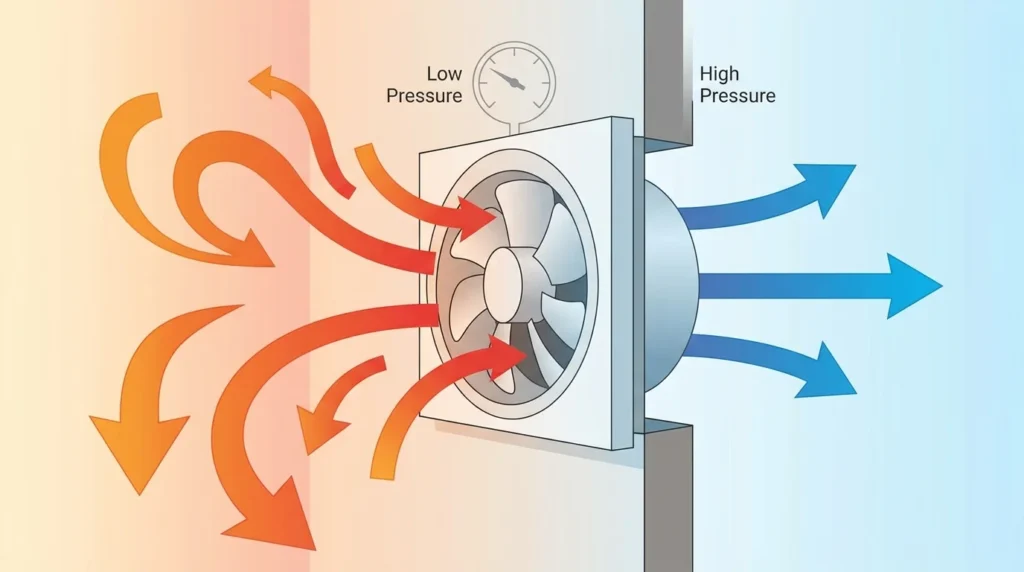
They operate using an electric motor that rotates fan blades to pull air out of a room. This creates negative pressure, which allows fresh air to enter from doors, windows, or ventilation openings.
Simple Explanation
An exhaust fan works like a suction device that pulls unwanted air out of a space. As it removes indoor air, fresh air automatically replaces it.
Practical Example
For example, in a bathroom, an exhaust fan removes humid air after a shower. This prevents condensation on walls and reduces the risk of mold growth.
Similarly, in kitchens, exhaust fans remove smoke, cooking fumes, and strong odors.
How Does an Exhaust Fan Work? (Working Principle Explained)
The working principle of an exhaust fan is based on creating a pressure difference that removes stale, hot, humid, or contaminated air from an enclosed space. An electric motor rotates specially designed fan blades, which generate airflow by lowering the air pressure near the fan. As the indoor air is drawn toward the rotating blades, it passes through the fan housing and is discharged outside the building through a duct or wall opening. The removal of indoor air creates negative pressure inside the room, allowing fresh outdoor air to enter naturally through windows, doors, vents, or other ventilation openings. This continuous exchange of air improves indoor air quality, reduces humidity, removes odors, and helps maintain a comfortable environment. Exhaust fans are commonly installed in bathrooms, kitchens, workshops, factories, warehouses, and commercial buildings to provide effective ventilation and prevent the buildup of heat, smoke, moisture, and airborne pollutants.
Step-by-Step Working Process
1. Power Is Supplied to the Motor
When the exhaust fan is switched on, electrical energy powers the electric motor, causing it to rotate at the designed operating speed.
2. Fan Blades Begin Rotating
The motor spins the fan blades rapidly. The blade design is optimized to move a large volume of air efficiently while minimizing energy consumption and noise.
3. Indoor Air Is Drawn Toward the Fan
As the blades rotate, they create a low-pressure area that pulls warm, humid, smoky, or stale air from the room into the fan.
4. Air Passes Through the Fan Housing
The extracted air flows through the fan housing and is directed toward the exhaust outlet. The housing helps guide the airflow smoothly and improves overall efficiency.
5. Stale Air Is Expelled Outdoors
The fan pushes the unwanted air through a wall vent, ceiling duct, or window opening, releasing it safely outside the building.
6. Fresh Air Replaces the Exhausted Air
As stale air leaves the room, fresh air naturally enters through doors, windows, air vents, or mechanical ventilation systems. This continuous air exchange keeps the indoor environment clean, fresh, and comfortable.
Simple Analogy
Think of an exhaust fan as a vacuum cleaner for indoor air. Instead of collecting dust into a container, it continuously removes hot, humid, smoky, or polluted air from a room and replaces it with fresh air from outside. This constant air circulation helps improve ventilation, reduce moisture, eliminate unpleasant odors, and create a healthier indoor environment.
Different Types of Exhaust Fans Explained
Exhaust fans are available in different designs depending on installation location and airflow requirements.
Wall-Mounted Exhaust Fans
Wall-mounted exhaust fans are ventilation devices installed directly on walls to remove hot air, smoke, humidity, dust, and unpleasant odors from indoor spaces. These fans are widely used in homes, kitchens, bathrooms, offices, workshops, warehouses, and small industrial areas where proper air circulation is required. Wall-mounted exhaust fans work by pulling stale air from inside the room and pushing it outside through a vent opening in the wall, helping to maintain fresh and healthy indoor air quality. They are one of the most common and practical ventilation solutions because they are easy to install, cost-effective, and efficient in improving airflow. These fans come in different sizes, blade designs, and motor power ratings depending on room size and ventilation needs. Small models are typically used in residential bathrooms and kitchens, while larger heavy-duty fans are used in commercial and industrial environments. One of the key advantages of wall-mounted exhaust fans is their ability to quickly reduce heat buildup, moisture levels, and airborne contaminants. They also help prevent mold growth, reduce cooking odors, and improve overall comfort in enclosed spaces. In industrial settings, they are used to remove fumes, dust particles, and heat generated by machines, ensuring a safer working environment. Modern wall-mounted exhaust fans are designed to be energy-efficient, quiet, and durable, often featuring advanced motors, aerodynamic blades, and protective grills for safety. Some models include automatic shutters that open during operation and close when the fan is off to prevent dust, insects, and outside air from entering. However, improper installation, weak ventilation design, or lack of maintenance can reduce performance and increase noise levels. Regular cleaning of blades, checking wiring connections, and ensuring proper airflow direction are important for long-term efficiency. Overall, wall-mounted exhaust fans are an essential and reliable ventilation solution that improves air quality, enhances comfort, and supports healthy indoor environments in residential, commercial, and industrial applications.
Wall-mounted exhaust fans are installed directly in walls.
Features include:
- Simple installation
- Commonly used in kitchens and bathrooms
- Direct air exhaust to outside
These are among the most widely used household exhaust fans.
Ceiling Exhaust Fans
Ceiling exhaust fans are ventilation devices installed on ceilings to remove hot air, humidity, smoke, dust, and unwanted odors from indoor spaces. These fans are commonly used in bathrooms, kitchens, offices, shops, laboratories, and industrial rooms where proper air circulation is required. Ceiling exhaust fans work by pulling stale air upward and pushing it out through a vent or duct system, helping to maintain fresh and clean indoor air quality. They are especially useful in closed spaces where natural ventilation is limited. Because they are mounted on the ceiling, they save wall space and provide efficient air extraction from the upper part of the room where hot air usually collects. Ceiling exhaust fans come in different sizes and motor capacities depending on room size and airflow requirements. Small models are used in homes and bathrooms, while larger and more powerful versions are used in commercial and industrial applications. One of the main advantages of ceiling exhaust fans is their ability to quickly reduce heat and moisture buildup, which helps prevent mold growth and improves comfort levels. They also help eliminate cooking smoke, steam, and chemical fumes in kitchens and laboratories. Modern ceiling exhaust fans are designed to be energy-efficient, quiet, and durable, often featuring advanced motor technology and aerodynamic blades for better airflow. Some models include automatic shutters that open when the fan is running and close when it stops, preventing dust and insects from entering. However, improper installation, lack of maintenance, or weak airflow capacity can reduce performance. Regular cleaning of blades and vents, along with motor inspection, is important for long-lasting efficiency. Overall, ceiling exhaust fans are an essential part of modern ventilation systems, providing effective air removal, improved indoor air quality, and a healthier living and working environment in both residential and commercial spaces.
Ceiling-mounted exhaust fans are installed in ceilings and connected to duct systems.
Benefits include:
- Ideal for bathrooms
- Hidden installation
- Efficient air removal
Window Exhaust Fans
Window exhaust fans are ventilation devices installed in windows to remove hot air, smoke, humidity, dust, and unpleasant odors from indoor spaces while allowing fresh air circulation. These fans are commonly used in homes, kitchens, bathrooms, offices, shops, workshops, and small commercial buildings where proper ventilation is needed. Window exhaust fans work by pulling stale or contaminated air out of the room and improving indoor air quality. They are easy to install because they fit directly into window openings without requiring complex duct systems. These fans are especially useful in areas with poor airflow or high moisture levels, such as kitchens and bathrooms, where smoke, steam, and odors can quickly build up. Window exhaust fans are available in different sizes, blade designs, and motor capacities depending on room size and ventilation requirements. Some models are designed for simple residential use, while others are heavy-duty fans suitable for commercial and industrial environments. One of the main advantages of window exhaust fans is their ability to reduce indoor heat and improve comfort during hot weather. They also help control humidity, prevent mold growth, and remove harmful airborne particles from enclosed areas. In kitchens, these fans help remove cooking smoke and oil vapors, while in workshops they help clear dust and fumes produced by machinery. Modern window exhaust fans are more energy-efficient, quieter, and equipped with features such as automatic shutters, speed control, and reversible airflow functions. However, improper installation, dirty fan blades, or poor maintenance can reduce efficiency and create unnecessary noise. Regular cleaning and motor inspection are important for smooth performance and long service life. Some advanced models also include weather protection and insect-proof covers for added durability and hygiene. Overall, window exhaust fans are affordable and practical ventilation solutions that improve air circulation, enhance indoor comfort, and maintain a healthier environment in residential, commercial, and industrial spaces.
Window exhaust fans are installed in window openings.
Advantages include:
- Easy installation
- Suitable for small rooms
- No duct system required
Inline Exhaust Fans
Inline exhaust fans are compact ventilation fans installed inside air ducts to improve airflow and remove unwanted air from enclosed spaces. These fans are commonly used in residential buildings, commercial areas, offices, workshops, kitchens, bathrooms, and industrial ventilation systems where direct wall-mounted ventilation is not practical. Unlike traditional exhaust fans, inline exhaust fans are placed within the ducting system, allowing them to move air efficiently over longer distances while operating more quietly. They are designed to remove heat, smoke, humidity, odors, dust, and stale air while bringing fresh air into the ventilation system. Inline exhaust fans are especially useful in areas with limited space because the fan unit can be hidden inside ceilings or ducts, creating a cleaner and more professional appearance. These fans are available in different sizes and airflow capacities depending on the application and ventilation requirements. Most inline exhaust fans use axial or mixed-flow technology to provide strong airflow with lower noise levels and better energy efficiency. One of the major advantages of inline exhaust fans is their ability to improve indoor air quality and maintain proper ventilation in difficult-to-reach locations. They also help reduce moisture buildup, which prevents mold growth and protects electrical equipment from humidity damage. In commercial kitchens and industrial facilities, inline fans help remove smoke, fumes, and excess heat generated during operations. However, improper duct design, incorrect fan sizing, or poor maintenance can reduce airflow performance and increase energy consumption. Regular inspection of ducts, cleaning of fan blades, and checking motor condition are important for reliable operation. Modern inline exhaust fans are now available with smart controls, variable speed settings, and energy-saving motors for improved efficiency. Some advanced systems also include automatic humidity or temperature sensors for better environmental control. Overall, inline exhaust fans are an important part of modern ventilation systems and provide efficient, quiet, and flexible airflow management for residential, commercial, and industrial applications.
Inline fans are installed inside ventilation ducts.
Characteristics include:
- Quiet operation
- Suitable for large ventilation systems
- Used in commercial buildings
Industrial Exhaust Fans
Industrial exhaust fans are powerful ventilation devices used to remove hot air, smoke, dust, fumes, moisture, and harmful gases from industrial and commercial environments. These fans play an important role in maintaining clean air circulation and creating a safe working atmosphere inside factories, warehouses, workshops, kitchens, manufacturing plants, and large commercial buildings. In many industries, machines generate excessive heat and airborne particles during operation, which can affect worker health, reduce machine efficiency, and increase the risk of accidents. Industrial exhaust fans help solve these problems by continuously extracting contaminated air and replacing it with fresh outside air. These fans are usually made from heavy-duty metal materials and are designed to operate for long hours under tough industrial conditions. Different types of industrial exhaust fans are available, including wall-mounted fans, roof exhaust fans, axial fans, centrifugal fans, and duct-mounted exhaust systems. The selection of the correct fan depends on factors such as room size, airflow requirement, temperature level, and industrial application. One of the biggest advantages of industrial exhaust fans is their ability to improve air quality and reduce heat buildup, which increases worker comfort and productivity. They also help control humidity and prevent damage caused by moisture and chemical vapors. However, improper installation, poor maintenance, or incorrect fan sizing can reduce efficiency and increase power consumption. Regular cleaning, motor inspection, and proper ventilation planning are important for long-term performance. Modern industrial exhaust fans are becoming more energy-efficient and quieter due to advancements in motor technology and smart ventilation systems. Today, many industries use automated exhaust systems connected with sensors for temperature and air quality monitoring. Overall, industrial exhaust fans are essential components in modern industrial ventilation systems and are widely used to improve workplace safety, air cleanliness, and operational efficiency.
Industrial exhaust fans are designed for large spaces such as factories.
Features include:
- High airflow capacity
- Heavy-duty construction
- Ability to remove heat, smoke, and fumes
Components of an Exhaust Fan and Their Functions
An exhaust fan consists of several mechanical, electrical, and structural components that work together to remove stale air, excess heat, humidity, smoke, odors, and airborne contaminants from an enclosed space. Each component performs a specific function to ensure efficient airflow, reliable operation, and long service life.
Understanding these components helps homeowners, students, technicians, and engineers select the right exhaust fan, troubleshoot common problems, and perform proper maintenance.
1. Electric Motor
The electric motor is the heart of an exhaust fan. It converts electrical energy into mechanical energy, causing the fan blades to rotate and generate airflow.
Most residential exhaust fans use single-phase induction motors, while commercial and industrial exhaust fans often use three-phase induction motors for higher power and continuous operation.
Functions
- Rotates the fan blades
- Produces airflow
- Determines fan speed
- Ensures smooth and efficient operation
Common Types
- Single-phase induction motor
- Three-phase induction motor
- Brushless DC (BLDC) motor (energy-efficient models)
2. Fan Blades (Impeller)
The fan blades, also called the impeller, are responsible for moving air through the exhaust fan.
As the motor rotates the blades, they create negative pressure that draws stale indoor air into the fan and expels it outside through the exhaust opening or duct.
The blade design—including size, pitch, shape, and number of blades—directly affects airflow, efficiency, and noise level.
Functions
- Draws indoor air into the fan
- Pushes polluted air outside
- Determines airflow capacity (CFM)
- Influences noise and energy efficiency
Common Materials
- Plastic
- Aluminum
- Steel
- Stainless steel
3. Fan Housing
The fan housing is the outer enclosure that supports and protects the motor, blades, and other internal components.
It also helps direct airflow efficiently toward the exhaust outlet while reducing vibration and protecting the fan from dust and moisture.
Functions
- Protects internal components
- Supports the motor assembly
- Directs airflow efficiently
- Reduces vibration and noise
Common Materials
- ABS plastic
- Galvanized steel
- Aluminum
- Stainless steel
4. Exhaust Duct
An exhaust duct carries the extracted air from the exhaust fan to the outside of the building.
Ducts are commonly used in ceiling-mounted bathroom fans, commercial kitchens, industrial ventilation systems, and HVAC installations.
Proper duct design improves airflow efficiency and minimizes pressure losses.
Functions
- Removes stale air outdoors
- Prevents moisture accumulation
- Eliminates odors, smoke, and fumes
- Improves ventilation efficiency
5. Protective Grille
The protective grille is installed over the front of the exhaust fan to prevent accidental contact with the rotating blades.
It also blocks insects, dust, and debris from entering the fan while allowing unrestricted airflow.
Functions
- Protects users from rotating blades
- Prevents foreign objects from entering
- Improves safety
- Maintains proper airflow
6. Mounting Frame
The mounting frame securely holds the exhaust fan in position on a wall, ceiling, window, or ventilation opening.
A strong mounting frame minimizes vibration and ensures long-term stability.
Functions
- Supports the fan securely
- Reduces vibration
- Improves installation stability
- Extends equipment life
7. Control Switch and Smart Sensors
The control switch allows users to manually turn the exhaust fan ON or OFF.
Many modern exhaust fans include smart control systems that automatically operate the fan based on environmental conditions.
Common Smart Features
- Timer switch
- Humidity sensor
- Motion sensor
- Temperature sensor
- Automatic speed control
- Wi-Fi or smart home connectivity
Functions
- Controls fan operation
- Improves energy efficiency
- Provides automatic ventilation
- Reduces unnecessary power consumption
8. Bearings
Bearings support the rotating motor shaft and reduce friction during operation.
High-quality bearings allow the fan to run smoothly, quietly, and efficiently while extending the motor’s lifespan.
Functions
- Reduce friction
- Support the rotating shaft
- Minimize operating noise
- Increase motor durability
9. Capacitor (Single-Phase Models)
Many single-phase exhaust fans use a capacitor to provide the starting torque needed to rotate the motor.
A faulty capacitor may cause the fan to start slowly, hum, or fail to rotate.
Functions
- Assists motor starting
- Improves motor efficiency
- Provides smoother operation
10. Power Cable and Electrical Connections
The power cable supplies electrical power from the mains to the exhaust fan.
Proper electrical connections are essential for safe and reliable operation.
Functions
- Supplies electrical power
- Connects the fan to the electrical system
- Ensures safe operation
Summary of Exhaust Fan Components
| Component | Primary Function |
|---|---|
| Electric Motor | Rotates the fan blades |
| Fan Blades (Impeller) | Moves air and creates airflow |
| Fan Housing | Protects components and directs airflow |
| Exhaust Duct | Carries stale air outside |
| Protective Grille | Prevents contact with blades and blocks debris |
| Mounting Frame | Supports and secures the fan |
| Control Switch & Sensors | Controls manual and automatic operation |
| Bearings | Reduce friction and support the motor shaft |
| Capacitor | Provides starting torque for single-phase motors |
| Power Cable | Supplies electrical power |
Key Takeaway
All the components of an exhaust fan work together to provide efficient ventilation, improved indoor air quality, and reliable performance. While the electric motor powers the fan, the blades move air, the housing and duct direct airflow, and the control system ensures efficient operation. Regular inspection and maintenance of these components help maximize airflow, reduce energy consumption, extend the fan’s service life, and ensure safe operation.
Exhaust fan advantages and disadvantages
Advantages of Exhaust Fans
Understanding the advantages and disadvantages of exhaust fans helps homeowners, engineers, technicians, and facility managers choose the right ventilation solution for residential, commercial, and industrial applications.
Exhaust fans improve indoor air quality by removing stale air, excess moisture, heat, smoke, and airborne contaminants. They create a healthier, safer, and more comfortable indoor environment while helping protect buildings from moisture-related damage.
Key Advantages
1. Improves Indoor Air Quality
Exhaust fans continuously remove stale, polluted, and contaminated air, replacing it with fresh outdoor air through natural or mechanical ventilation.
2. Removes Excess Moisture
Bathrooms, kitchens, and laundry rooms generate high levels of humidity. Exhaust fans remove moist air, preventing condensation on walls, ceilings, and windows.
3. Prevents Mold and Mildew Growth
By reducing humidity, exhaust fans help prevent the growth of mold, mildew, and fungi, protecting both building materials and occupants’ health.
4. Eliminates Odors, Smoke, and Fumes
Exhaust fans quickly remove cooking odors, cigarette smoke, chemical fumes, and unpleasant smells, keeping indoor spaces fresh and comfortable.
5. Reduces Heat Build-Up
Industrial and kitchen exhaust fans remove hot air from enclosed spaces, helping maintain a more comfortable working environment and reducing the load on cooling systems.
6. Improves Workplace Safety
In factories, workshops, and laboratories, exhaust fans help remove hazardous gases, dust, and airborne particles, creating a safer environment for workers.
7. Energy-Efficient Ventilation
Compared with air conditioners, exhaust fans consume relatively little electricity while providing effective air circulation and ventilation.
8. Protects Electrical and Building Equipment
Proper ventilation reduces moisture accumulation around electrical equipment, helping prevent corrosion, insulation damage, and premature equipment failure.
9. Easy Installation and Low Maintenance
Most residential and commercial exhaust fans are easy to install, require minimal maintenance, and have a long service life when cleaned regularly.
10. Cost-Effective Ventilation Solution
Exhaust fans provide an affordable method of improving indoor ventilation without the high installation and operating costs associated with larger HVAC systems.
Real-World Benefits of Exhaust Fans
Exhaust fans are widely used because they provide practical benefits in everyday environments, including:
- Healthier indoor air quality
- Better comfort in homes and workplaces
- Reduced humidity and condensation
- Improved kitchen and bathroom ventilation
- Lower risk of mold and structural damage
- Enhanced productivity in industrial facilities
- Better protection for electrical equipment and machinery
Disadvantages and Limitations of Exhaust Fans
Although exhaust fans offer many advantages, they also have certain limitations. Understanding these drawbacks helps users choose the most suitable ventilation system for their specific application.
1. Cannot Cool a Room Like an Air Conditioner
Exhaust fans remove hot air but do not lower the air temperature. They improve ventilation rather than providing active cooling.
2. Requires Fresh Air Intake
For effective operation, fresh air must be able to enter the room through windows, vents, or other openings. Without adequate air intake, ventilation performance decreases significantly.
3. Noise During Operation
Some exhaust fans, especially older or industrial models, can generate noticeable noise due to high-speed motors or worn bearings.
4. Dust and Dirt Accumulation
Over time, dust, grease, and debris can collect on the fan blades and motor, reducing airflow and operating efficiency.
5. Regular Maintenance Is Required
To maintain optimal performance, exhaust fans should be cleaned periodically, and moving parts should be inspected for wear and damage.
6. Heat Loss in Cold Weather
In colder climates, exhaust fans may remove warm indoor air, increasing heating requirements and energy consumption if not properly managed.
7. Higher Power Consumption for Large Industrial Fans
Large-capacity industrial exhaust fans require more electrical power than residential models, increasing operating costs.
8. Limited Air Distribution
Exhaust fans mainly remove indoor air and are not designed to distribute cooled or conditioned air evenly throughout a building.
Key Takeaway
Exhaust fans are an effective, economical, and energy-efficient ventilation solution for homes, commercial buildings, and industrial facilities. They improve indoor air quality by removing heat, humidity, odors, smoke, and airborne contaminants while helping prevent mold growth and protecting electrical equipment. However, they should not be considered a replacement for air conditioning, and their performance depends on proper installation, adequate fresh air intake, and regular maintenance.
Applications of Exhaust Fans in Residential, Commercial, Industrial, and Agricultural Settings
Exhaust fans are widely used in homes, commercial buildings, industries, and agricultural facilities to improve indoor air quality by removing stale air, excess heat, moisture, smoke, odors, dust, and harmful fumes. They play an essential role in maintaining a healthy, comfortable, and safe environment while reducing humidity and preventing the buildup of airborne contaminants. The application of an exhaust fan depends on the ventilation requirements of the space and the type of pollutants that need to be removed.
Residential Applications
In residential buildings, exhaust fans are installed to improve ventilation and maintain a fresh indoor environment. They help remove humid air, unpleasant odors, cooking smoke, and airborne pollutants, reducing the risk of mold growth and condensation.
Common residential applications include:
- Kitchens
- Bathrooms
- Laundry rooms
- Basements
- Garages
- Home workshops
Residential exhaust fans improve comfort, protect building materials from moisture damage, and enhance overall indoor air quality.
Commercial Applications
Commercial buildings require reliable ventilation systems to provide a comfortable environment for customers, employees, and visitors. Exhaust fans help maintain proper airflow, remove odors, and regulate indoor temperature in high-occupancy spaces.
They are commonly used in:
- Restaurants and commercial kitchens
- Office buildings
- Shopping malls
- Hotels
- Hospitals and healthcare facilities
- Schools and universities
- Supermarkets
- Public washrooms
Commercial exhaust fans contribute to better air circulation, improved hygiene, and a healthier working environment.
Industrial Applications
Industrial exhaust fans are designed to handle demanding operating conditions where heat, dust, smoke, fumes, and airborne particles are continuously generated. These fans improve workplace safety, protect equipment, and help maintain acceptable air quality for workers.
Industrial exhaust fans are widely used in:
- Manufacturing factories
- Mechanical workshops
- Warehouses
- Chemical processing plants
- Pharmaceutical industries
- Food processing facilities
- Textile factories
- Metal fabrication and welding shops
- Power plants
In industrial environments, exhaust fans help remove hazardous gases, welding fumes, excessive heat, and dust while supporting compliance with workplace safety standards.
Agricultural Applications
Agricultural facilities depend on proper ventilation to maintain healthy conditions for livestock, poultry, and crop production. Exhaust fans regulate temperature, humidity, and fresh air circulation, creating an environment that supports animal health and plant growth.
Common agricultural applications include:
- Poultry farms
- Dairy farms
- Livestock shelters
- Greenhouses
- Barns
- Hatcheries
- Grain storage facilities
These ventilation systems help control moisture, reduce harmful gases such as ammonia, improve air quality, and maintain optimal environmental conditions throughout the year.
Difference Between Exhaust Fan and Ventilation Fan
Understanding the difference between exhaust fan and ventilation fan helps clarify their roles in air circulation systems.
| Feature | Exhaust Fan | Ventilation Fan |
|---|---|---|
| Main Function | Removes indoor air | Circulates indoor air |
| Airflow Direction | Inside to outside | Inside circulation |
| Purpose | Remove heat, smoke, humidity | Improve airflow inside room |
| Installation | Wall, ceiling, window | Ceiling or wall |
| Typical Use | Kitchens, bathrooms | Living rooms, offices |
Exhaust fans remove contaminated air, while ventilation fans mainly circulate air within a space.
How to Choose the Right Exhaust Fan
Selecting the right exhaust fan is essential for maintaining proper ventilation, improving indoor air quality, and removing excess heat, moisture, odors, and airborne pollutants. The ideal fan should provide sufficient airflow while operating efficiently and quietly. Before purchasing an exhaust fan, consider the following important factors.
Room Size and Airflow Capacity
The size of the room is the most important factor when selecting an exhaust fan. A fan that is too small will not provide adequate ventilation, while an oversized fan may consume unnecessary energy and create excessive noise. Exhaust fan performance is measured in CFM (Cubic Feet per Minute), which indicates how much air the fan can move every minute. Larger rooms, kitchens, bathrooms, workshops, and commercial spaces require higher CFM ratings to ensure effective air circulation and moisture removal.
Installation Type and Mounting Location
Choose an exhaust fan that is specifically designed for the intended installation location. Different environments require different mounting options to achieve maximum efficiency and proper airflow.
- Wall-mounted exhaust fans are suitable for kitchens, garages, warehouses, and industrial spaces.
- Ceiling-mounted exhaust fans are commonly used in bathrooms, offices, and residential rooms where ducted ventilation is available.
- Window-mounted exhaust fans are ideal for rooms where wall installation is not possible and direct outdoor ventilation is required.
Proper installation also helps reduce vibration, improves airflow, and extends the lifespan of the fan.
Noise Level
Noise is an important consideration, especially for residential buildings, offices, bedrooms, and hospitals. Modern exhaust fans are available with low-noise motors that provide efficient ventilation without creating excessive sound. Fans with lower decibel (dB) ratings offer quieter operation while maintaining effective airflow, making them ideal for areas where comfort and silence are priorities.
Energy Efficiency
An energy-efficient exhaust fan reduces electricity consumption while delivering reliable performance. Look for models equipped with high-efficiency motors such as Brushless DC (BLDC) or energy-saving AC motors. Efficient fans lower operating costs, require less maintenance, and provide long-term savings, especially in applications where the fan runs continuously.
Build Quality and Durability
The construction material significantly affects the fan’s durability and performance. Fans made from corrosion-resistant materials such as stainless steel, aluminum, or high-quality ABS plastic perform better in humid, dusty, or chemically exposed environments. Industrial applications should use heavy-duty exhaust fans designed to withstand continuous operation and harsh working conditions.
Special Features
Many modern exhaust fans include advanced features that improve convenience, energy efficiency, and indoor comfort. Depending on your requirements, consider fans with:
- Humidity sensors for automatic moisture control
- Timer functions for scheduled operation
- Motion sensors for automatic activation
- Automatic on/off operation
- Variable speed control
- Backdraft shutters to prevent outside air from entering
- Built-in LED indicators
- Smart Wi-Fi or remote control compatibility
- Thermal overload protection for improved motor safety
These features enhance performance, reduce energy waste, and make the exhaust fan easier to operate in residential, commercial, and industrial environments.
Common Exhaust Fan Problems and Troubleshooting
Even a high-quality exhaust fan can develop performance issues over time due to wear, improper installation, or lack of maintenance. Identifying the cause early can prevent costly repairs and extend the fan’s service life. Below are some of the most common exhaust fan problems and their practical solutions.
Why Is the Exhaust Fan Not Working?
An exhaust fan that fails to operate is usually caused by electrical or mechanical issues.
Possible Causes:
- Power supply interruption
- Tripped circuit breaker or blown fuse
- Faulty wall switch
- Loose or damaged wiring
- Burnt-out motor
- Defective capacitor (for AC motor fans)
Solution:
- Verify that power is reaching the fan.
- Reset the circuit breaker or replace the fuse if necessary.
- Inspect the wall switch and electrical connections.
- Test the capacitor and motor using a multimeter.
- Replace damaged wiring or the motor if required.
Why Is the Exhaust Fan Making Excessive Noise?
Unusual noise often indicates mechanical wear or improper installation.
Possible Causes:
- Loose mounting screws
- Worn motor bearings
- Dust buildup on the blades
- Bent or damaged fan blades
- Motor vibration
Solution:
- Tighten all mounting hardware.
- Clean the fan blades and housing thoroughly.
- Lubricate bearings if the motor design allows.
- Replace worn bearings or damaged blades.
- Ensure the fan is securely installed and properly aligned.
Why Is the Airflow Weak?
Reduced airflow decreases ventilation efficiency and can lead to moisture buildup and poor indoor air quality.
Possible Causes:
- Dirty fan blades
- Blocked air vents or ductwork
- Clogged air filters (if installed)
- Incorrect fan size for the room
- Reduced motor speed due to wear
Solution:
- Clean the blades, grille, and ventilation ducts.
- Remove any obstructions from air passages.
- Replace or clean air filters.
- Verify that the fan’s CFM rating is suitable for the room size.
- Inspect the motor if airflow remains weak after cleaning.
Why Is the Exhaust Fan Vibrating?
Excessive vibration can increase noise, reduce efficiency, and damage mounting components over time.
Possible Causes:
- Improper installation
- Loose mounting brackets
- Unbalanced or bent blades
- Worn bearings
- Uneven mounting surface
Solution:
- Reinstall the fan according to the manufacturer’s guidelines.
- Tighten all mounting hardware.
- Replace damaged or unbalanced blades.
- Inspect and replace worn bearings.
- Ensure the mounting surface is stable and level.
Why Does the Exhaust Fan Overheat?
Motor overheating can reduce performance and shorten the lifespan of the fan.
Possible Causes:
- Continuous operation for long periods
- Dust accumulation around the motor
- Poor ventilation
- Motor overload
- Faulty capacitor
Solution:
- Allow the motor to cool before restarting.
- Clean the motor housing and ventilation openings.
- Ensure adequate airflow around the unit.
- Replace faulty electrical components if necessary.
- Avoid operating the fan beyond its rated capacity.
Future Trends in Exhaust Fan Technology
Exhaust fan technology continues to evolve with advances in energy efficiency, automation, and smart building systems. Modern ventilation solutions focus on improving indoor air quality while reducing energy consumption and maintenance requirements.
Smart Exhaust Fans
The latest exhaust fans integrate intelligent control systems that automatically adjust operation based on environmental conditions.
Common smart features include:
- Humidity sensors
- Temperature sensors
- Motion detection
- Wi-Fi connectivity
- Smartphone app control
- Voice assistant compatibility
- Automatic speed adjustment
- Scheduled operation
These technologies improve comfort while minimizing energy consumption.
High-Efficiency Motor Technology
Modern exhaust fans increasingly use Brushless DC (BLDC) and premium high-efficiency motors that offer several advantages:
- Lower electricity consumption
- Longer service life
- Reduced maintenance
- Higher airflow efficiency
- Better speed control
- Lower operating temperature
These motors help reduce operating costs in residential, commercial, and industrial applications.
Ultra-Quiet Operation
Manufacturers continue to develop quieter ventilation systems through improved engineering and advanced materials.
Recent innovations include:
- Aerodynamically optimized fan blades
- Precision-balanced impellers
- Low-vibration motor designs
- Sound-insulated housings
- Noise-reduction bearings
These improvements provide powerful ventilation with minimal operating noise.
Integrated Smart Ventilation Systems
The future of ventilation lies in fully integrated building management systems. Advanced exhaust fans are expected to work seamlessly with HVAC equipment, air purifiers, and indoor air quality monitoring systems.
Future systems may include:
- Real-time air quality monitoring
- Automatic ventilation adjustment
- Heat recovery ventilation (HRV) integration
- Energy management systems
- Predictive maintenance using IoT technology
- AI-based airflow optimization
These innovations will create healthier indoor environments while improving energy efficiency, reliability, and overall ventilation performance.
Conclusion
Exhaust fans are essential ventilation devices used to remove unwanted air, humidity, and pollutants from indoor environments. Their simple design and effective operation make them widely used in homes, offices, and industrial facilities.
In this article, we discussed the exhaust fans working principle, types, components, advantages, disadvantages, and exhaust fans applications. We also explained the difference between exhaust fan and ventilation fan, helping beginners understand how different ventilation systems work.
For electrical students, engineers, and technicians, understanding exhaust fans provides valuable knowledge about airflow mechanics, electric motors, and ventilation systems.
As technology advances, exhaust fans will continue to evolve with smarter controls, improved efficiency, and quieter operation, making them even more effective for maintaining healthy indoor environments.