
Think about turning on your ceiling fan on a hot summer day. It starts spinning smoothly after a slight hum, powered by the single-phase electricity from your home outlet. This everyday appliance uses a single-phase induction motor – simple, reliable, and everywhere in our homes. Without it, fans, washing machines, and refrigerators would be much harder to run affordably.
Single-phase induction motors are crucial because most homes and small businesses get single-phase power. They provide mechanical power for light loads without needing expensive three-phase supply. Understanding them helps electrical students, engineers, technicians, and beginners design, install, repair, and troubleshoot common devices safely and efficiently.
In this article, you’ll learn what a single-phase induction motor is, its working principle, types, main components, advantages and disadvantages, applications, and practical tips. We’ll cover the single-phase induction motor working principle step-by-step, real-world uses, selection advice, common fixes, and future trends. By the end, you’ll handle these motors with confidence, whether fixing a fan or studying for exams.
Single Phase Motors
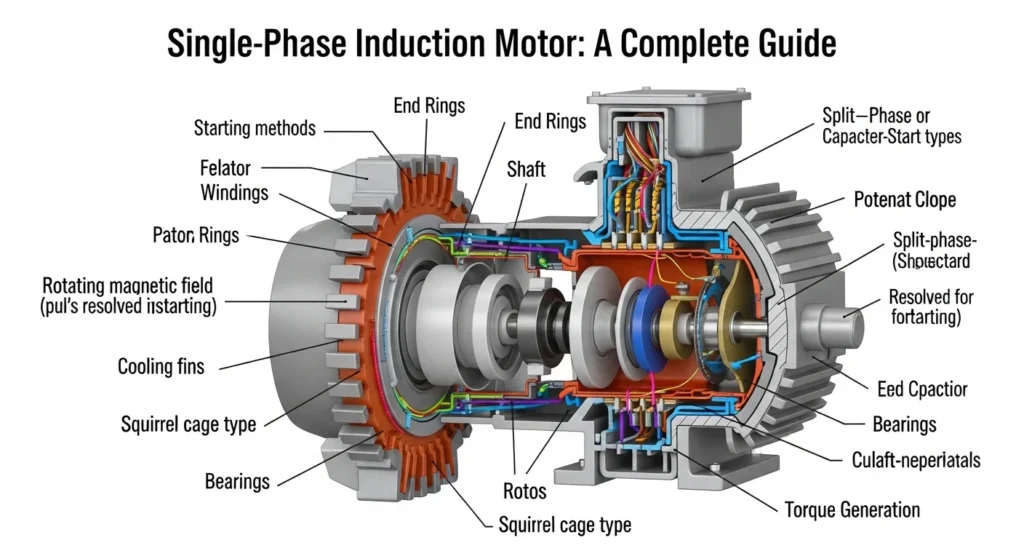
A single-phase motor is an electric motor that operates using single-phase AC power, which is the common electricity supply used in homes (usually 220–240 V in countries like Pakistan). These motors are widely used in household and small industrial applications because they can run directly from domestic power supply. A single phase motor is an electrical machine that converts electrical energy into mechanical energy and works on a single phase AC supply, which is commonly available in homes and small shops. It is one of the most widely used motors in daily life because of its simple design, low cost, and easy maintenance. Single phase motors are mainly used in household appliances like ceiling fans, water pumps, washing machines, air coolers, and small workshop machines. The basic single phase motor working principle is based on electromagnetic induction. When single phase AC supply is given to the stator winding, it produces a pulsating magnetic field. This field alone cannot start the motor, so an additional starting method such as a capacitor or auxiliary winding is used to create a rotating magnetic field. This rotating field produces starting torque, which makes the rotor start moving. Once the motor starts, it continues running due to inertia and continuous electromagnetic interaction between stator and rotor. There are different types of single phase motors such as split phase motors, capacitor start motors, capacitor start capacitor run motors, and shaded pole motors. Each type is used according to the requirement of starting torque and efficiency. Single phase motors are compact, reliable, and suitable for light and medium loads, but they are not ideal for heavy industrial applications because they have lower efficiency and limited starting torque compared to three phase motors. Overall, single phase motors play a very important role in modern life as they are used in almost every home appliance, making them an essential part of electrical systems.
What is a Single-Phase Motor?
A single-phase motor is an AC motor that runs on single-phase power instead of three-phase power.
- Power Supply: Single Phase (1-Phase)
- Voltage: Usually 220–240 V
- Frequency: 50 Hz
Unlike three-phase motors, a single-phase motor cannot start on its own, so it needs auxiliary components like capacitors or starting windings.
Main Parts of a Single-Phase Motor
- Stator – The stationary part containing the windings.
- Rotor – The rotating part inside the stator.
- Starting Winding – Helps start the motor.
- Run Winding – Keeps the motor running.
- Capacitor – Provides phase shift for starting torque.
- Centrifugal Switch – Disconnects the starting winding after startup.
Types of Single-Phase Motors
1. Split Phase Motor Explained: Construction, Working Principle, Features, and Applications
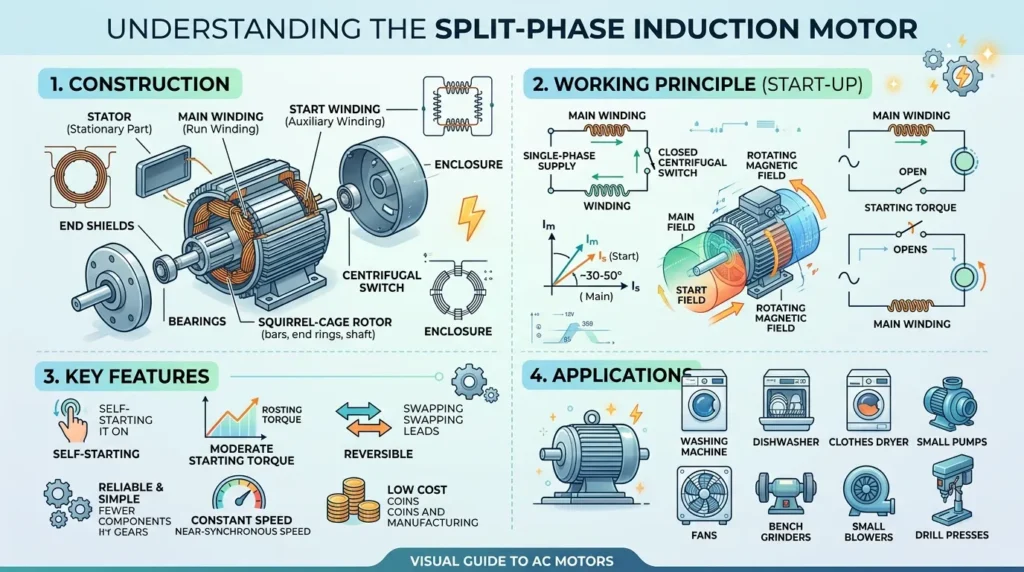
- Uses starting winding + running winding
- Moderate starting torque
- Used in fans, blowers, grinders
A Split Phase Motor is a type of single-phase induction motor that is widely used in residential, commercial, and light industrial applications. It is specifically designed to overcome the problem of starting torque in single-phase motors. Unlike three-phase motors, a single-phase supply does not naturally produce a rotating magnetic field. To solve this issue, the split phase motor uses two separate stator windings known as the main winding and the starting winding. These windings create a phase difference in the currents flowing through them, producing a rotating magnetic field that starts the motor. Once the motor reaches approximately 70–80% of its rated speed, the starting winding is automatically disconnected by a centrifugal switch, and the motor continues running using only the main winding.
The construction of a split phase motor is relatively simple and economical. The stator contains both the main and starting windings, while the rotor is usually of the squirrel-cage type. The starting winding is made with smaller wire and higher resistance compared to the main winding. This difference in resistance causes the current in the starting winding to be out of phase with the current in the main winding, creating the necessary starting torque. The centrifugal switch plays an important role by disconnecting the starting winding after the motor reaches its operating speed, preventing overheating and improving efficiency.
The working principle of a split phase motor is based on the creation of a temporary rotating magnetic field during startup. When power is applied, current flows through both windings, generating magnetic fields that are slightly out of phase. The interaction of these magnetic fields produces a rotating effect that causes the rotor to start turning. As the rotor accelerates and reaches a predetermined speed, the centrifugal switch opens and disconnects the starting winding. The motor then continues operating as a standard single-phase induction motor.
Split phase motors offer several advantages, including simple construction, low cost, reliable operation, and easy maintenance. They are suitable for applications requiring moderate starting torque and continuous operation. However, they also have some limitations, such as lower starting torque compared to capacitor-start motors and reduced efficiency under heavy loads.
Because of their practical design and dependable performance, split phase motors are commonly used in fans, blowers, washing machines, small pumps, grinders, polishing machines, and other household or workshop equipment. Their ability to provide reliable operation at an affordable cost makes them one of the most widely used single-phase motors in everyday electrical applications.
2. Capacitor Start Motor Explained: Construction, Working Principle, Features, and Applications
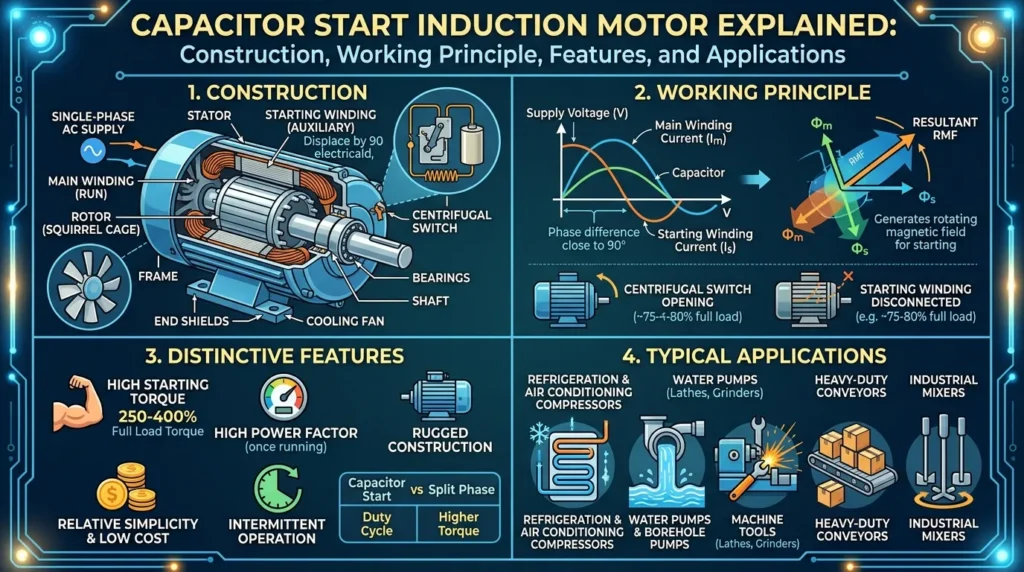
- Uses a large capacitor for starting
- High starting torque
- Used in air compressors, pumps, refrigerators
A Capacitor Start Motor is a type of single-phase induction motor that is designed to provide high starting torque for applications that require a strong initial force to start rotating. It is one of the most commonly used single-phase motors in domestic, commercial, and industrial environments. Unlike a standard split phase motor, a capacitor start motor uses a capacitor connected in series with the starting winding to create a larger phase difference between the currents in the main winding and starting winding. This increased phase difference produces a stronger rotating magnetic field, resulting in much higher starting torque. Because of this feature, capacitor start motors are ideal for equipment that starts under heavy load conditions.
The construction of a capacitor start motor includes a stator with two windings: the main winding and the starting winding. In addition, a capacitor and a centrifugal switch are connected in series with the starting winding. The rotor is typically a squirrel-cage rotor, similar to those used in other induction motors. The capacitor is the key component that distinguishes this motor from a split phase motor. It improves the phase displacement between the two winding currents, which enhances the starting performance. The centrifugal switch is used to disconnect the starting winding and capacitor once the motor reaches approximately 70–80% of its rated speed.
The working principle of a capacitor start motor is based on the creation of a strong rotating magnetic field during startup. When the motor is connected to the power supply, current flows through both the main winding and the starting winding. The capacitor causes the current in the starting winding to lead the current in the main winding, creating a significant phase difference. This phase difference generates a rotating magnetic field that produces a high starting torque, causing the rotor to accelerate quickly. As the motor reaches its operating speed, the centrifugal switch automatically disconnects the starting winding and capacitor from the circuit. The motor then continues to run using only the main winding as a normal single-phase induction motor.
One of the major advantages of a capacitor start motor is its high starting torque, which is considerably greater than that of a split phase motor. It also provides smooth starting performance, reliable operation, and good efficiency for heavy-duty applications. However, the motor is more expensive because of the additional capacitor and switching mechanism. It also requires slightly more maintenance compared to simpler motor designs.
Capacitor start motors are widely used in air compressors, water pumps, refrigeration units, conveyors, woodworking machines, pressure washers, and other equipment that requires a strong starting force. Their ability to start heavy loads efficiently and operate reliably makes them one of the most popular single-phase motors for demanding applications. As a result, capacitor start motors play a vital role in residential, commercial, and industrial electrical systems where dependable high-torque starting performance is essential.
Capacitor Start Capacitor Run Motor Explained: Construction, Working Principle, Features, and Applications
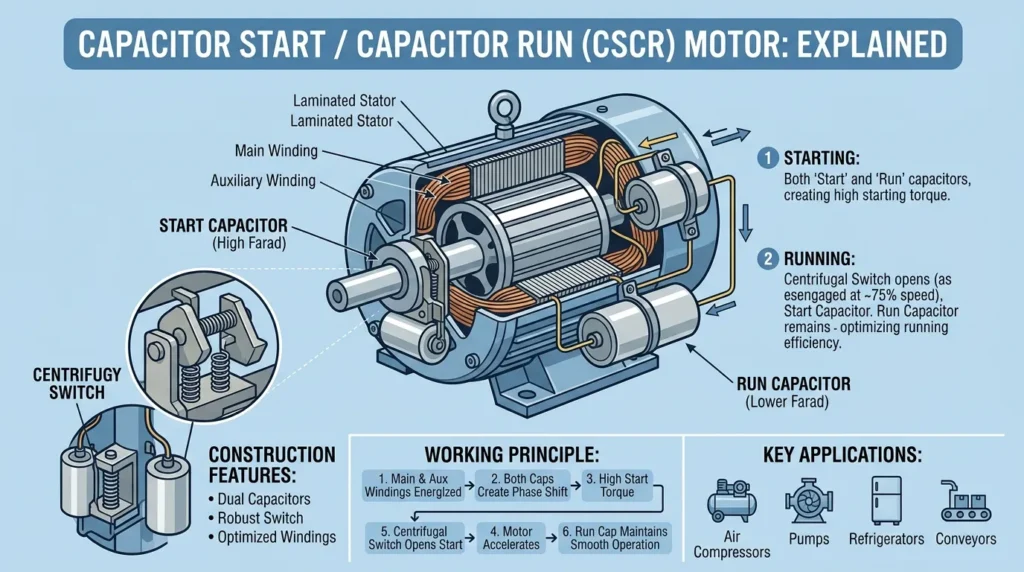
- Uses two capacitors (start + run)
- Very efficient and smooth operation
- Used in AC units, heavy pumps
A Capacitor Start Capacitor Run Motor (CSCR Motor) is an advanced type of single-phase induction motor that provides both high starting torque and improved running efficiency. It is widely used in applications where smooth operation, better performance, and energy efficiency are required. This motor combines the advantages of a capacitor start motor and a capacitor run motor by using two capacitors: one for starting and one for running. Because of this dual-capacitor system, it delivers excellent starting performance as well as stable operation during running conditions.
The construction of a Capacitor Start Capacitor Run Motor includes a stator with two windings: the main winding and the auxiliary (starting) winding. In addition, it has two capacitors: a large electrolytic capacitor used during starting and a smaller oil-filled capacitor that remains in the circuit during running. A centrifugal switch or relay is used to disconnect the starting capacitor once the motor reaches a certain speed, while the run capacitor remains connected continuously. The rotor is typically a squirrel-cage type, which ensures durability and simple construction.
The working principle of a CSCR motor is based on creating a strong and continuously rotating magnetic field. When the motor is started, both capacitors are connected in the circuit along with the auxiliary winding. This produces a large phase difference between the currents in the main and auxiliary windings, generating high starting torque. Once the motor reaches about 70–80% of its rated speed, the starting capacitor is disconnected by the centrifugal switch or relay, while the run capacitor stays in the circuit. The run capacitor improves the power factor, smooths the motor operation, reduces noise, and increases efficiency during continuous running.
One of the main advantages of a Capacitor Start Capacitor Run Motor is its excellent starting torque combined with high running efficiency. It operates more smoothly, produces less vibration, and has better power factor correction compared to other single-phase motors. It is also suitable for continuous duty applications. However, it is more expensive due to the use of two capacitors and additional switching components, and it requires slightly more maintenance than simpler motor types.
Capacitor Start Capacitor Run Motors are widely used in air conditioners, refrigerators, compressors, pumps, conveyor systems, HVAC systems, and industrial machinery. These motors are ideal for applications that require both strong starting power and efficient long-term operation. Their superior performance and reliability make them one of the most efficient single-phase motor designs used in modern electrical systems.
Permanent Split Capacitor (PSC) Motor Explained: Construction, Working Principle, Features, and Applications
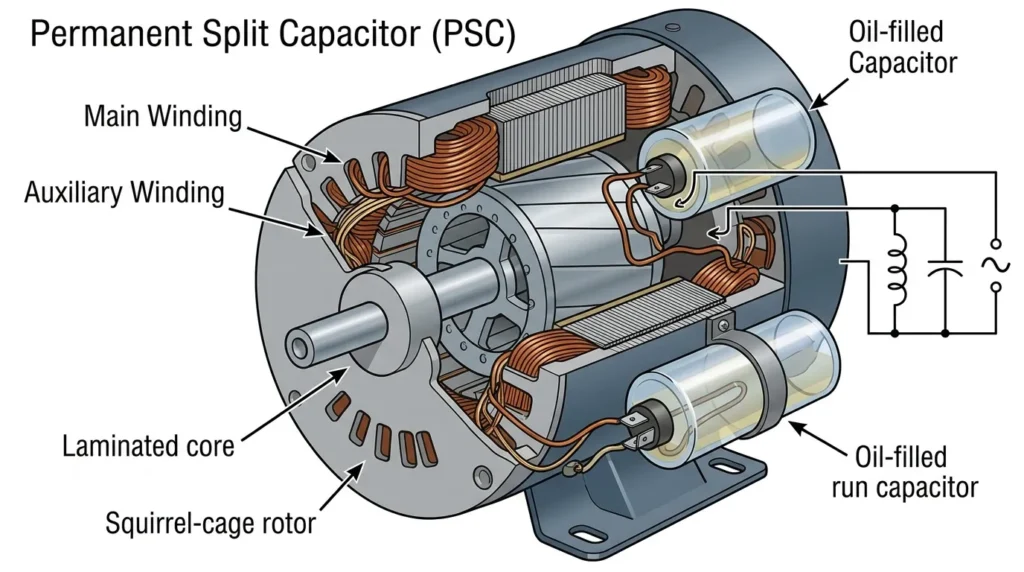
- Uses one capacitor continuously
- Quiet operation
- Used in ceiling fans and HVAC systems
A Permanent Split Capacitor (PSC) Motor is a type of single-phase induction motor that uses a capacitor permanently connected in series with the auxiliary (starting) winding. Unlike capacitor start motors, it does not use a centrifugal switch or relay to disconnect the capacitor. Because the capacitor remains in the circuit during both starting and running conditions, the motor operates smoothly with improved efficiency and better power factor.
The construction of a PSC motor includes a stator with two windings: the main winding and the auxiliary winding. A single run capacitor is connected in series with the auxiliary winding, and it stays connected at all times. The rotor is usually a squirrel-cage type, which provides durability, simple construction, and low maintenance. Since there is no starting switch mechanism, the overall design is more compact and reliable.
The working principle of a PSC motor is based on phase displacement created by the capacitor. When the motor is connected to the power supply, current flows through both windings. The capacitor causes a phase shift between the current in the main winding and the auxiliary winding, producing a rotating magnetic field. This rotating field generates torque that starts the motor. As the motor reaches its operating speed, the capacitor remains in the circuit and continues to improve the phase angle, ensuring smooth and efficient running. Because the starting torque is moderate, PSC motors are best suited for low to medium starting load applications.
One of the main advantages of a PSC motor is its simple construction, as it does not require a centrifugal switch or starting relay. This reduces mechanical wear and increases reliability. It also operates quietly, has better efficiency than split phase motors, and provides smooth performance. Additionally, it has good power factor improvement during operation due to the permanent capacitor.
However, PSC motors have some limitations. Their starting torque is relatively low compared to capacitor start or CSCR motors. They are not suitable for heavy-load starting conditions. Their performance is best in applications where the load is constant or lightly loaded at startup.
PSC motors are widely used in fans, blowers, air circulators, air conditioners (indoor units), refrigerators, HVAC systems, and small pumps. They are ideal for continuous-duty applications where smooth and efficient operation is more important than high starting torque.
In conclusion, the Permanent Split Capacitor motor is a reliable, efficient, and low-maintenance single-phase motor widely used in residential and commercial electrical systems due to its simplicity and smooth performance.
5. Shaded Pole Motor Explained: Construction, Working Principle, Features, and Applications
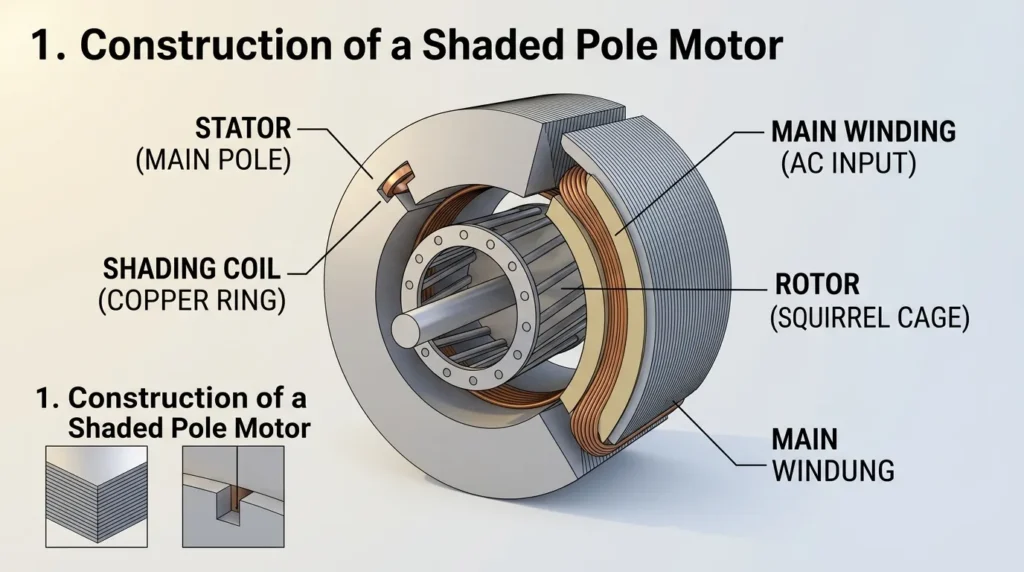
- Simplest design
- Very low starting torque
- Used in small fans, exhaust fans, toys
A Shaded Pole Motor is the simplest type of single-phase induction motor, commonly used for very low-power applications. It is known for its simple construction, low cost, and reliability in small devices. However, it produces low starting torque and low efficiency compared to other single-phase motors. Because of its basic design, it is mainly used in small household and light-duty electrical equipment.
The construction of a shaded pole motor consists of a stator with salient poles and a squirrel-cage rotor. Each stator pole has a portion covered by a copper ring called a shading coil. This shading coil is the key feature of the motor. Unlike other single-phase motors, it does not require a starting capacitor or auxiliary winding. The rotor is simple and robust, making the motor durable and easy to maintain.
The working principle of a shaded pole motor is based on the creation of a weak rotating magnetic field. When alternating current is supplied to the stator winding, an alternating magnetic flux is produced. The shading coil delays the magnetic flux in the shaded part of the pole. This delay creates a phase difference between the shaded and unshaded portions of the pole, producing a weak rotating magnetic field. This field generates torque that starts the rotor moving. The rotor then continues to rotate in the same direction due to induction.
One of the main advantages of a shaded pole motor is its extremely simple construction, which makes it very cheap to manufacture and highly reliable. It has no centrifugal switch, capacitor, or complex starting mechanism, which reduces maintenance requirements. It is also compact in size and operates quietly, making it suitable for small appliances.
However, shaded pole motors have several disadvantages. They have very low starting torque, poor efficiency, and limited power output. They also have higher energy losses compared to other single-phase motors. Due to these limitations, they are not suitable for heavy-load applications or continuous industrial use.
Shaded pole motors are widely used in small fans, exhaust fans, hair dryers, electric toys, air conditioners (small blowers), refrigerators, and small cooling devices. They are ideal for light-duty applications where cost and simplicity are more important than efficiency or high performance.
In conclusion, the shaded pole motor is the simplest form of single-phase motor, offering low cost and reliable operation for small electrical appliances. Although it has low efficiency and torque, its simplicity makes it a popular choice for low-power applications.
Applications of Single-Phase Motors
Single-phase motors are commonly used in:
- Ceiling fans
- Water pumps
- Washing machines
- Refrigerators
- Air conditioners
- Mixers and grinders
- Small compressors
Advantages of Single-Phase Motors
✅ Simple construction
✅ Works on household power supply
✅ Low cost
✅ Easy maintenance
Disadvantages
❌ Lower efficiency than three-phase motors
❌ Low starting torque (in some types)
❌ Not suitable for heavy industrial loads
Example
If a motor rating is:
- 1 HP single-phase motor
- Voltage = 230 V
Power conversion:1 HP=746 Watts
So the motor uses approximately 746 W of electrical power.
✅ In simple words:
A single-phase motor is a motor designed to run on normal household electricity and is used in most home appliances.
What is Single-Phase Induction Motor?
A single-phase induction motor is an AC motor that runs on single-phase power supply. It converts electrical energy into mechanical rotation using electromagnetic induction.
In simple terms, it has a stator (stationary part) with windings and a rotor (rotating part) like a squirrel cage. Single-phase current alone doesn’t create a rotating field, so extra tricks start it. Once running, it keeps going smoothly.
A practical example: Your table fan. Plug it in, and the motor spins the blades. It uses single-phase power, starts with help from an extra winding or shading, and runs quietly for years with little maintenance.
Working Principle
The single-phase induction motor working principle relies on electromagnetic induction and a rotating magnetic field created with help.
Single-phase AC creates a pulsing field, not rotating. The rotor stays still at start because torques cancel out. To fix this, we make a temporary rotating field.
Analogy: Imagine pushing a swing. A single push back-and-forth does little, but timed pushes in sequence make it swing fully. Similarly, we add a phase shift.
Step-by-step:
- Power On: Single-phase AC flows in stator main winding, producing alternating flux.
- Starting Help: Auxiliary method (extra winding, capacitor, or shading) creates out-of-phase flux.
- Rotating Field: Combined fluxes make a weak rotating field, inducing current in rotor bars.
- Torque Production: Rotor current interacts with stator field, creating torque to start rotation.
- Running: Once spinning, main field induces rotor current; motor runs near synchronous speed with slip.
Bullet points for key points:
- No starting torque without auxiliary means.
- Double revolving field theory explains: pulsating field splits into two opposite rotations.
- Forward field produces useful torque; backward reduces it slightly.
This makes the motor run efficiently after starting.
Types / Classification of Single-Phase Induction Motors: Complete Guide
Single-phase induction motors are mainly classified based on their starting methods. Since a single-phase supply cannot produce a rotating magnetic field on its own, different techniques are used to create starting torque. Each type of motor is designed for specific load conditions, efficiency requirements, and applications. Below is a clear and detailed explanation of all major types.
Split-Phase Induction Motor
A split-phase induction motor uses a resistance-start method to create starting torque. It has two windings: a main winding and an auxiliary (starting) winding. The auxiliary winding is made with high resistance and low inductance, which creates a phase difference between the two currents. This phase difference produces a weak rotating magnetic field that starts the motor. Once the motor reaches about 70–80% of its rated speed, a centrifugal switch disconnects the starting winding. This motor provides moderate starting torque and is commonly used in fans, blowers, and light machinery.
Capacitor-Start Induction Motor
A capacitor-start induction motor uses a capacitor in series with the starting winding to produce a strong phase difference between the windings. This results in high starting torque, making it suitable for heavy starting loads. After the motor reaches sufficient speed, the starting capacitor and auxiliary winding are disconnected using a centrifugal switch. These motors are widely used in compressors, pumps, refrigeration systems, and washing machines.
Capacitor-Start Capacitor-Run Motor (CSCR)
The capacitor-start capacitor-run motor uses two capacitors: one large starting capacitor and one smaller running capacitor. The starting capacitor provides high starting torque, while the run capacitor remains in the circuit during operation to improve efficiency and power factor. This design offers smooth operation, high performance, and better energy efficiency. It is used in air conditioners, industrial pumps, and compressors.
Permanent Split Capacitor (PSC) Motor
A PSC motor uses a single capacitor that remains permanently connected to the auxiliary winding. There is no centrifugal switch. This makes the motor simple, reliable, and maintenance-free. However, it has low starting torque. It is best suited for applications requiring smooth and quiet operation such as fans, blowers, air circulators, and HVAC systems.
Shaded-Pole Induction Motor
A shaded-pole motor is the simplest type of single-phase motor. It uses a copper shading ring placed on a portion of each stator pole to create a delayed magnetic field. This produces a weak rotating magnetic field that starts the rotor. It has very low starting torque and low efficiency but is extremely simple and inexpensive. It is used in small fans, toys, hair dryers, and low-power appliances.
Single-phase induction motors are classified according to their starting methods, and each type is designed for specific performance needs. From simple shaded-pole motors to high-performance capacitor-start capacitor-run motors, each design balances cost, efficiency, and torque requirements. Understanding these types helps in selecting the right motor for residential, commercial, and industrial applications.fans, toys.
Main Components
Stator: Outer frame with laminated core, main and auxiliary windings. Produces magnetic field.
Rotor: Squirrel-cage type – aluminum/copper bars shorted by rings. Rotates from induced currents.
Centrifugal Switch: In split/capacitor-start types. Opens at 75-80% speed to disconnect auxiliary.
Capacitor: In capacitor types. Shifts phase for starting torque.
Bearings: Support shaft, reduce friction.
Housing: Protects internals, mounts motor.
Fan Blades/Shaft: Output for mechanical work.
These parts make the motor durable and simple.
Advantages
- Low Cost: Cheaper to build and buy than three-phase.
- Simple Design: Fewer parts, easy repair.
- Runs on Home Power: No need for three-phase supply.
- Compact Size: Fits small appliances well.
- Reliable for Light Loads: Long life with minimal care.
- Quiet Operation: Especially PSC types.
These single-phase induction motor advantages and disadvantages show why they’re popular domestically.
Disadvantages / Limitations
Not self-starting – needs auxiliary help.
Low starting torque in some types (shaded-pole weakest).
Lower efficiency and power factor than three-phase.
Higher losses, heats more under load.
Limited power (usually under 1-2 HP).
Noisy starting in split-phase types.
Applications
In homes: Ceiling fans, exhaust fans, washing machines, refrigerators, mixers, vacuum cleaners.
Industry: Small pumps, blowers, conveyors, tools in workshops.
Modern tech: Air conditioners, electric drills, record players, printers.
Renewables: Small wind turbine auxiliaries.
Portable devices: Hair dryers, blenders.
Comparison Section
Single-phase vs three-phase induction motors differ in supply and performance. Table:
| Feature | Single-Phase Induction Motor | Three-Phase Induction Motor |
| Power Supply | Single-phase | Three-phase |
| Self-Starting | No (needs auxiliary) | Yes |
| Starting Torque | Low to moderate | High |
| Efficiency | Lower | Higher |
| Power Rating | Up to ~2 HP | Higher (up to hundreds HP) |
| Cost | Lower | Higher |
| Applications | Home appliances | Industry, heavy loads |
The difference between single-phase and three-phase induction motor is clear: single for light, home use; three for powerful, industrial.
Single-Phase Induction Motor Selection Guide and Troubleshooting
Choosing the right single-phase induction motor is important for performance, safety, and long-term reliability. Different motors are designed for different load conditions, so selecting the correct type ensures efficient operation and prevents frequent failures. Below is a simple guide to help you choose the right motor and understand common problems with their solutions.
Selection Guide: How to Choose the Right Motor
Match Motor Type to Load
The first step in selection is matching the motor type with the load requirement. For light loads such as fans and air circulators, shaded-pole motors or PSC (Permanent Split Capacitor) motors are suitable because they are simple and efficient. For medium to heavy starting loads like pumps and compressors, capacitor-start or capacitor-start capacitor-run motors are preferred because they provide higher starting torque and better performance under load.
Check Power Requirements
Always check the horsepower (HP) rating mentioned on the motor nameplate. Selecting the correct power rating ensures that the motor can handle the required mechanical load without overheating or failure. Undersized motors may burn out quickly, while oversized motors may waste energy.
Consider Starting Torque
Starting torque is a key factor in motor selection. Applications like water pumps, compressors, and heavy machinery require high starting torque motors, such as capacitor-start types. For low starting torque applications like fans, PSC or shaded-pole motors are sufficient.
Budget and Efficiency
Cost also plays an important role. Split-phase motors are the cheapest but less efficient. PSC motors offer a good balance between cost, efficiency, and reliability. Advanced capacitor motors are more expensive but provide better performance and energy savings.
Environmental Conditions
The operating environment affects motor performance. Motors used in dusty or harsh environments should be enclosed and protected, while motors requiring cooling should have proper ventilation. For outdoor or humid conditions, moisture-resistant designs are recommended.
Additional Selection Factors
For beginners and simple applications, PSC motors are the best choice due to their easy installation and safe operation. It is also important to check voltage rating (commonly 220V or 230V), speed (RPM), and mounting type before final selection.
Common Problems and Solutions in Single-Phase Motors
Problem 1: Motor Hums but Does Not Start
If the motor produces a humming sound but does not rotate, the issue is usually a faulty capacitor or a stuck centrifugal switch.
Solution: Test the capacitor using a multimeter and replace it if faulty. Also check and clean the starting switch mechanism if present.
Problem 2: Motor Overheats Quickly
Overheating can occur due to overload, poor ventilation, or continuous heavy-duty operation beyond rated capacity.
Solution: Reduce the load on the motor, ensure proper ventilation, and clean air passages to improve cooling.
Problem 3: Noisy Operation
Excessive noise is often caused by worn-out bearings or mechanical friction inside the motor.
Solution: Lubricate or replace the bearings and inspect moving parts for wear and tear.
Problem 4: Low Speed Under Load
If the motor runs slowly under load, it may be due to an incorrect motor type or weak winding performance.
Solution: Ensure the motor is suitable for the load. If windings are damaged, repair or replace the motor with a higher torque model.
Problem 5: Burning Smell from Motor
A burning smell usually indicates overheated windings or insulation failure.
Solution: Immediately stop the motor, disconnect power, and inspect for damage. Repair or replace the motor if windings are burnt.
Proper selection and maintenance of single-phase induction motors are essential for safe and efficient operation. By matching motor type to load, checking ratings, and understanding common faults, users can significantly improve performance and lifespan. Regular inspection and correct troubleshooting help prevent major breakdowns and ensure reliable operation in residential, commercial, and industrial applications.
Future Trends
Single-phase motors shift to efficient alternatives like ECM (electronically commutated motors) and BLDC for better efficiency.
VFDs add variable speed to induction types.
Permanent magnet designs replace some for appliances.
Energy standards push higher IE ratings.
Smart controls integrate IoT for monitoring.
Overall, focus on energy savings and variable speed.
Conclusion
Single-phase induction motors power countless home and small devices with simple, reliable design. We’ve covered the working principle, types, components, advantages and disadvantages, applications, and more.
As a senior electrical engineer, I’ve repaired hundreds – the basics never change. Juniors, practice on old fans or kits to see principles live.
Keep learning; motors evolve with efficiency demands. Master this, and you’ll excel in electrical work.